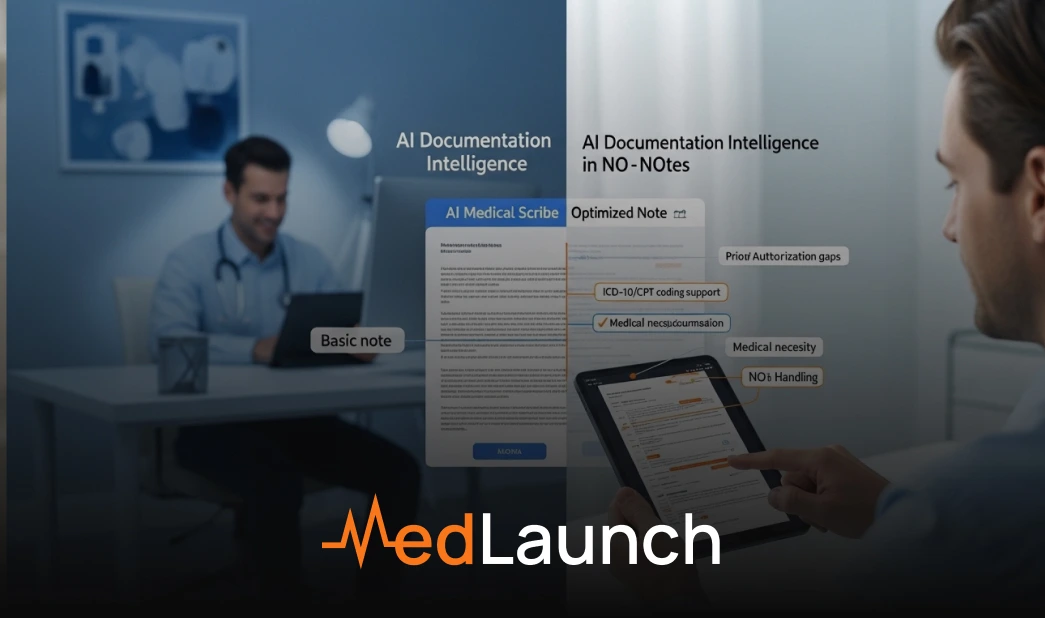

Key Takeaways: AI Medical Scribe vs. AI Documentation Intelligence
-
1Same starting point, different endpoint: Both tools listen during the visit and generate a note. The difference is what happens after the note is drafted and that difference has direct revenue consequences for your clinic.
-
2An AI scribe stops at the note: Most AI medical scribes generate a clinically reasonable draft and hand it to the provider. Prior authorisation gaps, coding structure, and medical necessity language are not their problem.
-
3AI Clinical Documentation for Healthcare Clinics starts at the note: It generates the note AND flags prior auth gaps in real time before sign-off, structures output for ICD-10 and CPT coding accuracy, and integrates natively into your EHR without clipboard workarounds.
-
4The copy-paste problem is bigger than it sounds: Most AI scribes outside enterprise tiers rely on clipboard workflows. That introduces HIPAA exposure and friction that quietly kills adoption within the first few weeks.
-
532% of claim rejections are coding-related: Most trace back to documentation that did not support the level of care delivered. An AI scribe that generates a note does not solve this; AI Clinical Documentation for Healthcare Clinics is built specifically to.
Clinic owners searching for documentation tools almost always land on AI medical scribe products first. The category is well-marketed, the product names are familiar, and the promise is clear: the AI listens during the visit, generates the note, and the clinician approves it. Time saved. Charting done.
That promise is real. AI scribes do reduce documentation time for many clinicians, particularly in high-volume primary care settings where the note format is relatively predictable and prior authorisation pressure is low.
But for GP and specialty clinics where documentation quality directly affects reimbursement, where prior authorisation volume is significant, and where billing teams depend on notes being structured for accurate coding, a basic AI scribe and an AI documentation intelligence platform are solving different problems. Choosing the wrong one does not just fail to deliver the benefit you expected. In some cases it creates new work.
This blog maps out the five critical differences between the two, using the distinction that matters most for small and mid-size clinic owners: not the technology, but the downstream clinical and financial outcomes.
Table of Contents
1. First, what do both tools actually do?
Understanding where the two categories diverge requires a clear definition of what each one does.
AI Medical Scribe
An AI medical scribe listens passively during a patient visit, processes the conversation using natural language processing, and generates a structured clinical note. The clinician reviews the draft, edits if needed, and approves. The note is then placed into the patient record, typically via copy-paste into the EHR in most non-enterprise implementations.
That is the full scope of what most AI scribes do. The core value proposition is time. Documentation happens during or immediately after the visit rather than after clinic hours. After-hours charting is reduced. That outcome is genuine.
AI Documentation Intelligence
AI Documentation Intelligence does everything an AI scribe does: ambient listening, real-time note generation, provider review, approval, and adds a downstream layer that basic scribes do not have.
That layer includes prior authorisation gap flagging at the point of note approval, meaning the system surfaces missing medical necessity language, undocumented conservative treatment history, and absent functional impact statements before the clinician signs off. It also structures notes specifically for ICD-10 and CPT coding accuracy, so billing teams receive documentation that supports the level of care delivered without chasing providers for clarification.
The note is still the output. But the note is engineered to protect revenue, not just to record the visit.
Side-by-side: AI Medical Scribe vs AI Documentation Intelligence
| AI Medical Scribe | AI Documentation Intelligence | |
| Core function | Generates a structured clinical note from the visit conversation | Generates notes + flags prior auth gaps + structures for ICD-10/CPT coding |
| Prior auth support | No, note generation ends at the draft | Yes, flags are missing documentation before the clinician’s sign-off |
| ICD-10 / CPT coding | Basic or suggestion-only in most tools | Structured specifically to support accurate coding and reduce billing queries |
| EHR integration | Most rely on copy-paste clipboard workflows | Native integration notes go directly into Epic or Athena Health |
| Customisation | Generic templates from shared repositories | Configured to clinic-specific templates and clinical language before go-live |
| Audio retention | Varies by vendor, not always deleted | Audio deleted after note generation, only structured note retained |
| Set up and support | Self-serve SaaS, you manage it | GP, specialty, and allied health clinics with prior authorization exposure and billing dependencies |
| Best for | Solo practitioners, low admin complexity | GP, specialty, and allied health clinics with prior auth exposure and billing dependencies |
2. Difference 1: Note generation vs revenue protection
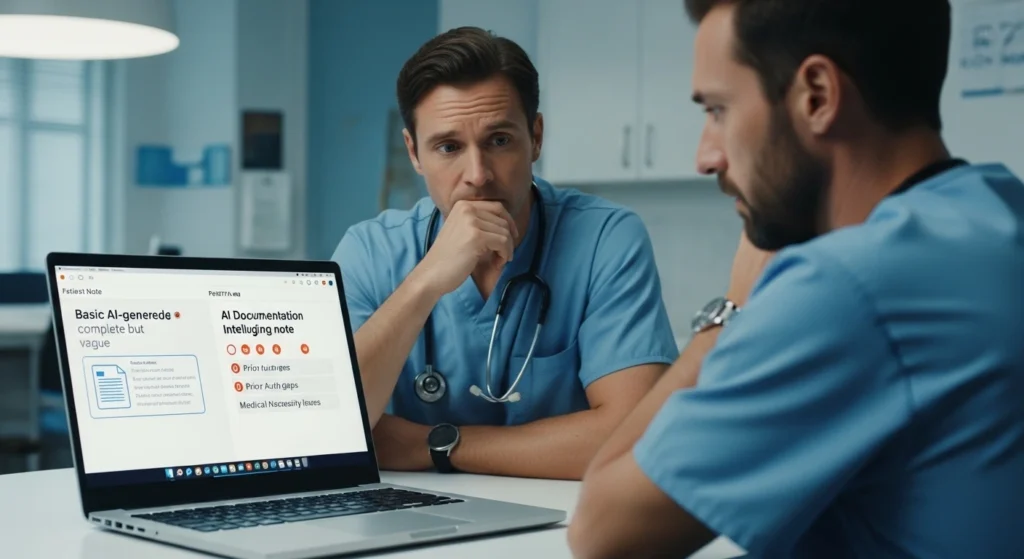
An AI scribe produces a note. The note may be accurate, well-structured, and clinically complete in the sense that it reflects what was said during the visit. But it does not know whether the language used will support a prior authorisation request next week, or whether the note contains the specific elements a payer’s medical necessity review requires.
This is not a criticism of AI scribes. They are not built to answer those questions. The problem is that clinic owners often assume note generation and revenue protection are the same outcome. They are not.
According to AMA data, coding-related issues account for approximately 32% of all insurance claim rejections. Most of those rejections trace back not to errors in care, but to documentation that did not clearly support the level of care delivered. The claim was clinically legitimate. The note was the problem.
Documentation Intelligence addresses this at the point of note creation, not after a denial arrives. Missing functional impact statement? Flagged before sign-off. Conservative treatment history undocumented? Flagged before sign-off. Vague medical necessity rationale? Flagged before sign-off. The clinician sees the gap when it can still be addressed, not when the appeal window is already closing.
3. Difference 2: Generic output vs clinic-configured documentation
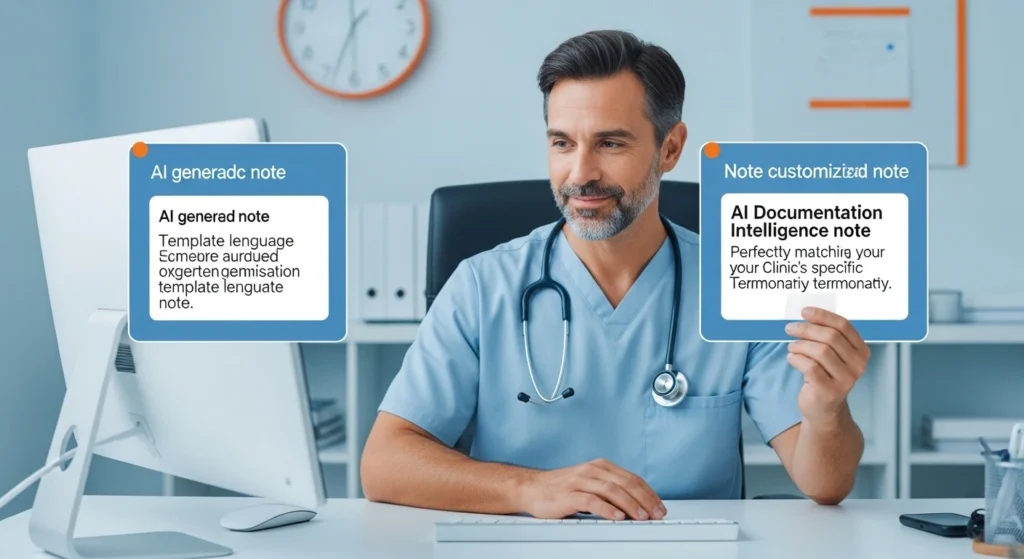
Most AI scribes produce output from general models trained on broad medical data. The notes are coherent and clinically reasonable, but they read like AI generated them. The phrasing is templated. The structure follows a pattern that is not quite how your specific providers write. The terminology does not match the conventions of your specialty.
This creates an editing burden. Clinicians who expected to spend less time on documentation find themselves reviewing and correcting output that needs significant work before it reflects how they actually document. Research published in npj Digital Medicine found that some AI scribes saved providers only 34 seconds per note, with high variability across individual clinicians. For many adopters, the time saving was minimal because the editing burden partially or fully offset it.
Documentation Intelligence configured properly to a clinic’s note templates, preferred clinical language, and documentation structure before go-live produces output that reads as the provider would have written it. The configuration is handled before the first live session, not left to the clinician to adjust.
The difference between these two experiences is the difference between approving a note and rewriting one. One changes the clinical workflow. The other creates a new version of the same burden under a different name.
4. Difference 3: Copy-paste clipboard workflows vs native EHR integration
This is the practical limitation of most AI scribes that rarely appears in marketing materials.
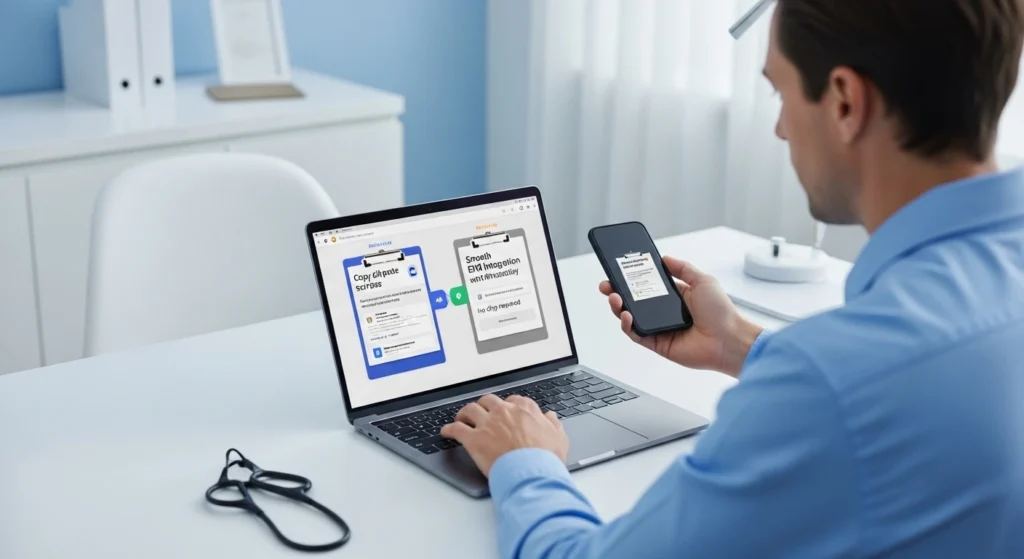
Most AI medical scribes outside enterprise tiers do not integrate natively into the EHR. The note is generated inside the scribe app. The clinician copies it. The clinician pastes it into the patient record inside the EHR. This clipboard workflow has two consequences that compound each other over time.
The first is HIPAA exposure. Patient information copied to a device clipboard is vulnerable in ways that a direct EHR integration is not. Clipboard contents can be accessed by other applications, persist beyond the session, and represent a data governance risk that most clinic owners do not consider at the point of purchase. Doctors of BC published guidance specifically calling out clipboard security as one of the primary risk considerations for AI scribe implementations.
The second is friction. Clipboard workflows feel minor. In practice, switching between a scribe app and an EHR, copying, pasting, reviewing, and correcting formatting issues introduces enough friction that adoption quietly declines after the first few weeks. Clinicians who found the tool useful in demo conditions find it disruptive in a full patient schedule.
Documentation Intelligence that integrates natively into Epic or Athena Health means the note moves directly into the patient record through the EHR workflow the clinician already uses. No switching. No copying. No clipboard. Nothing about the existing workflow changes other than where the note comes from.
5. Difference 4: Note accuracy vs prior authorisation gap flagging
This is the most commercially significant difference for small and mid-size clinics, and the one most absent from AI scribe comparison content.
An AI scribe that produces an accurate note is still not protecting your clinic from a prior auth denial caused by documentation gaps. The note might accurately reflect everything the clinician said. But if the clinician did not explicitly state the conservative treatment history the insurer requires, or the functional impact language that justifies imaging, the note is accurate and still useless for that claim.
Prior auth gap flagging at the point of note approval means the system checks the note against the documentation requirements that commonly trigger delays or denials before the clinician signs. Missing elements are surfaced in real time, at the moment they can still be corrected, as part of the normal review workflow.
This is a Documentation Intelligence function. It is not an AI scribe function. No major AI scribe product in the consumer or prosumer tier offers it as a standard feature. For any clinic where prior authorisation is a recurring part of daily operations, this is the difference that determines whether documentation technology reduces revenue loss or simply reduces after-hours charting.
6. Difference 5: Standalone subscription vs long-term technology partnership
Most AI scribes are self-serve SaaS products. You subscribe, you receive login credentials, and from that point the tool is yours to manage. If the note quality does not match your specialty, you adjust the templates yourself. If your EHR updates and compatibility breaks, you wait for a patch. If something is not working correctly, you submit a support ticket and wait.
This model works for solo practitioners or small practices with low documentation complexity and an owner who is comfortable managing software independently. It does not work well for small and mid-size GP and specialty clinics that do not have a dedicated IT team, a clinical documentation specialist on staff, or the administrative capacity to troubleshoot and maintain a documentation system on top of running a practice.
Documentation Intelligence as MedLaunch delivers it is a managed implementation. EHR integration, note template configuration, clinical language customisation, and staff briefing are handled by MedLaunch before the first live session. After go-live, ongoing monitoring, performance refinement, and technical maintenance are handled on an ongoing basis. The clinic does not manage the technology. MedLaunch manages it.
For the clinic types MedLaunch is built for, this distinction is the one that determines whether a documentation technology investment actually delivers sustained results or becomes another tool that gets used for three months and quietly abandoned.
7. Which one does your clinic actually need?
The honest answer depends on the complexity and financial stakes of your documentation environment.
You likely need an AI scribe if:
- You are a solo practitioner with straightforward billing and low prior auth volume
- Your primary goal is reducing after-hours charting time and note reconstruction from memory
- Your specialty has relatively predictable, low-complexity documentation requirements
- You are comfortable managing a self-serve software tool independently
You need Documentation Intelligence if:
- You run a GP or specialty clinic with meaningful prior authorisation exposure
- Your billing team depends on note quality for accurate ICD-10 and CPT coding
- Documentation gaps have previously caused claim denials or billing queries that required provider follow-up
- You want a technology partner managing the system, not a subscription you manage yourself
- You want documentation that protects revenue at the point of care, not one that generates rework after denials
Most GP and specialty clinics fall into the second category. The documentation complexity, prior auth exposure, and billing dependencies that characterise outpatient clinic operations at volume are exactly the conditions an AI scribe is not designed for and Documentation Intelligence is built around.
8. How MedLaunch Documentation Intelligence works in practice
MedLaunch Documentation Intelligence is built specifically for GP practices, specialty clinics, and allied health providers that carry the full documentation burden without dedicated IT support or a clinical documentation specialist team.
It listens during patient visits using ambient audio technology, generates structured SOAP notes in real time, flags prior authorisation gaps before the clinician approves the note, and integrates directly into Epic and Athena Health without clipboard workflows. Audio is deleted after the note is generated. Configuration to the clinic’s specific templates and clinical language is handled entirely by MedLaunch before the first live session. Most clinics are fully live within two to four weeks.
If you want to see the full workflow in detail, the Documentation Intelligence solution page at medlaunch.health walks through every step from ambient listening through EHR integration.
Frequently Asked Questions
What is the difference between an AI medical scribe and AI documentation intelligence?
An AI medical scribe listens during a patient visit and generates a structured clinical note draft. That is where its function ends. AI documentation intelligence does the same and adds prior authorisation gap flagging at the point of note approval, structures notes specifically for ICD-10 and CPT coding accuracy, and integrates natively into the EHR without copy-paste workflows. The difference is what happens after the note is drafted and whether the documentation protects downstream revenue.
Can an AI medical scribe help with prior authorisation denials?
Most AI medical scribes cannot. Standard scribe tools generate notes from the clinical conversation but do not check whether the note contains the specific documentation elements insurers require for prior authorisation approval. Prior auth gap flagging at the point of note approval is a documentation intelligence function, not a scribe function. For clinics with meaningful prior auth volume, the absence of this feature in a basic scribe has direct revenue consequences.
Why do AI scribe notes sometimes require significant editing after generation?
Most AI scribes are trained on general medical data and produce output from shared or generic templates that do not reflect how a specific clinic or individual provider documents. When the output does not match the provider’s preferred clinical language, note format, or specialty-specific conventions, clinicians must edit substantially before approving. A study published in npj Digital Medicine found some tools saved providers as little as 34 seconds per note, with high individual variability, because the editing burden offset most of the generation time saving.
What does it mean for documentation to be coding-ready?
Coding-ready documentation means the note is structured so that the clinical content clearly supports the diagnosis codes and procedure codes that will be billed. This includes accurate and specific ICD-10 codes that match the CPT services billed, documented medical necessity that justifies the level of care, and complete clinical detail that billing teams can code from without querying the provider. Coding-related issues account for approximately 32% of all insurance claim rejections according to AMA data, and most trace back to documentation that did not explicitly support the service delivered.
Do AI scribes integrate with Epic and Athena Health?
Enterprise-tier AI scribes from major vendors typically offer native EHR integration. Most consumer and prosumer tier scribes do not. They rely on clipboard copy-paste workflows where the clinician generates the note in the scribe app, copies it, and pastes it into the EHR. This introduces both HIPAA clipboard security risk and workflow friction. MedLaunch Documentation Intelligence integrates natively with Epic and Athena Health as part of the managed setup process, with no copy-paste workflow required.
How does documentation intelligence protect clinic revenue?
In three ways. First, it flags prior authorisation gaps before the clinician signs the note, so claims are submitted with complete documentation rather than discovered to be incomplete after a denial. Second, it structures notes for ICD-10 and CPT coding accuracy, reducing under-coding and billing queries that cost time and revenue. Third, it creates consistent, complete documentation across every provider in the clinic, so revenue protection does not depend on individual clinician documentation habits.
Is AI documentation intelligence suitable for small clinics without an IT team?
Yes. MedLaunch Documentation Intelligence is built specifically for small and mid-size outpatient clinics that do not have dedicated IT support. The entire setup process, including EHR integration, note template configuration, clinical language customisation, and staff briefing, is managed by MedLaunch. After go-live, ongoing monitoring and maintenance are also handled by MedLaunch. The clinic does not need an IT team to implement, maintain, or troubleshoot the system.
What happens if the AI documentation system generates an inaccurate note?
Every note generated by Documentation Intelligence is presented to the provider for review and approval before it is saved to the patient record. No note is added to the medical record automatically. The provider reads the draft, edits anything that needs changing, and approves before finalisation. The AI is a documentation assistant. The provider’s clinical judgment and sign-off are the final authority on every note, every time.
Conclusion
The AI scribe market is crowded, well-marketed, and growing fast. Most of the tools in it do what they promise: they listen during visits, generate notes, and reduce after-hours charting. For the right clinic and the right use case, that is a meaningful improvement.
But for GP and specialty clinics where documentation quality determines whether prior authorisations are approved, whether claims are coded correctly, and whether revenue already earned is actually collected, a basic AI scribe and an AI documentation intelligence platform are not interchangeable. They are solving different problems.
The question to ask is not which tool generates the best note. It is which tool produces documentation that holds up when it matters, under payer review, at the point of coding, and at the prior authorisation stage. That is what Documentation Intelligence is built for. That is what most AI scribes are not.
Ready to see AI Clinical Documentation in action?
Book a free assessment call and see exactly how it integrates with your clinic’s existing EHR setup.