
Key Takeaways: AI Ambient clinical documentation
-
1The Real Cost of Documentation: Physicians spend approximately 9 minutes inside their EHR for every 15 minutes they spend with a patient. Documentation is already consuming more than a third of every clinical day.
-
2What Ambient Actually Means: It is not voice dictation or transcription. It is AI that listens during a live visit, understands clinical context, and drafts a structured note in real time without the clinician stopping to type.
-
3The Note Does Not Bypass the Provider: Every generated note is presented to the clinician for review and approval before entering the patient record. The AI acts as an assistant, not an autonomous decision-maker.
-
4It Improves Quality, Not Just Speed: Clinics report more complete notes and fewer prior authorisation gaps because the AI captures the conversation as it happens, rather than relying on memory hours later.
-
5The Privacy Architecture Matters: Audio recordings are not retained after the note is generated. Only the structured clinical note remains, which is fully encrypted and HIPAA-aligned at every step.
There is a number that clinic owners rarely talk about, but almost every GP and specialist knows intuitively once they hear it.
Physicians spend approximately 9 minutes in their EHR for every 15 minutes with a patient. That is not the time to type while the patient talks. That is not the time to catch up at lunch. That is the ratio embedded inside the clinical day itself before a single after-hours chart is opened.
Multiply that across a full patient schedule, and you begin to understand why so many providers are still at their desks at 9 pm. Not because they are slow, disorganised, or bad at their jobs. Because the documentation load built into modern clinical practice genuinely cannot be completed during the hours the clinic is open.
Ambient clinical documentation is the most direct solution to that problem. But it is also one of the most misunderstood terms in healthcare right now.
This guide explains what it actually means, how it works step by step, what it changes for clinicians and their patients, and what clinic owners specifically need to know before evaluating whether it belongs in their practice.
Table of Contents
1. The short answer: what ambient clinical documentation actually means
Ambient clinical documentation is an AI-powered technology that listens during a patient visit and automatically generates a structured clinical note in real time without the clinician stopping to type, dictate, or interrupt the consultation to capture details.
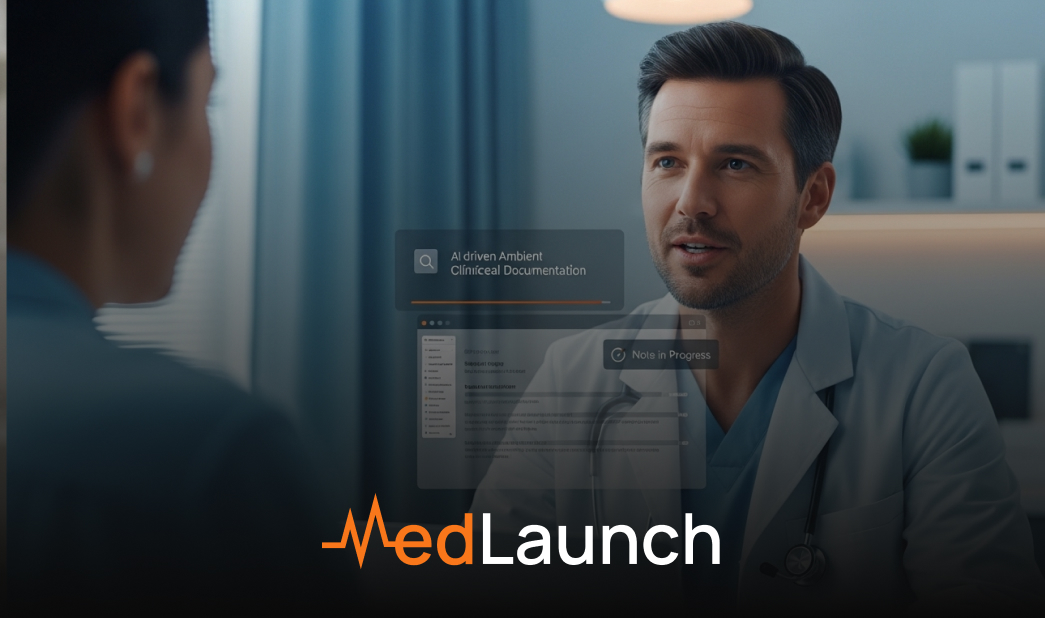
The word “ambient” is the important one. It means passive. The AI works in the background of the natural clinical conversation, not on top of it. The clinician talks to the patient the way they always do. The patient responds. The AI listens, identifies what is clinically relevant, and builds the note as the encounter unfolds.
By the time the visit ends, a draft note is already waiting for the provider to review, edit if needed, and approve. No typing during the visit. No backlog of charts to complete after clinic. No notes were written from a rushed reconstruction of what happened three patients ago.
It is sometimes called ambient charting, ambient AI, ambient scribing, or ambient clinical intelligence. All of these refer to the same underlying technology. The defining characteristic is always the same: documentation happens in real time, from the conversation itself, without adding steps to the clinician’s workflow.
2. Why documentation became such a problem for small clinics
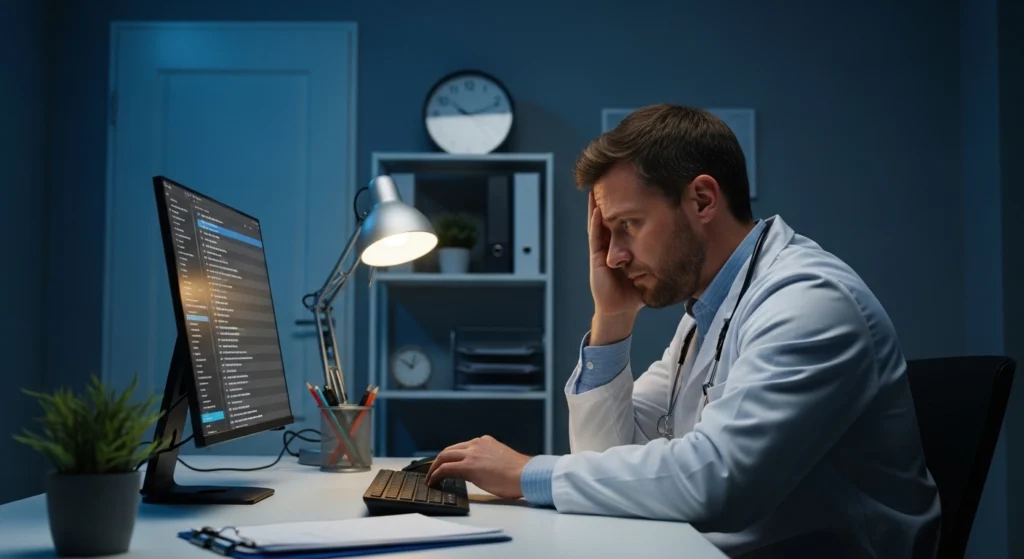
The documentation burden in clinical practice did not appear suddenly. It built up gradually over years of EHR adoption, payer compliance requirements, and coding complexity, and small clinics absorbed almost all of it without the resources that hospital systems use to manage it.
According to the AMA’s 2025 National Physician Comparison Report, 41.9% of physicians report at least one symptom of burnout. When researchers ask what is driving it, documentation and charting consistently come back as the number one answer cited in Tebra’s 2025 Physician Burnout Survey as the top contributor above all other factors, including difficult patients.
The practical reality for a GP or specialist in a small clinic is this. Every visit generates a note. Every note takes time that the schedule does not account for. When patients run longer than expected, when a complex case requires more detail, when a team member is absent, and the front desk needs covering, the notes get pushed back. They stack up. And the provider ends up completing them from home, on evenings, on weekends, from memory that is already degrading.
Research published in the Journal of Internal Medicine quantified this as approximately 1.2 hours of after-hours documentation on clinic days. That figure, described in the literature as “pajama time,” represents time taken from rest, family, and the capacity to be present and sharp for the next day’s patients.
For small clinics, this problem is more acute than it is for large health systems, because there is no dedicated documentation support, no clinical documentation specialist team, and no administrative buffer. The provider carries all of it personally.
Ambient clinical documentation exists because the documentation burden is structural, not personal and the solution has to be structural too.
3. How ambient clinical documentation works
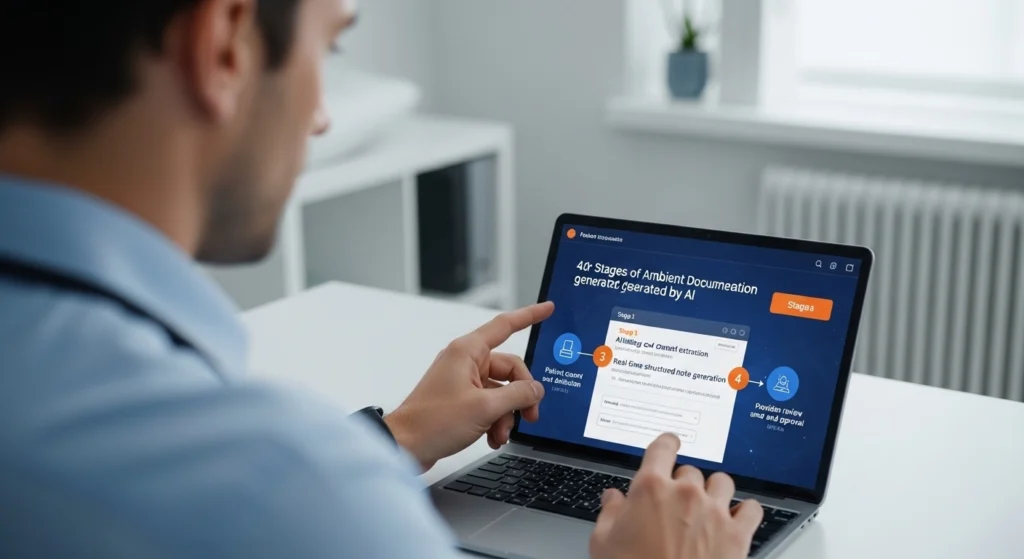
The technology behind ambient documentation combines three components: ambient listening, natural language processing, and structured note generation. The process runs in four stages during a normal patient visit.
Stage 1 — Patient consent and activation
Before the visit begins, the patient is informed that an AI documentation tool will be used to assist with note-taking, and gives their consent. This is built into the intake workflow and takes seconds. The clinician then activates the session in the app or device. From this point, the AI is listening passively in the background.
Stage 2 — Ambient listening and clinical context extraction
As the consultation unfolds, the AI does not transcribe every word. It listens for clinical relevance. Natural language processing identifies the symptoms described, the examination findings noted, the clinical history discussed, the medications mentioned, and the plan agreed. It understands medical context, the difference between “she had a fall last week” as background information and “she has ongoing left knee pain when descending stairs” as a presenting complaint.
Stage 3 — Real-time structured note generation
As the visit proceeds, the AI builds a structured clinical note in a format configured for that clinic, typically a SOAP note (Subjective, Objective, Assessment, Plan) or the note format the practice uses. By the time the visit ends, the draft note is already structured, populated, and ready.
Stage 4 — Provider review and approval
The clinician reads the draft note, makes any edits they need to, and approves it before it is saved to the patient record. This step is non-negotiable and built into every properly implemented ambient documentation system. The AI is an assistant. The provider’s judgment and sign-off are the final authority on what goes into the medical record.
The entire process adds no new steps to the clinical workflow. The clinician conducts the visit exactly as they normally would. The documentation layer runs in the background and delivers a draft rather than a blank screen to fill in.
4. What happens to the audio recording?
This is the question most clinic owners ask first, and it deserves a direct answer.
The audio captured during the visit is used solely to generate the clinical note. Once the note has been produced, the audio is typically deleted on the same day. It is not stored, not retained in any database, and not used to train AI models.
Only the structured clinical note remains in the system.
This architecture is not optional. It is a core requirement of any properly built ambient documentation tool operating within healthcare. HIPAA-aligned systems encrypt all data in transit and at rest, use role-based access controls so that only authorised personnel can view patient information, and operate under a Business Associate Agreement (BAA) with the clinic.
The short version: the AI listens during the visit, generates the note, deletes the audio, and the note lives inside your EHR under the same security standards as every other patient record.
5. What changes for clinicians and their patients
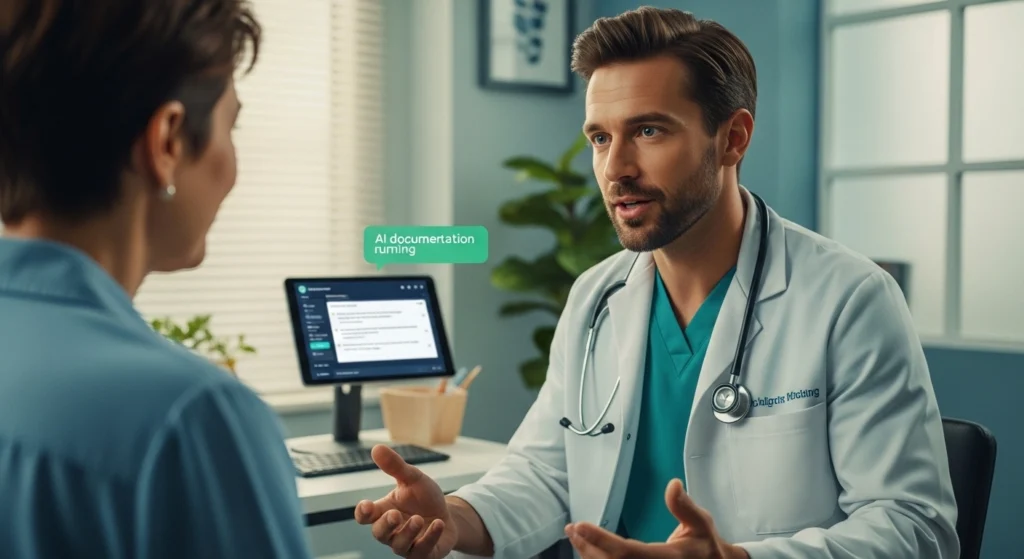
The impact of ambient documentation is felt in two directions simultaneously: what it changes for the provider, and what it changes for the patient experience.
For the clinician
The most immediate change is that the clinical day actually ends when the clinic ends. Notes are reviewed and approved before the last patient leaves, not completed at home from memory two hours later. The 1.2 hours of average after-hours documentation that currently defines clinic life for many GPs and specialists disappear.
Inside the visit itself, the difference is attention. A clinician who is not typing is fully present in the room. There is no split focus between the patient and the screen. There is no moment where the provider has to ask the patient to repeat something because they missed it while entering data. The clinical encounter becomes what it is supposed to be a conversation between a clinician and a patient, fully attended to.
A pilot assessment of ambient documentation published by UChicago Medicine found that after deployment, 90% of clinicians reported being able to give their patients undivided attention during visits. Before the tool was introduced, that figure was 49%.
For the patient
Patients notice when a doctor is genuinely present. The same UChicago study captured patient feedback describing their physicians as “more present in our conversations,” an outcome the research team described as more immediate and dramatic than they had anticipated.
Beyond the experience of the visit itself, better documentation translates to better continuity of care. A note captured completely from the actual consultation, rather than reconstructed afterwards, contains more accurate detail, a more complete clinical history, and clearer documentation of the reasoning behind clinical decisions.
6. Is this just about saving time or does it improve note quality too?
The time saving is real and measurable. Studies have shown documentation time reductions of up to 75% in 2026 ambient documentation deployments. But reducing time to complete a note is not the same as improving the note itself.
This is where ambient documentation offers something that pure time-saving tools do not.
When a clinician writes a note from memory after clinic, tired, distracted, and moving through a backlog, the note tends toward the generic. Vague language. Missing detail on functional limitations. Undocumented conservative treatment history. Clinical rationale that is implied rather than stated. These are not errors in care. There are gaps in documentation that have downstream consequences.
Those documentation gaps create coding problems. When notes do not clearly support the level of care delivered, coding teams either under-code to stay safe or spend hours chasing clinicians for clarification. Revenue earned is not captured. Under-coding, in particular, is systematic and invisible; it does not generate a denial that gets noticed; it simply results in reimbursement that is lower than it should be, every time.
Those same gaps also trigger prior authorisation delays. If imaging justification is missing, if conservative treatment history is not documented, or if functional impact is not clearly stated, insurers have a basis to deny or delay. The clinical case may be strong. The documentation is what gets reviewed.
Ambient documentation addresses this because the note is built from the actual consultation, not reconstructed afterwards. The detail is there because the AI captured it in context, not because the clinician remembered to include it at 9 pm.
A properly configured system goes one step further: it flags documentation gaps at the point of note approval before the clinician signs off, not after a claim comes back rejected. Missing medical necessity justification, absent functional impact statements, and undocumented prior treatment are surfaced when they can still be addressed, not when the damage has already been done.
7. Which clinic types benefit most from ambient documentation?
The documentation burden exists across all clinic types, but it presents differently depending on the practice.
General Practice clinics
GP clinics run on volume. A full patient schedule means documentation is always competing with the next patient who is already waiting. The after-hours backlog builds the most consistently here, and the burnout it creates is most directly related to the sheer number of notes that need to be completed every day. Ambient documentation eliminates the backlog by shifting note completion from after the clinic to inside the visit.
Specialty clinics
For specialists in orthopaedics, neurology, cardiology, and dermatology, the documentation requirement is more complex than in general practice. Prior authorisation requests are common. The notes need to demonstrate medical necessity in specific clinical terms. Documentation gaps in specialty settings do not just create inefficiency; they create denials that have to be appealed, reworked, or in some cases, lost entirely. Ambient documentation that includes real-time prior auth gap flagging addresses this at the source.
Allied health clinics
In physiotherapy, occupational therapy, chiropractic, and psychology practices, documentation drives outcomes and reimbursement in equal measure. Consistent, complete notes across an entire provider team, where each clinician has their own preferred language and note style, is difficult to maintain under manual conditions. An ambient documentation system configured with per-provider templates keeps documentation consistent without standardising away from how individual practitioners work.
8. Three things to look for before choosing an ambient documentation tool
Not all ambient documentation tools are built the same way. For a small or mid-size clinic evaluating options, three questions determine whether a tool will actually deliver what it promises.
1. Does it integrate with your existing EHR, or does it replace it?
The tools that require you to move to a new EHR in order to use ambient documentation are asking for a level of disruption that most small clinics cannot absorb. The right approach is to configure into your existing setup, Epic, Athena Health, or whichever PMS you are currently running, so that nothing changes about how your team works other than where the notes come from.
2. Does it learn your clinic’s language and note templates, or does it produce generic output?
Generic AI output is immediately recognisable, and it creates more editing work than it saves. A properly implemented ambient documentation system is configured to your specific note templates, your preferred clinical language, and your documentation structure before it goes live. Notes should read as if your providers wrote them because the AI was trained to reflect exactly that.
3. What is the audio retention and privacy architecture?
Ask this directly before committing to any tool. Audio should be deleted after note generation. There should be a BAA in place. Data should be encrypted in transit and at rest. Role-based access controls should be standard. If a vendor cannot answer these questions clearly and specifically, that is the answer.
9. How MedLaunch’s Documentation Intelligence fits into this
MedLaunch’s Documentation Intelligence is built for exactly the clinic types described in this guide: GP practices, specialty clinics, and allied health providers that carry the full documentation burden without a dedicated IT team or clinical documentation specialist to manage it.
It listens during patient visits, generates structured SOAP notes in real time, flags prior authorisation gaps before submission, and integrates directly into your existing EHR setup. Audio is deleted after the note is generated. Configuration to your templates and clinical language is handled entirely by MedLaunch before the first live session.
Most clinics are fully live within two to four weeks.
Conclusion
The 9-to-15 ratio — nine minutes of EHR time for every fifteen minutes of patient care — is not a personal failing. It is a structural feature of how documentation has been built into clinical practice over the past decade, and it was never designed to be sustainable for small clinics carrying the load without dedicated support.
Ambient clinical documentation does not ask clinicians to work faster or remember more. It changes the structure of the problem. Documentation happens during the visit, from the conversation itself, and is ready for review and approval before the next patient comes in.
The evenings come back. The notes get more complete, not less. And the coding, billing, and prior authorisation decisions that depend on documentation quality stop being the variable that quietly erodes revenue month after month.
For clinic owners who have been aware of the documentation problem for years but have not yet found a solution that fits, that is what ambient clinical documentation offers. Not a workaround. A structural fix.
Frequently Asked Questions
1. What is ambient clinical documentation?
Ambient clinical documentation is an AI-powered technology that listens passively during a patient visit and automatically generates a structured clinical note in real time, without the clinician stopping to type or dictate. The AI captures clinically relevant information from the natural conversation, organises it into a structured format such as a SOAP note, and presents a draft for the provider to review and approve before it is saved to the patient record.
2. How is ambient clinical documentation different from voice dictation?
Voice dictation requires the clinician to stop, speak directly into a microphone, and narrate the note, which interrupts the consultation and still requires editing afterwards. Ambient documentation works passively in the background of a live patient conversation. The clinician does not change how they speak or structure the visit. The AI listens, extracts what is clinically relevant, and builds the note without any deliberate input from the provider.
3. Is ambient clinical documentation HIPAA compliant?
Yes, when built correctly. HIPAA compliance in ambient documentation requires end-to-end encryption of all data, role-based access controls, a Business Associate Agreement between the clinic and the technology provider, and a clear audio retention policy. Audio should be deleted after the note is generated, and only the structured clinical note should remain. Any ambient documentation tool operating in a clinical environment must meet these standards as a baseline, not as an optional feature.
4. Does the AI write the note automatically or does the provider still review it?
The provider always reviews and approves the note before it is saved to the patient record. The AI generates a draft based on the clinical conversation. That draft is presented to the clinician, who reads it, edits anything that needs changing, and approves it. No note is added to the medical record automatically. The AI is a documentation assistant and the provider’s clinical judgment and final sign-off remain in place on every single note.
5. What happens to the audio recording after the note is created?
The audio is deleted after the note has been generated, typically on the same day. It is not stored, retained in any database, or used to train AI models. Only the structured clinical note remains in the system. This is a non-negotiable requirement for any properly built ambient documentation tool operating under HIPAA and should be one of the first questions any clinic owner asks before committing to a vendor.
6. Can ambient documentation help reduce prior authorisation denials?
Yes, indirectly but meaningfully. Prior authorisation denials are frequently caused by documentation gaps, including missing functional impact statements, undocumented conservative treatment history, and unclear medical necessity rationale. A system configured to flag these gaps at the point of note approval, before the clinician signs off, means the documentation is complete before a claim is ever submitted. This reduces the rate of denials triggered by avoidable omissions in the clinical record rather than by the clinical case itself being weak.
7. How long does it take to set up ambient clinical documentation in a clinic?
For most clinics, the full go-live timeline from initial setup through EHR integration, note template configuration, clinical language customisation, and staff briefing is two to four weeks. The clinic’s involvement during setup is minimal because the technology partner manages the implementation end to end.
8. Will the notes sound like my providers or like generic AI output?
The answer depends entirely on whether the system is configured correctly before go-live. A properly implemented system is set up with the clinic’s specific note templates, preferred clinical language, and documentation structure. When that configuration is done well, notes read as if the provider wrote them. When it is not done, or when a generic out-of-the-box deployment is used, the output tends toward templated AI language that requires significant editing and creates more work than it saves. Always ask a vendor how their system is customised to your clinic before committing.
See AI Clinical Documentation in Action
Most clinics are fully live within two to four weeks. See exactly how it works inside a clinical workflow and how our solution walks through every step in detail.