
Key Takeaways: Is AI Clinical Documentation HIPAA Compliant?
-
1Compliance is conditional, not automatic: AI clinical documentation can be fully HIPAA compliant, but it depends on the safeguards in place and a signed Business Associate Agreement (BAA) before any patient data is processed.
-
2The BAA is the legal baseline: Any vendor receiving or processing Protected Health Information (PHI) is legally required to sign a BAA before a single visit is documented. It is a mandatory requirement, not an optional bonus.
-
3Audio retention is the critical factor: Compliant systems should delete visit recordings immediately after the note is generated. Audio should never be archived or used for model training; always verify this written policy.
-
4Encryption and access controls: All data must be encrypted at rest and in transit. A HIPAA-aligned system requires role-based access controls and detailed audit logging for every access event.
-
5Provider accountability: HIPAA requires that the clinician remains the author of the record. The AI generates the draft, but the provider must review, approve, and sign the note to maintain legal accountability.
-
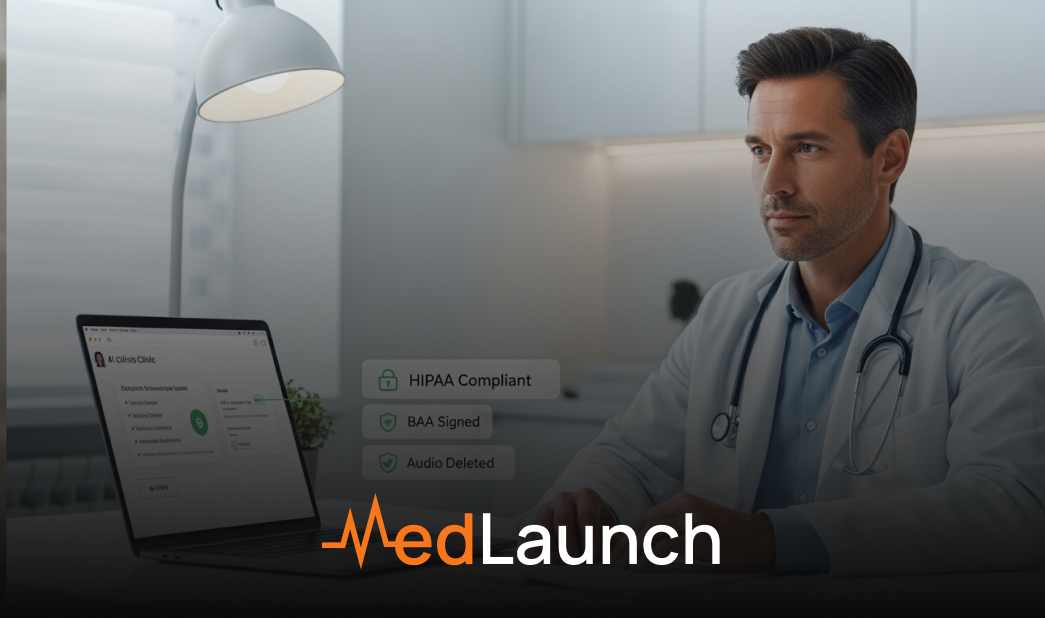
6The MedLaunch Standard: MedLaunch Documentation Intelligence enforces these rules by deleting audio post-generation, ensuring BAAs are in place before go-live, utilizing end-to-end encryption, and never using patient data to train external models.
The most common reason clinic owners delay evaluating AI clinical documentation tools is not cost. It is not a disruption to existing workflows. It is a compliance question that nobody in their team can confidently answer.
Is this actually HIPAA compliant? Or is that just something vendors say?
It is a good question. The answer is not complicated, but it does require understanding what HIPAA compliance for AI documentation actually means in practice, not in a vendor’s marketing page, but in the technical and contractual requirements that determine whether your clinic is protected or exposed.
This guide answers the question directly, covers every compliance element clinic owners need to evaluate, and explains exactly how MedLaunch Documentation Intelligence addresses each one.
Table of Contents
1. Can AI clinical documentation be HIPAA compliant?
Yes. AI clinical documentation can be fully HIPAA compliant, but compliance is a property of the implementation, not the technology category. The AI itself is neither compliant nor non-compliant in isolation. What determines compliance is how the system is built, how it handles Protected Health Information at every stage of the documentation workflow, and what contractual and technical safeguards govern that process.
The question clinic owners should be asking is not whether AI documentation as a category is HIPAA compliant. It is whether this specific vendor meets the specific HIPAA requirements that apply to any system that touches patient data in their clinic.
When those requirements are met, AI clinical documentation is not only HIPAA compliant but often more compliant than traditional manual documentation workflows, because every step is logged, controlled, and auditable in ways that a clinician typing from memory at 9 pm is not.
2. What HIPAA actually requires for AI documentation tools
HIPAA’s Privacy Rule and Security Rule both apply to any system that creates, receives, maintains, or transmits Protected Health Information. An AI documentation tool that listens during patient visits, processes that audio, and generates clinical notes is handling PHI at every one of those stages.
That means the following requirements apply without exception.
The Privacy Rule
The Privacy Rule requires that PHI is used only for the minimum necessary purpose. In this context, that means generating the clinical note. It must not be disclosed or repurposed beyond that. A vendor that uses patient audio or note content to train their AI models without explicit authorisation is violating this rule, regardless of what their website claims.
The Security Rule
The Security Rule requires three categories of safeguards. Administrative safeguards cover policies and workforce training. Physical safeguards cover control of the devices and facilities where PHI is accessed. Technical safeguards cover encryption, access controls, and audit logging.
Both rules apply to the vendor providing the AI tool, not just to the clinic using it. This is where the Business Associate Agreement becomes the central compliance mechanism.
3. The Business Associate Agreement: what it is and why it is non-negotiable

What a BAA is
A Business Associate Agreement is a legally binding contract between a covered entity, which is your clinic, and any vendor that handles PHI on your behalf. Under HIPAA, any third party whose service involves receiving, processing, or transmitting patient data is classified as a Business Associate. That classification triggers a legal obligation: the BAA must be signed before any PHI is shared.
Why can it not be skipped
The BAA is not a courtesy. It is a legal requirement. Sharing PHI with a vendor without a signed BAA in place is a direct HIPAA violation. One clinic was fined $750,000 for exactly this, releasing PHI to a vendor before the BAA was executed. The same HHS guidelines make clear that this obligation extends to AI vendors handling PHI on behalf of covered entities.
What a BAA for AI documentation must specifically cover
For AI documentation tools specifically, the BAA needs to address three things that standard agreements often miss.
- Whether the vendor is prohibited from using your patient data to train their AI models. PHI must not be used as training data without explicit authorisation. Any vendor that cannot confirm this in writing is a compliance risk.
- The data retention terms for audio recordings specifically. How long is the recording held? Under what circumstances is it accessible? Who within the vendor’s organisation can access it?
- The subcontractor chain. AI vendors typically use cloud infrastructure providers as sub-processors. The BAA must extend to those subcontractors as well.
If a vendor will not sign a BAA, or cannot answer these questions specifically, stop the evaluation at that point.
4. Audio retention: the question most clinics forget to ask
This is the compliance element that receives the least attention during vendor evaluation and carries the most risk if handled incorrectly.
When an AI documentation tool listens during a patient visit, it captures an audio recording of that conversation. That recording is Protected Health Information. It contains everything said in the consultation, including symptoms, diagnoses, treatment plans, patient history, and potentially information about third parties mentioned in the visit.
The only acceptable answer
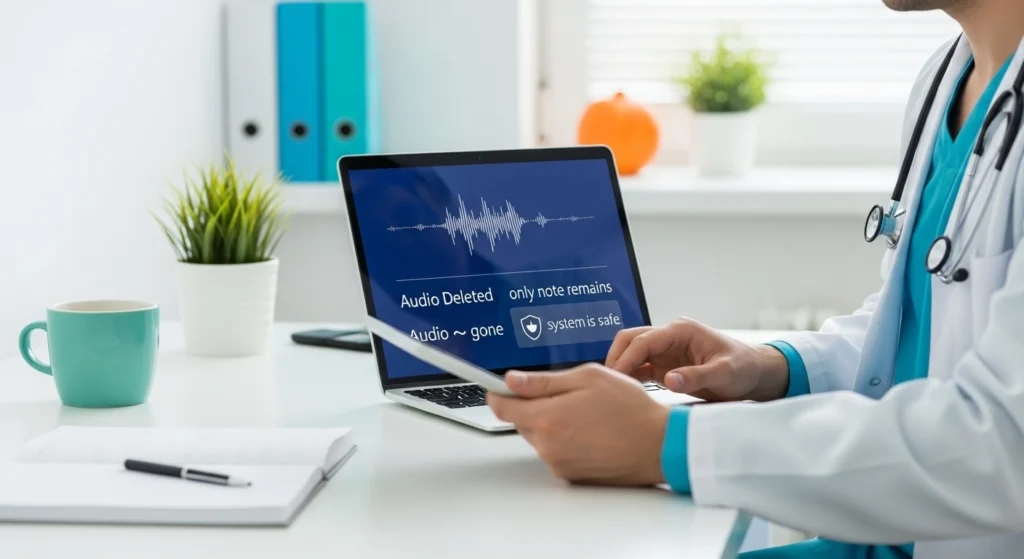
The audio is deleted immediately after the clinical note has been produced, typically on the same day and often within minutes. It is not stored. It is not archived. It is not accessible after deletion. Only the structured clinical note remains.
Some vendors retain audio as a quality assurance measure or for future model improvement. If a vendor’s retention policy allows audio to persist in their systems, even in encrypted form, that audio remains a PHI liability for your clinic. A breach of that stored audio is a breach on your watch.
How to verify this before signing
Always request the vendor’s written audio retention policy before signing anything. If they do not have a published, specific retention policy, that is a compliance gap regardless of what their marketing materials claim.
5. Encryption, access controls, and audit logging
These three technical safeguards are required under HIPAA’s Security Rule for any system that handles PHI. For AI documentation tools, they need to be present at every stage of the workflow.
Encryption
Encryption must cover data in transit and data at rest. In transit means any data moving between the device capturing the audio, the AI processing system, and the EHR, where the note is delivered, must be encrypted. At rest means any PHI stored in the system, including the structured clinical note, before it is approved, must be encrypted in storage.
Role-based access controls
Role-based access controls determine who within a multi-provider clinic or within the vendor’s organisation can access patient data. In a properly built system, only the provider whose patient the note belongs to can access that note for review and approval. Administrative staff, billing teams, and other providers should have access only to the PHI required for their specific role.
Audit logging
Audit logging requires that every access event involving PHI be recorded. This means every time a note is generated, reviewed, edited, approved, or accessed, a log entry is created showing who performed the action, when, and from where. These logs must be maintained for a minimum of six years under HIPAA and must be available for review in the event of a compliance audit or breach investigation.
6. Patient consent and the provider sign-off requirement
Patient consent for the recording
HIPAA does not require explicit written patient consent for treatment-related documentation. Recording a clinical encounter for the purpose of generating a note falls within the scope of treatment activity under HIPAA. However, state recording laws vary and some states require all-party consent before recording a conversation. A verbal disclosure at the start of the visit informing the patient that an AI tool is assisting with documentation is standard practice and the appropriate professional standard regardless of state law.
Provider sign-off on every note

This is not just a clinical safeguard. It is a HIPAA compliance requirement. The clinician who delivered the care is legally accountable for the clinical record that documents it. An AI documentation tool generates a draft. That draft must be reviewed, edited if needed, and approved by the provider before it is finalised in the patient record.
No compliant AI documentation system finalises or files a note automatically. The provider’s sign-off is the compliance control that makes the AI a documentation assistant rather than an autonomous clinical actor. Any vendor claiming their system can finalise notes without provider approval is describing a non-compliant implementation.
7. The 6 questions to ask any AI documentation vendor before you sign
Based on everything covered in this guide, here are the six questions every clinic owner should put to any AI documentation vendor before proceeding.
Question 1: Will you sign a BAA that specifically covers AI?
Will you sign a Business Associate Agreement before we begin, and does it specifically cover AI data handling including model training restrictions, audio retention, and subcontractor obligations?
Question 2: What is your written audio retention policy?
How long is the recording held after the note is generated, who can access it during that period, when is it deleted, and what happens to our data if we end the contract?
Question 3: How is patient data encrypted?
How is PHI encrypted in transit and at rest, and what encryption standards do you use?
Question 4: How are access controls implemented?
Does your system use role-based access controls, and can you confirm that patient data is accessible only to authorised personnel within the scope of their clinical role?
Question 5: Is patient data used to train your AI models?
Is patient data used to train or improve your AI models, and can you confirm this prohibition in the BAA as a written contractual commitment?
Question 6: Is provider approval required before every note is filed?
Is provider review and approval required before every note is finalised in the patient record, and can you confirm no note is filed automatically?
A vendor who can answer all six questions specifically, in writing, and is willing to commit to them in the BAA is demonstrating genuine compliance readiness. A vendor who deflects, speaks in generalities, or points to a marketing page instead of a policy document is not.
8. How MedLaunch Documentation Intelligence handles every one of these
MedLaunch Documentation Intelligence is built for the GP, specialty, and allied health clinic environment where the documentation burden is carried without a dedicated compliance officer or IT team. Here is exactly what is in place.
BAA signed before go-live
MedLaunch executes a Business Associate Agreement with every clinic before the system is activated. The BAA specifically covers AI processing, audio handling, model training restrictions, and subcontractor obligations. No PHI is processed before the BAA is signed.
Audio deleted after note generation
The recording made during the patient visit is used solely to generate the clinical note. Once the note is produced, the audio is deleted the same day, every time. No recordings are retained, archived, or accessible after deletion. Only the structured clinical note remains in the system.
End-to-end encryption
All data processed by Documentation Intelligence is encrypted in transit and at rest. Role-based access controls ensure that only the authorised provider can access their patients’ notes for review and approval.
Audit logging
Every access event involving PHI is logged, timestamped, and maintained in accordance with HIPAA’s six-year retention requirement for compliance documentation.
No patient data used for model training
MedLaunch does not use patient data to train or improve its models. This is committed to in the BAA, not just stated on a website.
Provider review and approval on every note
No note generated by Documentation Intelligence is filed automatically. Every draft is presented to the provider for review, editing if needed, and explicit approval before it is saved to the patient record.
If you want to see how the full workflow operates inside a clinical setup, the Documentation Intelligence solution page walks through every step from ambient listening through EHR integration.
Frequently Asked Questions
Is AI clinical documentation HIPAA compliant?
Yes, when implemented correctly. AI clinical documentation is HIPAA compliant when the vendor has signed a Business Associate Agreement, audio is deleted after note generation, all data is encrypted in transit and at rest, role-based access controls limit PHI exposure to authorised personnel, and provider review and approval is required before any note is finalised. HIPAA compliance is a property of the implementation, not the technology category. A properly built system is compliant. A generic consumer AI tool used to document patient visits is not.
Do I need a BAA with my AI documentation vendor?
Yes, without exception. Any vendor whose system will receive, process, or transmit Protected Health Information on behalf of your clinic is classified as a Business Associate under HIPAA. A signed BAA must be in place before any patient data is shared. This is not optional and cannot be addressed retroactively. Sharing PHI with a vendor without a BAA in place is a direct HIPAA violation regardless of whether a breach actually occurs.
What should happen to the audio recording after a note is generated?
The audio recording should be deleted immediately after the clinical note has been produced. It should not be stored, archived, or retained for any purpose including quality assurance or model improvement. The recording is PHI and carries the same data liability as any other patient record. Ask any vendor for their written audio retention policy before signing, and confirm the deletion timing, who has access before deletion, and what happens if you end the contract.
Can the AI documentation system file notes automatically without my review?
No compliant system does this. HIPAA requires that the clinician who delivered the care is accountable for the clinical record. Provider review and approval is a legal and clinical requirement, not a feature preference. The AI generates the draft. The provider reads it, edits if needed, and approves before the note is finalised. Any vendor describing a workflow where notes are filed automatically without provider sign-off is describing a non-compliant implementation.
What is the difference between HIPAA-eligible and HIPAA-compliant for AI tools?
A HIPAA-eligible service means the infrastructure or platform can be configured for HIPAA compliance. It does not mean it is compliant out of the box. Many cloud providers offer HIPAA-eligible services, meaning you can deploy on them in a compliant way if you configure them correctly and sign a BAA. HIPAA-compliant means the full implementation meets HIPAA requirements. Eligible is the starting point. Compliant is the outcome of doing everything correctly on top of that.
Conclusion
The compliance question that delays most clinic owners from evaluating AI documentation technology is not complicated once it is answered properly. Yes, AI clinical documentation can be HIPAA compliant. The conditions are specific, they are verifiable, and a properly built system meets all of them.
The BAA is not optional. The audio must be deleted. The data must be encrypted. Access must be controlled. The provider must approve every note. And no patient data should be used to train the vendor’s models.
Every one of those requirements has a clear answer. Either the vendor meets it or they do not. The six questions in this guide give every clinic owner the framework to find out before they sign, not after a compliance problem surfaces.
MedLaunch Documentation Intelligence is built to meet all of them. If you want confirmation of any specific element before evaluating, the assessment call is the place to get it, on the record, in writing, before anything is deployed.
Is your clinic ready for HIPAA-compliant AI?
Book a free assessment call to see how MedLaunch integrates securely with your EHR and protects your patient data.