
Key Takeaways: SOAP AI Notes in 2026
-
1Same standard, new source: While the Subjective, Objective, Assessment, and Plan structure remains the clinical gold standard, AI has shifted the source from late-night memory to live, real-time conversation.
-
2Real-time ambient drafting: Ambient technology listens during the visit and drafts a structured SOAP note in real time. This allows the clinician to review and approve the note before the next patient even walks in.
-
3Superior clinical quality: Notes generated from actual conversation capture vital treatment rationale and functional limitations that are often omitted when documenting from memory at the end of a long day.
-
4The new clinical norm: With 66% of US physicians now utilizing AI in their practice, AI-assisted SOAP note generation has moved from a “future tech” concept to a standard operational requirement.
-
5Intelligence beyond the note: MedLaunch goes further by flagging prior auth gaps and structuring output for ICD-10 and CPT accuracy, delivering finished notes directly into Epic or Athena Health.
Every clinician who went to medical school learned SOAP notes in their first year. Subjective. Objective. Assessment. Plan. The structure has been the standard framework for clinical documentation for over five decades. It has not changed, and it is not changing.
What is changing fast, and has changed dramatically in 2026, is how those four sections get populated, when they are written, and what that means for the quality of the clinical record.
For most of the history of EHR documentation, writing the SOAP note meant a clinician sitting down after the patient left, reconstructing the visit from memory and brief shorthand, and typing it into the record. Sometimes during the visit. Often after clinic. Frequently at home in the evening.
AI has made that workflow largely unnecessary. The note can now be generated from the visit itself, in real time, while the clinician is fully present with the patient.
This guide explains how that works, why it matters clinically and operationally, and what it actually changes for a GP or specialty clinic day to day.
Table of Contents
1. What SOAP notes are and why they matter beyond documentation
SOAP notes are the standard structure for recording a patient encounter in clinical practice. Each section captures a different layer of the visit.
Subjective: The Subjective section covers what the patient reports: their symptoms, concerns, history, and how they describe their condition in their own words. This is the patient’s voice in the clinical record.
Objective: The Objective section covers what the clinician observes and measures: examination findings, vital signs, test results, and clinical data. This is the evidentiary foundation of the note.
Assessment: The Assessment section covers the clinician’s clinical judgment: the diagnosis or differential diagnoses, the interpretation of the findings, and the clinical reasoning that connects the Subjective and Objective sections to a conclusion.
Plan: The Plan section covers what happens next: treatment decisions, prescriptions, referrals, follow-up instructions, and anything ordered as a result of the visit.
The structure exists for good reason. A complete SOAP note is not just a record of what happened. It is the legal documentation of clinical decision-making, the basis for billing and coding, the evidence base for prior authorisation requests, and the continuity record that the next clinician who sees this patient will rely on.
When any of those four sections is incomplete, vague, or missing key detail, the consequences are not limited to documentation quality. They cascade into coding errors, claim denials, prior auth delays, and audit risk.
2. The problem with how SOAP notes have been written until now

The documentation burden in clinical practice has built up over years of EHR adoption, payer compliance requirements, and coding complexity. The result is a documentation workflow that is structurally impossible to complete well under the conditions most clinicians face. The documentation burden is structural, not personal, and the solution has to be structural too.
A full patient schedule generates 15 to 25 encounters per day. Each one requires a SOAP note. The documentation happens in the gaps between patients, during lunch, after clinic, or at home in the evening. By the time many SOAP notes are written, the clinician is working from notes that are minutes or hours old, sometimes from memory alone.
This creates three predictable problems.
Notes are written from reconstruction, not observation
The most accurate clinical documentation happens at the moment of care, when findings are fresh, and the clinical reasoning is live. Documentation written from memory loses granularity. Functional limitations are approximated. Treatment rationale gets summarised rather than stated. Prior history discussed during the visit does not always make it into the record.
Cognitive load degrades quality across the day
A SOAP note written at the start of the clinic is typically more complete than one written at the end. A note written during clinic hours is typically more complete than one written at home after dinner. As the clinical day accumulates, documentation quality consistently declines, even among experienced, conscientious providers.
The Objective and Assessment sections are most affected
The Subjective section, capturing patient-reported symptoms, is relatively easy to reconstruct. The Objective and Assessment sections, which require specific clinical detail about findings and reasoning, are where the gaps most commonly appear. These are also the sections that payers scrutinise most closely when reviewing claims and prior auth requests.
3. How AI generates SOAP notes from the clinical conversation
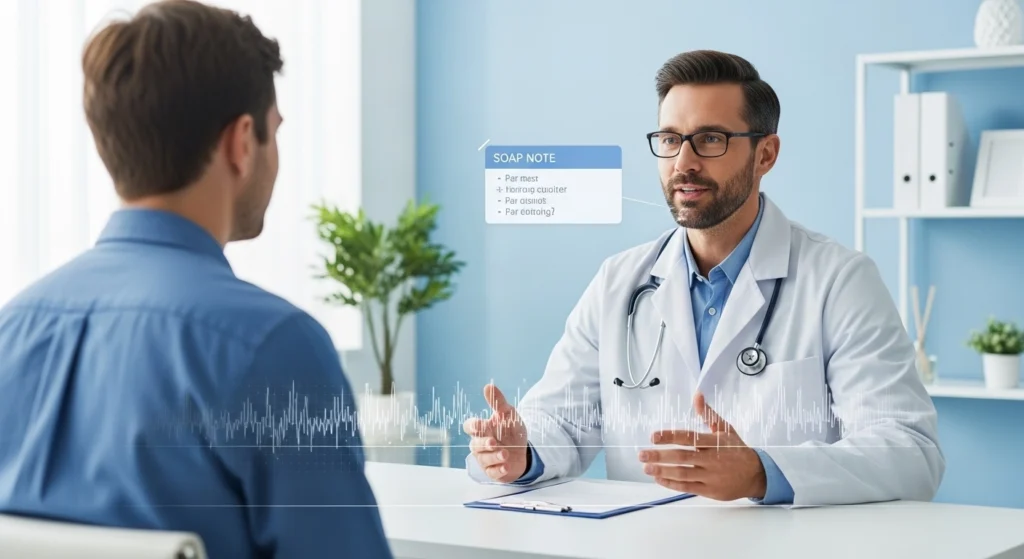
Ambient AI documentation technology addresses the root cause of the problem. Instead of asking the clinician to reconstruct the visit after the fact, it captures the visit itself.
Ambient listening
The system listens passively during the patient encounter through a device in the consultation room or the clinician’s phone. The patient is informed and gives consent. The conversation proceeds as it normally would. The AI listens in the background without intruding on the clinical interaction.
Natural language processing and clinical context extraction
The AI does not transcribe everything that is said. It uses natural language processing to identify what is clinically relevant within the conversation. It understands the difference between casual exchange at the start of a visit and a patient describing their presenting complaint. It distinguishes between a clinician thinking aloud and a clinician stating a clinical finding. It recognises medication names, anatomical references, symptom descriptors, and the language of clinical decision-making.
According to the American Medical Association, 66% of US physicians now use AI in their practice, up from 38% in 2023. SOAP note generation from ambient audio is one of the most widely adopted applications.
Structured note generation
As the visit unfolds, the system organises the extracted clinical content into the four SOAP sections in real time. By the time the consultation ends, a draft SOAP note is already structured and ready for review. Not a transcript. Not a raw summary. A formatted clinical note in the structure the clinician uses, with the content mapped to the correct sections.
Provider review and approval
Every AI-generated SOAP note is presented to the clinician for review before it is finalised. The clinician reads the draft, edits anything they want to change, and approves it. No note is filed automatically. The provider’s clinical judgment and sign-off are the final authority on what goes into the patient record.
4. What changes inside each SOAP section when AI is involved
The most useful way to understand what AI documentation changes is to look at what it does to each section of the note specifically.
Subjective: The Subjective section benefits most from the fact that it is drawn from the patient’s own words during the visit. When the AI captures what the patient actually said about their symptoms, onset, severity, and history, rather than a clinician’s paraphrase written later, the section is more complete and more accurate.
Patients often provide clinically relevant context in the first minutes of a consultation that gets compressed or lost in after-hours reconstruction. Duration of symptoms, how they have changed over time, what makes them better or worse, previous treatments tried at home. The AI captures all of it at the moment it is said.
Objective: The Objective section requires the clinician to verbalise findings during the examination for the AI to capture them. Clinicians working with ambient documentation tools quickly develop the habit of speaking their examination findings aloud: blood pressure readings, range of motion assessments, auscultation findings, skin observations. This verbalisation actually improves the completeness of the Objective section compared to after-hours documentation, because findings are stated explicitly rather than recalled approximately.
Assessment: The Assessment section is where AI documentation has the greatest potential to change clinical outcomes, not just documentation efficiency. When the clinician states their reasoning aloud during the visit, including differential diagnoses considered and the basis for the clinical judgment, those elements are captured in the Assessment section. In manual documentation, clinical reasoning is often compressed into a diagnosis code and a brief summary. In AI-generated documentation from the actual consultation, the reasoning is more fully captured.
This directly affects coding accuracy. A note that clearly supports the level of medical decision-making delivered is the basis for accurate evaluation and management coding. A note that underrepresents the clinical reasoning results in under-coding, lower reimbursement, and a documentation record that does not reflect the care delivered.
Plan: The Plan section benefits from the AI capturing every element of the clinical plan as it is communicated to the patient during the visit. Follow-up timing, specific medications and dosages, referrals discussed, patient instructions given, and orders placed. In after-hours documentation, elements of the plan discussed verbally with the patient sometimes do not make it into the written record because the clinician is reconstructing from memory rather than from the conversation.
5. The quality difference between AI-generated and after-hours notes
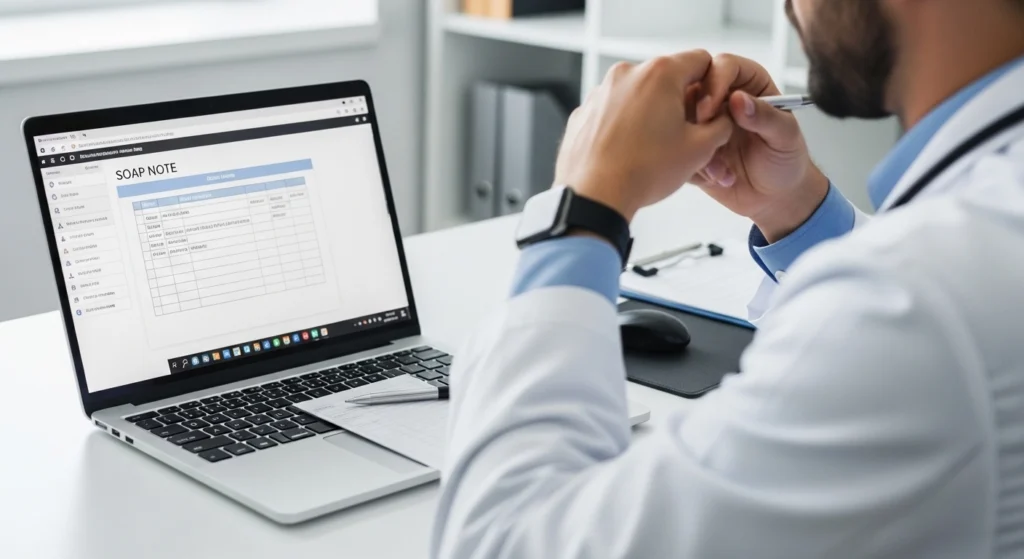
The difference between a note generated from the clinical conversation in real time and a note written from memory after clinic is not subtle. It shows up in specific, measurable ways.
Completeness
AI-generated notes consistently capture more clinical detail than after-hours manual documentation. This is not a reflection of clinician effort or competence. It is a structural result of documenting from the live conversation rather than from memory under fatigue.
Functional documentation
Prior authorisation requests for imaging, specialty referrals, and procedures commonly fail not because the clinical case is weak but because the functional impact on the patient was not documented. The patient may have described their functional limitations in detail during the consultation. If that detail is not in the note, it is invisible to the payer reviewing the request.
When the AI captures the patient’s own description of how their condition affects daily activity, that functional language goes into the Subjective section of the SOAP note at the time it is spoken. It does not depend on the clinician remembering to include it later.
Consistency across the clinical day
Manual documentation quality degrades across a long clinical day. AI-generated documentation does not. The note generated from the first visit of the day and the note generated from the last visit of the day are produced with the same completeness and the same structural accuracy, because both are generated from the conversations themselves rather than from a clinician whose cognitive resources have been depleted by preceding encounters.
6. How SOAP note quality affects prior auth and coding outcomes
This is where documentation quality connects directly to clinic revenue, and it is the connection that most content about SOAP notes and AI does not make explicitly.
Prior authorisation
Payers reviewing prior authorisation requests are reviewing clinical documentation, specifically the SOAP note. They are looking for documented medical necessity, functional impact, conservative treatment history, and clinical rationale. When these elements are absent from the note because they were discussed during the visit but not captured in the documentation, the prior auth fails on a documentation basis rather than a clinical one.
An AI documentation system that generates notes from the actual visit captures these elements because they were said. A system that also flags documentation gaps before the clinician signs gives the provider one final opportunity to address anything that was missed before the claim is submitted.
Coding accuracy
ICD-10 and CPT coding accuracy depends directly on note quality. Coding-related issues account for approximately 32% of all insurance claim rejections according to AMA data. Most of those rejections trace back to documentation that did not clearly support the level of care delivered.
A SOAP note that accurately reflects the Assessment and Plan from the clinical encounter, with specific diagnoses, documented reasoning, and a clear plan of care, gives billing teams what they need to code accurately. A vague or incomplete note generates coding queries, under-coding, and revenue loss that is systematic and invisible month after month.
For a complete breakdown of how documentation quality affects clinic revenue and what the cost of poor notes actually looks like, the revenue protection guide covers this directly.
7. What 2026 has brought to AI documentation
The AI documentation landscape shifted significantly in the first quarter of 2026 in ways that are directly relevant for clinic owners evaluating their options.
Major EHR platforms have embedded AI documentation natively
Epic launched AI Charting in February 2026, a built-in ambient documentation feature embedded in its clinical interface. Athena Health announced athenaAmbient in the same period, embedded in athenaOne Mobile at no additional cost to customers. Both moves signal that ambient SOAP note generation is no longer a specialist tool. It is becoming a standard expectation of EHR platforms.
The VA expanded ambient AI documentation nationwide
The US Department of Veterans Affairs expanded its ambient AI scribe technology to all VA medical centres across the country throughout 2026, following a successful launch in October 2025. The nationwide deployment is the largest government healthcare AI implementation in the US and signals the level of institutional confidence that has now accumulated around AI-generated SOAP notes.
66% of physicians now use AI in practice
According to AMA data, the proportion of US physicians using AI in their practice reached 66% in 2026, up from 38% in 2023. The adoption rate doubled in three years. Clinics that have not yet evaluated AI documentation tools are increasingly operating outside the norm of their professional cohort.
Documentation time savings are well-evidenced
A multicenter study published in JAMA Network Open found a 31% reduction in reported burnout and a 30% boost in physician wellbeing among physicians using ambient AI scribes. Clinicians at John Muir Health saved 34 minutes per day on documentation after adopting AI Charting. At UPMC, providers reduced after-hours charting by nearly two hours each day.
8. How MedLaunch Documentation Intelligence generates SOAP notes
MedLaunch Documentation Intelligence is a standalone clinical documentation platform that generates SOAP notes from the clinical conversation, structures them for coding accuracy, flags prior auth gaps before sign-off, and delivers them directly into Epic or Athena Health through the EHR’s integration pathway. For a full explanation of how the EHR integration works, the Epic and Athena Health integration guide covers every step in detail.
Note generation from the visit itself
Documentation Intelligence listens during the patient visit using ambient audio technology. It extracts the clinically relevant content from the natural consultation conversation and drafts a structured SOAP note in real time. The note is ready for review before the next patient comes in.
Prior auth gap flagging
Before the clinician approves the note, Documentation Intelligence surfaces any documentation gaps that commonly trigger prior authorisation delays or denials. Missing functional impact statements, undocumented conservative treatment history, absent medical necessity rationale. These are flagged at the point of review, where they can still be addressed.
Coding-ready structure
Every note generated by Documentation Intelligence is structured to support accurate ICD-10 and CPT coding. Billing teams receive documentation that reflects the level of care delivered without needing to follow up with providers for clarification.
Direct EHR delivery
The note lands in the patient record in Epic or Athena Health through the EHR’s API integration. No clipboard transfer. No switching applications. The clinician reviews and approves inside the EHR they already use.
Configuration before go-live
Before the first live session, MedLaunch configures Documentation Intelligence to your clinic’s specific note templates, preferred clinical language, and per-provider documentation conventions. Notes read as if your providers wrote them. Most clinics are fully live within two to four weeks.
Frequently Asked Questions
What is a SOAP note in clinical documentation?
A SOAP note is the standard format for recording a patient encounter in clinical practice. The four sections are Subjective, covering patient-reported symptoms and history; Objective, covering clinical findings and measurements; Assessment, covering the clinician’s diagnosis and clinical reasoning; and Plan, covering treatment decisions, prescriptions, referrals, and follow-up. The structure has been the standard framework for clinical documentation for over five decades and remains the basis for billing, coding, prior authorisation, and continuity of care.
How does AI generate SOAP notes from a patient visit?
AI documentation technology listens during the patient consultation using ambient audio. Natural language processing identifies the clinically relevant content from the conversation and maps it to the correct SOAP sections in real time. Subjective information from the patient’s own description, objective findings verbalised by the clinician during examination, assessment reasoning, and plan elements are each captured as they are spoken. A draft note is ready for provider review by the time the visit ends.
Does AI-generated SOAP documentation replace the clinician’s role?
No. Every AI-generated SOAP note is a draft that the clinician reviews, edits if needed, and approves before it is saved to the patient record. Nothing is filed automatically. The clinician remains legally accountable for the accuracy and completeness of the clinical record. AI is a documentation assistant. The provider’s clinical judgment and sign-off are the final authority on every note.
Why are AI-generated SOAP notes often more complete than manually written ones?
Because they are generated from the clinical conversation itself rather than from memory after the visit. Documentation written from reconstruction loses granularity, particularly in the Objective and Assessment sections where specific findings and clinical reasoning need to be stated explicitly. Functional limitations described by the patient during the consultation, examination findings verbalised by the clinician, and the reasoning behind clinical decisions are all captured at the moment they occur, not approximated from memory under fatigue.
How does SOAP note quality affect prior authorisation outcomes?
Payers reviewing prior auth requests assess the clinical documentation for documented medical necessity, functional impact, conservative treatment history, and clinical rationale. When these elements are absent from the note because they were discussed during the visit but not captured in documentation, the prior auth fails on a documentation basis rather than a clinical one. AI documentation that captures these elements from the live conversation, combined with gap flagging before sign-off, addresses this problem at the point of note creation rather than after a denial.
Is AI documentation of SOAP notes HIPAA compliant?
Yes, when the vendor meets specific requirements. These include a signed Business Associate Agreement before any patient data is processed, deletion of audio recordings after note generation, end-to-end encryption of data in transit and at rest, role-based access controls, and audit logging of all access events. The compliance is a property of the implementation, not the technology category. For a complete walkthrough of what HIPAA compliance for AI documentation requires, the HIPAA compliance guide for AI clinical documentation covers every element a clinic owner needs to verify.
What is the difference between a basic SOAP note generator and Documentation Intelligence?
A basic SOAP note generator produces a note from the visit conversation. Documentation Intelligence generates the note and adds downstream clinical intelligence: real-time prior authorisation gap flagging before the clinician signs, coding-ready note structure that supports accurate ICD-10 and CPT coding, and direct EHR integration that delivers the note into Epic or Athena Health without clipboard transfer. The difference is not note generation. It is what the documentation does after it is generated and how it connects to clinical and revenue outcomes. The full comparison between AI scribes and Documentation Intelligence covers this in detail.
Conclusion
SOAP notes are not going away. The structure that has served clinical documentation for five decades works precisely because it organises clinical thinking into a format that is complete, auditable, and useful to everyone who reads it: the clinician, the billing team, the payer, and the next provider who sees the patient.
What is going away is the workflow that produced them. Reconstruction from memory after clinic. Incomplete Objective sections from interrupted examinations. Assessment paragraphs that summarise clinical reasoning rather than stating it. Plan elements that were discussed in the room but never made it into the record.
AI documentation generates SOAP notes from the clinical conversation itself. The note is more complete because it comes from the visit, not from a tired clinician’s memory at 9pm. The Assessment and Plan sections reflect what was actually said and decided, not a compressed version. And the documentation is done before the next patient walks in.
For GP and specialty clinics where documentation quality directly affects prior auth outcomes, coding accuracy, and revenue recovery, this is not an incremental improvement. It is a structural change to the part of clinical practice that has been the most reliably broken for the longest time. Understanding what that documentation burden actually costs your clinic is where the conversation about AI SOAP note generation should start.
Stop documenting from memory at 9 PM.
See how MedLaunch generates complete, coding-ready SOAP notes from your patient visits in real-time.