
Key Takeaways: GP Clinic Has Outgrown Manual Documentation
-
1Gradual Failure: Manual documentation does not fail suddenly; it fails gradually. The signs accumulate over months until they impact revenue reports, clinical burnout, and the backlog of notes following GPs home.
-
2Sign 1: After-Hours Charting: The most visible symptom is that notes are not finished when the clinic closes. While often normalized and accepted, after-hours charting is the first major indicator of a failing system.
-
3Sign 3: Billing Team Queries: When billing staff must regularly return to providers for clarification on vague or incomplete documentation, it is evidence that the documentation system has structurally failed.
-
4Sign 5: Rising Prior Auth Denials: This is the most financially significant sign. Rising denial rates indicate a documentation problem notes submitted to payers lack the specific requirements needed for approval.
-
5A Common Structural Cause: All five signs stem from documenting after encounters from memory. AI ambient documentation fixes this by capturing the consultation in real-time, removing all five symptoms simultaneously.
Most GP clinic owners do not decide they need AI documentation. They discover it.
They discover it the third time this week they are still at their desk at 9pm finishing notes. They discover it when the billing team flags the same documentation problem for the fifth time this month. They discover it when a prior auth comes back denied and the reason is that the clinical necessity was not documented even though it was clinically obvious.
By the time the problem is visible, the clinic has usually been living with it for months. Because manual documentation does not fail suddenly. It fails gradually, in ways that are easy to normalise because every GP around you is experiencing the same thing.
This guide names the five signs that a GP clinic has outgrown manual documentation. If you recognise more than two of them, the structural cause and the solution are the same.
Table of Contents
1. Sign 1 — The notes are not done when the clinic closes

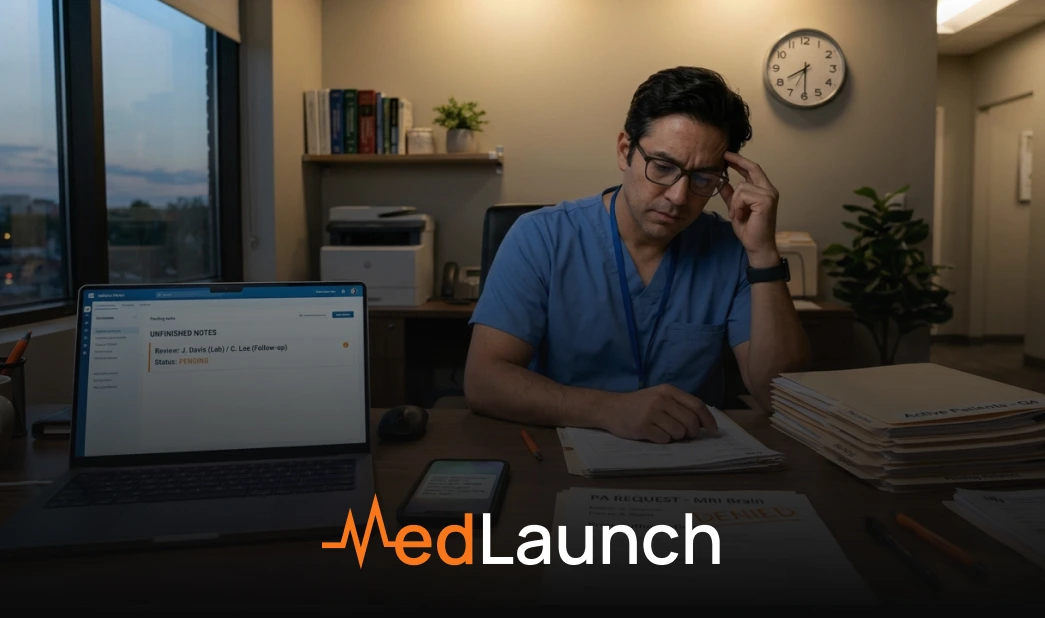
This is the sign that most GPs already know about because they experience it personally every day. It has a name in clinical circles: pajama time. It is the hours spent after clinic completing notes that could not be finished during the working day.
The scale of the problem
According to an exclusive AMA survey, 20.9% of physicians report spending more than eight hours per week on EHR documentation outside normal working hours. This figure has not changed over three consecutive years of measurement. Sonix
For a GP seeing 20 to 25 patients per day, each requiring a structured clinical note, the mathematics are straightforward. There is not enough time in the gaps between consultations to complete full documentation. The backlog accumulates across the clinical day and overflows into the evening.
Why this sign matters beyond personal inconvenience
After-hours charting is not just a work-life balance issue. It is a documentation quality issue. A note written from memory at 9pm after 20 preceding consultations is a different clinical document from a note written from the actual encounter. Functional details are approximated. Clinical reasoning is compressed. Treatment rationale that was expressed during the consultation does not make it into the written record.
That quality gap flows directly into coding accuracy, prior auth outcomes, and the clinical record that the next provider reading this note will rely on.
The test
If at least one GP in your clinic regularly completes notes after clinic hours, your documentation workflow has structurally failed. Not occasionally, as happens to everyone. Regularly, as a feature of the clinical schedule.
That is Sign 1.
2. Sign 2 — Coding queries from billing are a regular occurrence

This sign is less visible to the clinical team than after-hours charting because it manifests in the billing department rather than in the consultation room. But it is one of the most reliable indicators that the documentation system has broken down.
What coding queries reveal
When a billing team member sends a query back to a GP asking for clarification on a note, it means the documentation they received was not sufficient to accurately code the service delivered. The diagnosis was unspecified when it needed to be specific. The level of medical decision-making was not documented. The procedure was recorded but the clinical rationale for it was absent.
Incomplete or unclear provider documentation limits a coder’s ability to assign the most accurate codes. Missing details about evaluation and management complexity, procedure modifiers, or diagnoses can lead to under-coding, claim denials, and compliance risks that impact overall revenue integrity. These gaps result in additional coder queries and delayed claims.
The revenue cost of under-coding
When queries are not resolved, the default is to code conservatively. The billing team codes for the level of service the documentation supports, not the level of service the GP delivered. The difference between a correctly coded complex consultation and a conservatively coded standard consultation, multiplied across every under-documented encounter in a busy GP clinic, is systematic revenue loss that never shows up as a line item in any report.
Small practices frequently under-code because they prioritise compliance over optimisation. While avoiding audits is important, accurate coding ensures the practice is paid fairly for services provided.
The test
How many times per week does your billing team query a note back to a provider for clarification? If the answer is more than once, the documentation is consistently failing to give billing what they need. That is Sign 2.
3. Sign 3 — Prior auth denial rates are rising

A rising prior auth denial rate is one of the most financially significant signs a GP clinic has outgrown manual documentation, and it is the sign that is most commonly misattributed to billing process failures rather than documentation failures.
Why prior auth denials are a documentation problem
Initial claim denial rates climbed to 11.8% across US healthcare in 2024, up from approximately 10.2% just a few years prior. Medicare Advantage plans drove a 4.8% spike in denials from 2023 to 2024 alone.
Payers in 2026 use automated NLP systems to review prior auth submissions. These systems scan the clinical note for specific elements: documented functional impact, conservative treatment history, specific medical necessity language, treatment rationale connecting the diagnosis to the plan. If those elements are absent or vague, the request is denied automatically before a human reviewer sees it.
The elements that are most commonly absent are not absent because the clinician did not deliver appropriate care. They are absent because the note was written from memory after clinic and the specific documentation the payer required did not make it into the written record.
The 65% write-off problem
Medical necessity denials represent over 40% of inpatient rejection cases, and nearly 65% of those denials are never resubmitted, meaning the revenue is written off permanently.
For a GP clinic submitting 30 to 50 prior auth requests per month, a rising denial rate with a high write-off proportion is a direct and permanent revenue loss. Not a cash flow delay. A permanent loss of revenue for care that was delivered and clinically appropriate but not adequately documented.
The test
Have your prior auth denial rates increased over the past 12 months? Are the denial reasons citing documentation issues, insufficient clinical information, or medical necessity not established? If yes to either, that is Sign 3.
4. Sign 4 — Documentation quality varies across providers and shifts
In a single-GP clinic, documentation quality is consistent in its weaknesses because it reflects the habits and constraints of one clinician. In a multi-provider clinic, documentation quality varies across providers and that variation is a structural sign that manual documentation has reached its limits.
What inconsistent documentation costs a multi-provider clinic
When one GP documents functional impact consistently and another never includes it, the billing and prior auth outcomes for those providers diverge. The payer does not know or care that the care delivered was equivalent. The documentation they receive is not equivalent and the outcomes reflect that.
AI scribes produce structured documentation that carries intent forward clearly, supporting continuity across GP, emergency department, hospital, and specialty settings. By organising information consistently, they reduce ambiguity during handovers and referrals.
The consistency problem in multi-provider GP clinics is also a continuity problem. If a patient is seen by a different GP at the next visit, the quality of the clinical picture they inherit depends entirely on how well the previous provider documented the encounter. Inconsistent documentation creates inconsistent continuity.
End-of-day versus start-of-day documentation quality
Even within a single provider’s practice, documentation quality degrades across the clinical day. Notes written at the start of clinic are more complete than notes written at the end of clinic. Notes written during clinic hours are more complete than notes written at home after dinner.
The variation is not a reflection of care quality. It is a reflection of cognitive load and recall accuracy. Manual documentation is inherently vulnerable to both.
The test
Do different providers in your clinic produce documentation of noticeably different quality or detail? Does the documentation quality of any individual provider visibly decline across a long clinical day? If either is true, that is Sign 4.
5. Sign 5 — The clinic is growing but documentation capacity is not
This is the sign that matters most for GP clinic owners who are planning to grow, or who have already grown beyond the point where manual documentation could keep up.
Why documentation scales badly with patient volume
Manual documentation is linear. Every additional patient adds a proportional documentation burden. A GP seeing 20 patients per day has roughly 20 notes to complete. A GP seeing 25 patients per day has 25 notes. The documentation burden scales directly with volume and the time available to complete it does not.
At some point, additional patient volume does not mean additional revenue. It means additional after-hours documentation, additional coding errors from compressed notes, and additional prior auth denials from insufficient clinical detail. Growth amplifies every documentation problem that already exists.
The hire-to-fix instinct
The instinct when documentation capacity becomes a constraint is often to hire. A second receptionist to manage the administrative load. A medical secretary to handle prior auth paperwork. A biller to manage the growing denial queue. These hires address symptoms rather than the structural cause and they do not scale. Every additional GP added to the practice creates additional documentation burden that additional administrative staff cannot resolve.
The test
Is your documentation backlog growing alongside patient volume rather than staying proportional? Are you considering administrative hires specifically to manage documentation-related workload? If yes, that is Sign 5.
6. What all five signs have in common
Every one of the five signs described in this guide has the same structural cause.
Documentation is happening after the clinical encounter, from memory, in a format designed for billing compliance rather than for capturing what occurred during the consultation.
After-hours charting is what happens when the documentation cannot be completed during the clinical day. Coding queries are what happen when memory-based documentation lacks the specificity that accurate coding requires. Prior auth denials are what happen when memory-based documentation omits the functional and clinical detail that payer review systems require. Documentation inconsistency is what happens when individual providers have different habits for reconstructing clinical encounters from memory. Scaling problems are what happen when the linear documentation burden of manual charting grows alongside patient volume without any structural change.
All five signs disappear when the structural cause is addressed. That requires documentation that is generated from the clinical encounter itself, in real time, rather than from the clinician’s memory after the encounter is over.
7. How MedLaunch Documentation Intelligence addresses every one of them
MedLaunch Documentation Intelligence is a standalone clinical documentation platform that integrates with Epic and Athena Health. It listens during the patient consultation, generates a structured SOAP note from the clinical conversation in real time, and delivers it directly into the patient record for provider review and approval before the next patient arrives.
Sign 1 — After-hours charting
The note is ready for review before the next patient is called in. The GP reviews, edits if needed, and approves. The encounter is closed during the clinical day. There is no end-of-day backlog and no evening documentation queue. The clinic closes and the notes are done.
Sign 2 — Coding queries
Because the note is generated from the actual clinical conversation, it captures the level of medical decision-making, the diagnostic specificity, and the clinical reasoning that was expressed during the consultation. Billing teams receive documentation that supports accurate coding without requiring queries back to the provider.
Sign 3 — Prior auth denials
Before the GP signs each note, Documentation Intelligence surfaces prior auth documentation gaps: missing functional impact language, absent conservative treatment history, vague medical necessity wording. These are flagged at the point of approval, before the note is signed, while the information from the visit is still accessible and the gap can still be addressed.
Sign 4 — Documentation inconsistency
Documentation Intelligence is configured to each provider’s note templates and clinical language before go-live. Every provider in the clinic receives documentation in a consistent structure and format, regardless of individual documentation habits or where in the clinical day the session occurs. The first patient of the day and the last receive equally complete documentation.
Sign 5 — Scaling problems
AI documentation does not scale linearly with patient volume. Adding five patients to a GP’s daily schedule does not add five more after-hours notes. The documentation burden is absorbed into the clinical day regardless of volume. Growth becomes what it should be: additional revenue, not additional administrative burden.
Go-live
Most GP clinics are fully live within two to four weeks. MedLaunch manages the entire setup including EHR API connection, note template configuration, per-provider preferences, prior auth gap logic, and staff briefing. The clinic’s team involvement during implementation is minimal.
Frequently Asked Questions
How do I know if my GP clinic has outgrown manual documentation?
The five signs are: notes are not consistently finished when the clinic closes; billing queries notes back to providers for clarification more than occasionally; prior auth denial rates have increased over the past 12 months with documentation-related denial reasons; documentation quality varies noticeably between providers or across a single provider’s clinical day; and the administrative burden is growing alongside patient volume rather than staying proportional. If you recognise two or more of these signs, the structural cause is the same across all of them and the solution addresses all of them simultaneously.
Is manual documentation an acceptable approach for a small GP clinic?
It is an approach that becomes progressively less viable as patient volume grows, payer scrutiny increases, and the documentation requirements for accurate billing and prior auth approvals become more specific. In 2026, payers use automated NLP systems to evaluate documentation quality. A note that was clinically adequate under human review may fail automated review because it lacks the specific language those systems are scanning for. Manual documentation was designed for a compliance environment that no longer exists.
Why do prior auth denials indicate a documentation problem rather than a billing problem?
Because payers are evaluating the clinical note, not the billing submission. A prior auth denial citing insufficient documentation or medical necessity not established is a statement about the content of the clinical note that was submitted in support of the request. The billing process was correct. The note that billing was working from did not contain what the payer’s review criteria required. Fixing the billing process does not resolve a documentation problem.
Does switching to AI documentation require changing our EHR?
No. MedLaunch Documentation Intelligence is a standalone platform that integrates with your existing EHR through the API connection. If your clinic runs on Epic or Athena Health, the note lands directly in the patient record through the existing EHR infrastructure. No new EHR, no parallel systems, no clipboard transfer between applications. The clinical team uses the EHR they already use. The only thing that changes is when and how the note is produced.
How quickly do the signs of outgrown documentation improve after AI documentation goes live?
After-hours charting typically reduces from the first week of go-live because notes are completed during the clinical day. Coding query frequency reduces as documentation quality improves and billing teams receive notes that contain the specificity they need. Prior auth denial rates improve over weeks to months as the documentation submitted with prior auth requests becomes more consistently complete. Documentation consistency improves from day one because all providers receive notes in a configured, consistent format.
Is AI documentation HIPAA compliant for GP clinics?
Yes, when the vendor meets the specific requirements: a signed Business Associate Agreement before any patient data is processed, audio deleted after note generation, end-to-end encryption in transit and at rest, role-based access controls, and audit logging. MedLaunch signs a BAA with every clinic before go-live. For the full compliance walkthrough, the HIPAA guide for AI clinical documentation covers every requirement in detail.
What does the GP still do when AI documentation goes live?
The GP conducts the patient consultation as they always have. At the end of the visit, they review the draft note, edit anything that needs adjustment, and approve it. Nothing is filed automatically. The GP remains legally accountable for the accuracy and completeness of every clinical record. The difference is that the note was generated from the consultation rather than reconstructed from memory, and it is ready for review before the next patient arrives rather than after the clinic closes.
Conclusion
The five signs in this guide are not warning signs of a future problem. They are observations of a structural failure that is already happening in most GP clinics running manual documentation in 2026.
After-hours charting, coding queries, rising denial rates, inconsistent documentation quality, and administrative burden that scales with growth are not separate problems requiring separate solutions. They are all symptoms of documentation that happens after the encounter, from memory, in a format designed for compliance rather than for the consultation.
AI documentation addresses the structural cause. The note is generated from the visit itself, delivered into the patient record before the next patient arrives, and reviewed and approved during the clinical day. Every sign on this list improves because the root cause of every sign on this list is the same.
If you recognised two or more of these signs in your clinic, the assessment call is the place to see what changes and how quickly.
Recognize these signs in your clinic?
Book an assessment call to see how AI Documentation Intelligence addresses the structural root of charting backlogs and rising denials.