


After hours charting is the documentation work clinicians complete outside scheduled clinic hours: notes written after 5:30 p.m., records updated before 7 a.m., patient charts finished on weekends. It is commonly called pajama time. It is not a minor inconvenience. It is one of the most consistently identified drivers of clinician burnout, and burnout is the most consistently identified driver of clinician turnover.
This blog presents the 2025 and 2026 data on after-hours charting, what it is costing clinics in burnout rates and replacement expenses, how it connects directly to intent to leave, and what the peer-reviewed evidence now says about the only intervention that has demonstrably moved the numbers.
Key Takeaways: Solving the After-Hours Charting Crisis
-
1The Stagnation of “Pajama Time”: Despite high awareness, after-hours charting has not improved. AMA data shows over 20% of physicians still spend 8+ hours a week on EHR tasks outside work hours, with a 30-minute visit often generating an extra 6.2 minutes of documentation after 5:30 p.m.
-
2EHR as the Primary Occupation: Physicians currently spend nearly two hours on EHR tasks for every one hour of patient care. In a typical workweek, documentation and indirect tasks consume 13 hours, leaving only a small fraction of the day for face-to-face clinical interaction.
-
3Proven Burnout Reduction: A 2025 JAMA study revealed that ambient AI documentation dropped clinician burnout from 51.9% to 38.8% in just 30 days. This 74% reduction in the odds of burnout is the largest single-intervention improvement ever recorded in peer-reviewed literature.
-
4The High Cost of Attrition: Replacing a physician costs a clinic between $1.2M and $2.8M. With over 31% of physicians intending to leave within two years, the ROI for reducing documentation-driven burnout is a clear financial and operational necessity.
-
5Operational Time Recovery: In a massive analysis by The Permanente Medical Group, ambient AI saved over 15,000 hours of documentation time across 2.5 million encounters. This is the equivalent of returning nearly 1,800 workdays to physicians for clinical capacity or personal recovery.
Table of Contents
What Is After-Hours Charting and Why Has It Not Improved?

After-hours charting is EHR documentation completed outside scheduled clinic hours. It includes progress notes written after the last patient of the day, inbox management handled after 5:30 p.m., prescription approvals completed on evenings and weekends, and lab result reviews carried into personal time.
The term pajama time was coined to describe the specific pattern of physicians completing clinical documentation at home in the hours before sleep or before the clinical day begins. It is not an informal concern. It appears on health system wellness dashboards, in AMA reporting, and in peer-reviewed outcome studies as a measurable, quantifiable indicator of documentation burden.
A typical 30-minute scheduled patient visit generates 36.2 minutes of total EHR time, including 6.2 minutes of after-hours documentation completed after 5:30 p.m., according to a cross-sectional study of 307 primary care physicians at Massachusetts General Hospital and Brigham and Women’s Hospital.
That figure means the scheduled visit ends. The documentation does not. Every patient visit generates more EHR time than clinical time, and a portion of that EHR time bleeds reliably into personal hours.
AMA tracking data shows that 20.9% of physicians spent more than eight hours per week on the EHR outside normal work hours in both 2022 and 2023, an unchanged figure across two full years of reporting. An additional 14% spent six to eight hours weekly on after-hours EHR work in both years. The AMA’s own commentary stated directly: “With little movement on time spent on the EHR outside of work, this signals an urgent need to find solutions to reduce physicians’ pajama time.”
By 2024 the overall workweek had edged down slightly from 59 hours to 57.8 hours, but the structural problem had not changed. For every hour of patient care, physicians spend nearly two hours on EHR tasks, according to NEJM AI. The proportion of time spent on direct patient contact has remained at approximately 27% of the clinical workday.
The reason after-hours charting has not improved is structural. Clinical documentation in most practice settings is not completed during the visit. It is completed after it. The visit ends, the next patient begins, and the notes accumulate until the last appointment of the day. At that point, the clinician either stays late to complete them in the clinic or carries them home.
No wellness programme, schedule restructuring, or EHR optimisation exercise has moved this number at scale because none of them changes where in the clinical day the documentation happens.
What Does After-Hours Charting Actually Cost a Clinic?
The cost of after-hours charting operates at three levels, each distinct and each measurable.
Level 1: The direct burnout cost.
Clinicians with poor or marginal time for documentation have a 2.8 times higher odds of burnout compared with those who have sufficient documentation time, according to an ambient AI documentation study examining EHR burden and burnout outcomes across clinical settings. Burnout is not a soft outcome. It is measurable through validated instruments and it predicts a specific set of downstream behaviours including reduced work effort, intention to leave, and actual departure from the practice or the profession.
Physician burnout has declined from 53% in 2022 to 41.9% in 2025, according to AMA National Physician Comparison Report data drawn from nearly 19,000 responses across 38 states and 106 health systems. That improvement is real and the trend is positive. But the after-hours charting figure that drives a significant share of that burnout has not moved at all across the same period. The burnout rate is declining for reasons that are partially unrelated to documentation burden, including improved workforce structures in larger systems. In small and independent clinics, where the documentation burden falls entirely on the clinician without system-level support, the picture looks different.
Level 2: The intent to leave cost.
A 2023 athenahealth Physician Sentiment Survey of more than 1,000 physicians found that 56% had considered leaving the field or remaining in medicine but no longer seeing patients. The survey cited excessive administrative workloads and the expectation of availability outside clinic hours as primary drivers. Among physicians spending the highest amounts of time on after-hours EHR work, the correlation with intent to leave was direct and consistent.
The AMA’s 2025 data found that 31.1% of physicians reported intent to leave their current organisation within two years. One in four is considering leaving clinical medicine entirely. These are not abstract workforce concerns. They are clinic-level operational risks. A two-provider GP clinic where one clinician leaves represents a 50% reduction in clinical capacity during the recruitment and onboarding period, which averages six months to two years before a new clinician reaches full productivity.
Level 3: The replacement cost.
Replacing a physician costs an average of $1.2 million including recruiting costs, start-up costs, and lost revenue during the vacancy and onboarding period, according to Weatherby Healthcare data. PracticeMatch studies put the range between $1.8 million and $2.8 million depending on specialty. The overall financial burden from physician turnover in the US has been reported as between $979 million and $4.6 billion annually, according to peer-reviewed turnover cost analysis published in ScienceDirect.
Replacing a physician often costs a practice two to three times the annual salary of the physician who left, according to AMA burnout cost analysis. For a clinic owner considering the return on investment of a documentation intervention versus the cost of losing and replacing a clinician, the financial arithmetic is not close.
The 2025 JAMA Network Open Study: What the Evidence Actually Shows

The strongest peer-reviewed evidence on the relationship between after-hours charting, burnout, and the specific intervention that addresses it comes from a 2025 study published in JAMA Network Open by Olson et al., examining 263 clinicians across six US health systems.
The study measured the impact of 30 days of ambient AI documentation use on burnout, after-hours documentation time, and cognitive task load. The findings were statistically significant across every primary outcome.
Burnout reduction: The proportion of clinicians experiencing burnout dropped from 51.9% before the intervention to 38.8% after 30 days. That is a reduction of 13.1 percentage points, representing a 74% lower odds of experiencing burnout. This is the largest single-intervention burnout improvement reported in peer-reviewed literature for a documentation-based intervention.
After-hours documentation: The reduction in burnout was directly associated with improvements in after-hours documentation time and cognitive task load. Clinicians reported spending less time on notes outside scheduled hours from the first month of use.
The mechanism: The study authors noted that the proportion of time spent documenting continues to escalate, especially for primary care professionals, and that this escalation is directly associated with burnout, reduction in work effort, and turnover. The intervention that reduced burnout was not a wellness programme. It was a change in when and how documentation happened.
The study was published in JAMA Network Open with open access under the CC-BY License. It is the most current and most directly relevant peer-reviewed evidence on this specific causal chain available as of 2026.
The NEJM Catalyst Study: 15,791 Hours Returned
A separate year-long analysis by The Permanente Medical Group, published in NEJM Catalyst and highlighted by the AMA, examined the documentation time impact of ambient AI documentation across more than 2.5 million patient encounters over a 63-week evaluation period from October 2023 through December 2024.
The finding: Physicians saved an estimated 15,791 hours of documentation time during the evaluation period. That is the equivalent of 1,794 eight-hour workdays.
What those hours represent: The saved time came directly from documentation that previously extended beyond scheduled clinic hours. It represents pajama time that was not incurred, notes that were not written at 10 p.m., and weekend charting that did not happen. The TPMG analysis also found statistically significant improvements in patient-physician interactions and physician satisfaction alongside the time savings.
The scale: The Permanente Medical Group is a large, well-resourced health system. For a small or independent GP clinic seeing 80 patients per day across two providers, the proportional impact is smaller in absolute terms but the structural mechanism is identical. The documentation that currently happens after hours happens because the clinical workflow does not create time for it within the scheduled day. Ambient AI documentation that generates notes during the encounter changes the structural problem, not just the symptoms of it.
What the Data Looks Like for a Small Clinic Specifically
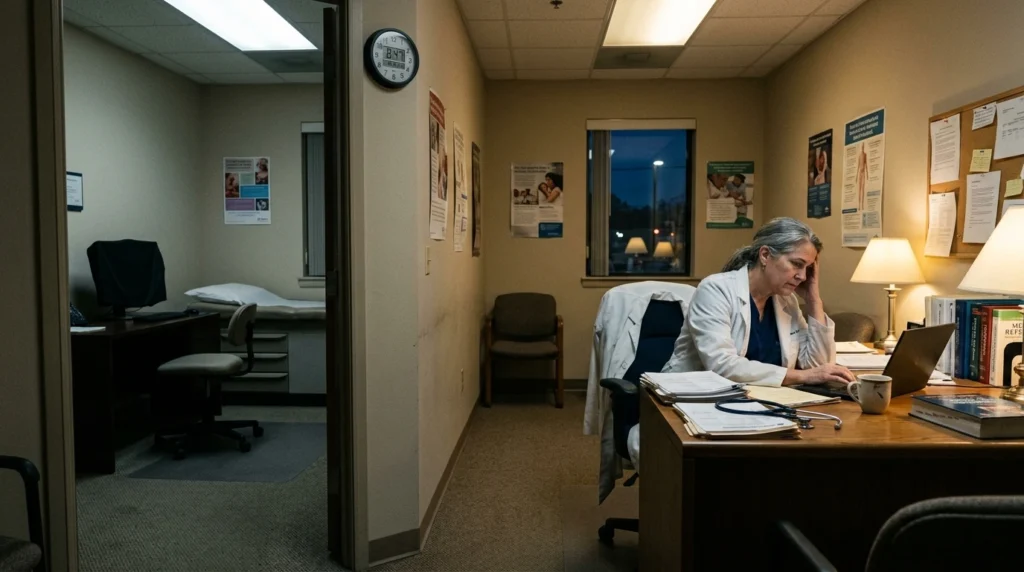
The studies above were conducted in large health systems with hundreds or thousands of clinicians. The question for a small clinic owner is whether the same mechanism applies at a smaller scale.
The answer from the data is yes, and in some respects the impact is larger in small clinics than in large systems.
In a large health system, documentation burden is partially absorbed by administrative infrastructure, team-based documentation support, and system-level EHR optimisation programmes. In a small or independent clinic, none of that infrastructure exists. The documentation burden falls entirely on the clinician. When a two-provider GP clinic has one clinician spending eight or more hours per week on after-hours charting, that burden is not distributed. It sits with one person, compounds without relief, and the burnout trajectory is faster.
The 20.9% of physicians spending more than eight hours weekly on after-hours EHR work is a national average that includes large systems with documentation support. In small independent practices, the figure is likely higher, not lower.
At the same time, the cost of losing a clinician to burnout is proportionally larger in a small clinic. A large health system that loses one of 500 physicians absorbs the impact across the organisation. A two-provider GP clinic that loses one clinician loses 50% of its clinical capacity.
The same intervention that saved 15,791 hours at TPMG and reduced burnout from 51.9% to 38.8% in the JAMA Network Open study operates at the individual clinician level. It does not require a large system to work.
The same documentation quality improvements that reduce burnout also address the undercoded notes problem that compounds revenue loss in GP clinics.
Why Wellness Programmes Have Not Fixed This
Many clinic owners have invested in physician wellness initiatives: reduced administrative tasks, schedule flexibility, wellbeing days, peer support programmes. These have value. They are not the reason after-hours charting has not improved.
After-hours charting has not improved because the interventions applied to it have not changed the structural problem. A wellness day does not change how many notes accumulate during a clinic day. Flexible scheduling does not change the ratio of EHR time to patient time. Peer support does not reduce the number of characters a physician types outside clinic hours.
The structural problem is this: documentation happens after the clinical encounter, not during it. Every intervention that does not change that structural fact will not move the after-hours charting figure. That is what the AMA data has shown consistently for four years.
The only intervention in the current evidence base that has moved after-hours charting at scale is ambient AI documentation, which generates the note during the encounter rather than after it. The JAMA Network Open study and the NEJM Catalyst TPMG analysis are the two largest and most current pieces of evidence on this specific intervention. Both show the same mechanism producing the same outcome: documentation that happens during the visit does not need to happen after it.
For a full explanation of how ambient documentation technology works at the point of the visit, what is ambient clinical documentation covers the mechanism in detail.
Without AI Documentation vs With AI Documentation: What Changes
Without AI documentation:
- Clinician sees 20 to 30 patients per day
- Each 30-minute visit generates 36.2 minutes of total EHR time
- Notes completed between patients, after the last appointment, or at home
- 20.9% of physicians spending more than 8 hours per week on after-hours EHR work
- After-hours charting associated with 2.8 times higher odds of burnout
- Burnout associated with 31.1% intent to leave within two years
- Turnover cost to clinic between $1.2 million and $2.8 million per departing clinician
- No change in this cycle despite four years of tracking and attention
With AI documentation:
- Clinician sees the same 20 to 30 patients per day
- AI captures the encounter in real time during the visit
- Structured note generated and reviewed at end of appointment, approved in under 5 minutes
- Notes completed within scheduled clinic hours on every clinic day
- After-hours documentation time reduced measurably from day one
- Burnout rate reduction of 13.1 percentage points after 30 days, per JAMA Network Open 2025
- Intent to leave rates lower in clinicians with adequate documentation time
- Turnover risk reduced at the point where the burnout cycle begins
The compounding outcome: For a small clinic where one clinician leaving triggers a replacement process costing $1.2 million or more, the cost of ambient AI documentation is not a technology expense. It is a retention investment. The return is measured against the cost it prevents, not the cost it incurs.
What This Means for Clinic Owners in 2026
The burnout trend is improving nationally but after-hours charting is not the reason. Burnout has declined from 53% in 2022 to 41.9% in 2025. That is a positive trend. But the after-hours charting figure, 20.9% of physicians spending more than eight hours weekly outside normal hours, has not moved since 2022. The two trends are not connected. Burnout is declining for structural reasons in large systems. Pajama time remains unchanged because the structural cause has not been addressed.
Intent to leave remains high and is directly linked to documentation burden. 31.1% of physicians reported intent to leave their current organisation within two years in the AMA 2025 report. Among those spending the highest amounts of time on after-hours EHR work, the correlation with intent to leave is consistent across survey data. Clinic owners who are not measuring their clinicians’ after-hours documentation time do not have visibility into their turnover risk.
The peer-reviewed evidence has now caught up to the problem. The 2025 JAMA Network Open study by Olson et al. and the TPMG NEJM Catalyst analysis are not pilot studies or early-stage signals. They are multi-site, controlled, peer-reviewed evidence from large clinical populations. The mechanism is understood, the outcome is measured, and the effect size is large enough to be clinically and operationally meaningful.
The smallest clinics have the most to gain and the least infrastructure absorbing the risk. A large health system losing one clinician to burnout from documentation burden absorbs the impact across the organisation. A two-provider clinic losing one clinician loses half its capacity. The intervention that prevents that outcome operates at the individual clinician level and does not require a health system to implement it.
MedLaunch Documentation Intelligence is built for GP and specialty clinics where documentation burden is not distributed across a system but carried by the clinicians in the room. Most clinics are fully live within two to four weeks. For clinics also concerned about how documentation quality affects prior authorization denials alongside retention, the analysis of how AI documentation reduces prior authorization denials in specialty clinics covers both outcomes. The documentation that previously extended the clinical day past scheduled hours is completed within it, from the first session after go-live.
The full workflow is on the AI Clinical Documentation Intelligence solution page.
Frequently Asked Questions
What is after-hours charting and why does it cause burnout?
After-hours charting is EHR documentation completed outside scheduled clinic hours, commonly called pajama time. It includes progress notes written after the last appointment, inbox management handled in the evenings, and records updated on weekends. Clinicians with poor or marginal time for documentation have a 2.8 times higher odds of burnout compared with those who have sufficient documentation time. The structural reason is simple: documentation accumulates during the clinical day and is completed after it, consistently extending the workday past scheduled hours.
What does the 2025 JAMA Network Open study say about after-hours charting and burnout?
A 2025 study published in JAMA Network Open by Olson et al., examining 263 clinicians across six US health systems, found that after 30 days of using ambient AI documentation, the proportion of clinicians experiencing burnout dropped from 51.9% to 38.8%. That represents a 74% lower odds of experiencing burnout. The reduction was directly associated with improvements in after-hours documentation time and cognitive task load. It is the largest single-intervention burnout improvement reported in peer-reviewed literature for a documentation-based intervention.
How much does physician turnover cost a small clinic?
Replacing a physician costs an average of $1.2 million including recruiting costs, start-up costs, and lost revenue during the vacancy and onboarding period, according to Weatherby Healthcare data. PracticeMatch studies put the figure between $1.8 million and $2.8 million depending on specialty. A new physician typically requires six months to two years to reach full productivity. For a small two-provider clinic, losing one clinician means losing approximately 50% of clinical capacity during that entire period.
Has physician burnout improved in 2026?
Yes, the trend is positive. AMA National Physician Comparison Report data drawn from nearly 19,000 responses shows burnout declined from 53% in 2022 to 41.9% in 2025. However, the after-hours charting figure that drives a significant share of burnout has not moved. 20.9% of physicians still spend more than eight hours weekly on EHR work outside normal hours, exactly the same figure as in 2022 and 2023. Burnout is improving for reasons partially unrelated to documentation burden, and pajama time remains an unresolved structural problem.
Why have wellness programmes not reduced after-hours charting?
After-hours charting has not improved because most wellness interventions do not change the structural cause. The structural cause is that documentation happens after the clinical encounter, not during it. Flexible scheduling, wellness days, and peer support programmes have value, but none of them changes the ratio of EHR time to patient time or the point in the clinical day when notes are written. The only intervention in the current evidence base that has moved after-hours charting at scale is ambient AI documentation, which generates the note during the encounter rather than after it.
What did The Permanente Medical Group find about AI documentation and after-hours charting?
A year-long analysis by The Permanente Medical Group, published in NEJM Catalyst and highlighted by the AMA, found that ambient AI documentation saved physicians an estimated 15,791 hours of documentation time across more than 2.5 million patient encounters over a 63-week evaluation period. That is the equivalent of 1,794 eight-hour workdays. The study also found statistically significant improvements in patient-physician interactions and physician satisfaction alongside the time savings.
Is after-hours charting a bigger problem for small clinics than for large health systems?
Yes, in terms of proportional impact. Large health systems absorb documentation burden through administrative infrastructure, team-based documentation support, and system-level EHR optimisation. Small and independent clinics do not have that infrastructure. The documentation burden falls entirely on the clinician. When a two-provider GP clinic has one clinician spending eight or more hours weekly on after-hours charting, that burden is not distributed. It compounds without relief, the burnout trajectory is faster, and the cost of losing that clinician is proportionally far larger than in a large system.
Conclusion
After-hours charting is not a productivity problem that better time management will fix. It is a structural problem that accumulates note by note, patient by patient, across every clinic day, and resolves only when the documentation stops happening after the encounter and starts happening during it.
The data on this is now unambiguous. A 30-minute patient visit generates more EHR time than clinical time. One in five physicians is spending more than eight hours weekly on documentation outside normal hours. That figure has not changed in four years. And the downstream consequences, burnout rates, intent to leave statistics, and replacement costs, are all measurable, all significant, and all connected to the same root cause.
The 2025 JAMA Network Open study and the TPMG NEJM Catalyst analysis are not early signals. They are peer-reviewed evidence from large clinical populations showing that ambient AI documentation reduces after-hours charting, reduces burnout rates, and does so from the first month of use. The mechanism is understood. The intervention is available. The return on investment, measured against the cost of the turnover it prevents, is not a close calculation.
For clinic owners, the question is not whether after-hours charting is driving turnover. The data has answered that. The question is whether the documentation structure in your clinic is going to change before the next clinician decides it will not.
Stop documentation from following your clinicians home.
If your team is charting at night, the clinical day isn’t ending. MedLaunch generates structured notes during the encounter so documentation stays at the clinic.