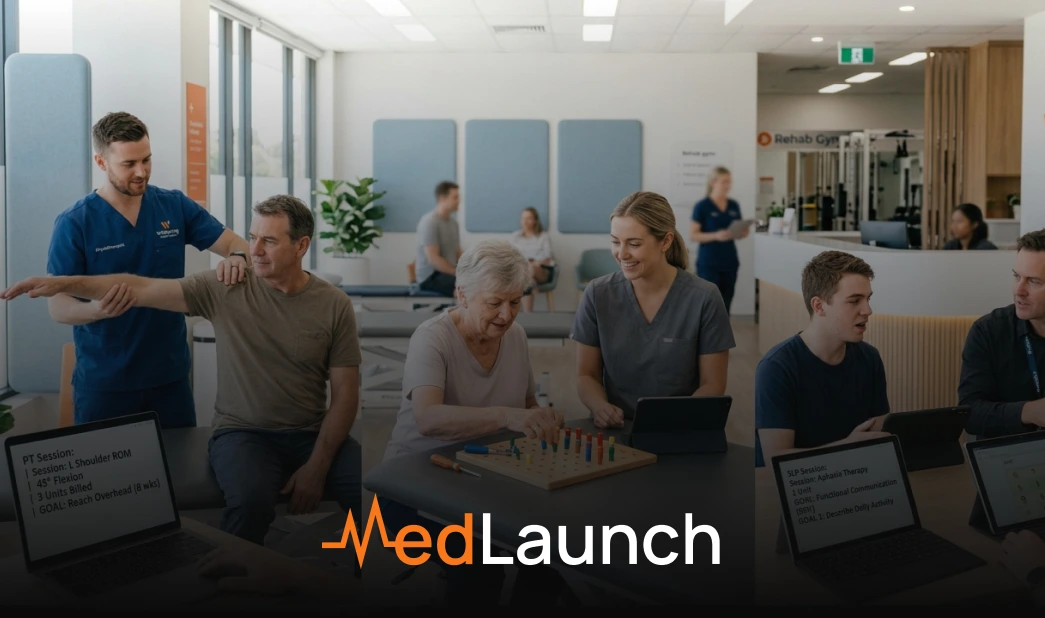

AI clinical documentation for allied health is the automated generation of specialty-specific clinical notes from the patient encounter in real time, structured to the note formats, timed unit billing requirements, functional goal frameworks, and CPT code sets that physiotherapy, occupational therapy, and speech-language pathology actually use. It is not the same tool as AI documentation for a GP clinic. It is not a generic note generator applied to a therapy setting. The documentation requirements, billing structures, and note formats that apply to allied health are fundamentally different from those that apply to medicine, and a documentation system that does not account for those differences does not serve an allied health clinic.
This blog explains exactly what makes allied health documentation different, how AI clinical documentation addresses each specialty’s specific requirements, and what to look for before adopting any tool in a physio, OT, or speech therapy practice.
Key Takeaways: AI Documentation for Allied Health
-
1Functional Goals over Medical Complexity: Allied health billing is built on timed units and measurable outcomes rather than E/M complexity. Using a system optimized for medical coding misses the specific structure Physio, OT, and Speech Therapy need to increase reimbursement and reduce denials.
-
2Managing the KX Modifier: With the 2026 threshold set at $2,480, every note beyond this limit must explicitly justify medical necessity. AI ensures the documentation remains compliant so that every session—even those exceeding Medicare thresholds—is successfully paid.
-
3Combating Clinician Attrition: Documentation burden is a primary driver of emotional exhaustion (reported by 58% of therapists) and professional attrition. Reducing this administrative load directly addresses the conditions that lead OTs and PTs to leave the profession.
-
4Significant Time Recovery: Ambient AI tools can reduce note completion time from 30 minutes per patient to under 5 minutes. This 50–75% reduction allows clinicians to finish their work within clinic hours rather than taking notes home.
-
5Discipline-Specific Templates: A generic SOAP note is insufficient for therapy billing. Allied health AI must be pre-configured for ROM measurements (Physio), occupational profiles (OT), and communication baselines (Speech) to ensure clinical accuracy and session-by-session progress tracking.
Table of Contents
What Makes Allied Health Documentation Different from GP Documentation?
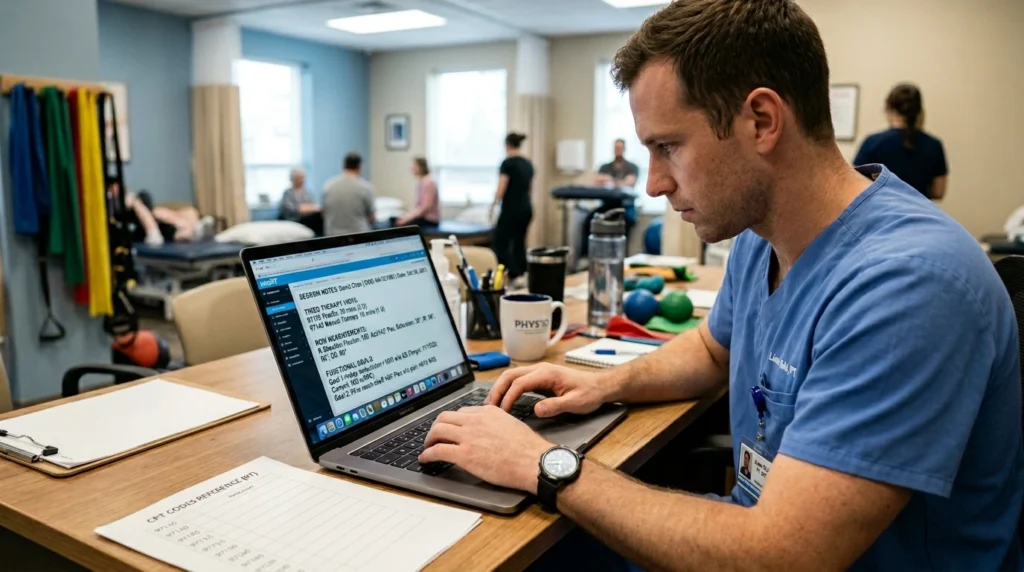
Allied health clinical documentation follows a fundamentally different structure from medical documentation. Understanding that difference is the foundation for understanding why AI documentation needs to be configured differently for a therapy clinic than for a GP practice.
In a GP clinic, the primary billing driver is the evaluation and management code, which is determined by the complexity of medical decision-making. The note needs to document the number of problems addressed, the data reviewed, and the risk level of the management decisions. The SOAP format maps to E/M levels through the MDM framework.
In an allied health clinic, the primary billing drivers are different across all three disciplines.
Physiotherapy bills primarily through timed service codes. The most commonly used PT CPT codes are 97110 (therapeutic exercise), 97112 (neuromuscular re-education), 97116 (gait training), 97140 (manual therapy), and 97530 (therapeutic activities). According to APTA data, therapeutic exercise (97110) accounts for approximately 42% of all physical therapy billing. Each code is billed in 15-minute increments using the 8-minute rule. The note must document the time spent on each timed service, the specific intervention delivered, the patient’s response, and progress toward functional goals. A note that does not document time accurately or does not link interventions to functional goals fails the medical necessity test for that claim.
Occupational therapy bills through a combination of evaluation codes (97165 for low complexity, 97166 for moderate complexity, 97167 for high complexity) and intervention codes. The 2026 CPT update includes 288 new codes, 84 deletions, and 46 revisions, some of which affect OT through interdisciplinary services. OT evaluation codes must be billed as a single unit even when services extend across multiple days. The note must document the occupational profile, relevant medical and therapy history, applicable assessments, performance deficit count, and complexity of clinical decision-making. CPT 97166 is the most commonly used OT evaluation code and, according to 2026 OT billing analysis, consistently the most commonly undercoded. Practices that habitually select 97165 for patients with three or four comorbidities affecting function are receiving lower reimbursement than the documentation actually supports.
Speech-language pathology bills through codes in the 92000 series, primarily 92507 (individual treatment for communication, voice, language, speech, or auditory processing disorders) and 92508 (group treatment). SLPs can also use physical therapy codes in the 97000 series with some exceptions. Notes must document baseline communication function, the specific therapeutic techniques applied, patient response, session progress toward treatment plan goals, and functional outcome measures. Swallowing and dysphagia documentation requires additional specificity including dietary modification levels, aspiration risk, and instrumental assessment findings where applicable.
The three disciplines share one billing requirement that medicine does not have at the same level: progress notes must demonstrate measurable, ongoing functional improvement at every session to justify continued skilled therapy. This is not a documentation preference. It is a medical necessity standard that payers apply systematically, and a note that fails it is a note that does not get paid.
For a detailed breakdown of how these two tools differ in their approach to note generation and coding accuracy, the comparison between an AI medical scribe and AI documentation intelligence covers the distinction in full.
What Is the Note Format for Each Allied Health Discipline?
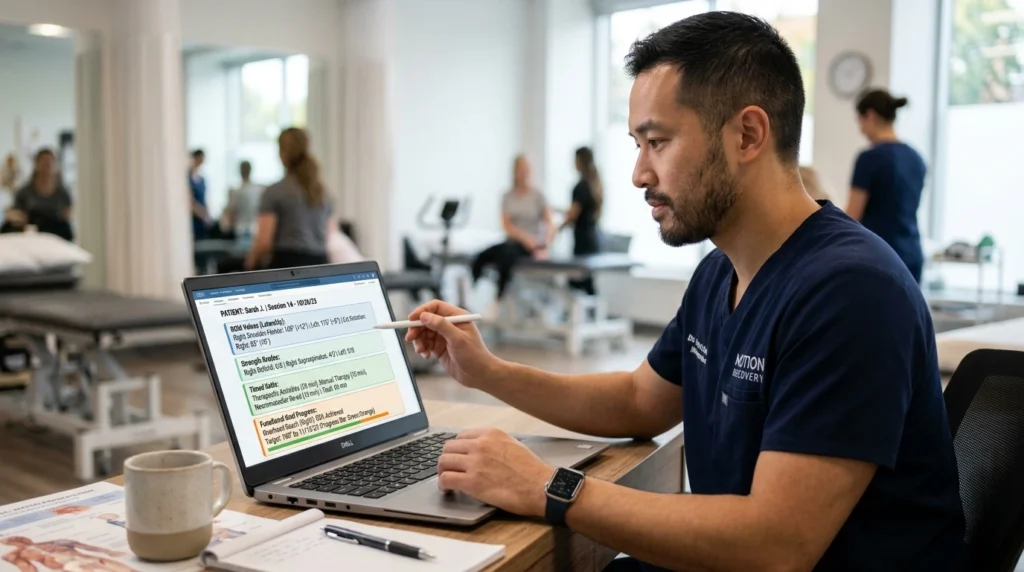
The note format used in allied health documentation is not uniform across the three disciplines and is not the same as the SOAP format used in medicine.
Physiotherapy: SOAP with functional emphasis
The physiotherapy SOAP note follows the Subjective, Objective, Assessment, Plan structure but with content requirements that differ substantially from medical SOAP notes.
The Objective section is the most critical and most billing-relevant section in a physio note. It must capture numerical measurements with laterality: range of motion in degrees, muscle strength on a 0 to 5 scale, pain scores, gait analysis observations, balance test results, and functional movement assessment findings. Generic descriptions like “patient demonstrated improved mobility” are not adequate for medical necessity or billing purposes. The note must say “right shoulder flexion improved from 85 to 110 degrees, abduction unchanged at 75 degrees, grip strength 3/5 right versus 4/5 left.”
The Assessment section must document objective progress toward each functional goal from the treatment plan, explain the clinical reasoning for any changes to the treatment approach, and address whether the patient is progressing, plateauing, or regressing. The Plan section must document the next session’s anticipated interventions, the frequency and duration of ongoing treatment, and any home exercise program updates.
Occupational therapy: SOAP with occupational profile and ADL focus
OT documentation centres on the occupational profile: a structured assessment of the patient’s roles, routines, environments, interests, and goals. Every OT evaluation note must include this profile because it is the framework payers use to evaluate whether the documented therapy goals are clinically appropriate.
The Assessment section in OT notes must document the specific ADL and IADL limitations being addressed, the performance deficits identified during the session, the patient’s functional status using standardised tools where applicable, and SMART goal progress. Short-term goals must be measurable and time-bound: “Patient will achieve 4/5 grip strength within four weeks” rather than “patient will improve hand function.” Long-term goals must connect therapy outcomes to functional independence: “Patient will achieve independence in dressing and meal preparation within six months.”
Speech-language pathology: SOAP with communication function baseline
SLP notes must establish and track a communication function baseline across every session. The Objective section requires documentation of specific assessment scores, error rates, cueing levels required, and response accuracy for each targeted communication goal. A note that says “patient worked on word retrieval” does not satisfy medical necessity requirements. A note that says “patient achieved 68% accuracy on confrontational naming with minimal phonemic cueing, improved from 52% accuracy at last session” does.
Swallowing and dysphagia notes have additional requirements: dietary consistency levels per IDDSI framework, aspiration risk documentation, and any instrumental assessment findings must be referenced. SLP notes for voice disorders must document acoustic measurements, vocal quality descriptors, and patient-reported functional impact.
How Does AI Clinical Documentation Address These Requirements for Each Discipline?
The mechanism of AI clinical documentation for allied health is the same as for medicine: ambient listening during the session, real-time note generation, clinician review and approval before the note is finalised. What changes entirely is the output.
For physiotherapy:
The AI system listens during the session and captures the measurements the clinician takes and reports verbally. ROM readings, strength grades, pain scores, balance test results, and timed unit counts are captured in the Objective section with the laterality and numerical specificity that physio billing requires. The system does not generate a note that says “patient demonstrated improved range of motion.” It generates a note that says “right shoulder flexion 110 degrees, improved from 85 degrees at previous session, abduction 75 degrees unchanged.” That is the difference between a note that passes medical necessity review and one that does not.
Timed unit calculations for codes like 97110 and 97140 are structured into the note based on the session time captured. The 8-minute rule is applied automatically. The note documents the time allocated to each timed service, satisfying the billing requirement without requiring manual time tracking by the clinician between patients.
The ambient listening technology that powers this process is explained in full in what is ambient clinical documentation.
For occupational therapy:
The AI system captures the occupational profile information discussed during the evaluation and structures it into the required format. Performance deficit counts, ADL assessment findings, and SMART goal progress are captured from what the clinician says and documents during the session, not reconstructed after the fact from memory.
The system flags whether the number of performance deficits documented supports the evaluation complexity level being coded. If a patient presents with four or five performance deficits but the note only mentions two, the system surfaces that gap at approval. For OT evaluation codes where 97166 is consistently the most undercoded, that gap-flagging directly prevents the reimbursement loss that comes from habitually selecting 97165 for patients whose documented complexity warrants 97167.
For speech-language pathology:
The AI system captures baseline communication function data, session-by-session accuracy scores, cueing levels, and response rates from what the clinician documents and discusses during the session. The note reflects the numerical specificity that SLP billing requires: percentages, accuracy rates, cueing levels, and standardised assessment score changes session by session.
For dysphagia notes, the system captures IDDSI dietary level references, aspiration risk assessments, and the clinician’s reasoning for any dietary modification decisions. The note documents what the clinician observed, what they assessed, and what they decided, in the format payers require to evaluate medical necessity.
The Note These Three Disciplines Need vs the Note a GP System Generates
The most useful way to understand why allied health documentation requires a separately configured system is to see what a generic GP-trained AI documentation tool produces versus what a specialty-configured allied health system produces for the same physiotherapy session.
Generic GP-trained AI output for a physio session:
“Patient presents for follow-up. Shoulder pain improving. Range of motion better than last visit. Exercises performed. Plan to continue current treatment program. Review next week.”
This note fails on every billing requirement. No ROM measurements. No timed unit documentation. No laterality. No progress toward functional goals. No medical necessity justification. A claim submitted with this note will be denied or paid at the lowest supported level.
Specialty-configured allied health AI output for the same session:
“Patient attending session 6 of 12 for right rotator cuff tendinopathy. Subjective: Patient reports pain 3/10 at rest, 6/10 with overhead activity, improved from 4/10 and 8/10 at session 5. Objective: Right shoulder AROM: Flexion 115 degrees (previous 95 degrees), Abduction 100 degrees (previous 80 degrees), External rotation 45 degrees (previous 35 degrees). Strength: Right shoulder abductors 3+/5, External rotators 3/5. Special tests: Empty can negative. Assessment: Patient progressing toward functional goals. Short-term goal (return to overhead activity without pain limitation) on track for achievement within 3 sessions. Long-term goal (return to recreational swimming) on track for 10-week target. Plan: 97110 therapeutic exercise 30 minutes, 97140 manual therapy 15 minutes. Home exercise program progressed to include resistance band IR/ER. Total timed units: 3. Review session 7 in 5 days.”
This note satisfies every billing requirement. ROM measurements with laterality. Timed unit documentation. Session-by-session goal progress. Medical necessity explicit in every section. These two notes describe the same 45-minute physiotherapy session. One of them will be paid accurately. One will not.
What Is the KX Modifier and Why Does Documentation Drive It?
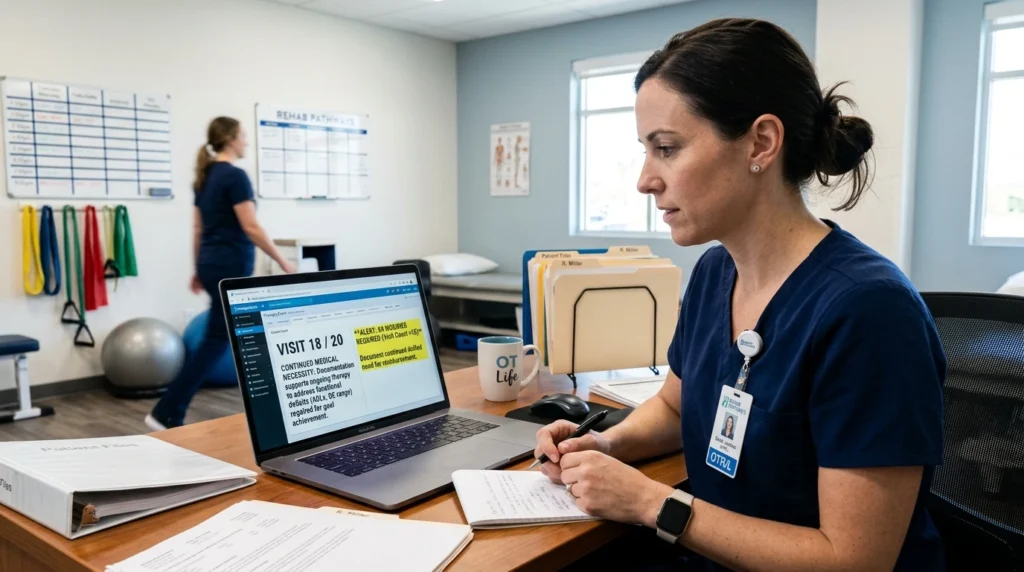
The KX modifier is required in 2026 when a patient’s Medicare therapy services exceed the annual therapy threshold. For 2026, the threshold is $2,480 for PT and SLP services combined and $2,480 separately for OT, both increased by $70 from 2025 and indexed annually to the Medicare Economic Index.
When a patient exceeds the threshold, every subsequent claim must have the KX modifier appended to confirm that services remain medically necessary. The documentation in every note from that point forward must explicitly justify why continued skilled therapy is required and what functional progress the therapy is producing.
A note that does not document measurable functional progress, does not explain why continued skilled intervention is required rather than a home program, or does not connect the session to the patient’s treatment plan goals will not support the KX modifier. The claim will be rejected, flagged for audit, or both.
AI documentation configured for allied health tracks session count relative to treatment plan duration, flags when the patient is approaching or has exceeded the KX threshold, and ensures every note from that point explicitly documents the medical necessity language the modifier requires. This is a documentation workflow that a generic AI scribe or a GP-configured documentation tool does not have and cannot provide.
Without AI Documentation vs With AI Documentation in an Allied Health Clinic
Without AI documentation:
- Clinician delivers a 45-minute physio session
- Documents between patients or after clinic hours
- ROM measurements recalled from memory rather than captured at time of assessment
- Timed unit calculations done manually, sometimes inaccurate
- Functional goal progress documented generically rather than with session-specific measurements
- Note does not explicitly support the CPT codes billed
- Claim denied or downgraded on medical necessity review
- KX modifier documentation inconsistent, triggering audit exposure
- Clinician spending 15 to 30 minutes per patient on documentation after clinic hours
With AI clinical documentation configured for allied health:
- Clinician delivers the same 45-minute physio session
- AI captures measurements verbally stated during the session in real time
- ROM values, strength grades, timed unit counts, and goal progress captured with numerical specificity
- Note generated and reviewed at session end, approved in under 5 minutes
- CPT codes supported by explicit documentation in every section
- KX modifier documentation included automatically from threshold onwards
- Claim submitted with documentation that satisfies medical necessity requirements on first submission
- Documentation completed within clinic hours on every session day
The compounding outcome: An allied health clinic converting from post-session manual documentation to AI-generated specialty-configured notes recovers both revenue (through accurate timed unit billing and correct evaluation complexity coding) and clinician time (15 to 30 minutes per patient per session that previously extended beyond clinic hours). For a physio practice seeing 30 patients per day, that time recovery is 7.5 to 15 hours per day returned to clinical capacity or personal time.
What to Look for in AI Documentation for an Allied Health Clinic
Not all AI documentation tools support allied health note formats or billing requirements. Most tools are configured for medicine and applied generically to therapy settings. Before adopting any AI documentation system in a physio, OT, or speech therapy clinic, these are the specific capabilities worth verifying.
Specialty-specific note template configuration before go-live. The system must be configurable to SOAP, DAP, or the note format the clinic uses before the first note is generated. A system that defaults to a generic medical SOAP note and asks the clinician to adjust it afterwards has not solved the documentation problem. It has shifted it.
Timed unit capture and 8-minute rule application. For physiotherapy billing, the system must capture the time spent on each timed CPT code and apply the 8-minute rule accurately. A system that generates narrative notes without structured timed unit documentation does not support physio billing.
Numerical measurement capture with laterality. ROM values, strength grades, pain scores, and functional test results must be captured as numbers with laterality specified, not as descriptive phrases. “Improved range of motion” is not a billing-supportable measurement. “Right shoulder flexion 115 degrees, improved from 95 degrees” is.
Functional goal tracking session by session. The system must carry forward the patient’s treatment plan goals and document progress toward each goal in every session note. A system that generates standalone notes without reference to the treatment plan does not support the medical necessity requirements of allied health billing.
KX modifier documentation awareness. The system should flag when a patient is approaching the therapy threshold and ensure every note from that point documents the continued medical necessity language the KX modifier requires.
HIPAA-compliant ambient audio capture. Therapy sessions often involve sensitive personal information about function, independence, and quality of life. The ambient audio capture must operate within a HIPAA-compliant framework covering how audio is stored, processed, and deleted. Any AI documentation tool used in an allied health clinic must provide clear documentation of its HIPAA compliance architecture.
MedLaunch Documentation Intelligence is configured to allied health clinic workflows, including physiotherapy, occupational therapy, and speech-language pathology, before go-live. Templates are built to your discipline’s specific note format and billing documentation requirements, configured by the MedLaunch team before the first note is generated. Integration with Epic and Athena Health is native. Most allied health clinics are fully live within two to four weeks.
The full workflow is on the AI Clinical Documentation Intelligence solution page.
What This Means for Allied Health Clinics in 2026
The 2026 therapy threshold increase creates more KX modifier documentation exposure. At $2,480 for PT and SLP combined and $2,480 for OT separately, more complex cases will cross the threshold earlier in the treatment episode than in previous years. Every note beyond the threshold requires explicit medical necessity documentation. Allied health clinics with inconsistent documentation practices will see higher audit exposure and higher claim rejection rates at the threshold point.
OT evaluation undercoding is a confirmed and quantified revenue loss. CPT 97166, the moderate complexity OT evaluation code, is the most consistently undercoded OT code according to 2026 OT billing analysis. In 2026, the reimbursement rate is identical across all three complexity levels at approximately $98.08 per evaluation. This means undercoding 97165 instead of 97166 or 97167 for a patient with three to five performance deficits produces zero clinical benefit and direct revenue loss. Documentation that accurately captures performance deficit count from the session supports the correct complexity level from the first evaluation.
Attrition in allied health is at crisis levels and documentation burden is a driver. A 2024 scoping review published in PMC found that occupational therapists showed the highest intent to leave of any allied health profession, ranging from 10.7% to 74.1% across studies. Documentation burden is consistently cited as a contributing factor to emotional exhaustion in physio and OT workforces. Reducing documentation time and after-hours charting is not only an efficiency improvement. It is a retention investment.
AI documentation configured for allied health supports prior authorization documentation too. The same note completeness that reduces undercoding and supports KX modifier claims also reduces prior authorization denials for high-cost physio and OT interventions. Documented functional limitations, failed conservative treatment, and explicit medical necessity language serve both the billing and the prior auth submission simultaneously.
MedLaunch Documentation Intelligence is built for allied health clinics that need documentation configured to their specific discipline, not a medical tool applied generically to a therapy setting.
Frequently Asked Questions
What is AI clinical documentation for allied health?
AI clinical documentation for allied health is the automated generation of specialty-specific clinical notes from the patient encounter in real time, structured to the note formats, timed unit billing requirements, functional goal frameworks, and CPT code sets that physiotherapy, occupational therapy, and speech-language pathology use. It differs from AI documentation for GP or specialty medicine because the billing structure, note format, and medical necessity requirements of allied health are fundamentally different from those of medical E/M coding.
How does AI clinical documentation work for physiotherapy specifically?
In a physiotherapy setting, an AI documentation system listens during the session using ambient audio technology and captures the measurements the clinician takes and states verbally, including ROM values with laterality, strength grades, pain scores, and functional test results. It generates a structured SOAP note with the numerical specificity that physio billing requires, calculates timed units for CPT codes like 97110 and 97140 based on the session time captured, and documents progress toward the functional goals in the treatment plan. The clinician reviews and approves before the note is finalised.
How does AI documentation handle timed unit billing for physical therapy?
Timed unit billing in physical therapy uses the 8-minute rule: a clinician must spend at least 8 minutes on a timed service to bill one unit, with additional units billed in 15-minute increments. An AI documentation system configured for physiotherapy captures the time spent on each timed CPT code from the session and applies the 8-minute rule automatically, generating a note that documents the timed services in a format that supports accurate billing without manual calculation between patients.
What is the KX modifier and how does documentation affect it?
The KX modifier is required in 2026 when a patient’s Medicare therapy services exceed the annual threshold of $2,480 for PT and SLP combined and $2,480 for OT. Appending the KX modifier signals to Medicare that continued therapy remains medically necessary. Every note with the KX modifier must contain explicit documentation of ongoing medical necessity and measurable functional progress. A note that does not document this is a note that will not be paid. AI documentation configured for allied health tracks session counts relative to the therapy threshold and ensures every note from the KX trigger point documents the required medical necessity language.
Is AI clinical documentation different for occupational therapy than for physiotherapy?
Yes, significantly. OT documentation centres on the occupational profile, ADL and IADL assessment, performance deficit documentation, and SMART functional goal tracking. OT evaluation codes (97165, 97166, 97167) are determined by the number of performance deficits and the complexity of clinical decision-making, not by time. An AI documentation system for OT must capture the occupational profile information and performance deficit count from the evaluation, and flag when the documented complexity level supports a higher evaluation code than the one habitually selected. CPT 97166 is the most consistently undercoded OT evaluation code, and accurate documentation of performance deficits directly prevents that revenue loss.
What note format does AI documentation use for speech-language pathology?
Speech-language pathology notes require communication function baselines, session-by-session accuracy scores, cueing levels, and standardised assessment score changes in numerical form. An AI documentation system for SLP generates notes that capture the specific accuracy percentages, cueing levels, and response rates the clinician documents during the session, rather than generic descriptions of therapy activities. For swallowing and dysphagia documentation, the system captures IDDSI dietary level references, aspiration risk documentation, and the clinician’s clinical reasoning for dietary modification decisions.
Can one AI documentation system handle physio, OT, and speech therapy in the same clinic?
Yes, if the system is configured with separate specialty templates for each discipline before go-live. A single AI documentation platform configured with physiotherapy, OT, and SLP-specific templates can serve a multi-disciplinary allied health clinic, with each clinician using the template relevant to their discipline. The critical requirement is that configuration happens before the first note is generated, not as an adjustment after generic notes have been produced. Each discipline needs its own template covering note format, timed unit requirements, functional goal structure, and relevant CPT code documentation requirements.
Conclusion
AI clinical documentation works for allied health when it is built for allied health. Not when a medical documentation tool is applied to a therapy setting and adjusted after the fact.
The documentation requirements that physiotherapy, occupational therapy, and speech-language pathology operate under are not minor variations on a medical note. They are a different billing structure, a different note format, a different medical necessity standard, and a different coding system. Timed unit calculations, ROM measurements with laterality, occupational profiles, performance deficit counts, communication function baselines, KX modifier documentation, and session-by-session functional goal progress are not features a generic AI scribe captures. They are the core of every allied health note that gets paid.
The clinics that benefit most from AI clinical documentation are not the ones that adopt the first tool they find and configure it later. They are the ones that identify a system configured to their specific discipline before the first note is generated, verify that timed unit billing is handled correctly, confirm that functional goal tracking carries forward across sessions, and check that KX modifier documentation is built into the workflow from the threshold point onwards.
The revenue recovery comes from accurate timed unit billing, correct evaluation complexity coding, and prior authorization documentation that does not get denied. The time recovery comes from notes completed within clinic hours rather than carried home. Both are available from the same documentation change. Neither requires new patients, new services, or a change in how the clinician practices.
What it requires is documentation that reflects the session as it actually happened, structured to the note format and billing requirements the discipline actually uses.
Get documentation configured for your specific discipline.
Stop using generic medical templates. See how MedLaunch Documentation Intelligence is purpose-built for the functional goals and timed units of allied health clinics.