


AI PHQ-9 screening for primary care is the automated delivery, scoring, and routing of the Patient Health Questionnaire-9 during patient intake at a GP clinic, without requiring clinical staff time to administer, score, or manually enter results. The PHQ-9 is sent to the patient before the visit, completed on their device, scored automatically, and available to the GP as a structured clinical alert before the appointment begins. The GP walks into the consultation already knowing whether the patient has a PHQ-9 score that warrants clinical attention.
This blog explains why depression screening in primary care is failing at scale, what the operational barriers are for GP clinics specifically, how AI PHQ-9 screening addresses each barrier without adding clinical load, and what the evidence says about the outcomes when systematic screening replaces ad hoc screening in a primary care setting.
Key Takeaways: Universal PHQ-9 Screening in Primary Care
-
1The Prevalence-Detection Gap: Only 4% of primary care patients are currently screened for depression, despite universal screening recommendations for all adults. With a 10% prevalence of MDD in the general population, approximately 1 in 10 GP patients likely has MDD—making this a purely operational failure rather than a clinical one.
-
2The Risk of Unrecognized Depression: Primary care providers fail to recognize up to 46% of depressed patients. Studies show that only 23.1% of patients who screen positive (PHQ-9 ≥ 10) receive a diagnosis, simply because the screening never happened, even though the clinical evidence was present.
-
3Shifting to Digital Delivery: Moving from in-clinic paper to automated pre-visit digital completion dramatically increases screening rates without adding staff time. This decreases frontline workload and allows care conversations to start from scored data rather than unscored paper forms.
-
4Immediate Diagnostic Impact: Systematic PHQ-9 implementation can increase depression diagnosis rates immediately—rising from 1.7% to 2.9% in some health systems. This improvement is achieved by identifying existing patients without requiring longer appointments or new patient volume.
-
5GP vs. Mental Health Workflows: AI PHQ-9 for primary care is operationally different from mental health clinic workflows. GP systems must handle a general population where depression may not be the primary visit reason, requiring different delivery methods, threshold interpretations, and EHR integration strategies.
Table of Contents
Why Is Depression So Consistently Missed in Primary Care?
Depression is the leading cause of disability in persons aged 15 years and older, according to the USPSTF. Its 12-month prevalence in the general adult population is approximately 10%. In a GP clinic seeing 80 patients per day, statistically 8 of those patients have major depressive disorder. The USPSTF has recommended universal depression screening for all adults in primary care since 2016, with a 2023 updated recommendation extending the Grade B recommendation to all adults aged 19 and older, including pregnant and postpartum individuals.
Despite all of this, only 4% of primary care patients are screened for depression, according to research published in the Annals of Family Medicine. The miss rate is not explained by clinical incompetence. It is explained by operational reality.
A GP appointment runs 15 to 20 minutes. In that time the clinician must address the presenting complaint, review medication, manage chronic conditions, complete documentation, and handle any acute concerns that arise. Asking every patient a structured nine-question depression screening questionnaire, scoring it, entering the result, and responding clinically if the score is above threshold is an additional workflow layer that most GP appointments do not have capacity to absorb.
The result is that depression screening in most GP clinics is selective rather than systematic. Clinicians screen patients they suspect may be depressed. They do not screen patients who present for a different reason and happen to be depressed. That selective approach is exactly how the 46% miss rate occurs.
Why Primary Care Is Where Depression Screening Matters Most
Mental health clinics already have depression identification mechanisms built into their clinical pathways. Patients attending a mental health clinic are already in a care setting where their mental health is the explicit focus of the encounter.
General practice is different. It is the first point of contact for the majority of the population across the full range of health concerns. A patient with undiagnosed depression presenting to their GP for knee pain, diabetes management, or a repeat prescription is not presenting in a context where depression is expected to be addressed. That patient will leave with their knee managed, their diabetes reviewed, and their depression undetected.
This is the scale problem that no mental health clinic can solve. The patients who need depression to be identified are not disproportionately concentrated in mental health clinics. They are distributed across the entire primary care patient population, attending appointments for every other reason, with a condition that is clinically detectable with a nine-question validated instrument that takes less than two minutes to complete.
The USPSTF recommendation for universal screening exists because the evidence supports it. Screening in primary care settings improves the accurate identification of adults with depression. Programmes that combine screening with adequate follow-up systems improve clinical outcomes, reducing and remitting depression symptoms in adults across populations. Treatment initiated through screening-identified depression, whether antidepressants, psychotherapy, or both, decreases clinical morbidity. The evidence for screening is strong. The execution gap is operational.
What Does AI PHQ-9 Screening for Primary Care Actually Do?

AI PHQ-9 screening for primary care changes the operational workflow of depression screening in four specific ways that address the barriers GP clinics face.
Pre-visit delivery removes the appointment time constraint. The PHQ-9 is sent to the patient before the visit through a secure digital channel, typically via SMS or patient portal link, as part of the automated intake process. The patient completes the nine-question form at home, in the waiting room, or on arrival. It does not require clinical staff time to administer. It does not consume appointment time to complete. By the time the patient enters the consultation room, the form is already done.
Automated scoring removes the manual calculation step. PHQ-9 scoring requires adding nine item scores and applying a severity threshold. At a score of 10 or above, sensitivity for major depressive disorder is 88% and specificity is 88%, according to validated psychometric data. Manual scoring in a busy GP clinic is inconsistently completed. Automated scoring is instantaneous and error-free. The score is calculated the moment the patient submits the final item.
Real-time GP alert changes when the clinical response happens. In a paper-based workflow, the GP receives a completed PHQ-9 form, scores it during the appointment, and decides how to respond with the patient in the room and the appointment clock running. In an AI-powered workflow, the GP receives a structured clinical alert with the score, the severity interpretation, and the flagged items before the appointment begins. The clinical response decision is made before the patient enters the room, not during the appointment under time pressure.
EHR integration removes the manual entry step. Scores, severity classifications, and flagged item responses are written directly into the patient record through native EHR integration. There is no manual entry. The documentation is complete before the consultation begins. The GP has the clinical information. The record has the structured data. No staff time was consumed.
The Operational Difference Between Paper PHQ-9 and AI PHQ-9 in a GP Clinic
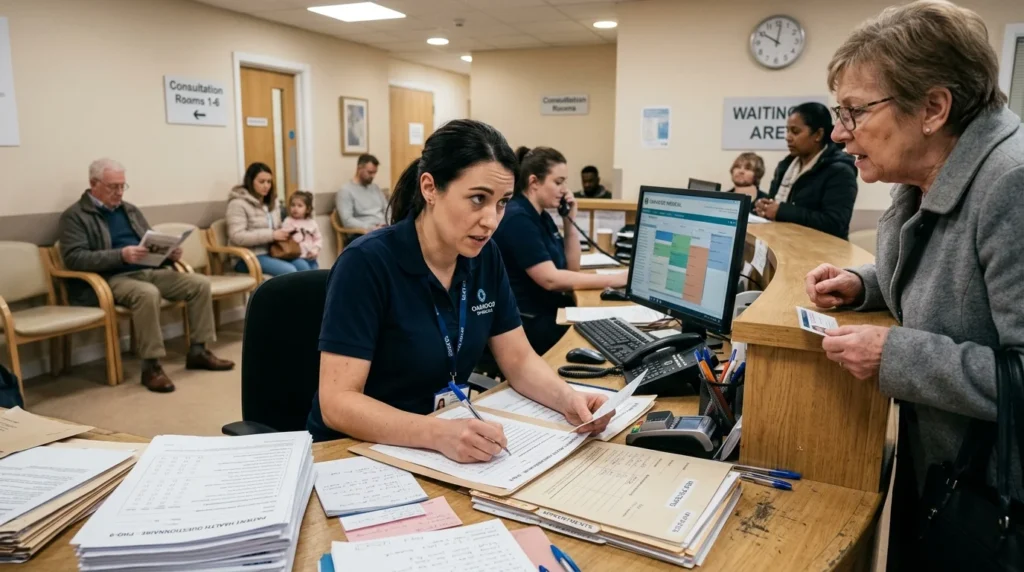
Understanding how much changes operationally when AI PHQ-9 screening replaces a paper or unstructured digital workflow in a primary care setting requires seeing both sides of the workflow in specific terms.
Paper PHQ-9 workflow in a GP clinic:
- Receptionist hands paper form to patient on arrival
- Patient completes form in waiting room, sometimes incompletely
- Form returned to receptionist or clinical staff
- Staff member manually scores the form during or between appointments
- Score manually entered into EHR or filed in paper record
- GP reviews score during appointment if time permits
- Clinical response discussed with patient during same appointment with no preparation time
- Process dependent on staff availability, patient compliance, and appointment capacity
AI PHQ-9 screening workflow in a GP clinic:
- System automatically sends PHQ-9 to patient 24 to 48 hours before appointment
- Patient completes form on their own device before arrival
- Score calculated automatically on submission
- Structured alert with score, severity, and flagged items available in EHR before appointment
- GP reviews alert as part of pre-appointment preparation alongside other clinical notes
- Clinical response prepared before the patient enters the room
- Documentation complete in EHR from the moment the form was submitted
- Zero staff time consumed in the screening, scoring, or entry process
The compounding outcome: A GP clinic seeing 80 patients per day with a 10% PHQ-9 positivity rate is identifying approximately 8 patients with clinically significant depression scores on any given day. With a paper workflow, some of those 8 patients do not complete the form, some forms are not scored on the day, and the GP learns of a high score for the first time in the appointment itself. With AI PHQ-9 screening, all 8 patients have scored forms in the EHR before they arrive. The GP knows before the appointment begins.
What Happens When Systematic PHQ-9 Screening Replaces Ad Hoc Screening in Primary Care?
The evidence on what happens when systematic PHQ-9 screening is introduced into a primary care setting is clear and consistent.
A cohort study published in the Journal of General Internal Medicine examined the introduction of systematic PHQ screening across a large health system, replacing the previous approach where physicians could screen at their own discretion. After systematic screening was introduced, the depression diagnosis rate increased from 1.7% to 2.9% immediately. That 1.2 percentage point increase represents a 71% relative increase in depression identification from the same patient population, the same clinical staff, and the same appointment structures. The only change was that screening became systematic rather than selective.
A quality improvement study conducted across 33 clinic sites in Northern California, published in JMIR Mental Health, found that automated pre-visit PHQ-9 delivery dramatically increased completion rates compared to in-clinic synchronous administration. It also found that patients who completed the PHQ-9 before the visit were twice as likely to complete a Columbia Suicide Severity Rating Scale when Q9 was flagged, compared to patients who completed it in-clinic. Pre-visit completion, made possible by AI-powered automated delivery, produces better clinical safety outcomes on the highest-risk items in the screening tool.
The study of 2,321 patients at urban primary care settings found that only 23.1% of patients who screened PHQ-9 positive received a diagnosis from their physician. That figure represents the current state of selective, unstructured screening in primary care. Systematic AI-powered screening does not guarantee that every positive screen results in a diagnosis. But it guarantees that every GP knows about every positive screen before the appointment, which is the prerequisite for any clinical response at all.
How AI PHQ-9 Screening in Primary Care Differs from Mental Health Clinic Screening
The existing AI PHQ-9 screening tools on the market, and the existing blogs about them including on this site, are almost entirely framed around mental health clinic workflows. The operational requirements in a GP primary care setting are different in five specific ways.
Patient population is general, not pre-selected. In a mental health clinic, every patient has a pre-existing reason to expect mental health screening. In a GP clinic, patients are attending for every possible reason. The PHQ-9 delivery and completion workflow must be embedded in the standard intake process for all patients, not triggered by a mental health referral or presenting complaint.
GP response capacity is different from mental health clinician response capacity. A mental health clinician receiving a PHQ-9 score of 15 has an established clinical pathway, specialist knowledge, and appointment time allocated to the mental health assessment. A GP receiving the same score in the context of a 15-minute appointment for hypertension management has a different decision environment. The clinical alert system needs to route moderate and severe scores to a response pathway that is appropriate to GP capacity, whether that is a same-day extended appointment, a nurse navigator call, or a referral trigger.
Longitudinal tracking requirements are different. In a mental health clinic, PHQ-9 scores are tracked at every session as part of measurement-based care. In a GP clinic, the USPSTF recommends annual screening for patients who screen negative, with more frequent screening for patients with risk factors. The screening cadence is different and the longitudinal tracking requirement reflects population-level management rather than individual treatment monitoring.
MIPS quality measure compliance adds a billing dimension. 2024 MIPS Quality Measure 134 specifically covers preventive care and screening for depression with a follow-up plan in primary care settings. GP clinics that systematically deliver and document PHQ-9 screening with a follow-up plan can use that documentation to support MIPS performance. A GP clinic using AI PHQ-9 screening with full EHR documentation is generating structured quality measure data on every screened patient, which is not available from a paper-based or unsystematic screening approach.
Integration with chronic disease management is a primary care specific requirement. Depression is significantly more prevalent in patients with chronic conditions including cardiovascular disease, diabetes, and cancer. A GP clinic’s PHQ-9 screening workflow should integrate with chronic disease registries so that patients with co-morbid conditions are automatically flagged for more frequent screening. This is a population management function that is specific to primary care and does not exist in the same form in a mental health clinic workflow.
For a full explanation of how PHQ-9 longitudinal tracking works in a measurement-based care context for mental health clinics specifically, PHQ-9 longitudinal tracking and treatment outcomes covers that workflow in detail.
What GP Clinics Catch Earlier With AI PHQ-9 Screening

The clinical benefit of earlier depression identification in primary care is not abstract. It translates to specific outcomes across specific patient groups.
Patients presenting for chronic disease management. Depression is two to three times more prevalent in patients with diabetes, cardiovascular disease, and chronic pain than in the general population. These patients attend GP clinics regularly for condition management. Without systematic screening, their depression is attributed to their physical condition or missed entirely. AI PHQ-9 screening delivered at every chronic disease management visit identifies comorbid depression in the patients most likely to have it.
Patients presenting for non-mental health complaints. A patient presenting for a musculoskeletal complaint, a repeat prescription, or a cervical screening appointment has no reason to raise their mental health symptoms unprompted. A GP managing a busy appointment has no clinical trigger to ask. Systematic pre-visit PHQ-9 delivery captures the depression score from this patient before the appointment begins, giving the GP the information they need to address it, extend the appointment, or flag for follow-up regardless of the presenting complaint.
Patients who would not self-refer to mental health services. The treatment gap for depression is largest in populations where self-referral to mental health services is least likely. Primary care is the only point of contact for many patients who experience depression but would not independently seek mental health support. Systematic PHQ-9 screening in primary care identifies these patients at the point where they are already engaging with the healthcare system, before their condition deteriorates to a point where the clinical and personal cost is significantly higher.
What This Means for GP Clinics in 2026
The USPSTF universal screening recommendation is not optional guidance. The 2023 USPSTF Grade B recommendation for depression screening in all adults aged 19 and older, including pregnant and postpartum individuals, reflects the strongest evidence-based guidance available. MIPS Quality Measure 134 creates a direct quality reporting and reimbursement pathway for GP clinics that implement systematic screening with a documented follow-up plan. Clinics that implement AI PHQ-9 screening are simultaneously satisfying a clinical standard and generating quality measure documentation.
The detection gap is an operational problem with an operational solution. Only 4% of primary care patients are screened despite a 10% prevalence rate for major depressive disorder. That gap is not explained by clinical disagreement about the value of screening. It is explained by the operational burden of paper-based administration, manual scoring, and in-appointment delivery. AI PHQ-9 screening removes every operational barrier that prevents systematic screening, without adding clinical staff time or appointment length.
Pre-visit completion produces better safety outcomes on high-risk items. The JMIR Mental Health study found that patients completing PHQ-9 before the visit were twice as likely to complete a Columbia Suicide Severity Rating Scale when Q9 was flagged, compared to in-clinic completers. The clinical safety case for pre-visit digital PHQ-9 delivery extends beyond depression detection to suicidality screening. For GP clinics, that is a significant clinical risk management argument for systematic AI-powered pre-visit delivery.
Chronic disease patients in your panel are the highest-priority screening population. If implementing systematic PHQ-9 screening across an entire patient panel is a phased process, the evidence strongly supports starting with patients who have chronic disease co-morbidities. These patients have the highest prevalence of comorbid depression, attend most frequently, and represent the population where earlier identification has the clearest clinical and cost benefit.
MedLaunch AI PHQ-9 Screening delivers, scores, and routes PHQ-9 results automatically before the GP appointment, with zero manual staff involvement. Reports are delivered directly into your existing EHR and workflow. Setup including EHR integration and configuration to your clinic’s workflows is handled entirely by MedLaunch. Most clinics are fully live within days.
For GP clinics also implementing AI clinical documentation alongside PHQ-9 screening, the two tools share the same EHR integration infrastructure, as covered in the AI clinical documentation implementation timeline.
The full workflow is on the AI Powered PHQ-9 Screening solution page.
Frequently Asked Questions
What is AI PHQ-9 screening for primary care?
AI PHQ-9 screening for primary care is the automated delivery, scoring, and routing of the Patient Health Questionnaire-9 during patient intake at a GP clinic, without requiring clinical staff time to administer, score, or manually enter results. The PHQ-9 is sent to the patient before the visit, completed digitally, scored automatically on submission, and available to the GP as a structured clinical alert before the appointment begins. It is operationally different from mental health clinic PHQ-9 workflows because it operates on a general patient population rather than a pre-selected mental health patient group.
Why are so many depressed patients missed in primary care?
Primary care providers fail to recognise up to 46% of depressed patients they see, according to peer-reviewed research cited in 2024 MIPS quality measure documentation. The primary reason is operational rather than clinical. A GP appointment runs 15 to 20 minutes and must address the presenting complaint, chronic disease management, medication review, and documentation. Administering, scoring, and responding to a nine-question depression screening tool adds a workflow layer that most appointments do not have capacity for. Without systematic pre-visit delivery, screening is selective rather than universal and the majority of depressed patients are missed.
How does pre-visit digital PHQ-9 delivery improve screening rates in GP clinics?
Pre-visit digital PHQ-9 delivery removes the in-appointment time constraint entirely. The form is sent before the visit, completed by the patient on their own device, scored automatically, and available in the EHR before the appointment begins. A quality improvement study across 33 clinic sites in Northern California, published in JMIR Mental Health, found that automated pre-visit web-based PHQ-9 delivery dramatically increased completion rates compared to in-clinic synchronous administration and decreased workload on frontline clinical staff. Patients who completed the PHQ-9 before the visit were also twice as likely to complete a Columbia Suicide Severity Rating Scale when Q9 was flagged, producing better safety outcomes on the most critical items.
What happens when a GP clinic moves from selective to systematic PHQ-9 screening?
A cohort study published in the Journal of General Internal Medicine found that introducing systematic PHQ-9 screening across a large health system increased the depression diagnosis rate from 1.7% to 2.9% immediately, a 71% relative increase. That improvement came from the same patient population and the same clinical staff. The only change was that every patient was screened rather than only patients the GP suspected might be depressed. Systematic screening identifies the patients who would otherwise leave the clinic without a diagnosis because no one asked.
Is AI PHQ-9 screening different for a GP clinic than for a mental health clinic?
Yes, in five specific ways. The patient population is general rather than pre-selected for mental health concerns. The GP clinical response capacity is different from a mental health clinician’s. The longitudinal tracking cadence follows USPSTF annual screening intervals rather than session-by-session measurement-based care. MIPS Quality Measure 134 creates a billing and quality reporting dimension specific to primary care that does not apply to mental health clinics. And integration with chronic disease registries for high-frequency screening of co-morbid populations is a primary care specific workflow requirement.
Does AI PHQ-9 screening in primary care support MIPS quality measure compliance?
Yes. MIPS Quality Measure 134 covers preventive care and screening for depression with a follow-up plan in primary care settings. A GP clinic using AI PHQ-9 screening with full EHR documentation generates a consistent, structured record of every screening and follow-up plan, creating the documentation trail that supports MIPS performance reporting. The documentation of the screening and the follow-up plan is created at the point of the screening workflow, not reconstructed from clinical notes after the fact. This makes systematic AI PHQ-9 screening a direct contributor to MIPS performance for GP clinics.
Which patients in a GP clinic are the highest priority for PHQ-9 screening?
While USPSTF recommends universal screening for all adults aged 19 and older, the highest-priority population for GP clinics implementing systematic screening is patients with chronic disease co-morbidities. Depression is two to three times more prevalent in patients with diabetes, cardiovascular disease, and chronic pain than in the general population. These patients attend GP clinics most frequently, have the highest clinical risk from undetected depression, and represent the group where earlier identification has the clearest evidence base for improved outcomes.
Conclusion
The depression screening gap in primary care is not a knowledge problem. GPs know what the PHQ-9 is. The USPSTF recommendation for universal screening has been in place since 2016 and strengthened in 2023. The clinical case for early identification and treatment is well established. The gap is operational.
Only 4% of primary care patients are screened despite a 10% prevalence rate for major depressive disorder. The majority of depressed patients attending GP clinics leave without a diagnosis. They leave not because their GP could not have identified them, but because the workflow did not create the conditions for systematic screening to happen.
AI PHQ-9 screening for primary care removes the workflow barriers one by one. Pre-visit delivery removes the appointment time constraint. Automated scoring removes the manual calculation step. Real-time EHR alerts remove the preparation deficit. Native integration removes the manual entry burden. What is left is a GP who walks into every appointment already knowing which patients need a conversation about depression, before the presenting complaint has even been addressed.
The patients being missed are not theoretical. They are in the waiting room right now, attending for another reason, carrying a condition that a nine-question validated instrument would have identified before the appointment began.
Your patients with depression are attending your clinic for other reasons.
MedLaunch delivers, scores, and routes results before the appointment with zero staff overhead, delivering structured PHQ-9 reports directly into your existing clinical workflow.