
Key Takeaways: Prior Authorization Denied? The Problem Usually Starts in Your Clinical Notes
-
1Rising Denial Rates: Initial claim denial rates hit 11.8% in 2024. Under the CMS-0057-F rule effective January 2026, documentation gaps are now explicitly named in standardized denial reasons, leaving no room for hidden errors.
-
2Algorithmic Reviewers: Payers now use Natural Language Processing (NLP) to scan notes against rigid medical necessity criteria. If clinical markers are missing, claims are denied automatically before a human ever sees them.
-
3The EBITDA Impact: 65% of denied claims are never resubmitted. For a practice collecting $5M annually, a 10% denial rate with this write-off frequency becomes a massive bottom-line revenue loss, not just a billing annoyance.
-
4Five Preventable Gaps: Most denials stem from missing functional impact statements, absent conservative treatment history, vague medical necessity language, unsupported diagnosis codes, or missing treatment rationale.
-
5Proactive Intelligence: MedLaunch Documentation Intelligence flags these specific gaps at the point of care. By addressing missing clinical markers before the note is signed, you stop denials before they are even triggered.
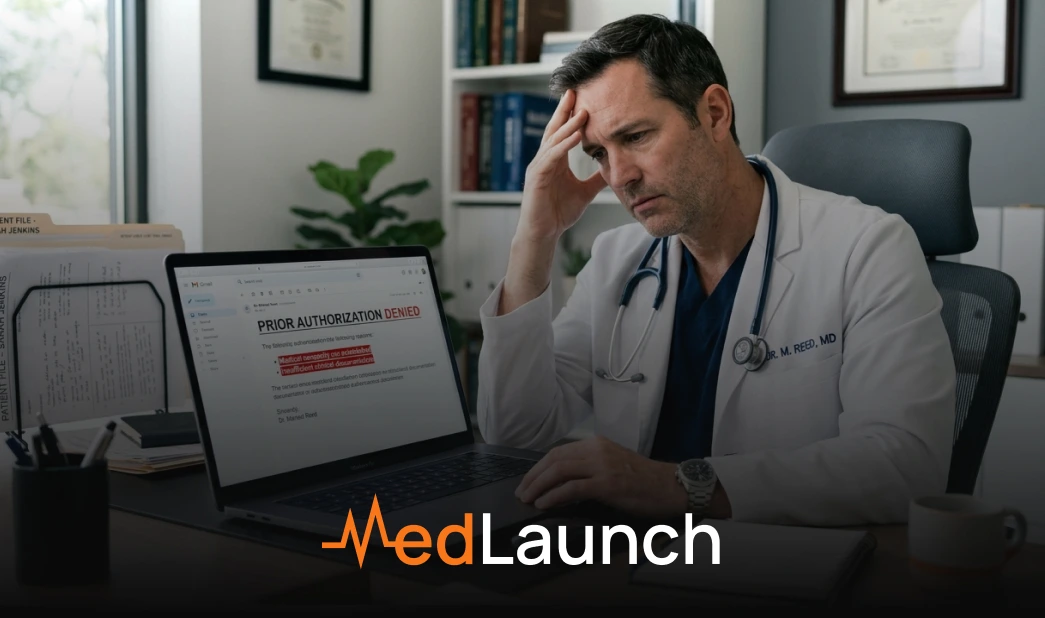
The denial letter arrives and the language is always the same. Medical necessity not established. Insufficient clinical documentation. Clinical criteria not met.
The clinician reading it knows the care was appropriate. The treatment was right for the patient. The diagnosis was accurate. The decision was clinically sound.
None of that is what the payer denied.
What the payer denied was the documentation. Specifically, the clinical note that was supposed to demonstrate the medical necessity, establish the functional impact, and provide the treatment rationale that the payer’s review criteria required. The note may have been clinically adequate. It was not documentationally adequate, and in 2026 that distinction is costing GP and specialty clinics revenue they are not recovering.
This guide explains exactly where the clinical note fails prior auth submissions, what the five most common documentation gaps are, and how AI documentation changes the point in the workflow where those gaps are caught and addressed.
Table of Contents
1. Why prior auth denial rates are rising in 2026
Prior authorisation has been a feature of clinical practice for decades. What has changed in 2026 is the scale, the speed, and the precision with which payers are identifying and acting on documentation deficiencies.
The numbers behind the trend
Initial claim denial rates climbed to 11.8% across US healthcare in 2024, up from approximately 10.2% just a few years prior. Medicare Advantage plans drove a 4.8% spike in denials from 2023 to 2024 alone, while commercial plan denials rose an additional 1.5% in the same period. The administrative cost per denied claim has risen from $43.84 in 2022 to $57.23 in 2023 and continues climbing.
Medical necessity denials represent over 40% of inpatient rejection cases, and nearly 65% of those denials are never resubmitted, meaning the revenue is written off permanently.
What CMS-0057-F changed on January 1, 2026
The CMS Interoperability and Prior Authorization Final Rule CMS-0057-F, released January 17, 2024, with payer compliance deadlines effective January 1, 2026, mandates standardised electronic prior authorisation workflows and requires payers to provide a specific, standardised reason for every medical necessity denial.
This matters operationally in both directions. Payers must now name the exact reason for every denial, which creates a more structured appeals environment. But it also means that documentation gaps which previously resulted in vague rejections are now explicitly labelled. Every clinic receiving a denial in 2026 is receiving a precise statement of what was missing from the clinical note.
Payers are using automated systems, not human reviewers
Payers now deploy Natural Language Processing algorithms to scan clinical notes in real time, matching language against rigid internal medical necessity policies that can span thousands of pages. If your documentation does not hit specific clinical markers, the claim is denied automatically before a clinical reviewer ever sees it.
In 2026, documentation stops being clinical and starts being proof. Many denials are not about inappropriate care. They are about documentation that does not state the clinical truth with enough specificity to satisfy automated review. Payers are not denying the service. They are denying documentation quality.
2. What payers are actually evaluating when they review a prior auth request

Most clinic owners and clinicians think of prior authorisation as a clinical question. Is this treatment appropriate? Is this diagnosis correct? Is this referral necessary?
Payers are asking a documentation question. Does this clinical note, as written, satisfy the criteria in our internal medical necessity policy?
The distinction between clinically appropriate and documentationally sufficient
A treatment can be entirely appropriate clinically and still be denied if the note does not contain the specific language and evidence the payer’s review criteria require. Medical necessity cannot be assumed. It has to be proven, sentence by sentence.
Payer medical necessity policies specify exact requirements. Documented failed conservative therapy before escalation. Explicit functional impact on the patient’s daily activity. Specific diagnostic language aligned with ICD-10 codes. Treatment rationale that connects the presenting problem to the proposed intervention. If the note does not contain these elements in a form the NLP system recognises, the request fails regardless of the underlying clinical validity.
What the OIG found about Medicare Advantage denials
The OIG confirmed that 13% of Medicare Advantage prior authorisation denials that met Medicare coverage rules were denied anyway. When appealed with precise documentation, over 80% of these decisions were overturned.
The implication is direct. The care was appropriate. The note was not sufficient to prove it was appropriate. When documentation was added at the appeal stage that properly established the clinical necessity, 80% of those decisions reversed. The problem was never the care. It was the documentation of the care.
3. The five documentation gaps that cause most prior auth denials

These are the specific elements that payer review systems look for and that clinical notes most commonly fail to provide.
Gap 1 — Missing functional impact statement
The most common documentation gap across all specialties. Payers require evidence that the patient’s condition has a measurable functional impact on their daily life. Not just that they have the diagnosis. Not just that the diagnosis is accurate. That it is affecting their function in specific, documented ways.
A note that says “patient presents with chronic lower back pain” does not establish functional impact. A note that says “patient reports inability to sit for more than 20 minutes without pain, has ceased driving, and cannot complete a full working day” does. The clinical picture may be identical. The documentation quality is not.
Gap 2 — Absent conservative treatment history
Most payer medical necessity policies require documented evidence that conservative treatment options were attempted and failed before approving escalated intervention. Referrals, imaging, procedures, and specialist consultations are the services most frequently subject to this requirement.
If the conservative treatment history is not in the clinical note, the payer has no evidence to evaluate. The treatment may have been tried. The documentation may not reflect it. The result is the same: denial.
Gap 3 — Vague or non-specific medical necessity language
Generic phrases like “medically necessary” or “clinically indicated” do not satisfy payer NLP review systems. The systems are scanning for specific diagnostic language, matched clinical criteria, and evidence-based rationale, not assertions of necessity.
A diagnosis of chronic knee osteoarthritis does not guarantee approval for hyaluronic acid without documented failed conservative therapy. The diagnosis alone is not the case. The documented clinical pathway that establishes why this intervention is appropriate for this patient at this point in their treatment history is the case.
Gap 4 — ICD-10 code and note content mismatch
The diagnosis code submitted with the prior auth request must align precisely with the clinical language in the supporting note. If the code and the note describe the same condition in incompatible terms, or if the note narrative does not contain the diagnostic specificity the code implies, automated review flags the mismatch and denies the request.
A single PA submission and status check takes an average of 12 minutes and 7 seconds. Multiply that by the 41 PAs the average physician handles weekly and the revenue leak becomes visible very quickly. Every denial that results from a code-note mismatch is a preventable administrative failure, not a clinical one.
Gap 5 — Missing treatment rationale connecting diagnosis to plan
The Plan section of the clinical note must explicitly connect the presenting diagnosis to the proposed treatment. Why is this intervention the appropriate response to this diagnosis at this point? What is the clinical pathway that leads from the presenting problem to the proposed intervention?
In after-hours manual documentation, this rationale is often compressed or omitted entirely because the clinician is reconstructing the note from memory rather than from the actual clinical reasoning they expressed during the visit. The rationale was there in the consultation. It did not make it into the note.
4. Why fixing denials at the appeal stage is the wrong strategy
The instinct when a prior auth is denied is to appeal. And appeals do succeed. 82% of prior authorization appeals succeed when properly documented. But the appeal-first strategy has three significant structural problems.
Appeals consume clinical and administrative time that compounds across a practice
The AMA has documented that physicians spend roughly 15 hours a week per provider on prior authorisation paperwork. Appeals add to that burden. Every appeal requires the clinician to review the denial reason, locate supporting documentation, write or dictate a clinical justification, and follow the payer’s specific appeal process. For a GP seeing 20 to 25 patients per day, that time does not exist within clinic hours.
65% of denied claims are never appealed at all
Insurance companies know that only 11% of prior authorization denials are actually appealed, despite the 82% success rate. They are counting on you giving up. The economics of the system are built around the assumption that most denials will not be challenged. For every clinic that writes off a denied claim without appealing, the payer retains the revenue.
The correct intervention point is the clinical note, not the appeal
For a multi-specialty group collecting $5M annually, a 10% denial rate with a 65% write-off rate is not a billing problem. It is an EBITDA event.
The appeal corrects a denial after it happens. The correct strategic response is to prevent the denial by producing documentation that satisfies payer review criteria at the point of care. That requires either a clinician who is trained to document with payer criteria in mind at every visit, which is not realistic at scale, or a documentation system that flags the gaps before the note is signed and while the clinical information is still accessible.
5. How documentation quality connects to prior auth outcomes at the point of care
The connection between what is written in a clinical note during a consultation and what happens to a prior auth request submitted weeks later is direct and largely invisible until the denial letter arrives.
The note is written when the clinical information is live
During the patient consultation, the clinician has access to everything they need to write a prior-auth-ready note. The patient is present. The history is being taken in real time. The functional limitations are being described by the patient in their own words. The conservative treatment history is being reviewed. The clinical reasoning is live in the clinician’s mind.
By the time the note is written, in many cases hours later, that information has to be reconstructed. Functional details get approximated. Rationale gets compressed. Conservative treatment history that was discussed verbally may not be documented explicitly. The note that arrives at the payer is clinically accurate but documentationally incomplete.
The gap between clinical care and clinical documentation is where revenue is lost
The OIG finding that 13% of Medicare Advantage denials met coverage rules but were denied anyway is not evidence of payer bad faith in every case. In many cases it is evidence that the clinical note did not document the compliance with coverage rules in a form the review system could recognise.
The care met the criteria. The note did not demonstrate that it met the criteria. The denial was the system functioning as designed.
6. How MedLaunch Documentation Intelligence catches gaps before the note is signed

MedLaunch Documentation Intelligence is a standalone clinical documentation platform that integrates with Epic and Athena Health. It generates SOAP notes from the clinical consultation in real time. Before the clinician signs the note, it surfaces prior auth documentation gaps while they can still be addressed.
Gap detection at the point of approval
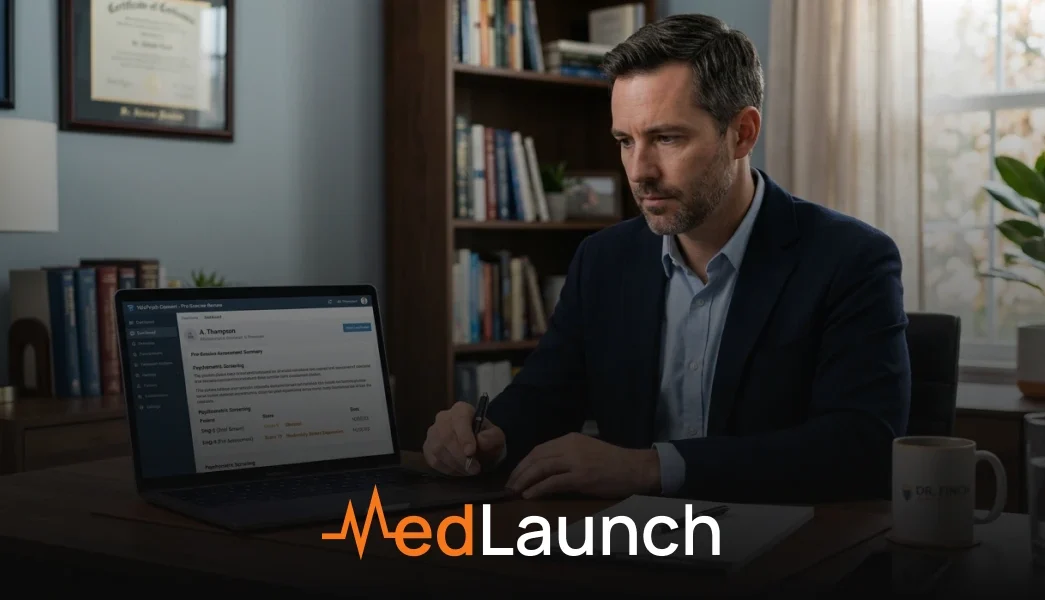
Before the clinician signs each note, Documentation Intelligence reviews the draft against the documentation requirements that commonly trigger prior auth denials for the clinic’s specific payer mix and specialty. Gaps are flagged specifically: missing functional impact language, absent conservative treatment history, vague medical necessity wording, code-note mismatches, missing treatment rationale.
The clinician sees what is missing. The information from the visit is still accessible. The gap is addressed before the note is finalised. The prior auth request, when submitted, is built on documentation that was designed to satisfy review criteria rather than documentation that will be evaluated against them after the fact.
Notes generated from the consultation, not from memory
Because Documentation Intelligence generates the note from the actual clinical conversation rather than from the clinician’s after-hours reconstruction, the functional impact language the patient used during the consultation makes it into the Subjective section of the note. The conservative treatment history discussed during the visit is captured. The treatment rationale the clinician expressed during the consultation is reflected in the Plan.
The documentation is more complete because it comes from the visit itself. The gaps that trigger denials are more likely to be caught because the information needed to fill them is present in the note draft rather than absent because the clinician forgot to include it at 10pm.
Direct integration with Epic and Athena Health
The note lands in the patient record in Epic or Athena Health through the EHR’s API integration. No clipboard transfer. No reformatting. The documentation Intelligence generates flows directly into the chart where the prior auth submission will be built.
For a full explanation of how the EHR integration works in practice, the Epic and Athena Health integration guide covers every step from ambient listening through note delivery.
Frequently Asked Questions
Why do most prior authorization requests get denied?
The most common reasons are incomplete documentation, medical necessity criteria not clearly established in the clinical note, missing conservative treatment history, and code-note mismatches where the diagnosis code and the clinical narrative describe the same condition in incompatible terms. Payers in 2026 use automated NLP systems to review prior auth submissions. If the clinical note does not contain specific language that satisfies the payer’s internal criteria, the request is denied automatically before a human reviewer sees it. The denial is typically not about the appropriateness of the care. It is about whether the note demonstrates that appropriateness in a form the review system can verify.
What does the 2026 CMS prior auth rule change mean for GP and specialty clinics?
Under CMS-0057-F effective January 2026, payers must provide a standardised specific reason for every prior authorisation denial. This is both an advantage and a signal. The advantage is that specific denial reasons enable more targeted appeals and allow clinics to identify patterns in their documentation gaps. The signal is that documentation deficiencies that previously resulted in vague rejections are now precisely named, making it harder to attribute denials to payer subjectivity rather than documentation quality.
Which documentation gaps most commonly trigger prior auth denials?
The five most common are: missing functional impact statements that establish how the condition affects the patient’s daily activity; absent conservative treatment history showing that lower-level interventions were attempted before escalation; vague or non-specific medical necessity language that does not satisfy payer NLP criteria; ICD-10 code and clinical note content mismatches; and missing treatment rationale that fails to connect the diagnosis explicitly to the proposed intervention.
Is it worth appealing a prior auth denial?
Yes. 82% of properly documented appeals succeed. The problem is that only 11% of denied claims are ever appealed, because the appeal process is time-consuming and the instinct is to write off the denial and move on. The more effective long-term strategy is to reduce the number of denials reaching the appeal stage by improving documentation quality at the point of care. Appeals are the right response to individual denials. Preventing them is the right response to systematic denial patterns.
How does AI documentation help prevent prior auth denials?
AI documentation systems that generate notes from the clinical conversation capture functional impact language, conservative treatment history, and clinical rationale from the actual consultation rather than from the clinician’s memory. Systems like MedLaunch Documentation Intelligence also surface documentation gaps before the note is signed, at the point of care where they can still be addressed. The result is notes that are more complete and more likely to satisfy payer review criteria on first submission.
What is the difference between a documentation gap and a clinical gap?
A clinical gap means the care delivered did not meet the standard required for the requested authorisation. A documentation gap means the care may have been entirely appropriate but the clinical note did not establish that appropriateness in terms the payer review system could verify. The OIG finding that 13% of Medicare Advantage prior auth denials met coverage rules but were denied anyway illustrates the distinction. The clinical case was sound. The documentation was insufficient to prove it. Most prior auth denials are documentation gaps, not clinical ones.
How does MedLaunch Documentation Intelligence flag prior auth gaps?
Before the clinician signs each note, Documentation Intelligence reviews the draft against the documentation requirements that commonly trigger prior auth denials for the clinic’s payer mix and specialty. Specific gaps are identified: missing functional impact language, absent conservative treatment history, vague medical necessity wording, code-note mismatches, and missing treatment rationale. The clinician sees each gap while the visit is still recent and the information needed to address it is accessible.
Does improving documentation quality actually reduce denial rates in practice?
Yes. Practices that implement pre-submission documentation quality review consistently report significant improvements in first-pass approval rates. One example from the research: practices running 22% PA denial rates dropped to under 8% within 90 days of implementing pre-submission scrubbing. The driver in every case is the same: catching documentation gaps before submission rather than addressing them through appeals after denial.
Conclusion
The denial letter is always the same language. Medical necessity not established. Insufficient documentation. Clinical criteria not met.
The care was appropriate. The diagnosis was accurate. The treatment decision was clinically sound.
What failed was the documentation. Specifically the five elements that payer review systems require and that clinical notes most commonly omit: functional impact, conservative treatment history, specific medical necessity language, code-note alignment, and explicit treatment rationale.
In 2026, with NLP systems automating denial decisions and CMS requiring payers to name exactly what was missing, the connection between documentation quality and prior auth outcomes has never been more direct or more clearly documented. The clinics absorbing the highest denial rates are not delivering worse care. They are producing documentation that was adequate for the clinical record but inadequate for the payer review system evaluating it.
MedLaunch Documentation Intelligence addresses this at the only point in the workflow where it can be addressed effectively: during the clinical day, before the note is signed, while the information from the visit is still present and the gap can still be filled.
Stop letting clinical notes trigger claim denials.
See how MedLaunch flags prior auth gaps and ensures clinical necessity is established before you sign the note.