

Key Takeaways: AI Documentation for Physical Therapists
-
1The 1:1 Charting Ratio: PTs spend nearly as much time charting as treating. With 9 to 18 patients per day, this leads to hours of after-hours documentation every single week.
-
2The Burnout Driver: 57% of PT clinicians cite excessive documentation as a leading cause of burnout. While PT burnout rates sit between 45-71%, documentation is the most fixable factor that follows therapists home.
-
3PT-Specific Intelligence: Unlike generic tools, PT-specific AI understands ROM measurements, MMT grades, functional goal tracking, gait analysis, and Plan of Care certification requirements.
-
4Measurable Time Recovery: AI documentation can cut charting time by 50% or more, saving teams upwards of 20 hours per week and improving revenue recovery through better coding accuracy.
-
5Integrated Workflow: MedLaunch Documentation Intelligence integrates with your EHR to deliver structured PT notes directly into the record before the next patient arrives, ending the clinical day on time.
Every physical therapist chose this profession to help patients move better. To restore function. To be present in the treatment room.
Not to spend the final hours of the day reconstructing session notes from memory, filling in ROM measurements that were measured eight patients ago, and documenting HEP instructions that were given verbally during a treatment that ended at 4:30pm.
Yet for most PT clinics in 2026, that evening documentation session is not optional. It is structural. The day is built around treating patients. The documentation gets done when the patients are gone.
AI documentation for physical therapy changes that structure directly. Notes are generated from the session itself. They are ready for review before the next patient arrives. The evening is free.
This guide explains how it works for PT clinics specifically, why PT documentation is different from general clinical documentation, and what the day actually looks like when AI documentation goes live in a physical therapy setting.
Table of Contents
1. The documentation burden in physical therapy in 2026
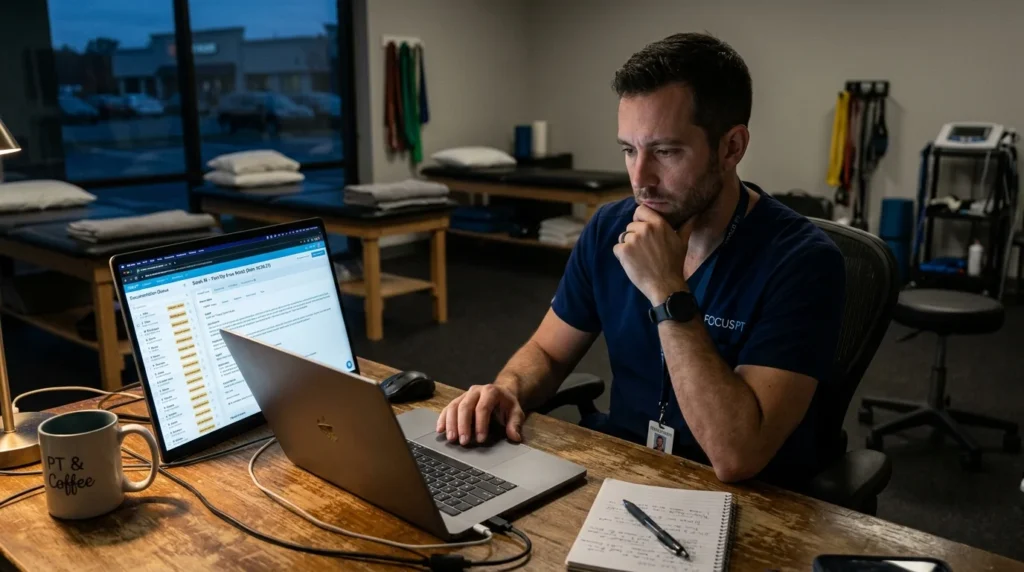
The documentation problem in physical therapy is not unique to the profession but it has specific characteristics that make it heavier and more disruptive than in many other clinical settings.
The time cost per session
Physical therapy is a high-volume, hands-on specialty. A typical outpatient PT sees 9 to 18 patients per day. Each session requires a structured clinical note. Research shows that for every hour spent treating patients, physical therapists spend nearly an equal amount of time on documentation and administrative tasks. That is not a rounding error. It means the clinical day is effectively twice as long as the schedule suggests.
Ambient scribe tools cut per-note time from 12 to 15 minutes to 6 to 7 minutes in reported outcomes. Across 6 daily sessions, that returns roughly 45 minutes to the clinical day. For many therapists, it is the difference between closing charts before dinner and staying up until 10 pm.
Documentation as a driver of PT burnout
Physical therapy burnout rates sit between 45% and 71%. Among the contributing factors, 57% of PT clinicians cite excessive documentation as a leading cause.
Many outpatient PTs face intense productivity pressure, treating up to 16 to 18 units per day while managing complex documentation requirements to satisfy multiple payers. This clerical load consumes time both during and after clinic hours, leaving little room for reflection or recovery.
The pattern is the same as in general practice: the care happens during the day, the documentation happens after it. The difference in physical therapy is that the documentation requirements are more technically specific, the payer scrutiny is higher, and the volume of sessions per day is often greater.
The workforce consequence
Documentation time is not billable in and of itself, although completing timely, accurate and thorough charting is directly correlated with higher reimbursement. Therapists are expected to devote personal time to completing this task when overtime is generally not offered and compensation is already limited.
When documentation regularly spills into personal time, it contributes to the decision calculus that leads experienced PTs to reduce their hours, leave clinical practice, or exit the profession entirely. The documentation burden is not just an efficiency problem for the clinic. It is a retention and workforce problem.
2. Why PT documentation is different from general clinical charting
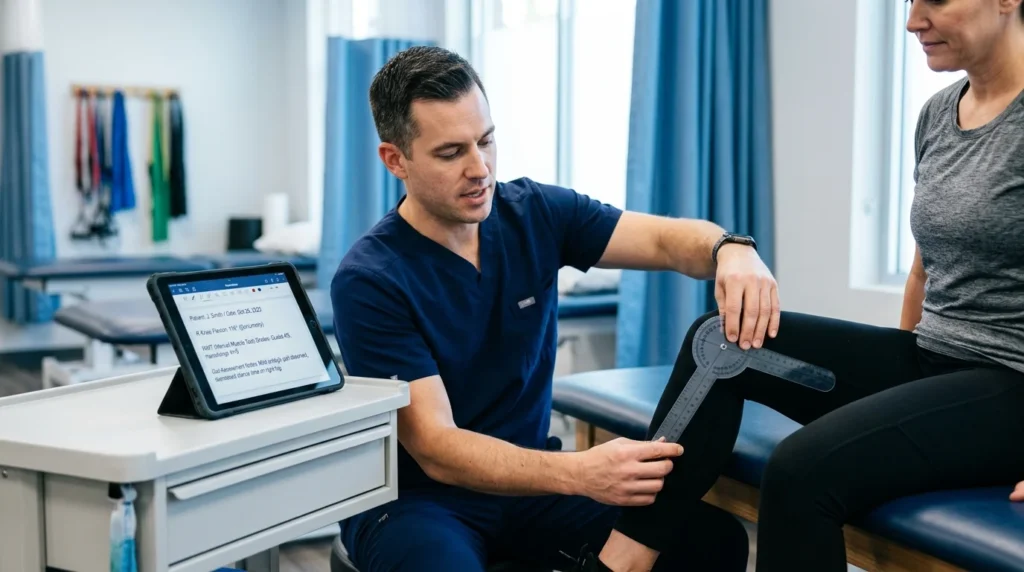
This is the part that most general AI documentation content gets wrong. Physical therapy documentation is not a simplified version of GP or specialist charting. It has distinct structural requirements that generic documentation tools do not understand.
PT-specific clinical measurements
A physical therapy note requires precise objective measurements that do not appear in most other clinical documentation formats. Range of motion measurements with degree values for specific joints and movement planes. Manual muscle testing grades for individual muscle groups. Gait analysis observations including cadence, stride length, symmetry, and compensatory patterns. Special test results with positive or negative findings and clinical significance. Functional mobility documentation covering transfers, ambulation distance, and assistance levels required.
These measurements are the evidentiary foundation of a PT note. Without them, the note does not support the level of skilled care delivered, does not justify the billing codes submitted, and does not satisfy payer review criteria for ongoing authorisation.
Plan of Care certification requirements
Plan of Care certification and re-certification requires a signed plan that includes diagnosis, long-term and short-term goals, treatment interventions, and frequency and duration. Re-certification is required every 90 days. AI documentation tools that can generate Plan of Care documents from clinical encounter data save significant administrative time.
The Plan of Care documentation cycle creates a recurring administrative obligation that does not exist in the same form in most other outpatient specialties. Missing or late POC certification directly affects reimbursement.
The KX modifier and Medicare compliance
The KX modifier is required when a patient’s therapy spending exceeds the Medicare threshold of $2,330 for PT and speech-language pathology combined in 2026. The KX modifier certifies that services are medically necessary, and the documentation must include clear evidence of functional progress and skilled care necessity. This is a common audit target. Insufficient documentation supporting the KX modifier can result in payment recoupment.
For PT clinics with a significant Medicare population, this requirement means that documentation quality is not just an efficiency issue. It is a compliance and audit liability.
Home exercise programme documentation
PT notes must document the specific home exercise programme assigned to the patient during the session, including exercise names, parameters, repetitions, sets, frequency, and any verbal instructions given. In after-hours documentation, HEP details are frequently compressed or omitted because the therapist is reconstructing from memory after multiple subsequent sessions. What was prescribed to patient eight is not always clearly remembered when the note is written at 9pm.
3. What AI documentation for physical therapy actually does
AI documentation for PT clinics works through the same ambient listening mechanism as in other clinical settings, but the output is structured specifically for physical therapy rather than for general clinical note formats.
Ambient capture during the session
The system listens passively during the therapy session. The PT conducts the treatment as they normally would. As the therapist performs and verbalises the assessment, measures ROM, calls out MMT grades, describes gait observations, and communicates the HEP to the patient, the AI captures each element from the natural clinical conversation.
This is why verbalisation during PT sessions is particularly valuable. Physical therapists already narrate much of what they observe during assessment and treatment. ROM measurements called out during goniometry. Manual resistance grades stated during MMT. Patient responses to functional tasks described during mobility assessment. The AI does not require a separate dictation step. It captures what is already being said.
PT-structured note generation
The AI does not generate a generic SOAP note. It generates a note structured for physical therapy, with the objective section containing the specific measurement data the session produced, the assessment section reflecting the clinical reasoning about functional progress, and the plan section capturing the treatment interventions, HEP, and next session goals.
The right AI platform understands PT-specific terminology including range of motion, gait analysis, manual therapy, modalities, and therapeutic exercise, then organises everything into audit-ready documentation.
Provider review and approval before filing
Every note is presented to the PT for review before it is finalised. The therapist reads the draft, edits any measurements or clinical details that need adjustment, and approves it. Nothing is filed automatically. The PT remains clinically and legally accountable for every note in the patient record.
4. What changes inside a PT SOAP note when AI is involved
The most useful way to understand what AI documentation changes for PT clinics is to look at each SOAP section specifically.
Subjective
The Subjective section captures the patient’s report of their symptoms, functional limitations, pain levels, and response to the previous session’s treatment and HEP. When generated from the session conversation, this section reflects what the patient actually said, not a paraphrase written after seven subsequent sessions. Patients describe their functional limitations in specific terms during the session. Those terms are more complete and more clinically useful in the note when they come from the conversation rather than from memory.
Objective
This is the section that changes most significantly when AI documentation is used in a PT setting. ROM measurements captured during goniometry, MMT grades recorded during manual testing, special test findings verbalised during assessment, and gait observations noted during ambulation training are all captured in real time from the session itself. The objective section is more complete and more specific because the data was stated aloud during the session and captured at the moment it was produced.
Assessment
The Assessment section reflects the PT’s clinical judgment about the patient’s progress, response to treatment, and remaining functional deficits. When the therapist verbalises their clinical reasoning during the session, including comparisons to baseline measurements, progress toward functional goals, and rationale for treatment modifications, that reasoning is captured in the assessment section of the note rather than being compressed into a brief summary written from memory after clinic.
Plan
The Plan section documents the treatment interventions delivered, the HEP prescribed, and the goals for the next session. When generated from the session conversation, it captures the HEP parameters as they were communicated to the patient during treatment, including exercise names, repetitions, sets, and frequency. In after-hours documentation, HEP details are the element most frequently lost to memory fatigue.
5. How AI documentation affects PT billing and prior auth outcomes
Documentation quality in physical therapy has a direct and measurable connection to revenue outcomes. This connection operates through two specific mechanisms.
Coding accuracy and the 8-minute rule
Physical therapy billing uses time-based CPT codes governed by the 8-minute rule. Each timed code is billed in 15-minute units, with the allocation of units across multiple timed services following a specific calculation based on total minutes. Accurate billing requires that the documented treatment time for each service matches the units billed.
When notes are written from memory after a full clinical day, treatment time documentation is frequently approximated rather than precise. The approximations compound across a practice with multiple therapists and high daily patient volumes, producing systematic undercoding that is invisible in the billing report until an audit makes it explicit.
AI-generated notes from the session capture treatment time and service details as they occurred, producing documentation that supports accurate coding rather than reconstructed approximations.
Prior auth and functional progress documentation
Physical therapy prior authorisation requests require documented evidence of functional progress toward measurable goals, clear medical necessity for continued skilled care, and the clinical rationale for ongoing treatment. These elements must be present in the clinical notes that support the authorisation request.
When objective measurements are precise and consistent across sessions, when functional progress is documented against baseline measurements taken from the actual session data, and when the KX modifier documentation meets Medicare audit standards, the prior auth submission is built on documentation that was designed to satisfy payer criteria. The result is fewer denials and fewer audit findings.
6. What the PT clinic day looks like when AI documentation goes live
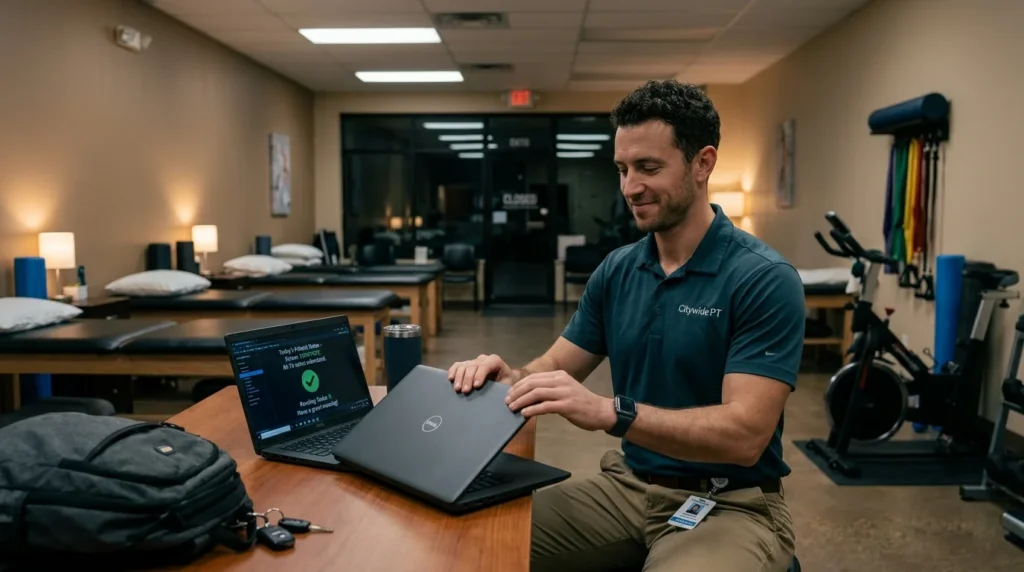
This is what a PT clinic day actually looks like when MedLaunch Documentation Intelligence is running.
During each session
The PT activates the Documentation Intelligence session from within their EHR at the start of the treatment. The patient is informed. The session proceeds as it always has. The PT performs the assessment, delivers the treatment, verbalises observations and measurements as part of their normal clinical workflow, and communicates the HEP to the patient. MedLaunch captures it all passively in the background.
Between sessions
The draft PT note is inside the patient record before the next patient is called in. The therapist reads the note, confirms the ROM values and MMT grades, edits anything that needs adjustment, and approves it. The note is filed. The encounter is closed. The next session starts.
End of the clinical day
The notes are done. Not pushed to the evening. Not waiting in a queue on the home laptop. Every session from the day has been reviewed, approved, and filed during the clinic day in the minutes between treatments.
Clinics report a 50% cut in documentation time, 20 or more hours saved weekly across a team, and measurable revenue recovered through improved coding accuracy.
7. How MedLaunch Documentation Intelligence works for PT clinics
MedLaunch Documentation Intelligence is a standalone clinical documentation platform that integrates directly with your EHR. For physical therapy clinics, here is what the implementation covers.
PT-specific note configuration
Before go-live, MedLaunch configures Documentation Intelligence to match the PT clinic’s specific note templates, preferred clinical language, and documentation conventions. Initial evaluation notes, daily treatment notes, progress notes, and discharge summaries are each configured to reflect how the clinic actually documents, not a generic template.
EHR integration
The note lands directly in the patient record in the clinic’s EHR through the API integration. No clipboard transfer. No copy-paste between systems. No reformatting. The PT reviews and approves inside the EHR they already use.
Prior auth gap flagging
Before the PT signs each note, Documentation Intelligence surfaces any documentation gaps that commonly trigger prior auth denials for the clinic’s specific payer mix. Missing functional progress documentation, absent medical necessity language, KX modifier compliance gaps. These are flagged at the point of review, where they can still be addressed before the note is signed and the encounter is closed.
Go-live timeline
Most PT clinics are fully live within two to four weeks. MedLaunch manages the entire setup including EHR connection, note template configuration, per-provider preferences, and staff briefing. The clinic’s team involvement during implementation is minimal.
Frequently Asked Questions
Why does AI documentation help PT clinics specifically?
Physical therapy documentation has requirements that do not exist in most other clinical settings. Precise objective measurements including ROM and MMT grades, Plan of Care certification cycles, KX modifier compliance for Medicare patients, home exercise programme documentation, and functional progress tracking across sessions. Generic AI documentation tools are not built to understand these requirements. A properly configured AI documentation system captures PT-specific clinical data from the session itself, structures it into audit-ready PT note formats, and surfaces compliance gaps before the note is signed.
Can AI capture ROM and MMT measurements from a therapy session?
Yes, when the PT verbalises the measurements during assessment as part of their normal clinical workflow. Most physical therapists already narrate ROM measurements during goniometry and state MMT grades during manual testing. When the AI listens during the session, these values are captured from the clinical conversation and placed in the correct fields in the objective section of the note. The PT reviews the draft and confirms the values before approving.
How much charting time does AI documentation actually save a PT clinic?
Evidence from PT clinics using AI documentation in 2026 consistently shows a 50% or greater reduction in documentation time. Per-note time drops from 12 to 15 minutes to 6 to 7 minutes in reported outcomes. For a PT treating 12 patients per day, that translates to roughly 45 minutes to an hour returned to the clinical day per therapist. Across a multi-therapist practice, the aggregate weekly time saving is substantial.
Does AI documentation affect PT billing accuracy?
Yes, positively. Physical therapy billing requires documentation precision that manual after-hours charting consistently fails to provide. Treatment time documentation, service specificity, and functional progress data are all more accurate when generated from the session itself rather than reconstructed from memory. More accurate documentation supports more accurate coding under the 8-minute rule, fewer undercoded sessions, and cleaner prior auth submissions.
Is AI documentation HIPAA compliant for PT clinics?
Yes, when the vendor meets the specific requirements: a signed Business Associate Agreement before any patient data is processed, audio deleted after note generation, end-to-end encryption of data in transit and at rest, role-based access controls, and audit logging. MedLaunch signs a BAA with every clinic before go-live and deletes audio immediately after note generation. For a complete walkthrough of every compliance requirement, the HIPAA compliance guide for AI clinical documentation covers each element in detail.
Does the PT still need to review and approve every note?
Yes, always. Every note generated by MedLaunch Documentation Intelligence is presented to the PT for review before it is finalised in the patient record. The therapist reads the draft, edits any clinical details that need adjustment, and approves it. Nothing is filed automatically. The PT remains clinically and legally accountable for every note. AI is a documentation assistant. The therapist’s clinical judgment and sign-off are the final authority.
How long does it take to go live with AI documentation on a PT EHR?
Most PT clinics are fully live within two to four weeks from the start of setup. MedLaunch manages the entire implementation including EHR API connection, PT-specific note template configuration, per-provider preferences, prior auth gap logic, and staff briefing. The clinic’s team involvement during implementation is minimal.
What happens to after-hours charting when AI documentation goes live?
It stops. The notes are generated from the session itself during the clinical day, reviewed and approved in the minutes between patients, and filed before the next session begins. By the end of clinic hours, the documentation is complete. The queue of unfinished notes that previously followed therapists home does not form.
Conclusion
Physical therapists spend close to as much time documenting care as delivering it. With complex payer requirements, high daily patient volumes, PT-specific note structures, and documentation that must be precise enough to survive Medicare audits and prior auth reviews, the charting burden in physical therapy is not just an inconvenience. It is a structural feature of the profession that drives burnout, degrades note quality, and follows therapists home every evening.
AI documentation for physical therapy addresses the structural cause. Notes are generated from the therapy session itself, structured for PT-specific requirements, and delivered into the patient record before the next patient arrives. The measurements are more precise because they came from the session. The functional documentation is more complete because it came from what the patient said. The HEP is documented accurately because it was captured when it was communicated.
The clinical day ends when the clinic closes. The documentation is done. That is what 50% reduction in charting time actually means for a PT clinic owner and for every therapist working under them.
End the 1:1 treatment-to-charting ratio.
See how MedLaunch delivers PT-structured notes, including ROM and functional goals, before your next patient walks in.