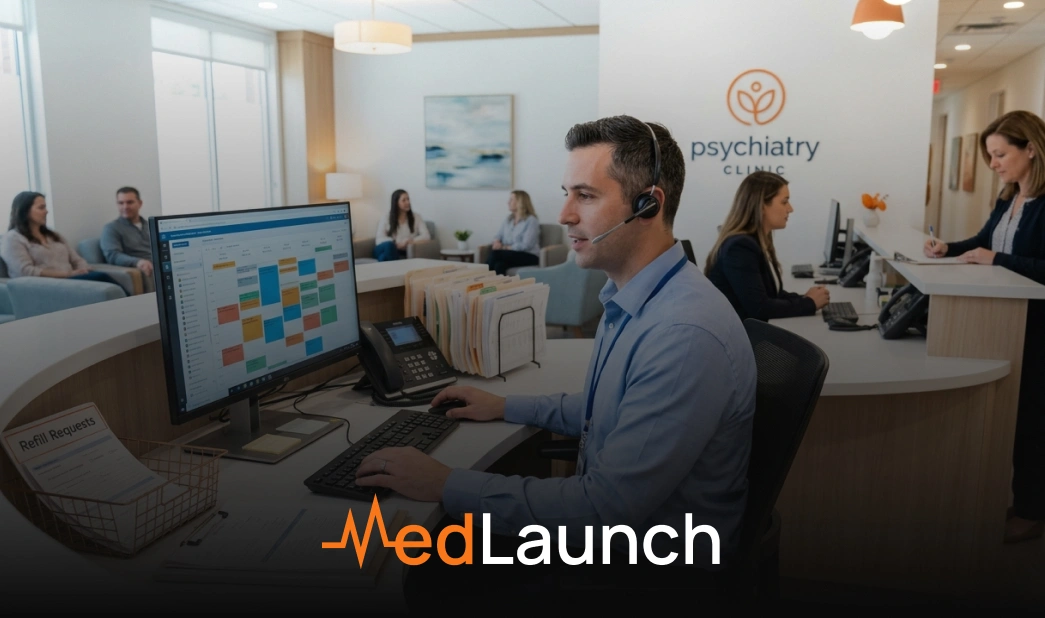

AI receptionist psychiatry practices is the deployment of a voice-guided or conversational AI system to manage the front desk functions of an outpatient psychiatry practice, including inbound call answering, appointment scheduling and reminders, medication refill request routing, and after-hours patient communication, without requiring a staff member to handle each interaction. Psychiatry practices have a front desk workload profile that differs significantly from general practice: higher call volume per provider, recurring medication management calls, elevated no-show rates requiring more reschedules and reminders, and a patient population whose clinical vulnerability means every missed call or unanswered message carries greater consequence than in a standard outpatient setting.
Table of Contents
Key Takeaways
- 38% of Healthcare Practices Now Use AI for Phone Answering: A 2025 MGMA survey cited by AInora found that 38% of healthcare practices in the US and EU have deployed AI for phone answering, appointment scheduling, or patient triage, up from 12% in 2023. Businesses using AI receptionists report a 27% increase in booked appointments and 35% to 60% cost reduction in front desk operations.
- Psychiatry Generates More Admin Calls Than Almost Any Other Outpatient Field: DENmaar’s 2026 analysis of AI in behavioral health identifies psychiatry and therapy as generating more after-hours questions, refill requests, and admin calls than almost any other outpatient specialty. Recurring psychotropic medication management creates a constant stream of refill and pharmacy coordination calls that manual front desk staff cannot sustain efficiently.
- AI Replaces 40% to 50% of Receptionist Workload in Psychiatry Settings: DENmaar’s behavioral health AI analysis found that AI scheduling and routing alone replaces 40% to 50% of receptionist workload in psychiatry practices, with the highest-value workflows being appointment scheduling, refill request capture, and reminder calls.
- Practices Report 57% Fewer Missed Appointments After AI Implementation: Arini’s 2026 research found that practices implementing AI communication tools report a 57% decrease in missed appointments. For psychiatry practices where no-show rates are higher than the general outpatient average, this recovery of clinical time is significant.
- Psychiatry Is the Most In-Demand Physician Specialty — Admin Burden Compounds the Shortage: AMN Healthcare’s 2025 review identifies psychiatry as one of the most in-demand physician specialties. Every hour a psychiatrist or their support staff spends on admin calls that AI could handle is clinical time that is not available to patients on the waiting list.
Why Psychiatry Practices Have a Different Front Desk Problem
The front desk challenge in a psychiatry practice is more demanding than in most outpatient specialties and the gap between what the workload requires and what manual staffing can deliver is wider than in general practice.
According to DENmaar’s 2026 analysis, psychiatry and therapy generate more after-hours questions, refill requests, and admin calls than almost any other outpatient field. The reasons are structural and specific to the specialty.
Psychiatry patients are seen more frequently than patients in most other outpatient specialties. A patient on psychotropic medication may be seen weekly or fortnightly during an adjustment period. Each appointment in the schedule represents more communication touchpoints: more reminders, more rescheduling calls when a symptom episode causes a cancellation, and more follow-up contacts between sessions.
Psychotropic medications require consistent, carefully timed refills. A patient whose antidepressant runs out because a refill request was not processed in time is not experiencing a minor inconvenience. They are experiencing a gap in their treatment. The refill call volume this creates is ongoing, predictable, and high. For a psychiatrist seeing 20 patients per week, that is 20 patients with monthly refill cycles, each generating a call, a routing action, a prescriber decision, and a pharmacy coordination step.
Administrative staff in psychiatry also manage a higher proportion of emotionally sensitive interactions than in general practice. The front desk is often the first contact point when a patient is struggling between sessions. Managing that interaction appropriately while also handling a full appointment schedule requires a level of attentiveness that burns out staff faster than in lower-acuity settings.
For psychiatry practices also using automated PHQ-9 screening, understanding how the AI receptionist works alongside clinical tools like MedLaunch’s AI Powered PHQ-9 Screening for Psychiatry Clinics is part of the broader operational picture.
The Medication Refill Call Problem in Psychiatry
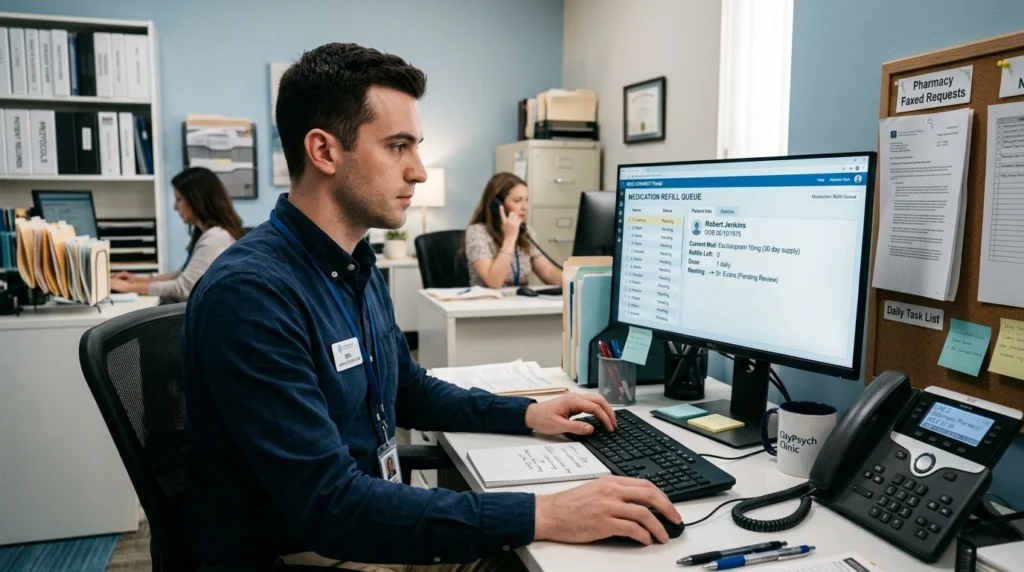
Medication refill management is the front desk task that most clearly differentiates psychiatry from other outpatient specialties and the one where manual workflows break down most visibly.
In a typical psychiatry practice, a refill request arrives by phone. A staff member takes the message, locates the patient record, confirms the medication name and dosage, checks the prescriber’s availability, routes the request to the right clinician, receives the prescriber’s decision, and communicates back to the patient or pharmacy. Each step requires staff time and introduces the possibility of error or delay.
For a practice with 50 active patients on psychotropic medications, each on 30-day refill cycles, this represents approximately 50 refill requests per month, or roughly 2 to 3 per working day. Across a working year, refill management alone represents hundreds of staff-hours that could be handled more efficiently.
An AI receptionist configured for psychiatry captures refill requests automatically. When a patient calls to request a refill, the AI confirms their identity, captures the medication name and dosage, validates that the information matches the patient record, and routes the structured request to the prescriber through the practice’s EHR or messaging system. The staff member receives a clean, validated refill request ready for prescriber review rather than a voicemail to transcribe and a record to look up.
DENmaar’s analysis confirms that AI systems handle refill request capture and routing as one of the highest-value workflows in psychiatry practice automation, alongside appointment scheduling and reminder calls.
What an AI Receptionist Actually Does in a Psychiatry Practice
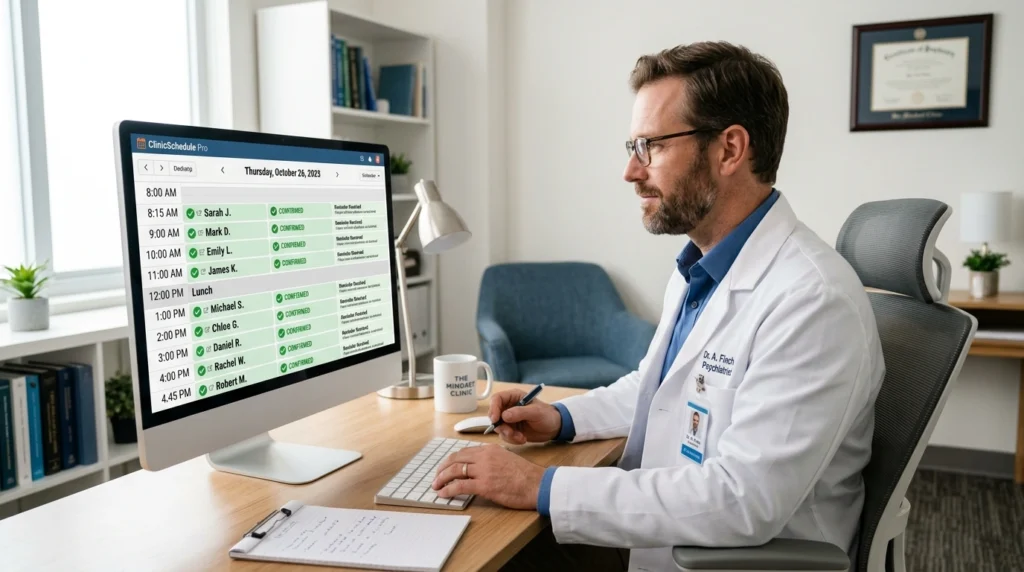
An AI receptionist for a psychiatry practice performs six core functions that currently require staff time.
Inbound call handling: The AI answers every incoming call instantly, 24 hours a day. It identifies the caller’s need and routes appropriately: scheduling, refill request, general enquiry, or crisis routing if the call requires it.
Appointment scheduling: The AI books, reschedules, and cancels appointments directly in the scheduling system. For psychiatry practices where cancellations driven by symptom episodes are more frequent than in general practice, real-time rescheduling availability means patients can reschedule at any hour without a staff callback.
Medication refill request capture: The AI captures refill requests, validates the required information, and routes the structured request to the prescriber. No staff member needs to manage the intake and routing of each individual request.
Appointment reminder sequences: Automated SMS and email reminders sent at defined intervals before each appointment. For psychiatry practices where no-show rates can exceed 20%, consistent reminder sequences reduce the number of missed sessions and the clinical disruption they cause.
After-hours patient communication: Patients who call outside office hours receive an immediate response rather than a voicemail. The AI handles scheduling requests, captures refill requests, and routes crisis calls appropriately, as covered in detail in How AI Handles After-Hours Calls From Mental Health Patients.
New patient intake information capture: When a new patient calls to enquire about the practice, the AI captures their contact details, insurance information, and the reason for seeking care, and routes the information to the practice for follow-up. New patient conversion happens at any hour, not only when a staff member is available.
How AI Reduces No-Show Rates in Psychiatry
No-show rates in psychiatry are consistently higher than in most other outpatient specialties. Patients miss appointments for reasons directly related to their condition: depression reduces motivation, anxiety creates avoidance, medication side effects cause fatigue. These are not logistical failures. They are clinical ones. But their operational consequence is the same: a clinical slot with no revenue and no patient care delivered.
Arini’s 2026 research found that practices implementing AI communication tools report a 57% decrease in missed appointments. For a psychiatry practice seeing 20 patients per day at a 20% no-show rate, that represents 4 missed appointments per day. A 57% reduction converts 2 to 3 of those back to attended sessions.
AI reduces no-show rates through three mechanisms:
Consistent reminder sequencing: Automated reminders sent at 48 hours and 24 hours before the appointment, followed by a morning-of confirmation, create more touchpoints than manual reminder systems can sustain consistently. Each touchpoint is an opportunity for the patient to confirm attendance or reschedule before the slot is lost.
Frictionless rescheduling: When a patient needs to cancel, the AI offers rescheduling immediately within the same interaction. A patient who cancels by phone at 9pm can reschedule for the following week within the same call. Manual systems that require a callback the next day lose rescheduling opportunities to inertia.
Automated recall for recurring cancellers: Patients with a history of cancellations can be automatically flagged and contacted proactively before their next appointment with an additional check-in. This does not replace clinical contact. It supplements it with an administrative touchpoint that increases the probability of attendance.
What the Research Says
Three findings from research and market data directly support AI receptionist deployment in psychiatry practice settings.
Finding 1 – AI replaces 40% to 50% of psychiatry receptionist workload immediately. DENmaar’s 2026 behavioral health AI analysis found that AI scheduling, routing, and reminder workflows replace 40% to 50% of receptionist workload in psychiatry and therapy practices, focusing on the highest-volume, lowest-judgment tasks. This is not a gradual efficiency gain. It is an immediate workload redistribution that takes effect from go-live.
Finding 2 – 38% of healthcare practices have already deployed AI for phone answering. A 2025 MGMA survey cited by AInora found that 38% of healthcare practices in the US and EU have deployed AI for phone answering and scheduling, up from 12% in 2023. Practices using AI receptionists report a 27% increase in booked appointments and 35% to 60% reduction in front desk operational costs. The adoption curve is steep. Practices that deploy now are moving with the trend rather than catching up to it.
Finding 3 – Psychiatry is the most in-demand physician specialty and admin burden is a direct contributor to the access gap. AMN Healthcare’s 2025 review confirms that psychiatry is one of the most in-demand physician specialties. The report notes that AI tools handling scheduling and billing significantly reduce administrative burden on practitioners. For a psychiatrist spending 30 to 60 minutes per day on phone-based administrative tasks that AI could handle, that time recovered is clinical time returned to the patients who need it most.
The Specific Psychiatry Workflows AI Handles Best
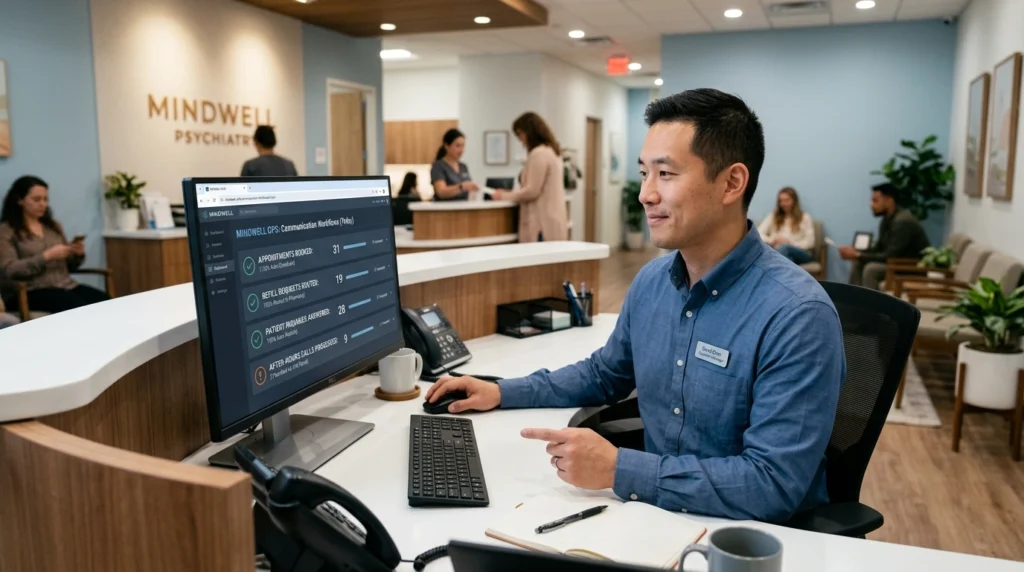
Ranked by operational impact for a typical outpatient psychiatry practice:
1 – Medication refill request capture and routing The highest-value psychiatry-specific workflow. AI captures every refill request, validates the required information, and routes a clean structured request to the prescriber. No transcription. No voicemail retrieval. No missed requests due to staff availability.
2 – Appointment scheduling and rescheduling The highest-volume general workflow. Every booking, reschedule, and cancellation handled automatically, 24 hours a day, without staff involvement.
3 – After-hours call handling Particularly valuable in psychiatry where patients may call outside business hours due to symptom episodes, medication questions, or distress. Immediate response replaces voicemail at every hour.
4 – Appointment reminder sequences Consistent 48-hour, 24-hour, and same-day reminders sent automatically. Each reminder includes a rescheduling option to capture the appointment before the slot is lost.
5 – New patient intake information capture New patient enquiries converted to structured intake records automatically, at any hour, without a staff callback requirement.
6 – Common FAQ answering Insurance accepted, location, hours, service descriptions, clinician availability questions. Answered instantly without staff involvement.
Crisis Call Routing Requirements for Psychiatry Practices
Crisis call routing is a non-negotiable requirement for any AI receptionist deployed in a psychiatry practice. The full protocol requirements are covered in detail in How AI Handles After-Hours Calls From Mental Health Patients. The psychiatry-specific points are as follows.
Psychiatry practices serve a higher-acuity patient population than general mental health counselling settings. The proportion of patients with active suicidal ideation, psychotic episodes, or severe mood disorder presentations is higher. This means the crisis routing protocol must be more explicitly calibrated for the specific language patterns of a psychiatry patient population.
The crisis routing hierarchy for a psychiatry practice should specify: on-call prescriber for medication-related emergencies, 988 Suicide and Crisis Lifeline for suicidal ideation, and emergency services for immediate safety situations. The protocol must be tested with psychiatry-specific crisis scenarios before go-live, including patients expressing medication-related distress, patients describing psychotic symptoms, and patients indicating passive suicidal ideation in indirect language.
The connection between robust crisis routing and consistent PHQ-9 screening is direct. Practices that screen consistently with automated PHQ-9, as covered in CPT 96127 Billing PHQ-9 Psychiatry: Complete Guide for Clinics in 2026, have a clearer clinical picture of their high-risk patients that can inform how the crisis routing protocol is configured.
What to Verify Before Deploying an AI Receptionist in a Psychiatry Setting
Five verification requirements specific to psychiatry before any AI receptionist system is deployed.
Verify 1 – Crisis routing protocol calibrated for psychiatry patient population. Request the vendor’s documentation of the crisis routing logic and verify that it includes psychiatry-specific language patterns for psychotic presentations, medication-related distress, and passive suicidal ideation, not only direct statements of self-harm intent.
Verify 2 – Medication refill workflow is validated and HIPAA-compliant. The refill request capture workflow must validate patient identity, capture the correct medication information, and route to the prescriber through a HIPAA-compliant channel. Verify that the refill workflow meets the specific requirements of your practice’s prescribing protocols before go-live.
Verify 3 – EHR integration covers both scheduling and refill routing. The AI system must integrate with both the scheduling module and the prescriber communication workflow in your EHR. If either integration requires manual transfer by a staff member, the workload reduction is incomplete.
Verify 4 – Call scripts are customised for a psychiatry patient population. Generic call scripts designed for GP or dental practices are not appropriate for psychiatry. The language, triage logic, and routing rules must reflect the specific clinical context and patient population of a psychiatry setting.
Verify 5 – Business Associate Agreement covers all call types including refill requests. All patient communication data, including medication refill requests, is protected health information under HIPAA. The BAA must explicitly cover every call type the AI system handles, including refill requests which involve medication information.
What This Means for Your Practice in 2026
Psychiatry practices face a front desk workload that manual staffing alone cannot sustain at the level of responsiveness patients need and the clinical environment requires. Medication refill calls, high no-show rates, after-hours contacts from vulnerable patients, and consistently high call volume per provider create an environment where AI receptionist deployment has the clearest operational case of any outpatient specialty.
The adoption data confirms this. The proportion of healthcare practices using AI for phone answering tripled between 2023 and 2025. The practices that have deployed report 27% more booked appointments and 57% fewer missed sessions. These are not marginal improvements. They are structural changes in how the front desk functions.
For a psychiatry practice where the waiting list is growing and the clinical team is stretched, recovering 40% to 50% of front desk workload through AI automation is not a technology decision. It is a clinical access decision.
For a complete overview of how MedLaunch AI Medical Receptionist works for psychiatry practices, visit the solution page.
FAQ
What does an AI receptionist do in a psychiatry practice?
An AI receptionist for a psychiatry practice handles inbound call answering, appointment scheduling and rescheduling, medication refill request capture and routing, appointment reminder sequences, after-hours patient communication, and new patient intake information capture. For psychiatry specifically, the medication refill workflow and crisis call routing protocol are the two most important configuration requirements before deployment.
Can AI handle medication refill requests for psychiatry patients?
Yes. An AI receptionist configured for psychiatry captures refill requests by phone, validates the patient identity and medication information, and routes a structured request to the prescriber through the practice’s EHR or messaging system. The staff member receives a clean, validated refill request rather than a voicemail to transcribe. As DENmaar’s 2026 analysis confirms, refill request capture and routing is one of the highest-value AI workflows in psychiatry practice automation.
How does AI reduce no-show rates in a psychiatry practice?
AI reduces no-show rates through consistent reminder sequencing, frictionless rescheduling within the cancellation call, and automated recall for recurring cancellers. Arini’s 2026 research found that practices implementing AI communication tools report a 57% decrease in missed appointments. For a psychiatry practice with a 20% no-show rate, this recovery of clinical slots directly increases the revenue and clinical capacity available each day.
Is an AI receptionist safe to use with psychiatry patients?
An AI receptionist is safe for administrative functions in a psychiatry practice when deployed with a correctly configured and tested crisis call routing protocol. The AI handles scheduling, refill requests, and routine communication. Clinical judgment, prescribing decisions, and crisis response remain with clinical staff. The safety question is not whether to use AI but whether the crisis routing protocol has been specifically calibrated for the psychiatry patient population and tested with realistic scenarios before go-live.
How does AI handle crisis calls in a psychiatry practice?
When a caller’s language indicates a mental health crisis, the AI routes immediately to the designated resource: an on-call prescriber for medication-related emergencies, the 988 Suicide and Crisis Lifeline for suicidal ideation, or emergency services for immediate safety situations. Every crisis routing event is documented and an alert is sent to the designated clinical staff member. The full crisis routing protocol requirements for psychiatry settings are covered in How AI Handles After-Hours Calls From Mental Health Patients.
How long does it take to implement an AI receptionist in a psychiatry practice?
With MedLaunch, most psychiatry practices are fully live within days. MedLaunch handles the full configuration including call scripts customised for a psychiatry patient population, medication refill workflow setup, crisis routing protocol development and testing, EHR integration, and staff briefing. No technical setup is required from the practice team.
Conclusion
Psychiatry practices have a front desk workload that is more complex, higher volume, and more clinically sensitive than most outpatient specialties. Medication refill calls, elevated no-show rates, after-hours contacts from vulnerable patients, and a patient population that requires more communication touchpoints per clinical episode all contribute to a front desk environment where manual staffing consistently falls short.
An AI receptionist configured correctly for psychiatry addresses all of these dimensions. Refill requests are captured and routed automatically. No-show rates fall through consistent reminder sequences and frictionless rescheduling. After-hours calls receive an immediate response. New patients are converted at any hour. And when a caller presents in crisis, the routing protocol delivers them to the right resource before the call ends.
The configuration requirements are more specific for psychiatry than for general practice. The medication refill workflow, the crisis routing protocol, and the call script customisation must all be calibrated for a psychiatry patient population. Done correctly, the outcome is a front desk that functions at a level manual staffing alone cannot achieve, and a clinical team that has more time for the work that only they can do.
For a complete overview of how MedLaunch AI Medical Receptionist works for psychiatry practices, visit the solution page. For psychiatry practices managing PHQ-9 screening and CPT 96127 billing, see AI PHQ-9 Screening for Psychiatry Clinics and CPT 96127 Billing PHQ-9 Psychiatry: Complete Guide for Clinics in 2026.