

CPT 96127 billing PHQ-9 psychiatry is the process of submitting a reimbursement claim for a brief emotional and behavioral assessment, specifically the Patient Health Questionnaire-9, under the procedure code 96127, which the American Medical Association defines as a brief emotional and behavioral assessment with scoring and documentation, per standardized instrument. For psychiatry clinics administering PHQ-9 as part of routine depression screening and monitoring, CPT 96127 represents a billable service at every eligible visit, provided the documentation meets the four elements payers require to approve the claim.
Table of Contents
Key Takeaways
- CPT 96127 Is Billable Per Instrument Per Visit: CPT 96127 can be billed each time a standardised instrument is administered, scored, and documented. For a psychiatry clinic administering PHQ-9 at every depression monitoring visit, this represents a reimbursable service at each applicable appointment throughout the treatment episode.
- 2026 Medicare Rate Is $4.97 Per Unit: As of January 2026, the Medicare national average reimbursement for CPT 96127 is $4.97 per unit according to Connected Mind, with a maximum of 3 units per date of service. Commercial payer rates are typically higher.
- Four Documentation Elements Determine Approval or Denial: According to iCanotes, payers deny 96127 most often because the chart lacks one of four elements: the instrument name, the score, the clinical interpretation, or the action plan. All four must appear in the note for the claim to be approved.
- AI PHQ-9 Screening Generates the Documentation CPT 96127 Requires: Automated PHQ-9 screening produces a structured, timestamped record containing the instrument name, total score, severity classification, and flagged item responses. This is the documentation structure CPT 96127 requires, generated automatically without manual note entry.
- No Prior Authorisation Required for Routine Screening: Under the Mental Health Parity and Addiction Equity Act, payers cannot impose additional barriers on mental health screening that exceed those for comparable medical screenings. Prior authorisation is not required for routine CPT 96127 billing.
What CPT 96127 Actually Covers
CPT 96127 is defined by the American Medical Association as a brief emotional and behavioral assessment with scoring and documentation, per standardised instrument. The full definition reads: brief emotional and behavioral assessment such as a depression inventory or attention-deficit and hyperactivity disorder scale, with scoring and documentation, per standardised instrument.
Three elements make up what the code covers. First, the administration of a validated standardised screening instrument. Second, the scoring of that instrument. Third, the documentation of the result and the clinical response in the patient record.
The PHQ-9 is explicitly listed as a qualifying instrument. It meets all three requirements. It is a validated standardised tool, it produces a numerical score, and its result is documented in the clinical record at every visit where it is administered.
The code is billed per instrument, not per session. A psychiatry clinic administering only the PHQ-9 at a visit bills one unit of 96127. A clinic administering the PHQ-9 and the GAD-7 at the same visit may bill two units. There is no designated time requirement for the code. The length of the administration does not determine eligibility. Completion of the three elements does.
Who Can Bill CPT 96127 in a Psychiatry Practice
Any physician or qualified healthcare professional may bill CPT 96127. For a psychiatry practice, this includes psychiatrists holding MD or DO credentials, nurse practitioners, physician assistants, and psychologists holding PhD or PsyD credentials.
According to Connected Mind’s 2026 billing guide, CMS defines a qualified healthcare professional as an individual qualified by education, training, and licensure who performs a professional service within their scope of practice. There is no specialty restriction. A psychiatrist, a GP, and a paediatrician all qualify under the same definition.
Who generally cannot bill CPT 96127 under CMS guidelines: licensed professional counsellors, licensed social workers, and licensed clinical social workers. This is because the CPT codes used for those services already include uncovering and monitoring mental health conditions. Multi-disciplinary psychiatry practices that include both MD providers and therapists or social workers need to ensure the claim is submitted under a qualifying provider’s credentials.
For telehealth psychiatry specifically, CMS has approved CPT 96127 for telemedicine visits through December 31, 2026. This applies directly to telehealth mental health providers administering pre-visit voice-guided PHQ-9 before a virtual session.
2026 Reimbursement Rates for CPT 96127
As of January 2026, the Medicare national average reimbursement for CPT 96127 is $4.97 per unit with a maximum of 3 units per date of service, for a maximum of $14.91 per visit under Medicare. Commercial payer rates are typically higher than Medicare and vary by contract.
| Payer Type | Rate Per Unit | Max Units Per Visit | Max Per Visit |
|---|---|---|---|
| Medicare (national avg.) | $4.97 | 3 | $14.91 |
| Commercial | Varies by contract | 3 | Varies |
| Medicaid | Varies by state | 3 | Varies |
For a psychiatry clinic seeing 20 patients per day where PHQ-9 is administered at every depression monitoring visit, CPT 96127 billing at the Medicare rate alone represents approximately $99 per day, or roughly $25,000 per year, from a single screening instrument that most clinics are already using and not billing for.
CMS does not limit the number of times per year that 96127 may be billed. The maximum of 3 units applies per date of service only. Individual commercial payers may impose their own annual frequency limits, which is worth verifying per payer before submitting high-volume claims.
One important distinction: during a Medicare Annual Wellness Visit, use G0444 instead of 96127 for the annual depression screen. G0444 pays significantly more at $18.25 for the AWV encounter. Never bill 96127 on the same day as a Medicare Annual Wellness Visit.
The Four Documentation Elements That Determine Approval or Denial

According to iCanotes, payers deny CPT 96127 claims most often because the clinical note is missing one of four required elements. Every claim submission must include all four.
Element 1 – Instrument name The note must explicitly name the standardised instrument administered. Writing “depression screening completed” is not sufficient. The note must state “PHQ-9 administered” or “Patient Health Questionnaire-9 completed.”
Element 2 – Score The numerical total score must appear in the note. A severity label without the number is not sufficient for all payers. The note should read “PHQ-9 score: 14” not just “moderate depression score.”
Element 3 – Clinical interpretation The note must document what the score means clinically. This does not require a lengthy entry. A brief statement such as “PHQ-9 score of 14 indicates moderate depression” satisfies the requirement.
Element 4 – Action plan The note must document what clinical action was taken in response to the score. This is the element most commonly missing in denied claims. The action plan can be brief. “Adjusted medication, scheduled follow-up in two weeks” satisfies the requirement. A score documented without a clinical response does not.
A complete note entry that satisfies all four elements looks like this: “Patient completed PHQ-9. Score: 14, indicating moderate depression. Discussed results with patient. Adjusted treatment plan to include cognitive behavioural therapy referral and scheduled follow-up in two weeks to reassess.”
What the Research Says
Three findings from peer-reviewed and clinical research are directly relevant to CPT 96127 billing in psychiatry practices.
Finding 1 – Routine brief screenings increase depression identification by 35%. A 2022 study published in the Journal of Clinical Psychiatry found that routine use of brief screenings in primary care settings increased the identification of depression and anxiety disorders by 35%, leading to faster treatment initiation and improved outcomes. As cited by Behave Health, this finding supports the clinical case for consistent PHQ-9 administration alongside the billing case. The two are not in tension. Billing consistently for PHQ-9 is a direct incentive to screen consistently, which produces better clinical outcomes.
Finding 2 – CPT 96127 does not require provider presence during administration. The code does not require the provider to be present while the patient completes the instrument. As confirmed across multiple billing guides including Connected Mind, self-administered PHQ-9 qualifies for CPT 96127 billing provided the provider reviews the result, documents the score, and records the clinical response. This directly supports AI pre-visit administration: a patient completing the voice-guided PHQ-9 before the appointment produces a billable service under CPT 96127 when the clinician reviews and documents the result.
Finding 3 – Mental Health Parity Act protects against prior authorisation barriers. Under the Mental Health Parity and Addiction Equity Act, payers cannot impose additional barriers on mental health screening that exceed those for comparable medical screenings. Prior authorisation is not required for routine CPT 96127 billing. If a payer requests medical records or prior authorisation for routine PHQ-9 screening, providers can challenge those requirements through parity law enforcement channels.
How AI PHQ-9 Screening Supports Accurate CPT 96127 Documentation
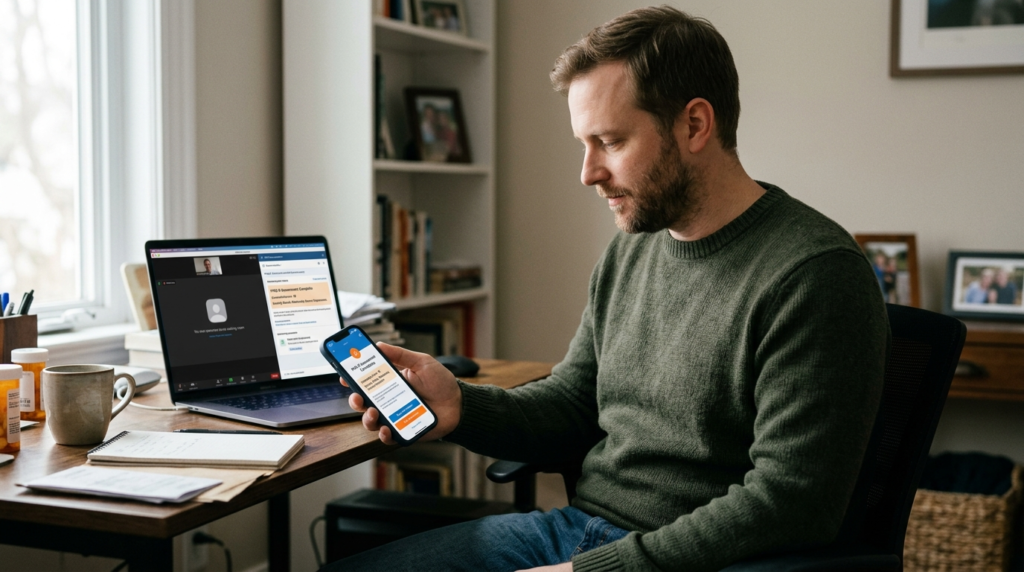
The four documentation elements CPT 96127 requires map directly onto the structured report that AI PHQ-9 screening produces automatically.
Instrument name is captured automatically. The structured report generated by MedLaunch AI Powered PHQ-9 Screening identifies the PHQ-9 by name in every report header.
Score is captured automatically. The total score is calculated the moment the patient submits the final response and appears in the structured report before the clinician enters the room.
Clinical interpretation is captured automatically. The severity classification, Minimal, Mild, Moderate, Moderately Severe, or Severe, is applied automatically based on the validated scoring thresholds and included in every report.
Action plan requires the clinician. This is the only element that requires manual input. The clinician reviews the report, documents the clinical response, and the claim is complete.
Without AI screening, all four elements depend on manual documentation during or after the session. With AI screening, three of the four are already present in the structured record before the clinician begins the appointment. The documentation burden is reduced to a single entry, the action plan, which the clinician would document regardless of how the PHQ-9 was administered.
For psychiatry clinics using MedLaunch for PHQ-9 screening, the CPT 96127 documentation is built into the clinical workflow automatically, at every visit where the PHQ-9 is administered.
Common CPT 96127 Billing PHQ-9 Psychiatry Mistakes That Cause Claim Denials
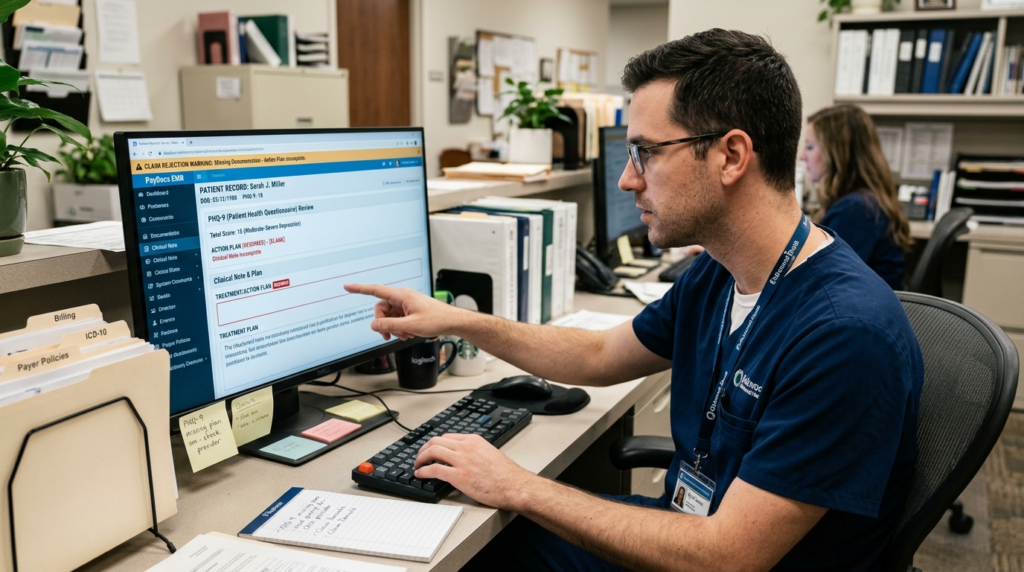
Five billing errors account for the majority of CPT 96127 claim denials in psychiatry practices.
Mistake 1 – Missing the action plan. The most common denial reason. A score is documented but no clinical response is recorded. The note must show what the clinician did in response to the result, even if the response is watchful waiting with a scheduled follow-up.
Mistake 2 – Using free-text score entry instead of structured data. A score entered as a free-text note rather than a structured data field makes the claim harder to verify and audit. Structured score storage produces cleaner claims and a cleaner longitudinal record. This is also why consistent use of AI PHQ-9 screening with full EHR integration, as covered in AI PHQ-9 EHR Integration: The Essential 2026 Guide, supports more reliable billing than paper-based workflows.
Mistake 3 – Not billing because the PHQ-9 was self-administered. CPT 96127 does not require provider presence during test administration. A self-administered or voice-guided pre-visit PHQ-9 is billable provided the clinician reviews the result and documents the score and clinical response.
Mistake 4 – Billing beyond the unit limit. CMS allows a maximum of 3 units per date of service. Some commercial payers allow 4. Billing beyond the applicable limit triggers automatic denial and may flag the claim for audit.
Mistake 5 – Missing modifier 25 on the E/M code. When CPT 96127 is billed on the same date as an Evaluation and Management code, modifier 25 must appear on the E/M code to indicate a significant, separately identifiable service. Missing this modifier causes the payer to bundle the screening into the E/M and deny the 96127 claim.
What This Means for Your Clinic in 2026
CPT 96127 billing for PHQ-9 in a psychiatry practice is not an optional revenue line. It is a reimbursable service for work the clinic is already doing. The only variable is whether the documentation is structured well enough to support the claim.
The four elements payers require are present in every well-documented PHQ-9 visit. The question is whether those elements are consistently captured, consistently structured, and consistently submitted. For a clinic running a manual paper PHQ-9 workflow, the answer is frequently no. For a clinic using AI PHQ-9 screening with full EHR integration, the answer is yes by default at every eligible visit.
For a deeper look at how consistent PHQ-9 implementation works without adding staff, see PHQ-9 Implementation in a Busy Mental Health Clinic. For the accuracy comparison between AI and clinician-administered PHQ-9, see AI PHQ-9 Accuracy vs Clinician Administered: What the Research Says in 2026.
FAQ
What is CPT 96127 and does it cover PHQ-9 in psychiatry?
CPT 96127 is defined by the American Medical Association as a brief emotional and behavioral assessment with scoring and documentation, per standardised instrument. The PHQ-9 is explicitly listed as a qualifying instrument. Psychiatry clinics administering PHQ-9 as part of routine depression screening and monitoring may bill CPT 96127 at every eligible visit where all four documentation elements are present: instrument name, score, clinical interpretation, and action plan.
What is the 2026 reimbursement rate for CPT 96127?
As of January 2026, the Medicare national average reimbursement for CPT 96127 is $4.97 per unit with a maximum of 3 units per date of service, totalling a maximum of $14.91 per visit under Medicare. Commercial payer rates vary by contract and are typically higher. For a Medicare Annual Wellness Visit, use G0444 instead of 96127, which pays $18.25 for that specific encounter type.
What documentation is required to bill CPT 96127?
Four elements must appear in the clinical note for a CPT 96127 claim to be approved: the name of the standardised instrument administered, the numerical total score, a brief clinical interpretation of what the score indicates, and a documented action plan showing what clinical response was taken. Missing any one of these four elements is the most common reason for claim denial.
Can CPT 96127 be billed for self-administered PHQ-9?
Yes. CPT 96127 does not require the provider to be present during test administration. A patient completing the PHQ-9 independently, including via a voice-guided pre-visit system, produces a billable service under CPT 96127 provided the clinician reviews the result, documents the score and interpretation, and records the clinical action taken in response.
Can CPT 96127 be billed on the same date as an E/M code?
Yes, with the correct modifiers. When billing CPT 96127 alongside an Evaluation and Management code on the same date of service, modifier 25 must appear on the E/M code to indicate a significant, separately identifiable service, and modifier 59 should appear on the 96127 code to indicate a distinct procedural service. Missing modifier 25 on the E/M is the most common cause of bundled denials.
How does AI PHQ-9 screening support CPT 96127 billing?
AI PHQ-9 screening automatically generates three of the four documentation elements CPT 96127 requires: the instrument name, the numerical score, and the severity classification. The clinician adds the action plan. This means the documentation required for a valid CPT 96127 claim is built into the clinical workflow before the appointment begins, reducing the documentation burden to a single manual entry at every eligible visit.
Conclusion
CPT 96127 billing for PHQ-9 in a psychiatry clinic is not a complex billing operation. It is a straightforward reimbursement claim for a service most psychiatry clinics are already providing but not capturing. The four documentation elements payers require, instrument name, score, clinical interpretation, and action plan, are present in every well-documented PHQ-9 visit. The only reason most psychiatry clinics are not billing CPT 96127 consistently is that the documentation is not structured, timestamped, and available in the right format at the point of claim submission.
AI PHQ-9 screening solves the documentation problem automatically. The structured report generated before every session contains three of the four required elements without any manual note entry. The clinician adds the action plan. The claim is complete.
A psychiatry clinic seeing 20 patients per day and billing CPT 96127 at every applicable visit is capturing reimbursable revenue that currently goes undocumented on every paper PHQ-9 form that never makes it into the clinical record in structured form.
See how MedLaunch works in psychiatry practices.
Visit our solution page for a complete overview, or read our guide on PHQ-9 Implementation in a Busy Mental Health Clinic to see how it works without adding staff time.