

PHQ-9 vs PHQ-2 telehealth mental health is the clinical decision facing telehealth providers when selecting a depression screening instrument for pre-visit or in-session administration in a virtual care environment. The PHQ-2 uses the first two items of the PHQ-9 as a brief initial screener for depressive symptoms. The PHQ-9 uses all nine items to screen for depression severity and monitor treatment progress. For telehealth providers, the choice between the two instruments is not purely clinical. It involves practical considerations specific to the telehealth context: completion time before a virtual session, sensitivity and specificity trade-offs, Question 9 suicidal ideation screening, and whether the instrument chosen supports CPT 96127 billing and longitudinal treatment monitoring.
Table of Contents
Key Takeaways
- The PHQ-2 Was Not Designed as a Standalone Clinical Instrument: The PHQ-2 was developed as an initial screening gateway to identify patients who should then complete the full PHQ-9. A positive PHQ-2 triggers the PHQ-9. It was never designed to replace it. A NCBI PMC machine learning analysis found the PHQ-2 results in more misclassifications than alternative item pairings, and the anhedonia item that defines it may be empirically incompatible with its role as a prescreener.
- The Completion Time Argument for PHQ-2 Does Not Apply to Telehealth Pre-Visit Delivery: The most common argument for using PHQ-2 over PHQ-9 is brevity. In a telehealth context where the PHQ-9 is administered via pre-visit voice-guided delivery before the session begins, the additional 7 items add approximately 90 seconds to a process the patient completes independently at home. That is not a meaningful burden.
- Only the PHQ-9 Includes Question 9 — the Suicidal Ideation Screening Item: The PHQ-2 does not include Question 9. For telehealth providers whose patients are not physically present at the point of screening, the pre-session window before a virtual call is the only opportunity to flag suicidal ideation before the clinician joins. Removing that window by using PHQ-2 is a clinical safety decision with direct consequences.
- Telehealth PHQ-9 Produces Clinically Meaningful Treatment Outcomes: A study published in NCBI PMC found that 80% of telehealth platform patients who completed PHQ-9 as part of measurement-based care achieved a clinically meaningful reduction of 5 or more points versus 52% of patients receiving treatment as usual. The PHQ-9 is not just a screening tool in telehealth. It is an active component of the treatment model.
- CPT 96127 Billing Requires a Standardised Instrument With Full Scoring — PHQ-9 Qualifies, PHQ-2 Alone Does Not: CPT 96127 billing for brief emotional and behavioral assessment requires administration, scoring, and documentation of a standardised instrument. The PHQ-9 satisfies this requirement. The PHQ-2 as a standalone screen is not typically sufficient for CPT 96127 billing without administration of the full PHQ-9.
What Is the PHQ-2 and How Does It Relate to the PHQ-9?
The PHQ-2 consists of the first two items of the PHQ-9. Item 1 asks about depressed mood: over the last two weeks, how often have you been bothered by feeling down, depressed, or hopeless? Item 2 asks about anhedonia: over the last two weeks, how often have you been bothered by little interest or pleasure in doing things?
Each item is scored on the same 0 to 3 frequency scale as the PHQ-9. Total PHQ-2 scores range from 0 to 6. A score of 3 or above is considered a positive screen that warrants administration of the full PHQ-9.
The PHQ-2 was explicitly designed as a gateway screener. Its intended workflow is: administer the PHQ-2, if the score is 3 or above administer the full PHQ-9. The PHQ-2 identifies who needs the full instrument. The PHQ-9 provides the clinical information that actually informs treatment decisions.
This two-step design makes sense in specific high-volume contexts where administering the full PHQ-9 to every patient is not feasible. A large primary care practice screening every adult patient at their annual check-up may use PHQ-2 as a first filter before administering the PHQ-9 to those who screen positive.
It does not make sense in ongoing telehealth mental health care where patients have already been identified as needing mental health treatment, where longitudinal PHQ-9 tracking is a core component of the treatment model, and where pre-visit automated delivery removes the burden argument entirely.
For telehealth providers already using automated pre-visit PHQ-9 delivery, the full comparison of AI administration validity is covered in AI PHQ-9 Accuracy vs Clinician Administered: What the Research Says in 2026.
The Clinical Case for PHQ-9 Over PHQ-2 in Telehealth
Four clinical reasons the PHQ-9 is the correct instrument for ongoing telehealth mental health care.
Reason 1 – Sensitivity and specificity. The original Kroenke et al. validation study in the Journal of General Internal Medicine established PHQ-9 sensitivity at 88% and specificity at 88% for major depressive disorder at a threshold score of 10 or above. The PHQ-2 at a threshold of 3 achieves sensitivity of approximately 83% and specificity of 92%. The PHQ-9 is more sensitive. In a treatment context where missing a depressive episode has clinical consequences, sensitivity matters more than specificity.
Reason 2 – Longitudinal treatment monitoring. The PHQ-2 produces a score ranging from 0 to 6. The PHQ-9 produces a score ranging from 0 to 27. PHQ-9 is sensitive to the small score changes across visits that indicate whether treatment is producing the expected response. PHQ-2 is too coarse a measure to track treatment progress meaningfully. Research published in NCBI PMC on telehealth measurement-based care established that a 5-point reduction in PHQ-9 score is the threshold for clinically meaningful improvement. A 5-point change on a 0 to 6 scale is clinically uninformative.
Reason 3 – Question 9 suicidal ideation screening. The PHQ-9 includes Question 9. The PHQ-2 does not. This is the most significant clinical distinction for telehealth providers and is covered in detail in the section below.
Reason 4 – CPT 96127 billing support. The PHQ-9 supports CPT 96127 billing as a standalone standardised instrument. The PHQ-2 as a standalone screen does not typically meet the CPT 96127 documentation requirements without subsequent administration of the full PHQ-9. This is covered in the billing section below.
Why the Completion Time Argument for PHQ-2 Does Not Apply to Telehealth
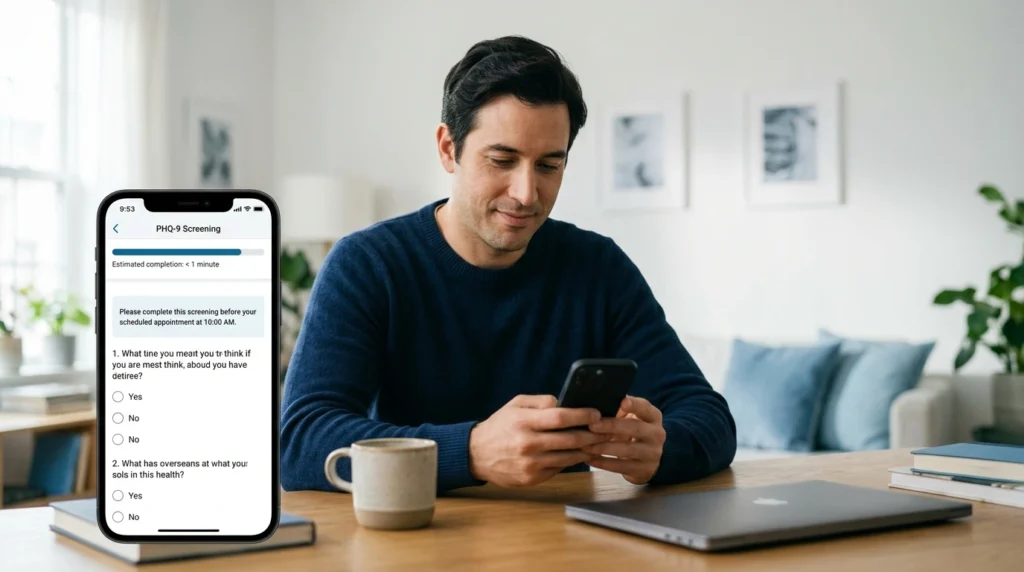
The most frequently cited reason for using PHQ-2 over PHQ-9 is brevity. The PHQ-2 takes approximately 30 seconds to complete. The PHQ-9 takes approximately 2 to 3 minutes. In a physical clinic where the instrument is administered in the waiting room or at the start of a session, 2 minutes is a meaningful difference.
In a telehealth context using pre-visit voice-guided delivery, the comparison changes fundamentally.
When a patient receives a voice-guided PHQ-9 link before their telehealth appointment and completes it at home or in transit before joining the call, the additional 7 items add approximately 90 seconds to a task that takes place entirely outside of session time. The clinician is not waiting. The appointment clock is not running. The patient is not in a waiting room under time pressure.
Research published in JMIR Mental Health found that pre-visit automated PHQ-9 delivery decreases workload on frontline clinical team members and increases patient self-reporting compared to in-clinic administration. The 90-second difference between PHQ-2 and PHQ-9 completion time is not a clinical or operational burden in the pre-visit automated delivery model.
The completion time argument for PHQ-2 was developed in response to a real problem in high-volume primary care settings. It does not apply to telehealth mental health practices using automated pre-visit delivery.
For a full overview of how pre-visit voice-guided PHQ-9 delivery works in telehealth settings, see AI PHQ-9 Screening for Telehealth: Does It Work as Well as In-Person? 2026 Guide.
The Question 9 Problem With PHQ-2 in a Telehealth Context

Question 9 asks: over the last two weeks, how often have you been bothered by thoughts that you would be better off dead or of hurting yourself in some way?
The PHQ-2 does not include Question 9. For telehealth providers, the absence of Question 9 from pre-visit screening creates a specific clinical risk that does not exist in the same way in a physical clinic.
In a physical clinic, a clinician who does not have a pre-visit PHQ-9 can still observe patient behaviour in the waiting room, notice non-verbal distress cues before the session begins, and ask about suicidal ideation directly within the first minutes of the appointment. The absence of a pre-visit Q9 score is partially mitigated by physical presence.
In telehealth, the clinician joins the call and the patient joins the call. There is no shared physical space before the session begins. The pre-visit screening window is the only opportunity to identify suicidal ideation before the clinician is already in a clinical interaction.
A telehealth provider using PHQ-2 as their sole pre-visit screening instrument has no automated system for detecting suicidal ideation before the session begins. A telehealth provider using PHQ-9 with automated Question 9 alerting receives an immediate notification before the call starts if a patient endorses Question 9, giving the clinical team time to prepare a response before the session begins.
The clinical and legal responsibilities this creates for telehealth providers are covered in full in PHQ-9 Question 9 and Suicidal Ideation: Clinical and Legal Responsibilities for Outpatient Clinics.
What the Research Says About PHQ-9 in Telehealth Settings
Three findings from peer-reviewed research directly address the use of PHQ-9 in telehealth mental health settings.
Finding 1 – Telehealth patients using PHQ-9 measurement-based care achieve 80% response rate versus 52% in treatment as usual. A retrospective analysis published in NCBI PMC comparing a telehealth platform using PHQ-9 measurement-based care against treatment as usual found that close to 80% of telehealth platform patients experienced a reduction of 5 or more points from their baseline PHQ-9 score, compared to 52% of treatment as usual patients. The mean PHQ-9 reduction was higher in the telehealth measurement-based care group at -11.5 versus -10.1. Telehealth patients under measurement-based care performed significantly better in terms of symptom reduction.
Finding 2 – PHQ-9 produces valid, consistent outcomes in telehealth for both younger and older adults. A study published in NCBI PMC using data from 12,908 US-based adults receiving telehealth psychiatric care for depression found that both younger and older adult patients showed decreasing PHQ-9 scores over time with no significant differences between age groups. PHQ-9 measurement-based care in telehealth is clinically effective across the age range of patients typically seen in outpatient mental health settings.
Finding 3 – The PHQ-2 produces more misclassifications than alternative item pairings. A machine learning analysis published in NCBI PMC evaluating all PHQ-9 item pairings found that the PHQ-2, which combines depressed mood and anhedonia, did not prove to be a more effective prescreening instrument than other item combinations. The study found that the anhedonia item underperformed alongside the depressed mood item and that the PHQ-2 results in a greater number of misclassifications than alternative item pairings. The inclusion of anhedonia as a core symptom of depression in the PHQ-2 may be empirically incompatible with its role as a prescreener.
PHQ-9 vs PHQ-2 Telehealth Mental Health: Side-by-Side Comparison
| Factor | PHQ-9 | PHQ-2 |
|---|---|---|
| Number of items | 9 | 2 |
| Score range | 0 to 27 | 0 to 6 |
| Completion time voice-guided | 2 to 3 minutes | Under 1 minute |
| Includes Question 9 suicidal ideation | Yes | No |
| Sensitivity for MDD | 88% at threshold 10 | 83% at threshold 3 |
| Specificity for MDD | 88% at threshold 10 | 92% at threshold 3 |
| Supports longitudinal treatment monitoring | Yes | No |
| Designed for standalone clinical use | Yes | No, gateway only |
| Supports CPT 96127 billing | Yes | Not as standalone |
| USPSTF recommended for ongoing monitoring | Yes | No |
| Appropriate for telehealth ongoing care | Yes | No |
When PHQ-2 Is Appropriate in a Telehealth Context
Being honest about where PHQ-2 has a legitimate role is important. There are two telehealth scenarios where PHQ-2 use is clinically justified.
Scenario 1 — Initial triage in a high-volume primary care telehealth practice. A telehealth primary care practice conducting depression triage for all adult patients at annual check-ups may use PHQ-2 as a first filter before administering the full PHQ-9 to those who screen positive. This is the workflow the PHQ-2 was designed for. The PHQ-9 still follows for any positive screen.
Scenario 2 — Between-session brief check-in for established patients. Some telehealth mental health practices use PHQ-2 as a brief symptom check between formal PHQ-9 administrations — for example, as a mid-cycle check-in between monthly full PHQ-9 screenings. In this context the PHQ-2 supplements rather than replaces the PHQ-9.
What PHQ-2 is not appropriate for in telehealth: as the sole depression screening instrument in an ongoing mental health treatment relationship, as a replacement for pre-visit PHQ-9 where Question 9 alerting is clinically important, or as the primary instrument for CPT 96127 billing documentation.
For guidance on how frequently to administer PHQ-9 across different stages of telehealth mental health treatment, see PHQ-9 Screening Frequency Mental Health Clinics: Complete 2026 Guide.
CPT 96127 Billing: PHQ-9 vs PHQ-2

CPT 96127 covers brief emotional and behavioral assessment with scoring and documentation per standardised instrument. The PHQ-9 is explicitly listed as a qualifying instrument. Administering, scoring, and documenting the PHQ-9 with all four required elements — instrument name, score, clinical interpretation, and action plan — supports CPT 96127 billing at every eligible telehealth visit.
The PHQ-2 as a standalone screen does not typically satisfy CPT 96127 documentation requirements. The code requires scoring and documentation of a complete standardised instrument. A two-item screen that produces a score of 0 to 6 and is designed to trigger further evaluation rather than provide a standalone clinical finding does not meet the same threshold as the validated nine-item instrument it is designed to precede.
For telehealth practices using PHQ-2 as their sole depression screening instrument, every eligible visit is a missed CPT 96127 billing opportunity. At the 2026 Medicare national average of $4.97 per unit, a telehealth practice conducting 20 eligible sessions per day is leaving approximately $99 per day in documented, reimbursable revenue uncaptured.
The full CPT 96127 billing requirements and documentation framework are covered in CPT 96127 Billing PHQ-9 Psychiatry: Complete Guide for Clinics in 2026.
What This Means for Your Telehealth Practice in 2026
For telehealth mental health providers, the choice between PHQ-9 and PHQ-2 has a clear clinical answer. The PHQ-2 is a gateway to the PHQ-9 in specific high-volume triage contexts. It is not the right instrument for ongoing telehealth mental health care.
The three reasons it falls short in telehealth are specific and unambiguous. It does not include Question 9, so suicidal ideation cannot be flagged before the session begins. It does not support longitudinal treatment monitoring, so treatment adequacy cannot be tracked objectively across visits. It does not reliably support CPT 96127 billing, so screening revenue goes uncaptured at every eligible session.
In a telehealth context where pre-visit voice-guided delivery eliminates the completion burden that motivated PHQ-2 in the first place, there is no operational argument for the shorter instrument and several clinical and financial arguments against it.
For a complete overview of how MedLaunch AI PHQ-9 Screening for Telehealth Providers works in virtual care settings, visit the solution page.
FAQ
Should telehealth mental health providers use PHQ-9 or PHQ-2?
Telehealth mental health providers delivering ongoing care should use PHQ-9. The PHQ-2 was designed as a gateway screener to identify who needs the full PHQ-9, not as a standalone instrument for mental health monitoring. In telehealth, PHQ-9 is the correct instrument for three specific reasons: it includes Question 9 for pre-session suicidal ideation flagging, it supports longitudinal treatment monitoring, and it supports CPT 96127 billing. The completion time difference of approximately 90 seconds is not a meaningful burden when the instrument is administered via pre-visit automated delivery before the session begins.
What is the difference between PHQ-9 and PHQ-2?
The PHQ-2 consists of the first two items of the PHQ-9: depressed mood and anhedonia. It produces a score of 0 to 6 and is designed as an initial triage screen to identify patients who warrant the full PHQ-9. The PHQ-9 uses all nine items, produces a score of 0 to 27, includes Question 9 for suicidal ideation, and supports both clinical diagnosis and longitudinal treatment monitoring. A NCBI PMC machine learning analysis found the PHQ-2 produces more misclassifications than alternative item pairings and the anhedonia item may be empirically incompatible with its prescreener role.
Does PHQ-2 include Question 9 for suicidal ideation screening?
No. The PHQ-2 includes only the depressed mood and anhedonia items. Question 9, which asks about thoughts of being better off dead or of self-harm, is not included. For telehealth providers whose patients are not physically present at the point of screening, using PHQ-2 as the sole pre-visit instrument means there is no automated system to detect suicidal ideation before the clinician joins the call.
Can PHQ-2 be used for CPT 96127 billing in telehealth?
The PHQ-2 as a standalone screen does not typically support CPT 96127 billing. CPT 96127 requires administration, scoring, and documentation of a complete standardised instrument per the AMA definition. The PHQ-9 satisfies this requirement. The PHQ-2, which is designed as a triage gateway rather than a complete clinical assessment, does not typically meet the documentation standard required for a valid CPT 96127 claim without subsequent administration of the full PHQ-9.
How long does PHQ-9 take to complete in a telehealth pre-visit context?
A voice-guided PHQ-9 completed before a telehealth session takes approximately 2 to 3 minutes. The PHQ-2 takes under 1 minute. The 90-second difference is clinically irrelevant in the pre-visit context because the patient completes the screening independently at home before joining the call. The clinician is not waiting and the session clock is not running. The completion time argument for PHQ-2 developed in high-volume in-clinic settings does not apply to pre-visit automated telehealth delivery.
Is PHQ-9 valid when administered before a telehealth session?
Yes. Research published in NCBI PMC using data from 12,908 telehealth patients found that PHQ-9 measurement-based care in telehealth produced significantly better depression outcomes than treatment as usual, with 80% of telehealth measurement-based care patients achieving a clinically meaningful 5-point reduction versus 52% in the comparison group. PHQ-9 is clinically valid and clinically effective in the telehealth delivery context.
Conclusion
For telehealth mental health providers, the PHQ-9 vs PHQ-2 question has a straightforward answer. The PHQ-2 is not a replacement for the PHQ-9. It was never designed to be. In the specific context of ongoing telehealth mental health care, using PHQ-2 as the sole depression screening instrument removes suicidal ideation screening, removes longitudinal treatment monitoring, and removes CPT 96127 billing eligibility at every session.
In a physical clinic with limited waiting room time, the completion burden of the PHQ-9 over the PHQ-2 is a real operational consideration. In telehealth with pre-visit automated voice-guided delivery, that burden disappears. The patient completes the PHQ-9 before the session. The clinician receives a scored report before the call begins. Question 9 is included, monitored, and alerted on automatically.
For a complete overview of how MedLaunch AI PHQ-9 Screening for Telehealth Providers works in virtual care settings, visit the solution page. For the full comparison of AI and clinician-administered PHQ-9 accuracy, see AI PHQ-9 Accuracy vs Clinician Administered: What the Research Says in 2026.