


Key Takeaways
-
1Patient Volume Reflects Operations: Volume depends on how well a practice manages access, scheduling, utilization, and care continuity across the patient journey, not how much it spends on advertising.
-
2No-Shows Reduce Volume: With industry no-show rates around 23–33%, the fastest way to increase completed visits is recovering scheduled appointments through reminders, confirmations, and same-day slot filling.
-
3Capacity Often Underused: Before hiring staff or opening new locations, most clinics can increase daily volume by aligning appointment lengths with visit types, reducing idle gaps, and filling cancellations quickly.
-
4Return Visits Drive Growth: Scheduling follow-ups before patients leave, reducing friction between visits, and maintaining care continuity increases visit frequency far more efficiently than acquiring new patients.
-
5Volume Needs System Management: Tracking daily census, visit turnover, attendance, and no-show rates helps identify bottlenecks early and enables timely operational adjustments.
What’s the secret behind clinics that never have empty appointment slots? Yet despite all that activity, patient volume often remains flat, unpredictable, or inconsistent month over month. This disconnect leaves clinic leaders frustrated, unsure why effort does not translate into sustainable growth.
The reality is that patient volume is rarely a demand problem. In most cases, people are already seeking care. The challenge lies in how effectively a practice converts that demand into completed visits. When access is limited, workflows are inefficient, or continuity breaks down, patient volume stalls even when interest is high.
Rather than viewing patient volume as a marketing outcome, it is more accurate to see it as an operational result. Volume reflects how well a practice manages access, utilization, experience, and follow-through across the entire care journey. Improving patient volume is less about attracting attention and more about removing friction inside the system.
This blog focuses on how practices can increase patient volume by improving operational efficiency, access, patient attendance, and continuity of care.
The strategies outlined here are designed to help practices stabilize daily census, optimize capacity, and support long-term patient volume growth without relying on short-term tactics. So, it’s time to stop guessing and start using strategies that consistently increase patient volume and streamline your clinic operations.
Table of Contents
What Patient Volume Really Means

Patient volume is often misunderstood as simply the number of new patients a practice brings in, but in reality it represents the total number of completed visits delivered over time.
It reflects how many patients are seen each day, how frequently existing patients return for care, and how effectively scheduled appointments convert into actual visits rather than missed ones.
Average no‑show rates often range from 23% to 33%, meaning a significant share of scheduled demand never converts into completed visits and real patient volume.
From an operational viewpoint, patient volume is a system-level outcome influenced by capacity management, resource allocation, patient attendance, and visit turnover throughout the day.
Two practices may attract similar demand, yet experience very different results depending on how efficiently they manage access, scheduling, and care delivery.
Understanding patient volume this way shifts the focus away from marketing alone and toward operational efficiency, continuity of care, and the systems that support consistent, sustainable patient volume improvement.
Patient Volume vs New Patient Acquisition
Patient volume is often confused with new patient acquisition, but the two are not the same. Acquiring new patients brings people into the system, while patient volume reflects how many visits are actually completed over time. A practice can attract new patients and still struggle with patient volume improvement if those patients fail to return or face barriers to care.
Patient Volume vs Visit Frequency
Another common misunderstanding is equating patient volume solely with the number of unique patients. In reality, patient visit frequency plays a critical role. Follow-up visits, preventive care, and ongoing treatment plans often account for a significant share of daily patient load. Improving visit frequency among existing patients can increase patient volume faster than acquiring new ones.
Why Volume Is a System-Level Outcome
Patient volume is the result of how multiple systems work together. Scheduling, staffing, care coordination, capacity management, and patient experience all influence whether visits are completed or lost. When these elements align, patient volume optimization happens naturally. When they do not, missed visits and idle capacity become the norm.
Why Clinics Struggle to Increase Patient Volume
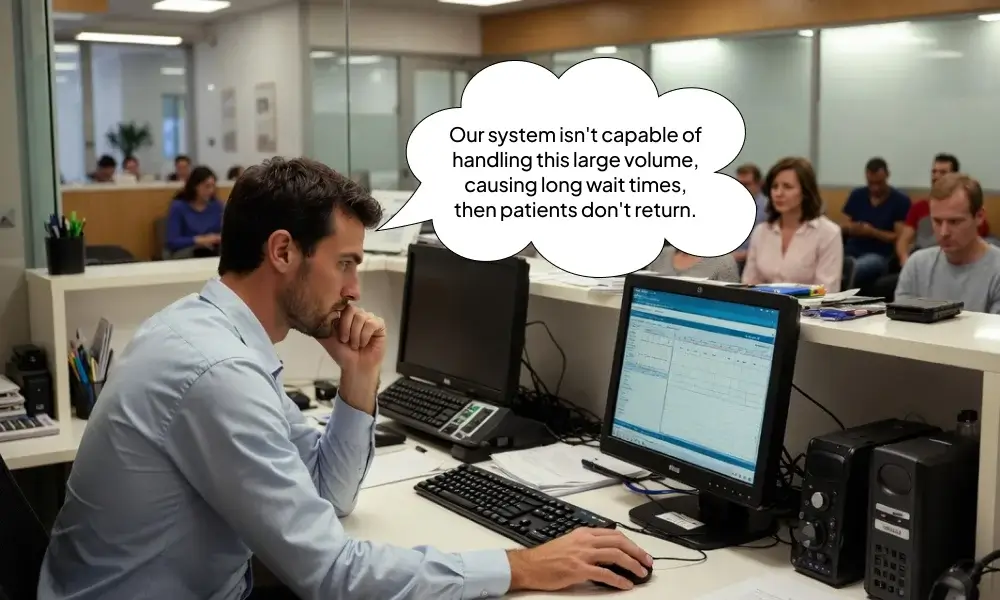
1. Operational Limitations Clinics Underestimate
Most clinics underestimate how small operational constraints affect volume. Limited appointment availability, rigid scheduling rules, or unclear workflows create bottlenecks that restrict patient flow. Over time, these constraints suppress patient volume even when demand remains strong.
Patient flow solutions, like automated scheduling and real-time tracking, can help eliminate these bottlenecks.
2. Scheduling, Staffing, and Workflow Friction
Scheduling friction is one of the biggest barriers to improving appointment volume. If patients struggle to find suitable time slots or experience long delays, AI patient scheduling can streamline the process, reducing abandonment and improving appointment flow.
Staffing imbalances and inefficient workflows further compound the problem, reducing visit turnover and limiting daily census.
3. The Compounding Effect of Small Inefficiencies
Small inefficiencies rarely appear critical on their own. However, when combined, they significantly impact patient attendance and completed visits. A few missed calls, delayed follow-ups, or unfilled cancellations can quickly reduce patient volume improvement over weeks and months.
Strategies for Improving Patient Volume in Your Clinics

Strategy 1: Improve Patient Access to Appointments
Access is the first and most critical gatekeeper of patient volume. When patients cannot easily book an appointment because phone lines are busy, online booking does not exist, or the next available slot is three weeks away, volume is lost before care even begins. The patient does not wait. They book elsewhere or delay care entirely.
How to improve patient access immediately:
- Add online self-scheduling — patients expect to book appointments the same way they book everything else; a practice that requires a phone call to schedule loses a measurable percentage of appointment requests to competitors who offer 24-hour digital booking; configure online scheduling to display real-time availability across all providers and locations
- Reduce new patient appointment lead times to under two weeks — lead times exceeding two weeks are one of the most commonly cited reasons new patients choose a different provider; audit your current new patient availability weekly and adjust scheduling templates to protect dedicated new patient slots that cannot be filled by return visits
- Add same-day and next-day appointment capacity — reserve a defined percentage of each day’s schedule — typically 15 to 20 percent — for same-day and next-day bookings; practices that offer same-day access convert significantly more patient inquiries into completed visits than those that offer only advance scheduling
- Eliminate phone hold time as the primary booking channel — measure your average phone hold time and abandonment rate monthly; if patients are waiting more than two minutes or abandoning calls at a rate above 10 percent your access problem is compounding daily; implement an AI medical receptionist to handle appointment booking, rescheduling, and patient inquiries across all hours without adding front-desk headcount
- Offer multiple booking channels simultaneously — phone, online portal, SMS-based booking, and patient app scheduling serve different patient demographics; limiting booking to a single channel excludes the patients who prefer other methods and suppresses total appointment conversion rate
- Audit your new patient intake friction — time how long it takes a new patient to complete their first booking from initial contact to confirmed appointment; every step that requires patient effort without delivering patient value is a drop-off point; the most common friction points are duplicate intake forms, insurance verification delays, and unclear instructions about what to bring to the first visit
Outcome: Practices that reduce booking friction and expand access channels consistently see new patient conversion rates improve by 20 to 35 percent without any increase in marketing spend.
Strategy 2: Expand Appointment Availability Without Hiring More Staff
The most common assumption when patient volume plateaus is that more staff are needed to see more patients. In most cases this assumption is wrong. The majority of practices have unused capacity already built into their existing schedule. It is simply allocated inefficiently, lost to no-shows, or blocked by rigid scheduling rules that prevent flexible use of available time.
How to expand availability without adding headcount:
- Cross-train clinical staff to cover multiple appointment types — staff who can support only one specific visit type create scheduling bottlenecks when demand for that visit type spikes; cross-training medical assistants and nurses to support a broader range of appointment types gives schedulers more flexibility to fill available slots efficiently.
- Audit your current schedule utilization rate — calculate what percentage of available appointment slots are actually filled with completed visits each week; most practices discover utilization rates between 70 and 80 percent, meaning 20 to 30 percent of existing capacity is already going unused before any expansion conversation is necessary.
- Introduce staggered provider start times — if all providers begin and end their sessions at the same time, the practice creates predictable demand spikes at opening and closing with underutilized midday capacity; staggering start times by 30 to 60 minutes across providers smooths patient load throughout the day and extends the effective appointment window without extending anyone’s working hours.
- Add early morning and early evening appointment slots — patients with work or school commitments cannot attend midday appointments; adding two to four slots before 8 AM or after 5 PM significantly increases access for working-age patients without requiring a full schedule extension.
- Implement telehealth for appropriate visit types — virtual appointments for follow-ups, chronic disease check-ins, medication reviews, and low-acuity concerns eliminate geographic and scheduling barriers for patients who struggle to attend in person; telehealth visits also typically have lower no-show rates than in-person appointments because the barrier to attendance is lower.
- Use group visit models for appropriate chronic care patients — for patients managing diabetes, hypertension, or weight management, structured group medical appointments allow one provider to deliver care to six to twelve patients simultaneously; group visits increase provider productivity per hour while maintaining individualized care components.
Strategy 3: Increase Utilization of Existing Capacity
Many outpatient practices operate with a substantial amount of unused capacity without realizing it. Operational benchmarks often target around 75–85% provider utilization, yet real‑world analyses frequently find clinics running closer to 70%.
This means roughly 30% of available appointment time is lost to gaps between visits, mismatched slot lengths, idle room time, and appointment types scheduled into slots that don’t fit their true duration.
Closing this utilization gap is one of the fastest ways to increase completed visits without changing anything about how the practice attracts patients.
How to increase capacity utilization systematically:
- Use an AI patient scheduling system to optimize slot allocation automatically — manual scheduling templates are updated infrequently and drift out of alignment with actual demand patterns over time; AI scheduling systems analyze historical appointment data, visit duration patterns, and provider availability in real time to optimize slot allocation continuously without requiring manual template adjustments.
- Match appointment slot length to actual visit duration by type — conduct a 30-day audit of actual visit durations segmented by appointment type and compare them to scheduled slot lengths; most practices discover that routine follow-ups are scheduled in 20-minute slots that consistently take 12 minutes while new patient consultations are scheduled in 30-minute slots that consistently require 45; correcting these mismatches alone typically recovers 8 to 12 additional appointment slots per provider per week.
- Implement a gap-filling protocol for cancellations — every cancellation should trigger an automatic outreach to a defined waitlist of patients who have requested earlier appointments; practices without a waitlist and gap-filling protocol lose the revenue from every cancellation permanently while practices with one recover 60 to 80 percent of canceled slots.
- Reduce between-appointment idle time — measure the average gap between consecutive appointments for each provider and identify whether idle time is caused by provider documentation delays, room turnover inefficiency, or scheduling template gaps; each of these has a different operational fix but all of them produce recoverable appointment capacity when addressed.
- Audit exam room utilization by time of day — track which exam rooms are occupied, being cleaned, or sitting idle at each hour of the clinical day; practices that identify consistent patterns of room underutilization at specific times can adjust scheduling templates to concentrate appointments during high-room-availability periods and reduce the bottlenecks that occur when multiple providers need rooms simultaneously.
Strategy 4: Reduce No-Shows and Appointment Leakage

No‑shows and late cancellations are the single largest source of recoverable lost volume in many practices. While national averages across all specialties are often reported in the 5–10% range, published studies and industry reports show that some outpatient clinics experience no‑show rates as high as 20–30% or more.
For a practice seeing 100 patients per day, a 20–30% no‑show rate means losing the equivalent of 20 to 30 completed visits daily to appointments that were scheduled but never delivered.
At an average revenue of roughly $150–$233 per outpatient visit, that represents about $3,000 to $7,000 in daily revenue at risk from a problem that is largely preventable with the right systems.
How to reduce no-shows and recover lost appointment volume:
- Address the root causes of no-shows by category — not all no-shows have the same cause; transportation barriers require different solutions than appointment anxiety, which requires different solutions than scheduling inconvenience; segment your no-show reasons through post-no-show outreach and address the top two or three root causes specifically rather than applying a generic reminder solution to a multi-cause problem.
- Implement a multi-touch reminder sequence — a single reminder sent the day before is insufficient for meaningful no-show reduction; implement a three-touch sequence: a confirmation message sent immediately at booking, a reminder sent 72 hours before the appointment, and a final reminder sent the morning of the appointment; each additional reminder touch reduces no-show probability by 20 to 30 percent.
- Use two-way SMS confirmation — reminders that require patients to actively confirm their appointment produce significantly lower no-show rates than one-way notifications that require no response; configure your reminder system to require a reply confirmation and automatically flag non-responders for a follow-up call from front-desk staff 24 hours before the appointment.
- Use an AI appointment setter to automate reminder sequences and confirmation follow-up — manual reminder systems are inconsistently executed and consume significant front-desk time; automated reminder sequences triggered by appointment booking ensure every patient receives every reminder touch without staff intervention.
- Build a same-day cancellation recovery protocol — define a specific workflow that triggers immediately when a same-day cancellation is received: notify the scheduling team, contact the top three patients on the waitlist by SMS simultaneously, and offer the slot to the first patient who confirms; practices with a defined same-day recovery protocol fill 60 to 75 percent of same-day cancellations compared to under 20 percent for practices without one.
- Identify and proactively manage high no-show risk patients — analyze your no-show history to identify the patient characteristics most predictive of non-attendance in your specific practice — commonly including new patients, patients with a previous no-show history, Monday morning appointments, and patients who booked more than three weeks in advance; apply additional confirmation touches to high-risk appointments proactively rather than treating all appointments identically.
Strategy 5: Make It Easier for Patients to Return
Return visits from existing patients are the fastest and lowest-cost lever for increasing patient volume. A patient who returns for a follow-up, a preventive care visit, or a chronic disease check-in generates completed visit revenue at zero acquisition cost.
Yet most practices leave return visit scheduling entirely to patient initiative. Patients who are not prompted, reminded, and made to feel expected do not consistently return on their own.
How to systematically increase return visit rates:
- Segment return visit outreach by care type and recency — a patient who missed their 3-month chronic disease follow-up needs different outreach than a patient who has not visited in 18 months; personalized outreach that references the specific care context produces significantly higher rebooking rates than generic “we miss you” messages.
- Schedule the next appointment before the patient leaves the building — the single highest-impact return visit intervention is booking the follow-up appointment at check-out while the care plan is fresh and the patient is physically present; practices that consistently schedule next appointments at check-out see return visit rates 30 to 40 percent higher than practices that ask patients to call when they are ready to book.
- Send a care plan summary with the next appointment already included — provide every patient with a written or digital post-visit summary that includes not just their diagnosis and treatment plan but also the date and time of their already-scheduled next appointment; patients who leave with a confirmed appointment on their calendar are significantly less likely to cancel than patients who leave with only a verbal recommendation to return.
- Automate preventive care and chronic disease recall outreach — identify every patient in your panel who is overdue for an annual wellness visit, a scheduled screening, or a chronic disease management appointment and send automated personalized outreach through their preferred channel; do not wait for patients to remember to book — reach out to them with a specific appointment offer before they fall further behind on their care schedule.
- Remove friction from the rebooking process — every step a patient must complete to rebook an appointment is a drop-off point; offer direct rebooking links in post-visit follow-up messages, allow patients to confirm their next appointment by replying to an SMS, and eliminate any requirement for patients to call the front desk for routine follow-up scheduling.
Strategy 6: Improve the In-Clinic Experience
Patient experience directly determines whether a completed visit leads to another completed visit. A patient who experiences long unexplained waits, a confusing check-in process, or a rushed provider interaction leaves with a lower likelihood of returning and a lower likelihood of recommending the practice to others.
In group practices where patient volume depends on consistent return visits and word-of-mouth referrals, in-clinic experience is not a satisfaction initiative. It is a volume growth strategy.
How to improve in-clinic experience to support volume growth:
- Close every visit with a clear next step — patients who leave a visit knowing exactly what happens next, their follow-up appointment date, their prescription pickup instructions, and their test result timeline, have a significantly better overall experience than patients who leave feeling uncertain. Uncertainty about next steps is one of the most common sources of post-visit dissatisfaction and one of the most preventable.
- Communicate wait times proactively and accurately — patients who are told their provider is running 15 minutes behind and understand why are significantly more tolerant of delays than patients who wait in silence with no information; train front-desk staff to proactively update waiting patients every 10 minutes when delays exceed 10 minutes.
- Reduce actual wait times by addressing scheduling root causes — perceived wait time management is important but actual wait time reduction is more important; the most common causes of chronic in-clinic delays are appointment template overbooking, late provider starts, and documentation bottlenecks between patients; address each root cause specifically rather than managing patient perception of a delay that could be prevented.
- Streamline check-in with digital pre-registration — patients who complete intake forms, insurance verification, and consent documentation digitally before arriving at the clinic move through check-in in under three minutes rather than the 10 to 15 minutes required for paper-based intake; faster check-in improves patient experience, increases room turnover rate, and reduces front-desk congestion during peak arrival periods.
Strategy 7: Increase Trust, Visibility, and Confidence

Trust is what converts a patient who found your practice online into a patient who books an appointment. Visibility is what determines whether they find you in the first place.
For most practices, digital trust and local search visibility are the two highest-leverage external factors affecting new patient volume, and both are largely within the practice’s control.
How to build trust and visibility that drives patient volume:
- Publish condition-specific content that answers patient questions — patients who find a blog post or FAQ on your website that answers a health question they searched for arrive at your practice with pre-established trust and a significantly higher booking conversion rate than patients who arrive through paid advertising with no prior content exposure.
- Optimize your Google Business Profile completely — your GBP listing is the first thing most new patients see before visiting your website; ensure your profile includes accurate hours, all accepted insurance plans, all service categories, current photos of the practice interior and exterior, and a consistent stream of responses to patient reviews; practices with fully optimized GBP listings receive 70 percent more appointment requests than practices with incomplete profiles.
- Generate Google reviews systematically not occasionally — online reviews are the primary trust signal for new patients evaluating your practice; implement a post-visit review request that goes to every satisfied patient automatically via SMS within two hours of their visit; do not rely on patients to leave reviews spontaneously — the practices with the most reviews are almost always the ones with the most systematic review generation processes.
- Respond to every review including negative ones — new patients read how practices respond to negative reviews as much as they read the reviews themselves; a professional, empathetic response to a negative review that acknowledges the concern and explains the improvement made consistently converts undecided new patients more effectively than a collection of five-star reviews with no practice responses.
- Ensure your practice appears in local search results for relevant queries — claim and optimize your listings on Healthgrades, Zocdoc, Yelp, and specialty-specific directories in addition to Google; new patients searching for care often use multiple platforms before selecting a provider and practices that appear consistently across platforms capture a disproportionate share of new patient bookings.
Strategy 8: Broaden Services to Capture More Visit Types
A practice that serves only a narrow range of visit types creates a ceiling on patient volume because patients with needs outside that range must go elsewhere. Once they establish care with another provider for one need, they often transfer all of their care.
Expanding the service mix strategically allows the practice to meet more patient needs within the same care relationship, increasing visit frequency, reducing referral leakage, and capturing visit types that would otherwise generate revenue for a competitor.
How to expand services to grow patient volume:
- Add telehealth as a permanent service channel — virtual visits for follow-ups, medication management, chronic disease check-ins, and low-acuity acute concerns expand access for patients who cannot attend in person and reduce the no-show rate for visit types that do not require physical examination.
- Add preventive care and wellness services — annual wellness visits, preventive screenings, and vaccination programs generate recurring visit volume from healthy patients who would otherwise have no reason to schedule; preventive care patients also have significantly higher lifetime retention rates than patients who visit only for acute concerns.
- Introduce chronic disease management programs — structured programs for diabetes, hypertension, obesity, and cardiovascular risk management generate multiple visits per patient per year and qualify for value-based care reimbursement in addition to fee-for-service revenue; each chronic disease patient enrolled in a structured management program contributes three to six completed visits annually compared to one to two for a standard episodic care patient.
- Evaluate behavioral health integration — integrating behavioral health services into a primary care or specialty practice captures a significant volume of patient needs that currently result in referral leakage; patients referred out for behavioral health frequently do not follow through on the referral, losing the visit volume entirely.
Strategy 9: Reactivate Inactive and Missed Patients
Inactive patients are the most underutilized volume resource in most practices. A patient who visited 18 months ago and has not returned since represents a care gap, a revenue opportunity, and a retention risk simultaneously.
Unlike new patient acquisition which requires marketing investment to attract someone who has never heard of the practice, patient reactivation targets people who already know you, have already experienced your care, and simply need a reason and an easy pathway to return.
How to build a patient reactivation system that increases volume:
- Make rebooking a single step — include a direct booking link in every reactivation message so the patient can confirm an appointment with one tap rather than navigating to a website or calling the front desk; every additional step required reduces reactivation conversion rate measurably.
- Define inactivity thresholds by care type — a patient who has not visited in 12 months is inactive for primary care; 6 months is inactive for chronic disease management; 18 months is inactive for preventive-only patients; applying a single inactivity threshold across all patient types produces both over-outreach to patients who are appropriately between visits and under-outreach to patients who are genuinely overdue.
- Segment inactive patients by reactivation priority — prioritize outreach to patients with known care gaps such as overdue screenings or incomplete treatment plans, patients with chronic conditions who have missed scheduled follow-ups, and patients who were previously high-visit-frequency attenders; lower priority goes to patients who visited once for an acute concern with no ongoing care need.
- Send personalized reactivation outreach referencing specific care context — a message that says “we noticed you are due for your annual diabetes management review” produces significantly higher response rates than a generic “we have not seen you in a while” message; personalization signals that the practice remembers the patient and has a specific clinical reason for reaching out.
- Use a multi-touch reactivation sequence — send an initial outreach message, follow up with a second message 10 days later if no response, and make a personal phone call for high-priority patients who do not respond to either message; a three-touch sequence recovers two to three times more inactive patients than a single outreach attempt.
Strategy 10: Systemize Patient Volume Management
Patient volume improvement achieved through one-time initiatives does not last. Practices that fix their scheduling template once and never review it again, run a reactivation campaign once a year and call it done, or monitor no-show rates only when volume drops are not managing patient volume. They are reacting to it.
Sustainable volume growth requires treating patient volume as an ongoing operational system with defined metrics, regular review cadences, and clear accountability for each component.
How to build a patient volume management system:
- Set quarterly volume improvement targets — define a specific, measurable volume improvement goal each quarter such as reducing no-show rate by 3 percentage points, increasing capacity utilization from 74 to 82 percent, or reactivating 15 percent of patients inactive for more than 12 months; quarterly targets with defined owners and review dates produce consistent incremental improvement that compounds into significant volume growth over 12 to 18 months.
- Define your core volume metrics and review them weekly — daily census, scheduled vs completed visit ratio, no-show rate, cancellation recovery rate, new patient conversion rate, and return visit rate are the six metrics that together give a complete picture of volume performance; practices that review these metrics weekly identify and address problems before they compound into significant volume loss.
- Assign ownership of each volume metric to a specific role — no-show rate is owned by the care coordinator; scheduling utilization is owned by the practice manager; new patient conversion rate is owned by the front-desk lead; metrics without an owner do not get improved.
- Build a monthly volume review into leadership meetings — present volume metrics alongside revenue and clinical quality metrics in every leadership meeting so volume performance is treated with the same operational seriousness as financial performance.
- Use patient flow solutions to automate volume monitoring and reporting — manual data collection for volume metrics is time-consuming and inconsistently executed; automated dashboards that pull scheduling, completion, and attendance data in real time give practice managers actionable intelligence without requiring manual report generation.
Common Mistakes That Limit Patient Volume

Many practices attempt to increase patient volume without addressing root causes. Overbooking without improving access leads to burnout and poor experience. Adding services without fixing scheduling creates chaos rather than growth.
Focusing only on marketing ignores operational constraints that limit throughput. Ignoring no-show patterns allows missed visits to quietly erode patient volume over time.
Avoiding these mistakes is essential for meaningful patient volume improvement.
Sustainable Patient Volume vs Short-Term Growth
Short-term tactics may temporarily increase patient traffic, but they often come at a cost. Overloading staff increases burnout and reduces care quality. Patient experience suffers when volume exceeds operational capacity.
Sustainable patient volume growth balances demand with operational efficiency. Practices that prioritize capacity management, care coordination, and experience build volume that lasts.
Long-term success comes from systems that support consistent patient load without compromising care.
Conclusion
Increasing patient volume is not about working harder or spending more. It is about working smarter within the systems that shape access, utilization, and continuity of care.
By viewing patient volume as an operational outcome, practices can identify where visits are lost and where capacity is underused. Small improvements in access, scheduling, experience, and follow-up compound into meaningful patient volume growth over time.
When patient volume is managed intentionally, clinics achieve more completed visits, stronger patient relationships, and sustainable operational performance. This approach not only improves daily patient volume but also positions practices for long-term stability and success.
FAQs
How is patient volume different from patient acquisition?
Patient volume measures the total number of patients seen, while patient acquisition tracks how many new patients are brought in.
How does patient experience impact volume growth?
Positive experiences drive repeat visits and referrals, directly increasing patient volume.
Which marketing tactics are working best now to grow volume?
Digital ads, social media engagement, email campaigns, and targeted referral programs are most effective.
What operational changes help see more patients without burnout?
Streamlining workflows, automating scheduling, and optimizing staff allocation reduce strain while increasing capacity.
What are the risks of pushing for higher volume?
Overloading staff can reduce care quality, harm patient experience, and increase burnout.