
Key Takeaways: GP Clinic Instagram DMs
-
1The Shift in Patient Search: Instagram is now a primary first-contact channel. With 80% of patients starting searches on Google/AI and 26% influenced by AI reviews, those who reach your Instagram are much closer to booking than realized.
-
2A Structural Response Gap: Front desk staff are overwhelmed with phones, check-ins, and admin. Real-time Instagram monitoring doesn’t fit into the traditional workflow, making the response gap a design problem, not a staffing failure.
-
3Five Points of Disappearance: Enquiries vanish through unanswered DMs, unaddressed comments on Reels/posts, unseen story replies, delayed responses that arrive too late, and generic auto-replies that offer no path to booking.
-
4The High Cost of Non-Response: Patients who DM have already built trust through your content. The DM is the final step in their decision; failing to respond here is the costliest mistake in the acquisition journey.
-
5Intentionality in Communication: The fix must be structural. Instagram needs to be managed as a serious patient channel with the same intentionality and workflow as phone or email communications.
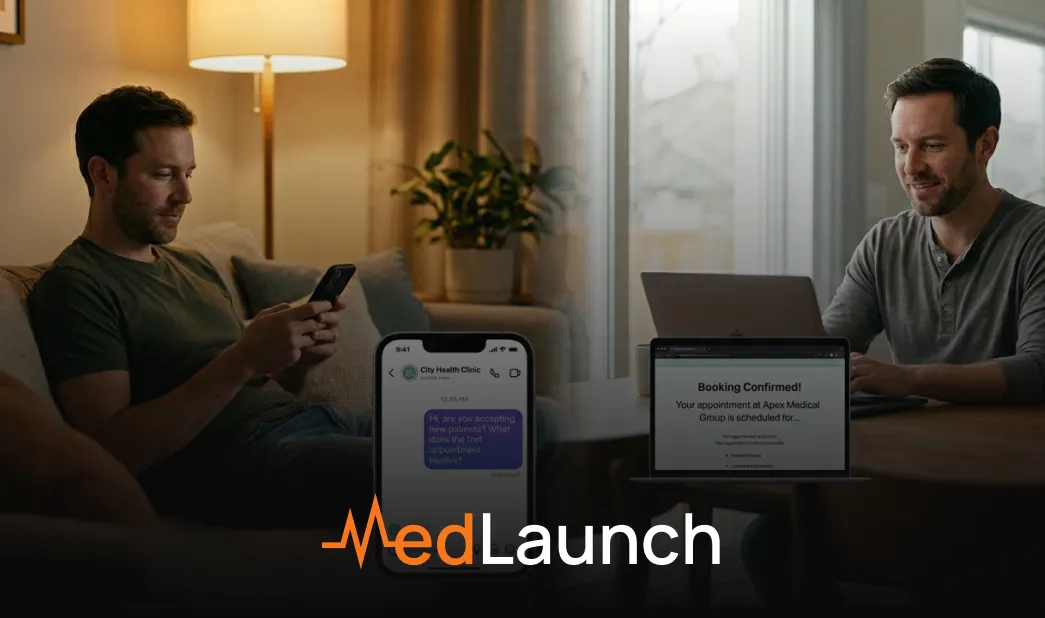
A new patient finds your GP clinic on Instagram. They have been dealing with a persistent health concern for weeks. They watched your health tips Reel, read through your bio, checked your reviews, and decided you look like the right fit.
They tap the DM button and type: “Hi, I am looking for a new GP. Do you have availability for new patients? What does the first appointment involve?”
They send it on a Sunday evening.
Your front desk sees it on Monday afternoon at 2pm, between a patient check-in and an incoming phone call.
By then, the patient has already booked with a clinic that replied on Sunday night.
If your GP clinic is active on Instagram and not seeing the booking conversions your follower count suggests you should be getting, this is almost certainly how the gap is operating. Not through a single obvious failure, but through a quiet, repeating pattern that most GP owners do not know exists until they start looking at their DM inbox carefully.
This guide explains exactly why it is happening, where the five specific loss points are, and what the structural fix looks like.
Table of Contents
1. Why GP clinics are now generating patient enquiries on Instagram
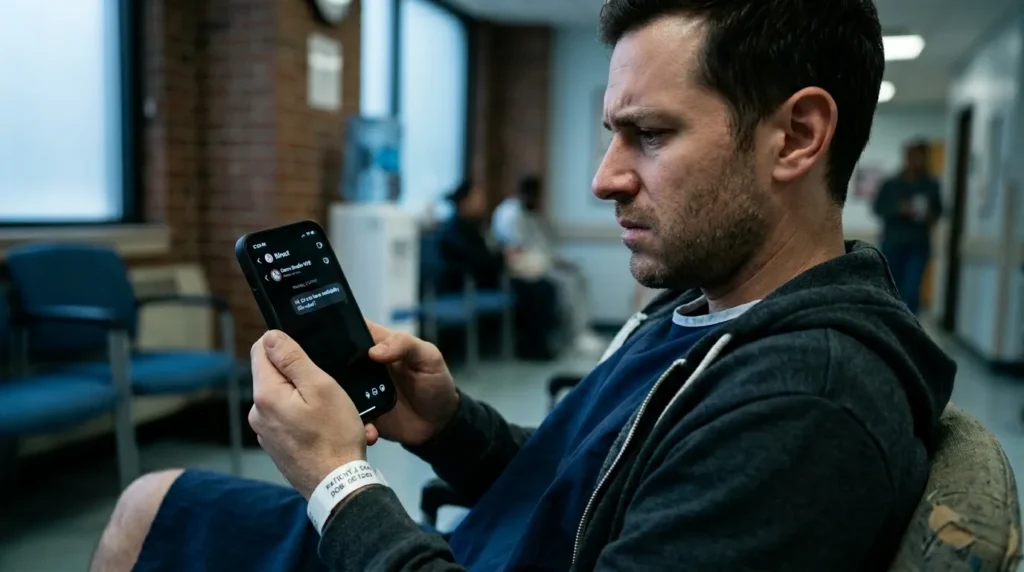
General practice has historically relied on physician referrals, word of mouth, and local proximity as the primary patient acquisition channels. That landscape has changed materially in 2026, and Instagram has entered the picture in a way that most GP clinic owners are still catching up to.
More than 80% of patients search online before booking an appointment, and the clinics that thrive in 2026 use full-funnel digital strategies that connect visibility, conversion, and patient retention. For GP clinics, Instagram is now sitting in the visibility layer of that funnel, and for a growing number of new patient enquiries, it is also the conversion layer.
The shift away from passive referral growth
Direct primary care practices and independent GP clinics are increasingly leveraging social media to build direct patient relationships, as the traditional referral pipeline becomes less reliable. GP clinics that are building Instagram audiences are not just creating brand awareness. They are generating first contact from patients who are actively looking for a new practice, have seen the clinic’s content, and have made enough of a trust decision to reach out directly.
What GP patients are looking for when they DM
The GP patient who sends an Instagram DM is not equivalent to someone passively scrolling past a clinic post. They have already decided they trust the clinic enough to make contact. The DM is almost always the last step before a booking, not the first step in an evaluation. They want to know whether you are accepting new patients. They want to understand what the first appointment involves. They want to know your billing model or whether you accept their insurance. They want to know if you have availability that works for their schedule.
These are buying questions. They are asking them via Instagram because Instagram is where they encountered the clinic and where the trust was built.
The volume is higher than most owners expect
A quarter of future patients are being nudged toward a provider by a large language model or AI search assistant before they ever visit the clinic’s website. The patients who reach Instagram have done enough searching to find the clinic specifically. For a GP clinic with an active Instagram presence and a few thousand engaged local followers, the volume of genuine patient enquiries arriving through DMs, comments, and story replies each week is typically higher than owners realise, precisely because no one on the team is systematically counting them.
2. Why the response gap is larger than most GP owners realise
It is easy to assume that a missed DM occasionally is a minor inconvenience. The cumulative pattern tells a different story.
A GP clinic posts several times a week. Each piece of content generates engagement: likes, saves, comments, DM replies, and story responses. Some of that engagement is passive. Some of it is active patient enquiries from people who are close to booking. The active enquiries are the ones that disappear, because no system distinguishes them from general engagement and prioritises a response.
Why the front desk cannot solve this
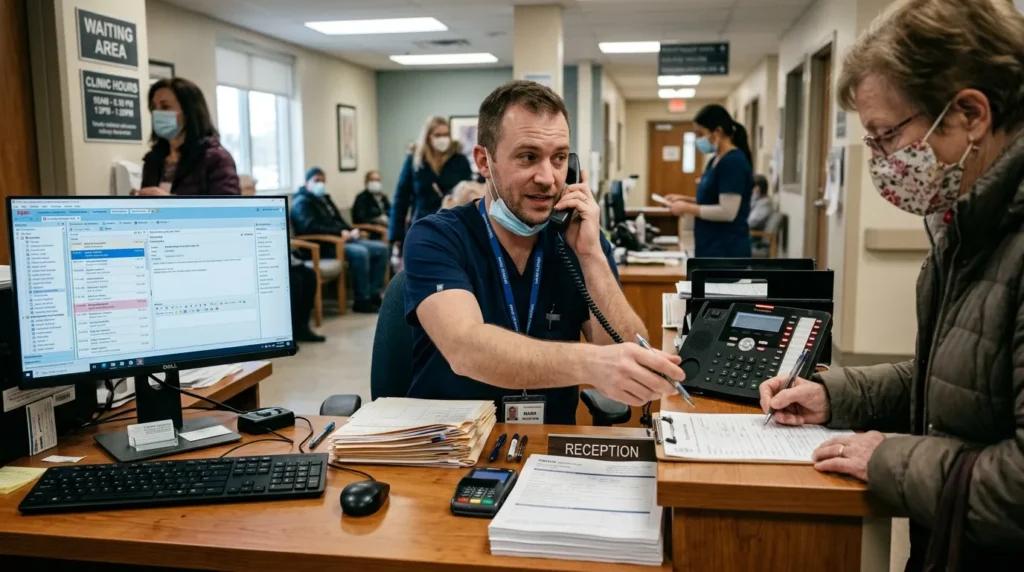
A GP clinic front desk team is managing incoming calls, patient check-ins, administrative coordination, insurance queries, and clinical support. Instagram is not part of the patient communication infrastructure they were hired to manage. When Instagram DMs are added to that workload without dedicated time, tooling, or process, they fall to the bottom of the priority list during busy periods, which is exactly when the clinic is most likely to be generating Instagram engagement from potential new patients.
This is not a staffing failure. It is a design problem. The patient communication workflow was built before Instagram became a first-contact channel for GP patients.
The response time problem is decisive
90% of leads go cold if you do not respond within five minutes. For GP patients who are in the process of choosing a new practice and have reached out to more than one clinic simultaneously, the first clinic to give a specific, helpful response wins the booking. A clinic that replies six hours later is not just late. It has typically already lost that patient to whichever clinic responded first.
The DMs that arrive on evenings and weekends, which is when a significant proportion of GP patient Instagram activity occurs, are the most likely to go unanswered for the longest period.
3. The five points where GP patient enquiries disappear
Understanding exactly where the loss happens makes the fix more targeted. For GP clinics, the enquiry drop-off clusters around five specific patterns.
The Five GP Instagram Enquiry Loss Points
Loss Point 1 — Unanswered DMs
The most common and most visible gap. A potential patient sends a DM outside clinic hours, during a busy session, or on a weekend. The message sits unread until a team member happens to check the Instagram app. By the time the clinic responds, the patient is already registered elsewhere.
This pattern is particularly pronounced for GP clinics that have grown their Instagram following through consistent health education content. More followers generate more DMs. More DMs, without a system for handling them, mean more that expire before they can be answered.
Loss Point 2 — Comments treated as engagement rather than enquiries
Comments on GP Reels and posts are a less obvious but equally significant source of lost patient enquiries. When someone comments “Do you take new patients?” or “How do I book a first appointment?” on a health tip Reel, they are not engaging with content. They are raising their hand as a patient who is ready to book.
A comment that goes unanswered for 24 hours signals to the person who wrote it, and to everyone else who reads the thread, that the clinic does not respond to direct questions from the public. The patient moves on. The comment thread signals poor responsiveness to every future visitor who reads it.
Loss Point 3 — Story replies that never convert
Instagram story replies arrive in the DM inbox alongside regular messages, but are easy to miss in a busy thread that also includes notifications, comment replies, and tagged content. A patient who replies to a story about a specific health service, a new appointment availability announcement, or a before and after patient outcome post is showing strong, specific intent.
These replies carry some of the highest conversion potential of any Instagram interaction type because they come from patients who were engaged enough to watch the specific story that prompted the reply. Missing that message means missing a warm lead at exactly the moment of peak interest.
Loss Point 4 — Delayed responses that arrive too late
Some GP clinics do eventually respond to every DM. The problem is timing. A response that arrives six hours after the message was sent, or the following morning after a Sunday evening enquiry, arrives after the patient’s decision window has closed.
Online scheduling and instant responses now determine whether a potential patient converts. For a patient who is managing a health concern and has decided to find a new GP, the clinic that responds first with a specific and helpful answer wins the booking. Timing is the variable that determines which clinic that is, not content quality, not reputation, not proximity.
Loss Point 5 — Generic auto-replies that kill the conversation
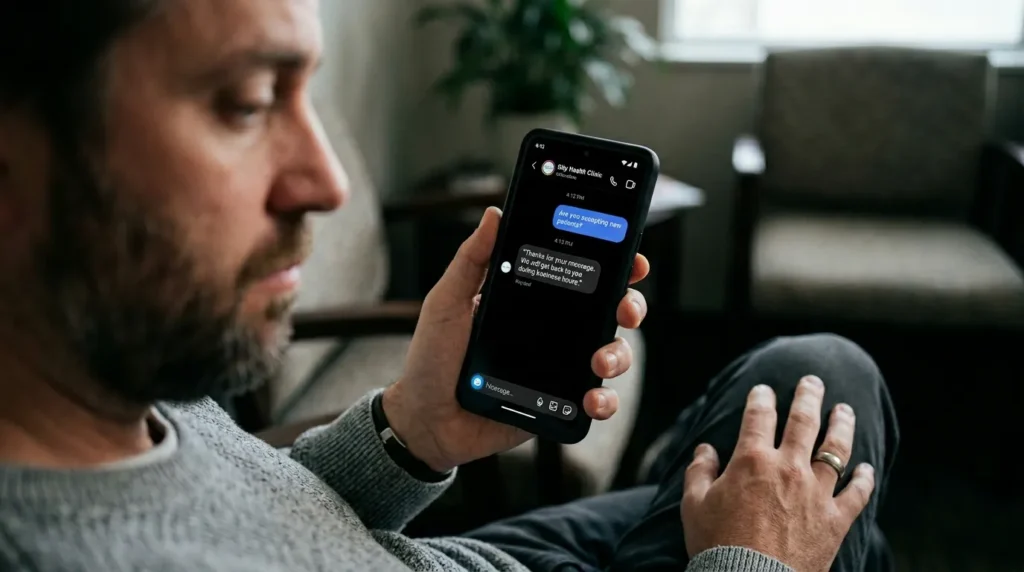
Some clinics have addressed the response time problem with a basic Instagram auto-reply. Every DM receives an immediate message along the lines of “Thanks for your message. We will get back to you during business hours.”
This is better than no response in terms of acknowledgement. But for a GP patient who asked whether the clinic is accepting new patients and what the first appointment involves, a generic acknowledgement does not answer either question. It tells the patient to wait. Patients who are choosing between clinics do not wait. They move to the next option.
A generic auto-reply can actually perform worse than no reply in conversion terms, because it creates the impression that the patient’s specific question was received, noted, and set aside rather than being answered.
4. What a lost Instagram enquiry actually costs a GP clinic
The individual cost of a missed DM is easy to dismiss. One patient, one message, one lost booking.
The aggregate cost across a year of operation is significantly harder to ignore.
A GP patient who registers with a clinic and becomes a regular patient represents meaningful long-term revenue across preventive care visits, chronic disease management, health assessments, and the referral relationships that build around an established patient-GP relationship. A patient who enquired on Instagram, did not receive a timely useful response, and registered with a competitor represents not just a lost first appointment but the entire lifetime value of that patient relationship.
77% of patients read online reviews before choosing a provider, and most new patients begin their search digitally rather than through word-of-mouth alone. The GP patient who found the clinic through Instagram and reached out via DM is one of the warmest leads the clinic can generate organically. Losing that lead at the final moment, after the content investment, after the trust building, and after the patient made the decision to reach out, is the most expensive inefficiency in the Instagram marketing workflow.
For a GP clinic generating ten to fifteen Instagram enquiries per week, a conservative estimate for an active account with a few thousand local followers, even a 50% response failure rate represents five to seven potential patient relationships lost every week. Over a year the aggregate becomes difficult to ignore from a revenue perspective.
5. How GP clinics are closing the gap
The GP clinics that have addressed this problem effectively have done so by treating Instagram as a patient communication channel that requires the same structure as any other communication channel, not as an afterthought to the content strategy.
The manual workflow approach
For GP clinics with staff capacity to support a dedicated Instagram response workflow, building a structured process with clear ownership, defined response time targets, and a triage protocol for identifying genuine patient enquiries versus general engagement can close a significant portion of the gap.
This requires nominating a specific team member who owns Instagram responses, setting a response time target (within one hour during business hours, automated acknowledgement after hours), and providing that person with prepared responses to the most common GP patient enquiry types: new patient availability, first appointment process, bulk billing or insurance, and service specific questions.
The manual approach works when the clinic has the staff capacity and the discipline to maintain it consistently. For most small to mid-size GP clinics, consistency is the failure point. During busy clinical sessions, the Instagram response workflow is the first thing that falls away.
The automation approach
For clinics that do not have staff capacity for a dedicated Instagram response workflow, which represents the majority of independently operated GP practices, an Instagram AI bot configured for GP-specific enquiries handles the response layer without adding to the team’s workload.
A properly configured GP clinic Instagram AI bot responds to every DM, comment, and story reply in under one minute at any hour. It is loaded with the clinic’s specific information: whether new patients are being accepted, what the first appointment involves, billing model and insurance details, available appointment times, and any service-specific information that GP patients typically ask about before booking.
When a patient DMs asking whether the clinic is accepting new patients, the bot gives the clinic’s actual answer. When a patient asks about the first appointment, the bot describes the clinic’s actual first appointment process. When a patient asks about availability, the bot checks the live schedule and offers real times. The patient gets a specific, helpful answer immediately, regardless of when the DM arrives.
Complex questions that fall outside the configured scope are flagged for a staff member to follow up personally. The front desk team does not need to monitor Instagram. The system monitors it for them and alerts them only when a conversation needs human involvement.
For a full walkthrough of how MedLaunch builds and configures its Instagram AI Bot for healthcare clinics, the complete guide to Instagram AI bots for healthcare covers every element of the setup and workflow.
Frequently Asked Questions
Why is my GP clinic getting Instagram followers but not new patient bookings?
Most GP clinics that generate Instagram audiences without proportionate booking conversions have the same structural problem: a content strategy but no response strategy. Patient enquiries arrive through DMs, comments, and story replies at all hours, and without a dedicated system for responding to them quickly and specifically, the majority go unanswered until it is too late. The follower count reflects content quality. The booking conversion reflects response infrastructure. The two require separate strategies.
How quickly do GP patients expect a reply to an Instagram DM?
Consumer research consistently shows that the majority of people making an online enquiry expect a response within one hour. For GP patients who are actively choosing a new practice and are typically contacting more than one clinic simultaneously, the effective window is shorter. The clinic that responds first with a specific, helpful answer wins the booking in the majority of cases. A response that arrives the following morning after an evening DM has typically missed the decision window entirely.
Are Instagram comments as important as direct messages for GP patient enquiries?
Yes. A patient who comments “Are you accepting new patients?” or “How do I book an appointment?” on a GP clinic Reel is showing the same level of intent as a patient who sends a DM. The difference is that the comment is public, so an unanswered comment signals poor responsiveness not just to the person who asked, but to every future visitor who reads that thread. For GP clinics, unanswered clinical or booking questions in the comments of health-related content can actively discourage other potential patients from making contact.
How many Instagram enquiries does a typical GP clinic receive per week?
For a GP clinic with an active Instagram presence and a few thousand engaged local followers, the realistic range for genuine patient enquiries across DMs, comments, and story replies combined is five to twenty per week. The variation depends on posting frequency, content type, and how specifically the content speaks to local patients who are in the market for a new GP. Clinics that post condition-specific health education content, appointment availability announcements, and direct calls to action consistently generate the higher end of this range.
What is the difference between a patient enquiry and general Instagram engagement on a GP clinic account?
General engagement includes likes, saves, shares, and non-specific positive comments on content. A patient enquiry is any message or comment that asks a specific question about services, pricing, availability, billing, or how to become a patient. These are the interactions that require a timely, specific response and represent genuine new patient acquisition opportunities. General engagement is valuable for reach and algorithm performance. Patient enquiries are where bookings come from.
Can a GP clinic manage Instagram patient enquiries without automation?
Yes, but only with a structured, consistently maintained manual workflow that includes a nominated owner, defined response time targets, and prepared responses to common GP patient enquiry types. For clinics with the staff capacity to sustain this consistently, a manual approach works. For the majority of independently operated GP practices where the front desk team is already managing a full clinical and administrative workload, the manual approach tends to produce inconsistent results because Instagram monitoring falls to the bottom of the priority list during busy periods.
Does responding to Instagram DMs affect a GP clinic’s reputation on the platform?
Yes, positively and negatively. A GP clinic that responds quickly and specifically to DMs and comments builds a reputation for responsiveness that compounds over time. Patients who receive helpful responses often reference the experience in reviews and word-of-mouth recommendations. A GP clinic whose public comments frequently go unanswered, or whose DM response times are slow, signals to potential patients that the clinic does not prioritise the communication channels its audience is using.
Conclusion
The GP patients sending DMs to your clinic on Instagram are not casual enquirers. They are potential patients who have already done their research, decided your clinic looks right, and are asking the final questions before booking. The DM is not the start of their evaluation. It is the last step.
The response gap that loses these patients is not a reflection of the clinic’s quality of care, the content’s quality, or the team’s effort. It is a structural gap between a patient acquisition channel that has grown organically through Instagram content and a patient communication infrastructure that was built before Instagram existed as a first-contact point for GP patients.
The five loss points described in this guide are all addressable through the same structural intervention: treating Instagram as a patient communication channel with dedicated response infrastructure, not as a content-only channel that is monitored when someone happens to check the app.
Whether through a dedicated manual workflow or an automated response system, the clinics closing this gap are not losing warm patient enquiries at the final moment after everything that came before was done well.
Stop losing warm patient leads at the final step.
Bridge the structural gap between your content and your booking book. See how MedLaunch’s AI Bot converts your Instagram DMs into patient appointments.