


Key Takeaways: AI in Patient Experience
-
1AI in patient experience is not about diagnostics:
Most AI healthcare coverage focuses on clinical AI; imaging, diagnostics, drug discovery. But the highest near-term patient impact is in operational and communication AI: scheduling, reminders, triage routing, follow-up, billing clarity, and ongoing engagement between visits. -
2Patient experience gaps are almost always data and integration problems first:
When patients repeat information at every touchpoint, when staff lack context on incoming calls, when reminders are generic rather than personalised, these are symptoms of disconnected systems. AI’s first job is integrating data sources to create a coherent patient view. -
3Personalisation at scale is AI’s defining advantage in patient engagement:
A human team cannot send 10,000 patients individually tailored messages based on their diagnosis history, risk profile, and communication preference. AI and consistently outperforms generic outreach on response rate, appointment completion, and patient satisfaction. -
4Proactive AI beats reactive care on every metric that matters:
Predictive outreach before a care gap becomes a clinical event. Early deterioration alerts before a readmission. Automated service recovery before a negative review. Moving from reactive problem solving to proactive anticipation is where AI delivers its most significant return on investment. -
5Human-centered design is non-negotiable for AI in clinical settings:
Patients must know when they are interacting with AI. Escalation pathways to human staff must be fast and clear. Bias monitoring and consent management must be embedded from day one. AI that patients don’t trust won’t be used and unused AI delivers no experience improvement. -
6Measure AI impact across three dimensions:
Satisfaction scores alone don’t capture AI’s full impact. Track experience metrics (NPS, chatbot containment), clinical metrics (readmissions, no-shows, chronic disease control), and financial indicators (cost per interaction, HEDIS performance) simultaneously to understand real ROI.
Healthcare is undergoing a fundamental transformation. For decades, systems were designed around volume, more visits, more procedures, more output.
Today, however, success increasingly depends on delivering seamless, personalized, and compassionate care journeys. This shift from volume-based care to experience-driven, patient-centered care has elevated AI in Patient Experience from a futuristic concept to a strategic priority.
Patient expectations are shaped by industries like banking, retail, and travel, where personalization, real-time updates, and on-demand access are standard. Healthcare organizations must now match that level of convenience while maintaining clinical excellence. This is where AI-driven patient experience becomes critical.
AI in patient experience refers to the use of data, machine learning, predictive analytics, and intelligent automation to enhance every interaction a patient has with a healthcare organization, from the first website visit to post-discharge follow-up. Importantly, it extends far beyond clinical decision support.
While AI has long been associated with diagnostics and imaging, artificial intelligence in patient engagement now shapes scheduling, communication, education, billing, and ongoing care coordination.
At its core, AI-powered patient engagement uses intelligent automation to make care more personalized, accessible, and proactive, without losing the human element. Rather than replacing clinicians, AI amplifies their ability to connect meaningfully with patients by reducing administrative burden and friction.
Table of Contents
From Satisfaction Scores to Real-Time Journeys

What “Patient Experience” Really Means Today
Patient experience is often confused with patient satisfaction. While satisfaction measures whether expectations were met, experience encompasses the entire journey, every touchpoint, emotion, and perception formed along the way.
It is also distinct from clinical outcomes. A patient can have excellent clinical results but still report a poor experience due to long waits, confusing instructions, or billing frustrations.
A modern patient journey typically includes:
- Awareness – Searching for providers, reading reviews
- Access – Booking appointments, verifying insurance
- Intake – Filling forms, providing history
- Consultation – Interacting with clinicians
- Follow-up – Receiving results, medication instructions
- Billing – Understanding charges and payments
- Ongoing engagement – Preventive care reminders and chronic management
Experience gaps can appear at any stage.
The Experience Gaps AI Can Address
Common pain points include:
- Long wait times and phone hold queues
- Confusing or inconsistent communication
- Poor follow-up after visits
- Limited access outside office hours
- Data silos across EHR, CRM, portals, and call centers
When data lives in disconnected systems, patients repeat information, staff lack context, and communication becomes fragmented. Artificial intelligence in patient engagement addresses these issues by integrating data sources and delivering timely, personalized interventions.
For example, instead of generic reminders, AI models analyze patient history, risk factors, and engagement patterns to send relevant nudges. Rather than reactive problem-solving, organizations can move toward proactive, continuous engagement powered by AI improving patient experience in real time.
Pillars of AI-Driven Patient Experience
Personalization at Scale
One of the greatest strengths of AI is its ability to process vast datasets, clinical records, behavioral signals, social determinants of health (SDOH), and demographic factors—to tailor communication and care.
Precision medicine laid the groundwork for personalized treatment. Now, AI applies similar principles to engagement:
- Customized appointment reminders
- Tailored educational materials
- Risk-specific alerts
- Personalized outreach timing
This allows organizations to scale personalization without overwhelming staff.
Access and Convenience
Modern patients expect 24/7 access. AI-enabled patient communication supports this demand through:
- Intelligent chatbots
- Voice assistants
- Smart portals
- Automated scheduling systems
Patients can ask questions, confirm appointments, get directions, review prep instructions, or check benefits coverage instantly, reducing friction and frustration.
Proactive and Preventive Care
AI shifts care from episodic to continuous. Predictive analytics models identify patients at risk for readmission, complications, or care gaps.
Instead of waiting for deterioration, organizations can intervene early—turning isolated visits into ongoing AI-powered patient engagement journeys. This proactive approach improves both outcomes and patient confidence.
Intelligent Automation in Patient Experience: Key Use Cases

Virtual Assistants and AI Contact Centers
Virtual assistants and AI-powered contact centers transform access and responsiveness. Symptom checkers guide patients to the appropriate level of care, while chatbots answer FAQs, manage appointments, and escalate complex concerns to human agents.
Benefits include:
- Reduced hold times
- Improved first-contact resolution
- Lower operational costs
- Enhanced perceived responsiveness
When integrated with platforms from organizations like Epic Systems or Cerner, these assistants can access patient context in real time, making interactions smarter and more relevant.
Smart Self-Service Portals and Apps
Modern portals are no longer static dashboards. AI-driven recommendation engines suggest content, services, or follow-ups based on user profiles and behavior.
Key features include:
- Intelligent scheduling
- Automated reminders
- Personalized education feeds
- Cost estimators
For example, portals may push tailored preventive care reminders—screenings or vaccines—based on predictive risk models.
360-Degree Patient View for Frontline Teams
Fragmented systems limit empathy. AI aggregates data from EHRs, wearables, SDOH sources, and feedback tools into a unified profile.
Clinicians receive “next best action” suggestions during visits, supporting context-aware conversations. Instead of focusing on administrative tasks, providers can focus on listening—enhancing the overall AI-driven patient experience at the bedside or in clinic.
Predictive Analytics for Outreach and Care Gaps
Predictive models flag high-risk patients for readmissions, non-adherence, or complications. Automated workflows trigger outreach via SMS, calls, or portal messages.
Patients feel “watched over” between visits, strengthening trust while reducing adverse events.
AI-Enhanced Remote Monitoring and Virtual Care
Wearables and home devices generate continuous data streams. AI detects anomalies, adjusts thresholds, and escalates alerts appropriately—reducing alarm fatigue while maintaining safety.
This is particularly impactful for chronic disease management, where AI improving patient experience extends beyond hospital walls into daily life.
Automation in Feedback and Service Recovery
Sentiment analysis tools scan surveys and reviews in real time, identifying dissatisfaction before it escalates.
Automated service recovery workflows—apology calls, billing clarifications, follow-up scheduling—close the loop quickly. This proactive approach strengthens loyalty even when issues arise.
How AI Actually Improves Patient Experience (Not Just Efficiency)
Reducing Friction Across the Journey
Consider two scenarios:
Before AI: Patients call repeatedly for lab results.
After AI: Results are proactively delivered with contextual explanations.
Before AI: Manual appointment booking with long hold times.
After AI: AI-guided self-service scheduling available 24/7.
Fewer forms, less repetition, and smoother transitions dramatically improve perception.
Increasing Perceived Empathy and Human Connection
By automating administrative tasks, AI frees clinicians to focus on listening and educating.
Predictive alerts help staff prioritize emotionally vulnerable patients. “Always-on” AI support ensures patients feel heard—even outside clinic hours.
The result is not cold automation but augmented empathy.
Enabling Personalized Education and Health Literacy
AI adapts educational content based on literacy level, preferred language, condition, and communication channel.
Conversational interfaces allow patients to ask questions in natural language and receive understandable answers—improving comprehension and adherence.
How to Measure the Impact of AI in Patient Experience

Experience and Engagement Metrics
- NPS and CSAT scores
- HCAHPS (or local equivalents)
- Portal adoption and chatbot usage
- Call containment rates
- Response times
Clinical and Operational Metrics
- Readmission rates
- ED revisits
- Length of stay
- Chronic disease control measures
- No-show rates
- Appointment lead times
Financial and Value-Based Care Indicators
AI supports performance metrics such as HEDIS and Star measures, which influence reimbursement in value-based models. Automation also reduces staffing costs tied to manual workflows.
Designing Human-Centered AI in Patient Experience
Keeping Humans in the Loop
Clear handoff rules ensure AI escalates complex or emotional cases to human agents. Supervisory dashboards allow teams to monitor interactions and intervene when needed.
Trust, Transparency, and Ethics
Patients should know when they are interacting with AI and why. Ethical frameworks from organizations like the World Health Organization emphasize fairness, transparency, and accountability.
Bias monitoring, consent management, and secure data practices are essential when deploying AI-enabled patient communication at scale.
Change Management for Teams
Staff must view AI as augmentation, not replacement. Training programs, pilot feedback loops, and transparent communication foster adoption and trust.
Implementation Roadmap: From Pilot to System-wide AI-Powered Patient Engagement
Assess Current Patient Experience Pain Points
Map the patient journey and identify friction points. Prioritize use cases where AI in patient experience can deliver quick wins, such as appointment reminders or chatbot support.
Choose the Right AI Use Cases and Partners
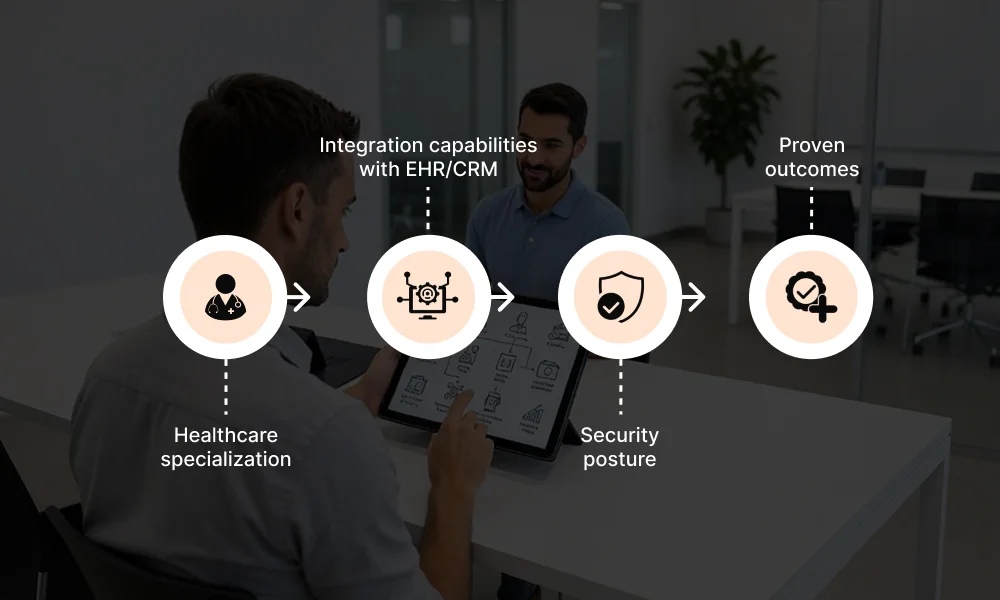
Evaluate vendors based on:
- Healthcare specialization
- Integration capabilities with EHR/CRM
- Security posture
- Proven outcomes
Decide between building in-house solutions or partnering externally.
Run Pilots with Clear Success Metrics
Define baselines and measurable goals—such as reducing no-shows by 20% or improving CSAT by 10%. Collect qualitative feedback during pilots.
Scale, Govern, and Continuously Improve
Establish governance structures for model monitoring, bias checks, and safety reviews. Continuously retrain models and expand use cases.
Future of AI in Patient Experience
Next-Generation Experiences
Multimodal AI combining voice, text, and image recognition will create more natural interactions. Hyper-personalized pathways will adjust dynamically based on new data and behaviors.
Integrating AI Across Clinical and Operational Environments
Future systems will coordinate clinical decisions, staffing workflows, and even facility operations for a seamless experience across hospital, clinic, virtual, and home settings.
Conclusion
The true promise of AI in patient experience lies not in replacing people but in empowering them. Intelligent automation removes friction, anticipates needs, and supports personalization at scale.
When designed with empathy and guided by patient needs, AI-driven patient experience becomes a strategic lever for better care, stronger relationships, and sustainable healthcare systems.
Organizations that embrace AI-powered patient engagement today are not merely adopting new technology, they are redefining what compassionate, connected, and proactive care looks like in the modern era.
Frequently Asked Questions
What is AI in patient experience?
AI in patient experience is the application of machine learning, predictive analytics, and intelligent automation to personalise, streamline, and proactively improve every interaction a patient has with a healthcare organisation, from first website visit and booking through consultation, billing, and ongoing chronic care engagement. It extends far beyond clinical AI to cover the full operational and communication journey.
How does AI actually improve patient experience?
By eliminating friction (24/7 self-service scheduling, instant chatbot responses, automated reminders), enabling personalisation at scale (communication tailored to diagnosis history, risk profile, and channel preference), and shifting care from reactive to proactive (predictive outreach before care gaps widen, early deterioration alerts, automated service recovery). The net result is an experience that feels faster, more responsive, and more personal without requiring proportionally more staff.
Can AI replace human staff in patient-facing healthcare roles?
No. AI is designed to augment staff, not replace them. It automates repetitive high-volume tasks (hold queues, form completion, routine FAQs, appointment reminders) so clinicians and patient-facing staff can focus entirely on the complex, emotionally sensitive interactions that require human judgment and empathy. AI amplifies human connection; it doesn’t substitute for it.
What are the most impactful AI use cases in patient experience?
The six highest-impact applications are: virtual assistants and AI contact centers for 24/7 access; smart portals with intelligent scheduling and personalised education; 360-degree patient profiles giving frontline staff full context on call answer; predictive analytics for proactive outreach to high-risk and care-gap patients; AI-enhanced remote monitoring for chronic disease management; and real-time sentiment analysis for automated service recovery before issues escalate.
How do you measure the ROI of AI in patient experience?
Track three metric categories simultaneously. Experience metrics: NPS, CSAT, portal adoption rate, chatbot containment rate, response times. Clinical and operational metrics: readmission rates, no-show rates, appointment lead times, chronic disease control measures. Financial indicators: cost per interaction, staff hours saved, and performance on HEDIS and Star measures that influence reimbursement. Set baselines before deployment and measure at 30, 60, and 90 days.
What are the ethical considerations for AI in patient experience?
Patients must be informed when they are interacting with AI rather than a human. Clear escalation pathways to staff must be fast and accessible. Bias monitoring must be embedded in AI models trained on unrepresentative data can perpetuate care disparities. Consent management, data security, and HIPAA compliance are non-negotiable from day one. AI that patients don’t understand or trust will simply go unused.
Ready to Put AI to Work Across Your Patient Experience?
Book a call to see how MedLaunch deploys AI in patient experience.