


Reduce no-shows mental health clinic is the operational challenge of lowering the rate at which scheduled patients fail to attend their appointments, which in outpatient mental health settings reaches as high as 50% according to clinical data, significantly above the 5% to 8% average across all medical specialties. The reasons patients miss mental health appointments are clinically specific: depression reduces executive function and motivation, anxiety creates avoidance, and the conditions themselves make the act of attending an appointment harder than it would be for a patient managing a physical health condition. This guide covers what the research confirms actually lowers no-show rates in mental health clinics, what does not work, and how AI automation makes the interventions that work run consistently without adding staff workload.
Table of Contents
Key Takeaways
- Mental Health No-Show Rates Reach Up to 50% — Far Above the Medical Average: According to Mend’s 2026 mental health no-show analysis, no-show rates have reached as high as 50% in outpatient clinics. The national average across all medical specialties is 5% to 8%. Mental health is the highest no-show specialty because the conditions being treated directly affect the patient’s ability to attend.
- Two-Way Confirmations Outperform One-Way Reminders Significantly: Curogram’s April 2026 analysis found that a text allowing patients to reply confirm or reschedule is far more powerful than a one-way reminder. Two-way confirmations give patients a clear action and give the clinic real-time attendance data before the slot is lost.
- Practices That Prioritise No-Show Recovery See 10% to 20% Revenue Increases: Curogram’s client data found that recovering even a fraction of missed appointments drives a 10% to 20% increase in revenue for practices that make it a priority. At an average session value of $150, a 20% improvement on 4 daily no-shows in a 20-patient-per-day clinic is $60 per day or $15,000 per year.
- The 24-Hour and 72-Hour Post-No-Show Windows Are the Most Effective Recovery Actions: MGMA’s August 2025 guide identifies the missed-visit play as a core operational practice: within 24 hours of a no-show send a blame-free rebooking link; within 72 hours make a live call for clinically important follow-ups. Tracking reclaimed slots as a KPI is specifically recommended.
- Patient-Preferred Reminder Formats Outperform Standard Phone Call Reminders: Research from the University of St Augustine found that patient preferred appointment reminders including telephone and email reminders based on patient preference, sent one week before and the day before appointments, outperformed standard phone call reminders alone at a mental health clinic with a pre-intervention no-show rate of 21%.
Why You Need to Reduce No-Shows Mental Health Clinic Staff Cannot Handle Alone
The national average no-show rate across all medical specialties is 5% to 8%. Mental health outpatient clinics regularly see rates of 20% to 30% and in some settings as high as 50%. The difference is not logistical. It is clinical.
Depression reduces executive function. Getting out of bed, getting dressed, navigating to a clinic, and sitting in a waiting room are tasks that are significantly harder for a depressed patient than for someone presenting with a physical health complaint. The very condition the appointment is meant to treat is the thing making the patient less likely to attend.
Anxiety creates avoidance. A patient with anxiety who is ambivalent about therapy has a neurologically reinforced pathway toward not going. The anticipatory anxiety about the session itself, particularly early in treatment before a therapeutic relationship is established, is a real attendance barrier that generic reminder systems do not address.
Mend’s 2026 analysis identifies these clinical factors as the primary drivers of the no-show gap between mental health and other specialties. For virtual sessions, they note that telehealth can help by eliminating the travel component of the attendance barrier. For in-person sessions, the intervention has to reduce the friction at the decision point, which is typically the 24 hours before the appointment.
The cost of each missed session compounds. Curogram’s research notes that missed mental health appointments stall treatment progress, weaken the patient-provider relationship, lead to worsening symptoms, and reduce trust. The clinical consequences of non-attendance are not separate from the financial ones. They reinforce each other.
For psychiatry practices specifically, the no-show challenge is covered in detail in AI Receptionist for Psychiatry Practices: Scheduling, Calls, and Patient Communication in 2026.
What Does Not Work and Why Clinics Keep Trying It Anyway
Three interventions that do not reliably reduce no-show rates in mental health clinics, despite being widely used.
No-show fees. Charging patients who miss appointments without adequate notice is the most common intervention and one of the least effective. Research consistently shows that no-show fees create resentment in the patient population most likely to be disengaged, do not improve future attendance, and disproportionately affect lower-income patients who are already underserved by mental health care. For a patient who missed because their depression made it impossible to leave the house, a $50 fee does not solve the problem. It adds a financial barrier to the relationship.
Single phone call reminders. A standard phone call reminder sent two days before an appointment is a one-touchpoint system applied to a population that needs multiple touchpoints. For patients with depression or anxiety, a single reminder that they can ignore creates the illusion of a process without the actual intervention. The evidence from the University of St Augustine is clear: patient preferred reminders sent at multiple intervals significantly outperform single phone call reminders alone.
Punitive cancellation policies. Requiring 48-hour notice for cancellations under threat of a fee, enforced consistently regardless of clinical context, alienates the patients most vulnerable to the clinical barriers described above. It also creates a perverse incentive: a patient who does not cancel because they fear the fee, and then does not attend, appears as a no-show rather than a cancellation, making the data look worse while the patient disengages.
Strategy 1: Two-Way Confirmations Over One-Way Reminders
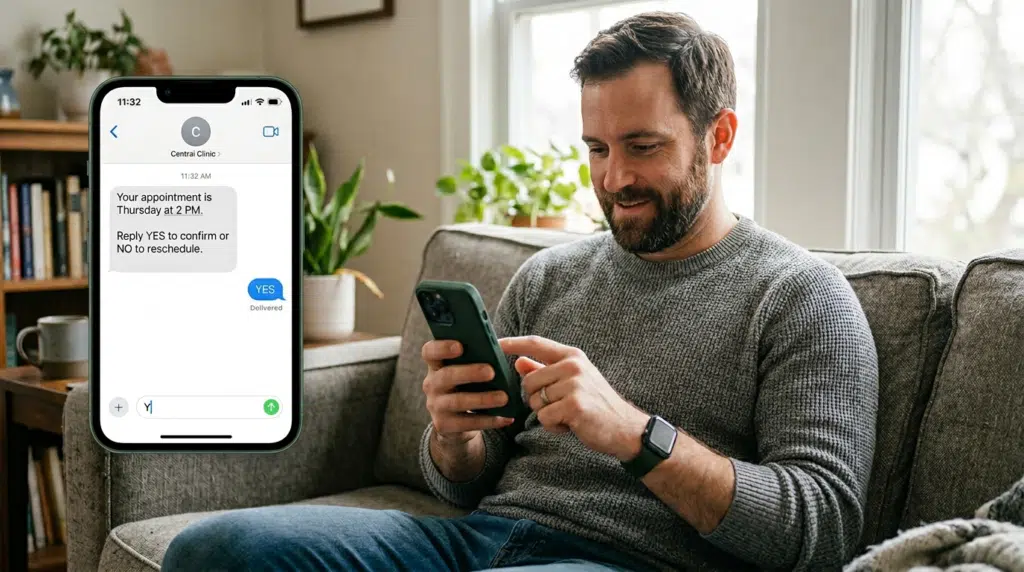
The single most impactful change a mental health clinic can make to its reminder system is switching from one-way to two-way confirmation messages.
A one-way reminder says: you have an appointment on Thursday at 2pm with Dr Smith. The patient reads it and either shows up or does not.
A two-way confirmation says: you have an appointment on Thursday at 2pm with Dr Smith. Reply YES to confirm or NO to reschedule. The patient is given an action. The clinic receives real-time data on attendance before the slot is lost.
Curogram’s April 2026 analysis is direct: a text that lets patients confirm or reschedule is far more powerful than a one-way reminder. Two-way tools put the ball in motion for both sides. This shift alone can cut behavioral health no-shows significantly.
The operational consequence is equally important. When a patient replies NO to reschedule, the clinic has advance notice of the empty slot and the opportunity to fill it before the appointment time. A clinic that receives a reschedule reply on Tuesday for a Thursday appointment has two days to fill the slot. A clinic using one-way reminders discovers the empty slot when the patient does not show up.
Strategy 2: The Reminder Sequence That Actually Works
A single reminder is not enough for a patient population dealing with motivation and attention challenges. The evidence supports a multi-touchpoint sequence with specific timing and specific message purposes at each stage.
One week before: An awareness reminder. The purpose is to ensure the appointment is on the patient’s radar with enough lead time to plan. Message tone: informational, not alarming. Include the date, time, location or video link, and clinician name.
48 hours before: A confirmation prompt. The purpose is to get an explicit confirmation or reschedule decision while there is still time to fill the slot. Include a two-way response option. This is the most important touchpoint in the sequence.
Morning of: A day-of reminder. Short, frictionless, and practical. Include the video link if telehealth, the address if in-person, and a simple reschedule option. The day-of reminder addresses the inertia barrier specifically — the patient who has confirmed but is wavering on the morning of the appointment.
MGMA’s August 2025 guide confirms that practices which maintained or improved their no-show rates in 2025 most often credited consistent patient communication including frequent digital reminders and automated calls. Consistency is the operative word. The sequence works when it runs for every patient at every appointment, not when a staff member remembers to send it.
The University of St Augustine research also confirms that patient-preferred channels matter. Some patients respond better to text, others to email, others to phone. A system that adapts to patient preference at each touchpoint outperforms a one-channel system.
Strategy 3: Frictionless Rescheduling Within the Cancellation Interaction
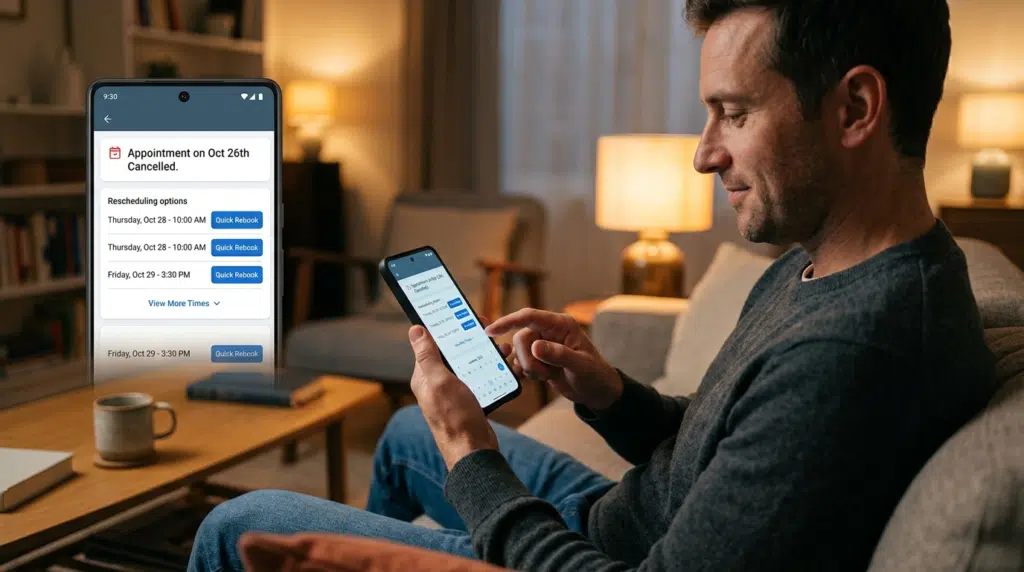
Every cancellation is a rescheduling opportunity. The difference between a clinic with a 20% no-show rate and a clinic with a 12% no-show rate is often not the number of cancellations. It is the conversion rate from cancellation to rescheduled appointment.
A patient who calls to cancel at 9pm on a Sunday has two outcomes depending on the system they reach. They leave a voicemail and wait for a callback on Monday morning, by which point their motivation to reschedule has often passed. Or they interact with an AI system that accepts the cancellation, confirms it, and immediately offers available slots for the following week.
The second outcome converts the cancellation into a rescheduled appointment before the motivation to disengage takes hold. For a patient population whose conditions affect motivation and follow-through, the window between the decision to cancel and the decision to rebook is narrow. A frictionless rescheduling system captures that window automatically.
Curogram’s analysis identifies this principle directly: reducing no-shows is about removing friction and building connection. Frictionless rescheduling removes the friction at the most critical conversion point.
This is one of the core functions of MedLaunch’s AI Medical Receptionist in a mental health setting. When a patient calls after hours to cancel, the AI accepts the cancellation and immediately offers rescheduling without requiring a callback the next business day.
Strategy 4: The 24-Hour and 72-Hour Post-No-Show Recovery Play
When a no-show occurs, the default response in most mental health clinics is to document it and wait for the patient to rebook. This passive approach loses the majority of missed appointment revenue permanently.
MGMA’s August 2025 guide identifies a specific recovery protocol that practices with strong no-show metrics consistently implement.
Within 24 hours of the no-show: Send a friendly, blame-free rebooking message. The tone is important. Not “you missed your appointment” but “we missed you today. Here is a link to rebook when you are ready.” This message captures patients who missed due to circumstances beyond their control and who would rebook if given an immediate, low-friction option.
Within 72 hours for clinically important follow-ups: Make a live outreach call for patients who missed appointments that were clinically significant, including patients with high PHQ-9 scores, patients in early treatment where no-shows predict dropout, and patients with a history of crisis presentations. The live call signals clinical concern rather than administrative follow-up.
MGMA specifically recommends tracking reclaimed slots as a key performance indicator. A clinic that measures how many no-show slots are recovered within 48 and 72 hours has a direct metric for the effectiveness of its recovery process and a clear lever to pull when the rate falls.
Strategy 5: Shorter Wait Times and Same-Week Scheduling
MGMA’s 2025 data confirms a finding that is consistent across healthcare settings: shorter lead times between booking and appointment reduce no-show rates. The longer the wait between scheduling and attending, the more time for motivation to erode, circumstances to change, and the appointment to feel less urgent.
For mental health clinics with long waiting lists, this is an inherent tension. Reducing wait times requires either adding clinical capacity or improving scheduling efficiency so that existing capacity is used more effectively. Two mechanisms contribute to scheduling efficiency without adding clinical headcount.
Open-access scheduling blocks: Reserving a proportion of the schedule for same-week or next-day bookings creates a path for patients who are ready to be seen quickly. A patient who can be seen within 48 hours of calling is significantly less likely to no-show than a patient who waits 6 weeks.
Rolling optimisation based on no-show patterns: Tracking no-show rates by time slot, day of week, and appointment type reveals where the clinic’s no-show risk is concentrated. Scheduling new patients and high-risk appointments in the time slots and days with historically lower no-show rates improves attended session rates without changing the total number of slots.
Strategy 6: AI Automation That Runs All Five Strategies Simultaneously

The strategies above are not new. Most mental health clinic managers are familiar with the research on reminder sequences, two-way confirmations, and post-no-show recovery. The gap between knowing what works and doing it consistently is operational. Running five distinct communication workflows manually for 20 to 30 patients per day, every day, is not sustainable without automation.
AI automation resolves this by running all five strategies simultaneously, without staff involvement, at every appointment for every patient.
The reminder sequence fires automatically at the right intervals for every appointment. Two-way confirmation handling routes patient responses in real time without a staff member monitoring the inbox. Frictionless rescheduling is available 24 hours a day when a patient wants to cancel. The post-no-show rebooking message fires automatically within 24 hours of a missed appointment. And the scheduling system adapts based on completion rate data over time.
This is what MedLaunch’s AI Medical Receptionist does for mental health and psychiatry clinics. Every no-show reduction strategy runs automatically, consistently, and without adding a single step to the clinical team’s workflow. For a full overview of how AI receptionists work in mental health settings, see AI Medical Receptionist for Mental Health Clinics: What Clinic Owners Need to Know in 2026.
What the Research Says
Three findings from research and clinical data directly support the strategies in this guide.
Finding 1 – Recovering missed slots drives 10% to 20% revenue increases. Curogram’s client data from clinical settings found that practices that make no-show recovery a priority see a 10% to 20% increase in revenue from reclaimed appointments. The key mechanism is the 24-hour rebooking link combined with frictionless rescheduling at the point of cancellation. Both require automation to run consistently across a full patient caseload.
Finding 2 – Patient preferred reminder formats significantly outperform standard phone call reminders. University of St Augustine research at a mental health clinic with a 21% pre-intervention no-show rate found that patient preferred appointment reminders sent at multiple intervals outperformed single phone call reminders. The intervention involved asking patients for their preferred reminder channel and timing, then delivering reminders accordingly. The implication is that personalisation of the reminder format, not just the number of reminders, determines effectiveness.
Finding 3 – Consistent communication including frequent digital reminders is the primary differentiator for practices with low no-show rates. MGMA’s August 2025 guide surveyed medical practice leaders who maintained or improved no-show rates in 2025. The most frequently credited factor was consistent patient communication including frequent digital reminders, automated calls, and occasional live outreach. The consistency component is the key word. Reminder systems that run for some patients some of the time produce inconsistent results.
The Revenue Calculation: What Reducing No-Shows Is Actually Worth
The following table shows the annual revenue recovered at different no-show improvement levels for a mental health clinic seeing 20 patients per day at $150 average session value and a starting no-show rate of 20%.
| No-Show Improvement | Daily No-Shows Recovered | Daily Revenue Recovered | Annual Revenue Recovered |
|---|---|---|---|
| 10% improvement | 0.4 sessions | $60 | $15,000 |
| 20% improvement | 0.8 sessions | $120 | $30,000 |
| 30% improvement | 1.2 sessions | $180 | $45,000 |
| 50% improvement | 2.0 sessions | $300 | $75,000 |
A 30% improvement in no-show rate represents recovering approximately 1.2 missed sessions per day. This is a conservative target for a clinic implementing all five strategies with AI automation. The $45,000 annual return at 30% improvement is net of the vendor cost for the AI receptionist system.
For a full revenue analysis across multiple dimensions of practice automation, see PHQ-9 Automation ROI Mental Health Clinics: What the Numbers Look Like in 2026.
What This Means for Your Clinic in 2026
Reducing no-shows in a mental health clinic requires acknowledging that the clinical conditions being treated are part of the attendance problem. Generic reminder systems designed for physical health specialties do not account for the motivation and avoidance barriers that define the mental health no-show profile.
The strategies that work are specific and evidence-based: two-way confirmations that give patients an action to take, multi-touchpoint reminder sequences at the right intervals and in the right channels, frictionless rescheduling at the point of cancellation, and the 24-hour and 72-hour post-no-show recovery play. Each strategy is well-documented. Each requires consistent execution to produce results. Consistent execution at scale without adding staff workload requires automation.
For a complete overview of how MedLaunch AI Medical Receptionist handles no-show reduction for mental health and psychiatry clinics, visit the solution page.
FAQ
What is the average no-show rate for mental health clinics?
No-show rates in mental health clinics range from 20% to 50% depending on the patient population, practice type, and reminder systems in place. According to Mend’s 2026 analysis, rates as high as 50% have been documented in outpatient settings. This is significantly above the national average of 5% to 8% across all medical specialties. The gap exists because the conditions being treated directly affect patients’ ability and motivation to attend.
What is the most effective way to reduce no-shows in a mental health clinic?
The evidence supports a combination of strategies rather than a single intervention. Two-way confirmation messages, multi-touchpoint reminder sequences, frictionless rescheduling within the cancellation interaction, and the 24-hour post-no-show rebooking play together produce the most consistent results. MGMA’s 2025 data confirms that consistent patient communication including frequent digital reminders is the primary differentiator for practices with low no-show rates.
Do no-show fees reduce missed appointments in mental health clinics?
No. No-show fees are one of the most widely used and least effective interventions for reducing mental health no-show rates. Research consistently shows they create resentment without improving attendance, disproportionately affect lower-income patients, and do not address the clinical barriers, including depression and anxiety, that cause most mental health no-shows. They may reduce cancellation without notice but do not address the underlying reasons patients miss appointments.
How does AI automation reduce no-shows in a mental health clinic?
AI automation reduces no-shows by running the five evidence-based strategies simultaneously and consistently for every patient at every appointment without staff involvement. Automated reminder sequences fire at the right intervals. Two-way confirmation responses are handled in real time. Rescheduling is available 24 hours a day at the point of cancellation. Post-no-show rebooking messages fire automatically within 24 hours. None of these require a staff member to initiate or manage individually. For a full overview of how this works in mental health settings, see AI Medical Receptionist for Mental Health Clinics.
What should a mental health clinic do within 24 hours of a no-show?
Send a friendly, blame-free rebooking message within 24 hours of the missed appointment. The tone should be welcoming rather than punitive: the message signals that the clinic noticed the absence and wants to help the patient rebook, not that the patient has done something wrong. MGMA’s August 2025 guide recommends a blame-free rebooking link within 24 hours and a live outreach call within 72 hours for clinically important follow-ups. Tracking the number of reclaimed slots from this process as a KPI is specifically recommended.
How much revenue does a mental health clinic lose to no-shows per year?
At a 20% no-show rate for a clinic seeing 20 patients per day at $150 per session, 4 missed sessions per day represents $600 per day in lost revenue or approximately $150,000 per year across 250 working days. Even recovering 20% to 30% of those missed sessions through consistent no-show reduction strategies represents $30,000 to $45,000 in annual revenue recovery.
Conclusion
Reducing no-shows in a mental health clinic is not a technology problem or a reminder volume problem. It is a clinical understanding problem. The conditions being treated make attendance harder, and the strategies that work acknowledge that reality rather than imposing a standard healthcare no-show framework on a population that does not respond to it.
Two-way confirmations remove the passive non-response pathway. Multi-touchpoint reminder sequences create multiple opportunities to re-engage a patient whose motivation fluctuates. Frictionless rescheduling captures the cancellation before the disengagement becomes permanent. The 24-hour and 72-hour recovery play re-engages patients who missed without intent to drop out. And AI automation makes all five run consistently without adding a single step to the clinical team’s workload.
For a complete overview of how MedLaunch AI Medical Receptionist handles no-show reduction for mental health and psychiatry clinics, visit the solution page. For the full after-hours call handling guide, see How AI Handles After-Hours Calls From Mental Health Patients.