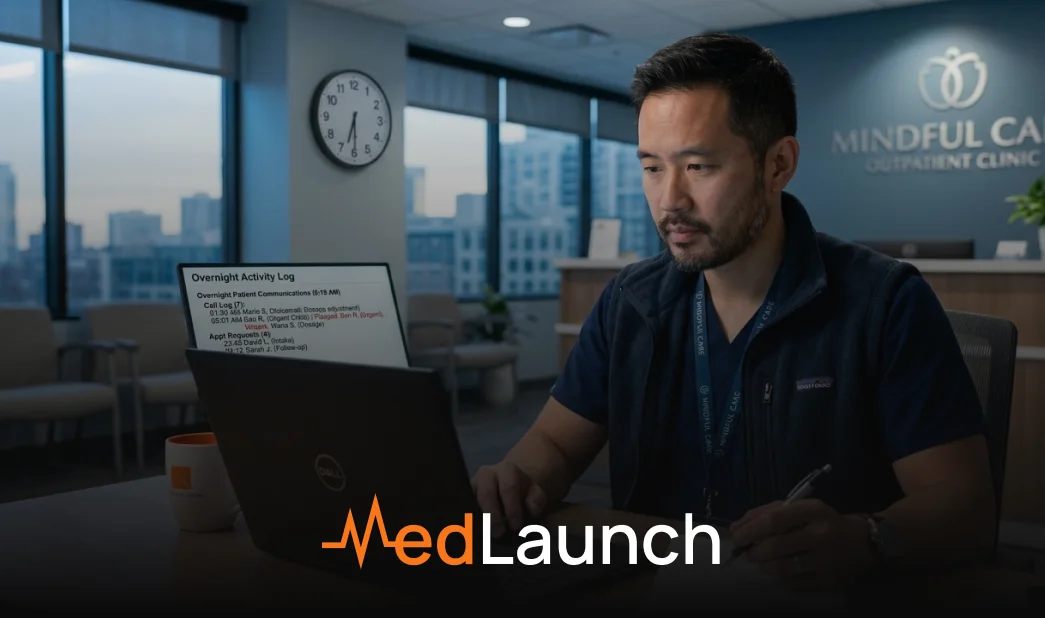

AI after hours calls mental health patients is the operational challenge of ensuring that every patient contact outside of staffed clinic hours receives an immediate, appropriate, and clinically safe response through an automated system that can handle scheduling requests, answer common questions, and route crisis communications to the right resource before the next business day. For most outpatient mental health clinics, after-hours calls currently go to voicemail. The patient leaves a message, waits, and the gap between reaching out and receiving a response is left entirely to chance. This guide covers exactly what an AI voice system does with those calls, where the clinical and operational boundaries are, and what the crisis routing protocol must look like before any system is deployed in a mental health setting.
Table of Contents
Key Takeaways
- The After-Hours Gap Is an Access Problem, Not Just an Operational One: According to SAMHSA, over 12 million adults in the US had serious thoughts of suicide in 2021. Patients experiencing mental health crises do not wait for office hours. An after-hours voicemail is not a neutral outcome. It is a gap in access that carries clinical and legal consequences.
- AI Cannot Provide Clinical Care After Hours — It Can Eliminate the Silence: An AI voice system does not replace the clinical response a mental health patient sometimes needs after hours. What it eliminates is the silence: the phone ringing to voicemail, the message left unanswered until Monday, the patient who does not call back. Every after-hours contact receives an immediate response.
- Crisis Routing Is the Technical and Clinical Non-Negotiable: Any AI system handling after-hours calls from mental health patients must have a configured, tested, and documented crisis routing protocol. The 988 Suicide and Crisis Lifeline, emergency services, and on-call clinical staff must all be accessible via the routing logic before the system is deployed.
- The Majority of After-Hours Calls Are Not Crisis Calls: Research and operational data consistently show that the majority of after-hours calls to outpatient mental health clinics are scheduling requests, appointment confirmation queries, and general information requests. An AI system that handles these correctly frees the clinical team from the next-day backlog without creating clinical risk.
- A Patient Who Reaches Voicemail Is a Patient Who May Not Call Back: mdhub’s 2026 analysis of behavioral health clinic operations identifies the after-hours gap as a recurring operational risk that carries real clinical, legal, and financial consequences. A patient in distress who reaches voicemail at 8pm on a Thursday and does not hear back until Monday morning has had the worst weekend of their week with no contact point.
AI After Hours Calls Mental Health Patients: What Happens at Most Clinics Today
At most outpatient mental health clinics, the after-hours call handling process follows the same pattern: the phone rings, a recorded message plays asking the caller to leave a voicemail, and the caller either leaves a message or does not. The message is retrieved the next business day. The callback is made when someone has time. In many cases, the callback happens 24 to 48 hours after the initial contact.
For routine scheduling requests, this gap is an inconvenience. For a patient calling at 9pm because their symptoms have intensified, their medication is producing unexpected effects, or they are having passive thoughts of self-harm, the gap is not an inconvenience. It is a clinical access failure.
The consequence of this failure compounds over time. Patients who do not receive a timely response after one after-hours contact are less likely to reach out again. In a patient population that already experiences barriers to help-seeking due to stigma, previous negative experiences, and the nature of their conditions, a voicemail that goes unreturned is often the end of a care-seeking attempt.
As covered in AI Medical Receptionist for Mental Health Clinics, the national average wait time for behavioural health services is already 48 days. The after-hours gap extends that wait further and reduces the likelihood that the patient stays in the queue.
What Types of After-Hours Calls Mental Health Clinics Actually Receive
Understanding the composition of after-hours call volume is essential before designing a response system. The assumption that after-hours calls in a mental health setting are predominantly crisis calls is not supported by operational data.
The realistic breakdown of after-hours calls to outpatient mental health clinics looks like this:
Scheduling and administrative requests (60% to 70% of volume): Appointment booking, rescheduling, cancellation, location queries, and insurance enquiries. These are routine requests that patients make after hours because that is when they have time to call.
General information requests (15% to 20% of volume): Questions about the clinic’s services, wait times, clinician availability, fees, and accepted insurance. These are new patient enquiries that do not require clinical input.
Clinical support requests (10% to 15% of volume): Patients with questions about their medication, symptoms, or care plan that they want answered before their next appointment. These require routing to a clinical staff member or to a clinical information resource rather than resolution by an AI system.
Crisis calls (5% to 10% of volume): Patients in acute distress who need immediate clinical support, crisis line routing, or emergency services. These require an immediate routing response to a human resource.
The implication for system design is clear. An AI after-hours system that handles the first two categories correctly eliminates 75% to 90% of the voicemail backlog without touching the clinical response requirement. The remaining 10% to 25% requires either clinical staff routing or crisis line routing, which the system must handle correctly without clinical staff being physically present.
What an AI Voice System Does With an After-Hours Call
An AI voice system deployed for after-hours call handling at a mental health clinic performs four functions when a patient calls outside of staffed hours.
Function 1 – Immediate answer and triage. The AI answers every incoming call instantly. It identifies itself as an automated assistant, confirms the clinic’s identity, and asks the caller to describe the nature of their call. This immediate response replaces the voicemail experience entirely from the caller’s perspective.
Function 2 – Scheduling and administrative resolution. For the majority of callers with scheduling or administrative requests, the AI resolves the query without requiring a human callback. It books, reschedules, or cancels appointments directly in the scheduling system, answers common questions from the clinic’s configured knowledge base, and confirms the interaction with the caller before ending the call.
Function 3 – Clinical support routing. For callers with clinical questions that the AI cannot and should not resolve, the system takes a detailed message, confirms it will be prioritised for a clinical callback the next business day, and offers the caller the option to be added to the urgent callback queue if the matter cannot wait.
Function 4 – Crisis detection and routing. When a caller’s language or content triggers the crisis routing logic, the system routes immediately to the designated resource: the 988 Suicide and Crisis Lifeline, an on-call clinical staff member, or emergency services. This routing happens without any delay or voicemail step.
MedLaunch’s AI Medical Receptionist is configured with all four functions as part of the standard deployment for mental health and psychiatry clinics, with the crisis routing protocol built and tested before go-live.
The Crisis Call Routing Protocol: What It Must Include
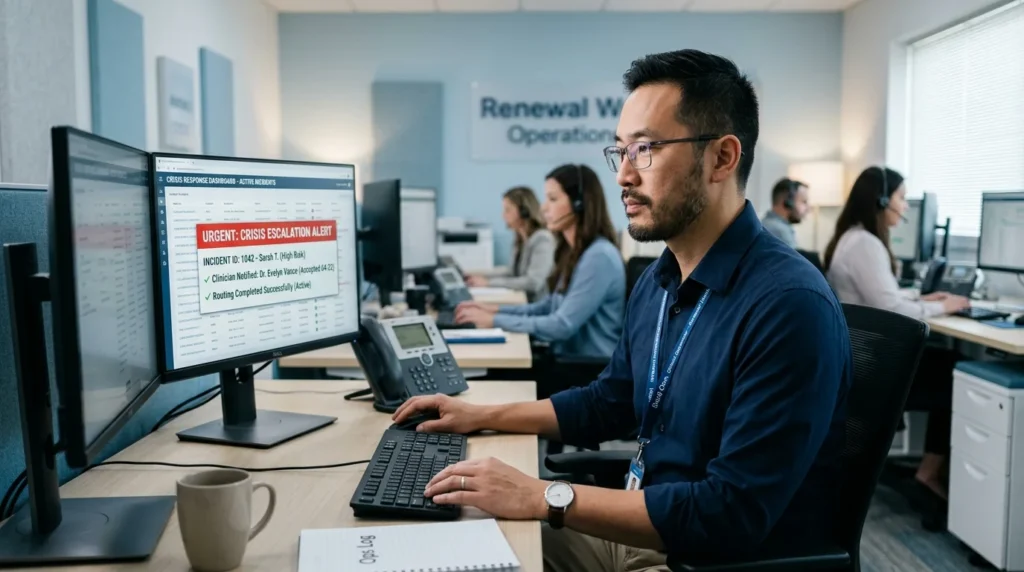
The crisis call routing protocol is the single most important component of any AI after-hours system deployed in a mental health clinic. It must be explicitly designed, documented, tested, and verified by clinical staff before the system handles a single live call.
A complete crisis call routing protocol for a mental health clinic must include the following elements:
Trigger language definitions. The protocol must specify which words, phrases, and language patterns trigger a crisis routing response. This includes direct statements such as “I want to hurt myself” and indirect language such as “I can not take this anymore” or “there is no point.” The trigger list must be developed in consultation with clinical staff who understand the specific patient population.
Routing hierarchy. When a crisis is detected, the routing hierarchy must specify: first, route to an on-call clinical staff member if one is designated for after-hours coverage. Second, if no on-call staff member is available, route to the 988 Suicide and Crisis Lifeline. Third, if the caller indicates an immediate safety emergency, provide the number for emergency services. The CDC confirms that the 988 line automatically routes calls by area code to the nearest crisis center, making it the appropriate first-line resource for clinics without 24-hour on-call coverage.
Caller refusal protocol. Some callers in crisis will refuse transfer to a crisis line or emergency services. The protocol must specify what the AI does when a caller declines the offered resource: at minimum, the system should provide the resource information verbally, confirm the caller’s name and callback number, and alert the on-call clinical staff member or flag the call for first-priority callback the next morning.
Alerting and documentation. Every crisis routing event must generate an alert to the designated clinical staff member and create a documented record of the call. This documentation is both a clinical requirement and a legal protection.
Pre-deployment testing. The crisis routing protocol must be tested with clinical staff using live scenarios before the system goes live. Testing must include scenarios with indirect language, caller refusal, and escalation to emergency services.
What the Research Says
Three findings from research and clinical literature are directly relevant to AI after-hours call handling in mental health clinic settings.
Finding 1 – Machine learning can route crisis calls effectively in mental health helpline settings. A peer-reviewed study published in NCBI PMC examining machine-learning-based routing of callers in a mental health hotline found that algorithmic routing of callers to appropriate counselling agents was feasible and produced better outcomes than manual routing. The study confirms that AI-assisted call routing in mental health settings is not a theoretical concept. It is an established and validated operational approach.
Finding 2 – The after-hours gap is a clinical and legal risk, not just an operational inconvenience. mdhub’s 2026 analysis of AI in behavioral health crisis management identifies the scenario where a patient sends a message at 11pm and the language indicates distress, but no one on the team sees it until morning, as a recurring operational risk that carries real clinical, legal, and financial consequences. The analysis notes that human-only monitoring does not scale across a full caseload, an after-hours gap, and hundreds of patient touchpoints per week.
Finding 3 – Voice AI for healthcare provides 24-hour coverage that reduces delayed care and lost appointments. Goodcall’s 2026 voice AI healthcare analysis found that missed after-hours calls often mean delayed care, lost appointments, and frustrated patients, and that voice AI provides 24-hour call coverage that ensures patients can schedule appointments, access information, or leave structured requests at any time. For mental health clinics where the after-hours call volume includes a meaningful proportion of patients in heightened distress, the elimination of the voicemail gap has clinical as well as operational significance.
The Clinical and Legal Boundaries of AI After-Hours Call Handling
Understanding what an AI after-hours system cannot do is as important as understanding what it can.
An AI system cannot provide clinical care. It cannot assess suicide risk. It cannot conduct a safety assessment. It cannot provide therapeutic support or clinical advice. Any interaction that requires clinical judgment must be routed to a human resource, not resolved by the AI.
An AI system cannot replace on-call clinical coverage for high-acuity practices. For mental health clinics that serve high-acuity patient populations, including intensive outpatient programmes, partial hospitalisation programmes, and practices with a high proportion of patients with severe and persistent mental illness, AI after-hours call handling does not substitute for designated on-call clinical coverage. It supplements it by handling the non-clinical volume so that on-call staff are reached only for contacts that genuinely require clinical input.
Documentation is a legal requirement, not an option. Every after-hours call handled by an AI system must be documented. The record must include the time of the call, the nature of the request, the system’s response, and any routing decisions made. For crisis calls specifically, the documentation must include the trigger language, the routing action taken, and the outcome. This documentation protects the clinic in the event of a patient safety incident and is required for regulatory compliance.
The Business Associate Agreement must cover after-hours call handling. All patient communication data processed by an AI after-hours system is protected health information under HIPAA. The vendor must provide a signed Business Associate Agreement that explicitly covers after-hours call handling before the system is deployed.
For the specific clinical and legal responsibilities that arise when suicidal ideation is expressed, see PHQ-9 Question 9 and Suicidal Ideation: Clinical and Legal Responsibilities for Outpatient Clinics.
How AI After-Hours Call Handling Reduces Next-Day Backlog
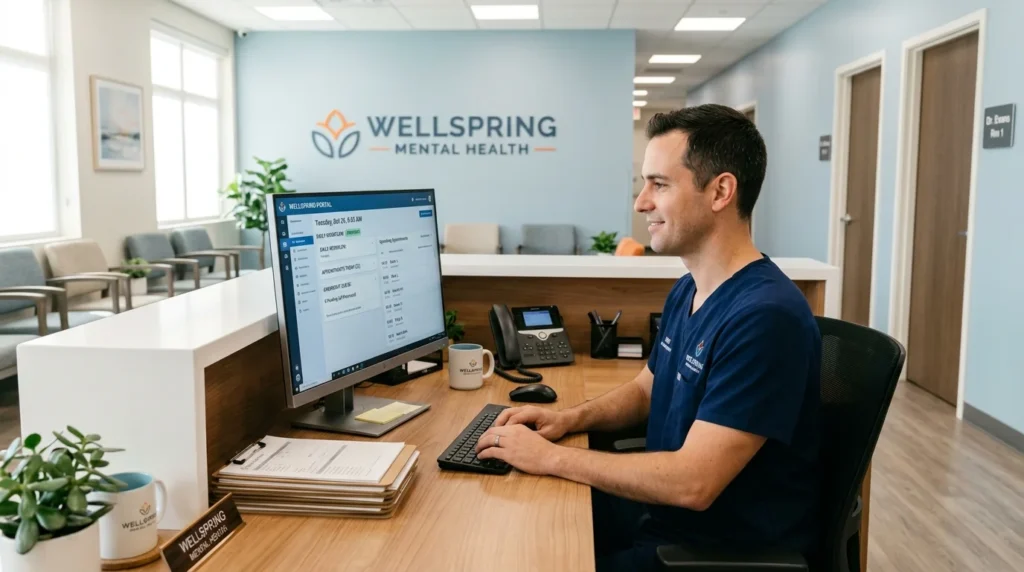
One of the most direct operational benefits of AI after-hours call handling is the reduction in next-day administrative backlog for clinical staff.
In a typical mental health clinic without AI after-hours coverage, the first 60 to 90 minutes of the next business day are consumed by: listening to overnight voicemails, returning calls from patients who left scheduling requests, processing appointment changes that were requested after hours, and triaging messages from patients who needed clinical input.
When an AI system handles the scheduling and administrative calls overnight, those tasks are already completed when staff arrive in the morning. Appointments have been booked, rescheduled, and confirmed. Common questions have been answered. The next-day call queue contains only the contacts that genuinely require human attention: clinical queries, complex scheduling situations, and flagged crisis calls that need priority follow-up.
For a mental health clinic where clinical staff regularly spend the first hour of the day on overnight voicemail processing, this represents a meaningful recovery of clinical time that can be redirected to patient care.
What to Verify Before Deploying AI for After-Hours Calls in a Mental Health Clinic
Six verification requirements before any AI after-hours call system is deployed in a mental health setting.
Verify 1 – Crisis routing protocol is documented and tested. Request the vendor’s documentation of the crisis routing logic, including trigger language, routing hierarchy, caller refusal protocol, and alerting procedure. Conduct live scenario testing with clinical staff before go-live.
Verify 2 – The 988 Suicide and Crisis Lifeline is included in the routing hierarchy. This is the national standard for after-hours crisis routing in outpatient settings. Any system that does not include it in the routing hierarchy is not configured for a mental health context.
Verify 3 – HIPAA compliance and Business Associate Agreement. All after-hours call data is protected health information. The BAA must explicitly cover after-hours call handling.
Verify 4 – EHR integration for scheduling. Appointments booked by the AI after-hours system must appear directly in the clinic’s scheduling system. If manual transfer is required, the after-hours backlog has not been eliminated. It has been deferred.
Verify 5 – Documentation of every call. The system must generate a record of every after-hours call, including non-crisis calls. This record must be accessible by clinical staff the next business day.
Verify 6 – Customisation for your patient population. The trigger language for crisis routing must reflect the language patterns of your specific patient population. A system configured with generic crisis language may not detect indirect expressions of distress that are common in the population your clinic serves.
What This Means for Your Clinic in 2026
The after-hours call handling problem at outpatient mental health clinics is not a technology problem. The technology to handle it exists and is validated. It is a configuration and deployment problem. The majority of clinics that still route after-hours calls to voicemail do so not because they have evaluated AI alternatives and rejected them, but because implementing a system that handles after-hours calls safely in a mental health context requires clinical input, protocol development, and testing that most clinics have not had time to prioritise.
An AI after-hours system that is correctly configured eliminates the voicemail gap for 75% to 90% of callers without any clinical involvement. It handles scheduling overnight. It answers common questions. It documents every interaction. And when a caller presents with language that indicates distress, it routes to the right resource before the patient reaches another voicemail box.
For a complete overview of how MedLaunch AI Medical Receptionist handles after-hours calls for mental health clinics, visit the solution page. For the broader context of how AI receptionists work in mental health settings, see AI Medical Receptionist for Mental Health Clinics.
FAQ
What does an AI system do when a mental health patient calls after hours?
An AI system answers the call immediately, identifies the nature of the request, and responds appropriately. For scheduling and administrative requests, the AI resolves the query directly. For clinical questions, it takes a detailed message and confirms a callback timeline. For callers expressing distress or crisis language, it routes immediately to the designated resource: an on-call clinical staff member, the 988 Suicide and Crisis Lifeline, or emergency services.
Can AI handle crisis calls from mental health patients after hours?
An AI system can detect crisis language and route immediately to a human resource. It cannot conduct a clinical assessment, provide therapeutic support, or determine the severity of a patient’s risk. The AI’s role in a crisis call is to ensure the patient reaches a human resource as quickly as possible and to document the interaction. It does not replace clinical judgment. It eliminates the voicemail step that currently delays the patient reaching that judgment.
What is the 988 Suicide and Crisis Lifeline and should it be included in AI routing?
The 988 Suicide and Crisis Lifeline is the national mental health crisis line in the United States. According to the CDC, calling or texting 988 connects callers to trained crisis counselors and automatically routes by area code to the nearest crisis center. It should be included as the primary crisis routing destination for any AI after-hours system deployed in a mental health clinic that does not have 24-hour on-call clinical coverage.
How does AI after-hours call handling reduce next-day administrative work?
When an AI system handles scheduling and administrative calls overnight, those tasks are completed before clinical staff arrive the next morning. Appointments have been booked and confirmed. Common questions have been answered. The next-day call queue contains only contacts that require human input. For clinics where the first hour of the day is consumed by overnight voicemail processing, this represents a direct recovery of clinical and administrative time.
What HIPAA requirements apply to AI after-hours call handling in mental health clinics?
All patient communication data processed by an AI after-hours system is protected health information under HIPAA. The vendor must provide a signed Business Associate Agreement explicitly covering after-hours call handling. All call records must be stored securely, access-controlled, and encrypted. The documentation of crisis routing events carries additional requirements due to the clinical sensitivity of the content.
How long does it take to implement AI after-hours call handling in a mental health clinic?
With MedLaunch, most clinics are fully live within days. MedLaunch handles the full configuration including crisis routing protocol development, call script customisation for a mental health patient population, EHR integration, and pre-launch testing with clinical staff. No technical setup is required from the clinic’s team.
Conclusion
AI after-hours call handling for mental health clinics solves a specific and consequential operational problem: the gap between a patient reaching out after hours and receiving any response at all. The majority of after-hours calls are scheduling and administrative requests that an AI system can resolve completely overnight. The minority that require clinical input are routed to the appropriate resource without delay, documented, and flagged for priority follow-up.
The clinical boundary is clear. An AI system does not provide clinical care after hours. It eliminates the voicemail gap that currently means most after-hours contacts receive no response until the next business day. For a patient population that includes people in heightened distress, that is not a minor operational improvement. It is the difference between reaching out and being heard, and reaching out and being asked to try again tomorrow.
For a complete overview of how MedLaunch AI Medical Receptionist works for mental health and psychiatry clinics, visit the solution page. For the next blog in this series, see AI Receptionist for Psychiatry Practices: Scheduling, Calls, and Patient Communication in 2026.