

AI PHQ-9 telehealth screening is the administration of the Patient Health Questionnaire-9 through an automated voice-guided or digital system before or during a virtual clinical session, in which the patient completes the nine-item questionnaire remotely on any device, the score is calculated automatically, and the result is delivered to the clinician’s workflow before the telehealth appointment begins. The clinical question is whether PHQ-9 administered remotely through an AI system produces scores that are psychometrically equivalent to those produced through in-person administration, and whether the telehealth delivery context introduces any clinical or operational differences that affect how the results should be interpreted and used.
Table of Contents
Key Takeaways
- Remote PHQ-9 Is Psychometrically Valid: Research published in Frontiers in Digital Health found that automated remote PHQ-9 administration achieved a completion rate of 99.82% and an internal consistency of 0.896 across 3,902 adults, equivalent to the validated paper instrument.
- Voice-Guided Delivery Outperforms Written Digital Forms for Some Populations: A JMIR Mental Health study found that Hispanic and Latino patients were 40% less likely to complete PHQ-9 asynchronously via written digital link. Voice-guided administration removes the reading and typing barrier and produces higher completion rates across diverse patient populations.
- Question 9 Requires a Telehealth-Specific Alert Protocol: In telehealth, the clinician is not physically present when the patient completes pre-visit screening. A positive Question 9 response requires an immediate alert to clinical staff before the session begins, giving the team time to respond before the call starts.
- CPT 96127 Is Billable for Telehealth PHQ-9 Through December 2026: CMS has approved CPT 96127 for telehealth visits through December 31, 2026. Pre-visit AI PHQ-9 administration produces the documentation required to support CPT 96127 billing on eligible telehealth sessions.
- Pre-Visit Completion Is More Effective Than During-Session Administration for Telehealth: The absence of a physical waiting room in telehealth means there is no natural in-session administration point. Pre-visit delivery, where the patient completes the PHQ-9 before joining the call, is the only workflow that consistently produces a scored result before the clinician begins the session.
What AI PHQ-9 Telehealth Screening Actually Involves
AI PHQ-9 telehealth screening can be delivered at three different points in the telehealth patient journey. Understanding which point is clinically optimal is the starting decision for any telehealth practice implementing automated PHQ-9.
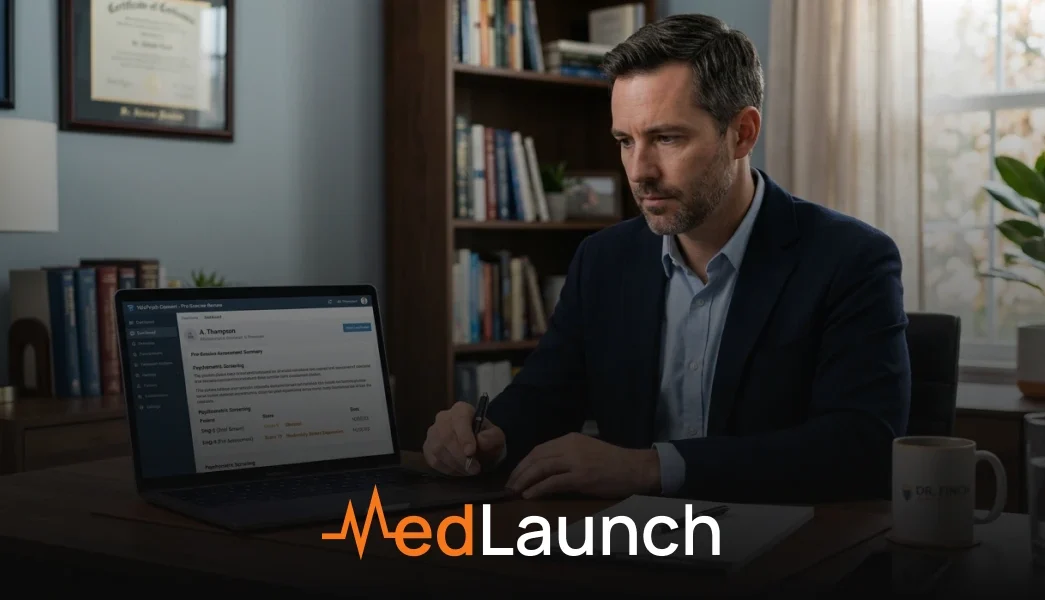
Pre-visit delivery is where the patient receives a link before the appointment and completes the PHQ-9 on any device before joining the call. The score is calculated automatically and delivered to the clinician’s EHR workflow before the session begins. The clinician joins the call with a scored result already in hand. Pre-visit delivery is the only approach that makes a Question 9 alert response possible before the session starts.
During-session delivery is where the patient completes the PHQ-9 on their device while the clinician is already on the call. The clinician either waits for the result or begins the session and reviews the score when it arrives. This approach produces a score but eliminates the clinical preparation window that pre-visit delivery provides.
Post-session delivery is where the PHQ-9 link is sent after the call as a follow-up assessment. This approach produces data for longitudinal tracking but does not inform the clinical encounter it follows.
For the purposes of clinical decision-making, safety alerting, and CPT 96127 billing documentation, pre-visit delivery is the only approach that serves all three purposes simultaneously. The rest of this guide assumes pre-visit delivery as the operational standard for AI PHQ-9 telehealth screening.
Does Remote PHQ-9 Produce the Same Results as In-Person?
The psychometric validity question for AI PHQ-9 telehealth screening is the same question addressed for any remote PHQ-9 administration: does the format of delivery introduce systematic bias into how patients respond to the nine items?
The research evidence is clear. A study published in Frontiers in Digital Health by Dosovitsky, Kim, and Bunge at Palo Alto University assessed the psychometric properties of a chatbot-administered PHQ-9 across 3,902 adults and older adults in the US and Canada. The remote chatbot version achieved a completion rate of 99.82% and an internal consistency score of 0.896, results statistically equivalent to the validated paper instrument. The one-factor structure of the PHQ-9 held consistently across both age groups and both delivery formats.
A separate study published in PMC examined an automated telephone version of the PHQ-9, the most directly relevant format for voice-guided remote delivery. The study found test-retest reliability of weighted kappa 0.76, sensitivity of 82.4%, and specificity of 90.7% for moderate-plus depression. These results are consistent with the validated paper instrument across the same psychometric benchmarks.
The consistent finding across remote delivery formats, chatbot, telephony, digital form, and smartphone app, is that the PHQ-9 items produce psychometrically stable results regardless of the medium, provided the nine questions and their four response options are presented consistently. For a deeper comparison of AI and in-person PHQ-9 accuracy, see AI PHQ-9 Accuracy vs Clinician Administered: What the Research Says in 2026.
The Telehealth PHQ-9 Completion Rate Problem
The completion rate problem for PHQ-9 in telehealth is more acute than in physical clinic settings. In a physical clinic, a patient can complete a paper form in the waiting room as a last resort even if the pre-visit digital link was not used. In telehealth, there is no waiting room. There is no in-person fallback point before the clinician joins the call.
For a telehealth practice relying on a digital link sent before the appointment, the completion rate of that link determines whether the clinician has PHQ-9 data before the session. And completion rates for asynchronous digital PHQ-9 links vary significantly by patient population, device access, and digital literacy.
A written digital form sent by SMS or email before a telehealth session requires the patient to read the instructions, navigate the form interface, type or tap their responses, and submit the form before the appointment time. For patients with limited digital literacy, older adults less comfortable with smartphone interfaces, or patients for whom English is a second language, this sequence introduces friction that produces incomplete submissions.
The completion rate consequence is direct. A telehealth practice sending written digital PHQ-9 links and achieving a 60% completion rate before sessions means 40% of its patients are starting their telehealth appointments without a scored PHQ-9. For those patients, the clinician joins the call without the clinical context the PHQ-9 was supposed to provide.
Voice-Guided vs Written Digital PHQ-9 for Telehealth Patients
The most significant operational finding relevant to PHQ-9 delivery format in telehealth comes from the JMIR Mental Health asynchronous screening study conducted across 33 clinic sites in Northern California. The study found that Hispanic and Latino patients were 40% less likely to complete a PHQ-9 asynchronously via written digital link compared to other patient groups.
For telehealth practices serving diverse patient populations, including the large Hispanic and Latino communities in Miami, Los Angeles, New York City, and across the Southwest, this finding has direct operational implications. A written digital PHQ-9 link systematically under-captures screening data from patients who are already less likely to complete it. The completion gap is not random. It is demographically structured.
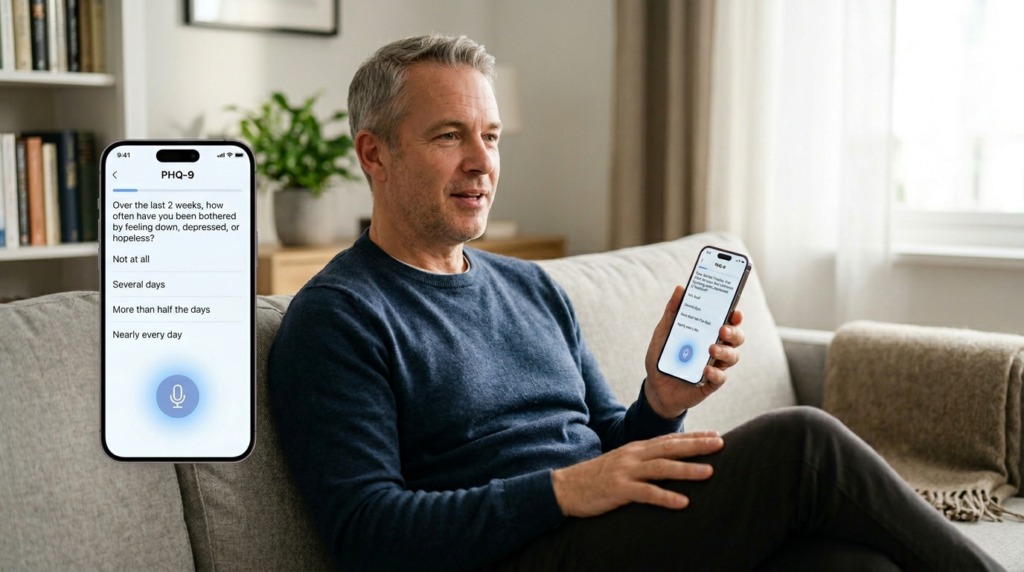
Voice-guided PHQ-9 administration removes the reading and typing barrier that creates this gap. A patient receiving a voice call or a voice-activated link before their telehealth appointment responds to spoken questions rather than reading and tapping a digital form. No typing required. No form navigation required. No written instructions to follow.
The completion rate advantage of voice-guided delivery over written digital forms is particularly significant for telehealth practices because telehealth disproportionately serves patients in geographically dispersed, demographically diverse populations, precisely the populations where written asynchronous completion gaps are most pronounced.
What the Research Says
Three findings from peer-reviewed research directly address the validity and operational effectiveness of AI PHQ-9 telehealth screening.
Finding 1 – Remote automated PHQ-9 is psychometrically equivalent to paper. The Frontiers in Digital Health study confirmed that automated remote PHQ-9 administration produces internal consistency, completion rates, and factor structure equivalent to the validated paper instrument across 3,902 adults. Multiple prior studies cited in the same paper found correlations of 0.92 or higher between automated remote formats and the paper instrument. Remote delivery does not degrade the psychometric properties of the PHQ-9.
Finding 2 – Voice administration is specifically validated for remote monitoring. The PMC automated telephony study found that voice-administered PHQ-9 produced test-retest reliability of kappa 0.76 and sensitivity and specificity profiles consistent with the validated instrument. For telehealth practices considering voice-guided pre-visit delivery specifically, this is the most directly applicable evidence: voice administration is clinically valid for both screening and longitudinal monitoring, including in remote contexts.
Finding 3 – Written asynchronous digital delivery produces completion gaps by demographic. The JMIR Mental Health study found that Hispanic and Latino patients were 40% less likely to complete written asynchronous PHQ-9 links compared to other groups. This finding indicates that format selection for telehealth PHQ-9 delivery is not clinically neutral. Written digital forms systematically under-screen specific patient populations. Voice-guided delivery closes the gap by removing the literacy and interface barrier.
The Question 9 Alert Protocol for Telehealth Settings

The clinical and legal responsibilities that arise when PHQ-9 Question 9 is endorsed are covered in full in PHQ-9 Question 9 and Suicidal Ideation: Clinical and Legal Responsibilities for Outpatient Clinics. In a telehealth setting, those responsibilities carry an additional operational dimension.
In a physical clinic, a positive Question 9 response with pre-visit screening gives clinical staff time to conduct a brief risk assessment before the patient enters the room. The staff member can approach the patient in the waiting area. The clinician can be briefed before entering the consultation room. The response protocol has a physical context it operates within.
In telehealth, the patient is at home when they complete the pre-visit PHQ-9. If they endorse Question 9, the clinical staff member receives the alert before the patient joins the call. The response window is the time between the alert and the scheduled call start. What happens in that window depends on the clinic’s protocol.
A telehealth-specific Question 9 alert protocol should specify at minimum: which staff member receives the alert, what channel the alert arrives through, whether the call start is delayed pending a check-in, how the check-in is conducted in a remote context, and what the escalation pathway is if the patient cannot be reached before the call.
MedLaunch AI Powered PHQ-9 Screening sends an immediate alert to the designated clinical staff member when Question 9 is endorsed during pre-visit screening. Because the screening is completed before the patient joins the call, the clinical team has time to prepare a response before the session begins. The alert cannot be disabled and applies at every telehealth session where the PHQ-9 is administered.
CPT 96127 Billing for Telehealth PHQ-9 in 2026
CPT 96127 billing for telehealth PHQ-9 sessions is covered in detail in CPT 96127 Billing PHQ-9 Psychiatry: Complete Guide for Clinics in 2026. The key points for telehealth practices are:
CMS has approved CPT 96127 for use with telehealth visits through December 31, 2026. According to Connected Mind’s 2026 billing guide, the Medicare national average reimbursement is $4.97 per unit with a maximum of 3 units per date of service. For telehealth sessions, the appropriate telehealth modifier should be applied alongside the standard CPT 96127 modifiers.
The four documentation elements CPT 96127 requires are the same for telehealth as for in-person sessions: instrument name, numerical score, clinical interpretation, and action plan. Pre-visit AI PHQ-9 administration generates the first three elements automatically before the session begins. The clinician adds the action plan during or immediately after the call. The claim documentation is complete.
CPT 96127 does not require the provider to be present during test administration. A patient completing the PHQ-9 via voice-guided pre-visit link before their telehealth session produces a billable service under CPT 96127 provided the clinician reviews the result and documents the clinical response.
Pre-Visit vs During-Session PHQ-9 Administration in Telehealth

The choice between pre-visit and during-session PHQ-9 administration in telehealth is not a preference question. It is a clinical outcomes question. The two approaches produce materially different clinical situations at the start of every session.
| Factor | Pre-Visit Administration | During-Session Administration |
|---|---|---|
| Clinician has score before call | Yes | No |
| Question 9 alert before session | Yes | No |
| CPT 96127 billable | Yes | Yes |
| Clinical preparation window | Full window before call | Zero window |
| Patient completion pressure | None, completed at own pace | Present, clinician waiting |
| Completion rate | Higher, pressure-free environment | Lower, time-pressured |
| Longitudinal data timing | Available at session start | Available mid-session at earliest |
Pre-visit administration is clinically superior in every dimension that affects the quality of the clinical encounter. The scored result is in the clinician’s hands before the session begins. The Question 9 alert response is possible before the call starts. The patient completes the screening in a pressure-free environment before the appointment rather than while the clinician is waiting on screen.
The only argument for during-session administration is that it serves as a fallback for patients who did not complete the pre-visit link. For a practice using MedLaunch AI PHQ-9 telehealth screening, the pre-visit voice-guided link can be resent at the start of the call if a patient did not complete it, with the scored result arriving within minutes of the session beginning.
What This Means for Your Telehealth Practice in 2026
AI PHQ-9 telehealth screening is clinically valid, operationally effective, and billable under CPT 96127 through December 2026. The psychometric evidence confirms that remote administration produces scores equivalent to the validated paper instrument. The operational evidence confirms that voice-guided delivery outperforms written digital forms for completion rates, particularly in diverse patient populations.
The remaining questions for telehealth practices are operational. Which delivery point, pre-visit, during-session, or post-visit, is used? Is the delivery format voice-guided or written digital? Does the Question 9 alert protocol account for the absence of physical presence? Is CPT 96127 billing documentation being captured at every eligible telehealth session?
For practices not yet capturing CPT 96127 on telehealth PHQ-9 sessions, each uncaptured session is a documented, reimbursable service going unbilled. At the 2026 Medicare rate of $4.97 per unit, a telehealth practice conducting 20 PHQ-9 sessions per day and not billing CPT 96127 is leaving approximately $99 per day undocumented.
For a complete overview of how MedLaunch AI Powered PHQ-9 Screening works for telehealth providers, visit the solution page. To understand how PHQ-9 screening frequency should be managed across a telehealth caseload, see PHQ-9 Screening Frequency Mental Health Clinics: Complete 2026 Guide.
FAQ
Is AI PHQ-9 screening valid for telehealth patients?
Yes. Research published in Frontiers in Digital Health and PMC confirms that automated remote PHQ-9 administration, including voice-guided formats, produces psychometric properties equivalent to the validated paper instrument. Internal consistency, test-retest reliability, and sensitivity and specificity profiles are consistent across remote delivery formats when the nine items and their response options are presented standardly.
Can PHQ-9 be administered remotely before a telehealth session?
Yes. Pre-visit remote PHQ-9 administration is the clinically preferred delivery point for telehealth. The patient receives a link before the appointment, completes the PHQ-9 at home or in transit on any device, and the scored result is delivered to the clinician’s EHR workflow before the call begins. This is the only approach that gives the clinician a scored result before the session starts and makes a Question 9 alert response possible before the call.
What happens when a telehealth patient endorses Question 9 before the call?
When a telehealth patient endorses Question 9 during pre-visit screening, MedLaunch sends an immediate alert to the designated clinical staff member before the session begins. Because the patient is at home completing the screening rather than in a waiting room, the response window is the time between the alert and the scheduled call start. The clinical team should have a telehealth-specific protocol specifying what happens in that window, including whether the call start is delayed and how a remote check-in is conducted.
Can CPT 96127 be billed for PHQ-9 administered during a telehealth visit?
Yes. CMS has approved CPT 96127 for telehealth visits through December 31, 2026. The documentation requirements are the same as for in-person sessions: instrument name, numerical score, clinical interpretation, and action plan. Pre-visit AI administration generates the first three automatically. The clinician adds the action plan. The telehealth modifier should be applied alongside the standard CPT 96127 modifiers when submitting the claim.
Why is voice-guided PHQ-9 better than a written digital form for telehealth?
A JMIR Mental Health study found that Hispanic and Latino patients were 40% less likely to complete written asynchronous PHQ-9 links. Voice-guided administration removes the reading and typing barrier that produces this completion gap, resulting in higher completion rates across diverse patient populations. For telehealth practices serving demographically diverse patient populations, voice-guided delivery produces more consistent pre-visit screening data than written digital forms.
Does MedLaunch PHQ-9 screening work for telehealth patients?
Yes. MedLaunch AI Powered PHQ-9 Screening is designed for telehealth and hybrid practices. The voice-guided pre-visit PHQ-9 is sent to the patient before the appointment and completed on any device. The scored result is delivered to the clinician’s EHR workflow before the call begins. An immediate Question 9 alert is sent to the designated clinical staff member when suicidal ideation is endorsed. CPT 96127 documentation is generated automatically. Most telehealth practices are fully live within days with no technical setup required from the clinical team.
Conclusion
AI PHQ-9 telehealth screening is clinically valid, operationally superior to in-session administration, and billable under CPT 96127 through December 2026. The psychometric evidence from multiple peer-reviewed studies confirms that remote voice-guided and digital PHQ-9 administration produces scores equivalent to the validated paper instrument. The operational evidence confirms that pre-visit delivery is the only approach that consistently gives clinicians a scored result before the telehealth session begins and makes a Question 9 alert response possible before the call starts.
The format question, voice-guided versus written digital, is not clinically neutral. For telehealth practices serving diverse patient populations, voice-guided delivery produces meaningfully higher completion rates and more consistent screening data across demographic groups.
For a complete overview of how MedLaunch AI Powered PHQ-9 Screening works across telehealth and hybrid practices, visit the solution page. For telehealth providers specifically, see AI PHQ-9 Screening for Telehealth Providers.