
PHQ-9 implementation in a mental health clinic is the process of establishing a consistent, repeatable workflow through which every eligible patient completes the Patient Health Questionnaire-9 before or during each applicable visit, with the scored result reaching the clinician before the session begins. In a busy clinic, the PHQ-9 implementation mental health clinic question is not whether to use the PHQ-9. It is how to remove every manual step that currently makes consistent administration impractical without adding headcount to an already stretched team.
Table of Contents
Key Takeaways
- Staff Workload Is the Primary Barrier: Research published in Clinical Medicine Journals confirms that nurses and front desk staff in busy clinics perceive PHQ-9 administration as additional work they do not have time for. The implementation approach that works removes the administration step from staff entirely rather than adding to their responsibilities.
- Asynchronous Pre-Visit Delivery Solves the Time Constraint: A quality improvement study published in JMIR Mental Health found that asynchronous PHQ-9 delivery decreases workload on frontline clinical team members and increases patient self-reporting compared to synchronous in-clinic administration.
- Completion Rates Improve Dramatically When Administration Is Automated: A quality improvement study published in ScienceDirect found PHQ-9 completion rates increased from 10.8% to 57.1% after reducing perceived administrative burden. The intervention that worked was reducing manual steps, not adding staff.
- The Implementation Bottleneck Is the Handoff, Not the Questionnaire: The PHQ-9 takes under three minutes to complete. The implementation problem is the chain of manual steps around it: handing over a form, collecting it back, scoring it, entering it into the EHR. Removing those steps is what makes consistent implementation practical.
- EHR Integration Is Not Optional: PHQ-9 implementation without EHR integration means staff must manually transfer results into the clinical record. That manual step recreates the workload the implementation was supposed to eliminate. Integration is not a premium feature. It is the foundation.
Why PHQ-9 Implementation Fails in Busy Mental Health Clinics
PHQ-9 implementation in a mental health clinic fails for one reason almost every time. The administration process is designed around staff availability that does not exist in a busy outpatient setting.
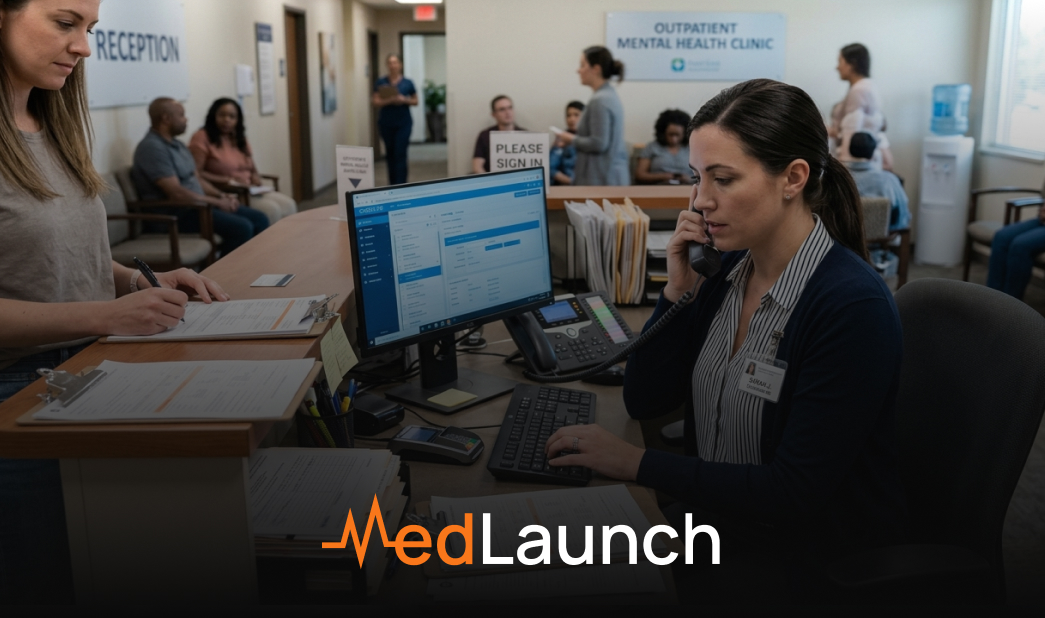
Research published in Clinical Medicine Journals found that nurses and front desk staff in busy primary care and mental health clinics perceive PHQ-9 administration as additional work they simply do not have time to complete. Providers in the same study reported seeing up to 20 patients per day in 30 to 60 minute appointment slots. In that environment, the manual PHQ-9 workflow breaks before it ever gets started.
The consequence is visible in national screening data. Research published in the Annals of Family Medicine found that only 4% of primary care patients are currently screened for depression despite USPSTF universal screening recommendations. That figure reflects the failure of manual workflows in high-volume outpatient settings, not clinical indifference to depression screening.
The gap between a clinic that intends to screen and a clinic that screens consistently is entirely operational. And the operational failure happens at the same point every time: the manual handoff between the screening tool and the clinical record.
The Three Manual Steps That Break Every Implementation

Most PHQ-9 implementations fail not because the questionnaire is difficult but because of the chain of manual steps required to turn a completed form into a clinically useful result. In a busy mental health clinic, each step is a failure point.
Step 1 – Administration dependency. Someone must remember to give the form to the patient at the right visit. When the front desk is managing check-ins, phones, and insurance queries simultaneously, this step gets skipped. The patient walks in without a PHQ-9 and the clinician starts from zero.
Step 2 – Manual scoring. A staff member must collect the completed form, tally the nine-item score, and classify the severity level. A miscalculated score produces a misread severity level and a clinical decision built on inaccurate data. Under time pressure, scoring errors are not rare.
Step 3 – EHR entry. The scored result must be transferred into the patient’s clinical record before the clinician enters the room. In a back-to-back appointment schedule, this step is frequently skipped or delayed. The clinician sometimes discovers the score mid-session, with no time to prepare a response.
These three steps together mean a busy mental health clinic running a manual PHQ-9 workflow is not screening consistently. It is screening occasionally, when everything goes right, which is not a clinical workflow. It is an aspiration.
How Pre-Visit Automated Delivery Changes the Implementation Picture

Pre-visit automated PHQ-9 delivery removes all three manual steps from the implementation by moving the administration point to before the patient arrives at the clinic.
The patient receives a secure link before their appointment. A voice-guided AI walks them through all nine PHQ-9 questions at a natural pace before they leave home. No staff member hands over a form. No device is passed across a reception desk. No paper is collected and scored manually.
When the patient submits their responses, the score is calculated automatically and a structured report is delivered into the clinician’s existing EHR workflow before the appointment begins. The clinician does not need to check a separate application or wait for a staff member to complete a data entry step. The scored PHQ-9 is in their workflow alongside the other clinical information they review before every session.
The administration dependency disappears. The manual scoring step disappears. The EHR entry step disappears. What remains is a completed, scored PHQ-9 in the clinician’s hands before the patient walks in. This is exactly how MedLaunch AI Powered PHQ-9 Screening is built to work, with full EHR integration handled by MedLaunch as part of setup, as covered in detail in AI PHQ-9 EHR Integration: The Essential 2026 Guide. For a deeper look at how automated and clinician-administered PHQ-9 compare on psychometric accuracy, see AI PHQ-9 Accuracy vs Clinician Administered: What the Research Says in 2026.
What the Research Says
Three findings from peer-reviewed research directly address the staff workload barrier to PHQ-9 implementation in mental health clinics.
Finding 1 – Asynchronous delivery reduces frontline staff workload. A quality improvement study published in JMIR Mental Health evaluated asynchronous versus synchronous PHQ-9 screening across 33 clinic sites in Northern California. The study found that asynchronous pre-visit delivery decreased workload on frontline clinical team members, increased patient self-reporting, and elicited more intentional clinical responses from providers compared to synchronous in-clinic administration. The researchers concluded that removing the in-clinic administration dependency was the single most effective intervention for improving PHQ-9 completion rates without adding staff.
Finding 2 – Reducing administrative burden produces dramatic completion rate improvements. A quality improvement initiative published in ScienceDirect aimed to improve PHQ-9 monitoring rates in an outpatient psychiatry clinic from 5% toward 90%. After implementing interventions focused on reducing perceived administrative burden, including clinician coaching and removal of manual steps, completion of symptom scales increased from 10.8% before the intervention to 57.1% during the 26-week intervention period. The study identified perceived administrative burden as the primary barrier to implementation uptake.
Finding 3 – Staff perception of workload determines implementation success. The Clinical Medicine Journals implementation study found that PHQ-9 implementation success in busy clinic environments is directly correlated with how much additional work staff perceive the implementation to require. Implementations that added steps to the existing workflow consistently underperformed. Implementations that removed steps from the existing workflow produced sustainable results.
The consistent finding across all three studies is the same: PHQ-9 implementation in a busy mental health clinic succeeds when it removes manual steps from the clinical team and fails when it adds them.
The Step-by-Step Implementation Approach That Works Without Adding Staff

Based on the research and the operational requirements of a busy outpatient mental health clinic, here is the implementation approach that works without adding headcount.
Step 1 – Define which patient types and visit types require PHQ-9. Not every patient at every visit requires PHQ-9 screening. Define the rule clearly before implementation begins. For example: all new patients at intake, all existing patients at every follow-up visit for depression, all patients in an IOP or PHP programme monthly. A clear rule means the system can apply it automatically without staff judgment at the point of administration.
Step 2 – Set up automated pre-visit delivery linked to your scheduling system. The PHQ-9 link should go to the patient automatically when the appointment is confirmed or 24 to 48 hours before the visit, triggered by the appointment type defined in Step 1. No staff member should need to manually trigger this for individual patients.
Step 3 – Configure EHR integration so scored reports land in the clinical workflow automatically. This is the step that determines whether the implementation actually removes the manual transfer burden. If the scored report goes to a separate vendor dashboard, a staff member still has to retrieve and transfer it. Full EHR integration means the report lands in the clinician’s existing workflow with no human step in between.
Step 4 – Brief clinical staff on the Q9 alert protocol. When a patient endorses suicidal ideation on Question 9, clinical staff need to know what to expect and what to do. The alert should reach the designated clinical staff member before the patient enters the room. This briefing takes 15 minutes and needs to happen once before go-live.
Step 5 – Go live and monitor completion rates in week one. In the first week, track how many patients received the pre-visit link and how many completed it before arriving. A completion rate below 60% in the first week usually indicates the delivery timing needs adjustment, either sent earlier or with a reminder message the morning of the appointment.
This five-step approach applies equally to mental health counselling clinics and psychiatry practices.
What to Do on Day One
With MedLaunch, the clinic’s team does not manage any of the technical setup described above. MedLaunch handles the entire configuration, EHR integration, and staff briefing. Most mental health clinics are fully live within days.
On day one your clinical staff do one thing: confirm they understand the Q9 alert protocol and know which channel the alert will reach them through. That is the only process change required from your team.
From that point forward, every patient who has an appointment receives the pre-visit PHQ-9 link automatically. Every completed screening is scored and delivered to the clinician’s workflow before the session begins. Every Q9 endorsement triggers an immediate clinical alert. No staff member touches the PHQ-9 process between the patient submitting their responses and the clinician seeing the result.
What This Means for Your Clinic in 2026
PHQ-9 implementation in a busy mental health clinic is not a staffing problem. It is a workflow design problem. The evidence from multiple quality improvement studies confirms that completion rates improve dramatically when the implementation removes manual steps from the clinical team rather than adding to them.
The pre-visit automated delivery model solves the three failure points that break manual implementations in busy outpatient settings. Administration no longer depends on a staff member remembering to hand over a form. Scoring no longer requires manual calculation and entry. The EHR record is updated automatically before the clinician enters the room.
For a full breakdown of how this works across different mental health clinic types, see AI PHQ-9 Screening for Mental Health Clinics and AI PHQ-9 Screening for Psychiatry Clinics.
MedLaunch AI Powered PHQ-9 Screening handles the entire implementation from configuration through EHR integration, with most clinics live within days and no technical work required from your team.
FAQ
How do I implement PHQ-9 in a busy mental health clinic without disrupting the workflow?
PHQ-9 implementation in a busy mental health clinic works without disruption when it removes steps from the existing workflow rather than adding them. Pre-visit automated delivery means the patient completes the PHQ-9 before arriving at the clinic, without any staff involvement at the point of administration. The scored result lands in the clinician’s existing EHR workflow automatically. The clinical team does not change how they work. The PHQ-9 process runs around them, not through them.
Does PHQ-9 implementation require additional staff?
No. The implementations that succeed in busy mental health clinics are the ones that remove manual steps from existing staff, not the ones that add new responsibilities. A quality improvement study published in JMIR Mental Health found that asynchronous pre-visit PHQ-9 delivery specifically decreases workload on frontline clinical team members. With full automation and EHR integration, no additional staff member is needed at any point in the PHQ-9 workflow.
What is the biggest barrier to PHQ-9 implementation in mental health clinics?
Research published in Clinical Medicine Journals identifies perceived staff workload as the primary barrier to PHQ-9 implementation in busy clinic settings. Staff who already feel overstretched resist implementations that add administration steps to their day. The solution is not to address that resistance through training or policy. It is to design the implementation so that no new steps are added to the staff workflow at all.
How long does it take to implement PHQ-9 screening in a mental health clinic?
With MedLaunch, most mental health clinics are fully live within days. MedLaunch handles the entire configuration, EHR integration, and staff briefing. The only action required from the clinical team before go-live is a 15-minute briefing on the Q9 alert protocol. For a detailed breakdown of what the implementation timeline looks like week by week, see AI PHQ-9 EHR Integration: The Essential 2026 Guide.
Does PHQ-9 implementation require changes to the EHR?
No changes to the EHR system are required. MedLaunch integrates with your existing EHR and delivers scored PHQ-9 reports into your current clinical workflow. There is no new system for clinical staff to learn and no EHR configuration required from your team. MedLaunch handles all integration setup as part of clinic onboarding. For information on whether MedLaunch integrates with your specific EHR, contact the team before committing to anything.
What does MedLaunch pricing look like for PHQ-9 implementation?
MedLaunch offers flexible pricing including monthly plans and performance-based models depending on the size and needs of your practice. There is no fixed long-term contract. Contact the team and they will walk you through what makes sense for your specific clinic setup.
Conclusion
PHQ-9 implementation in a busy mental health clinic does not require extra staff. It requires removing the manual steps that make consistent administration impractical in the first place. Pre-visit automated delivery, automated scoring, and full EHR integration together produce the consistent screening record that manual workflows cannot sustain in a high-volume outpatient setting.
For a complete overview of how MedLaunch AI Powered PHQ-9 Screening works across all clinic types, visit the solution page.
Go live with MedLaunch PHQ-9 Screening within days.
Most mental health clinics require zero technical setup from their team. Book a free assessment today and we will show you exactly how it works for your clinic.