

AI PHQ-9 EHR integration is the technical connection between an AI-powered PHQ-9 screening system and a clinic’s existing electronic health record, through which completed PHQ-9 scores, severity classifications, and flagged item responses are delivered into the clinical workflow the clinician already uses, without requiring staff to manually retrieve, score, or enter results. When the integration works correctly, the clinician sees a structured PHQ-9 report in their existing workflow before the patient enters the room. When it does not, a staff member is doing data entry work that the technology was supposed to eliminate.
This blog explains exactly how AI PHQ-9 EHR integration works in 2026, why the distinction between integrated and non-integrated screening workflows matters operationally, what the data says about manual PHQ-9 workflows and where they fail, how voice-guided AI PHQ-9 delivery changes the integration picture compared to paper or tablet forms, and the five questions every clinic owner should ask before selecting a system.
Key Takeaways: Optimizing the PHQ-9 Clinical Workflow
-
1Visibility Changes Encounters: A PHQ-9 score is only useful if it enters the clinical workflow before the appointment starts. The goal of AI integration isn’t just digitization—it’s ensuring severity classifications and flagged items are visible to the clinician within their existing interface to drive better clinical outcomes in the room.
-
2Manual Workflow Failure Points: Traditional workflows often fail due to inconsistent administration and delayed data entry. Automated pre-visit delivery has been proven to dramatically increase completion rates while reducing the burden on frontline staff, bypassing the operational friction of manual screening.
-
3The Independence of Voice AI: Voice-guided administration removes the need for staff to manage devices or paper forms. Patients complete the screening independently via a secure link before their visit, ensuring the report is ready and waiting for the clinician without any middle-man administrative steps.
-
4Structured Data Enables MBC: Storing scores as structured data rather than free-text notes is the operational foundation of measurement-based care (MBC). This structure allows for automated longitudinal tracking, trend alerts, and population-level visibility—features that are impossible with manual text entry.
-
5Eliminating Workflow Friction: The most critical integration factor for a small clinic is the elimination of manual steps. A system that leaves even a single administrative task between form completion and clinical use creates friction that accumulates, whereas a fully automated loop changes clinical practice for the better.
Table of Contents
Why PHQ-9 EHR Integration Fails in Most Small Clinics Today
The PHQ-9 is one of the most widely validated and freely available clinical screening tools in existence. Administration takes under two minutes. Scoring is a simple nine-item addition. The USPSTF recommends it for universal depression screening in all adults aged 19 and older. And yet, as covered in the analysis of AI PHQ-9 screening for primary care, only 4% of primary care patients are screened for depression according to research published in the Annals of Family Medicine.
The gap is not clinical. It is operational. And the operational failure happens at the integration point between the screening tool and the clinical workflow.
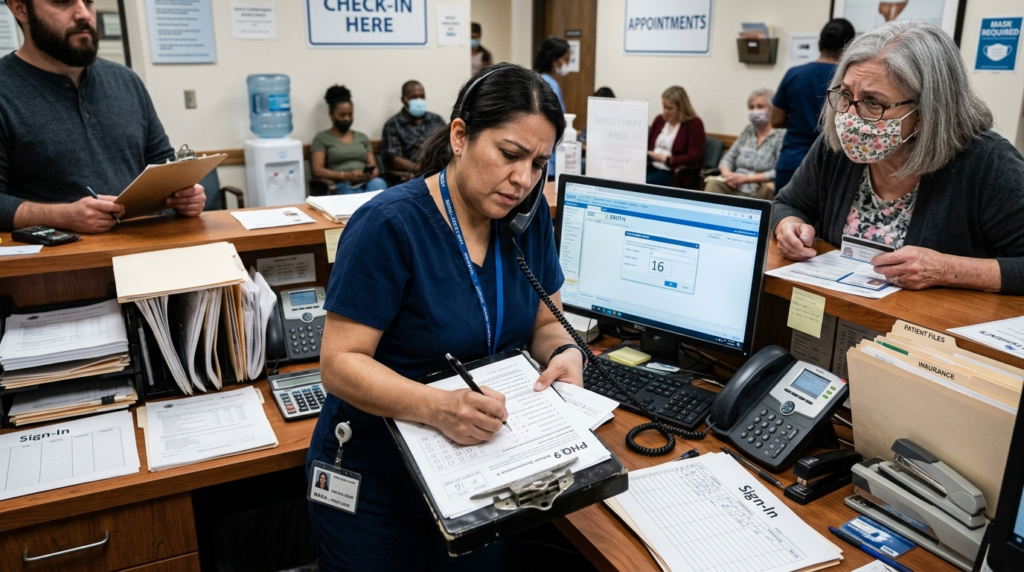
In a typical small clinic using a paper or unstructured digital PHQ-9 workflow, the failure chain looks like this. A receptionist or medical assistant hands the form to the patient. The patient completes it in the waiting room. The form is returned to the front desk. A staff member scores it manually. The score is either entered into the EHR by hand or filed in the paper record. The clinician checks the score during the appointment if there is time.
Every step in that chain is a failure point. The form is sometimes not given to the patient. The patient sometimes returns it incomplete. The manual scoring step is sometimes skipped. The EHR entry is sometimes made in the wrong field. The clinician sometimes learns of a high score for the first time while the patient is in the room, with no preparation time.
A study published in JAMIA Open examining EHR-integrated depression assessment implementation found that when PHQ-9 scoring required manual entry steps, uptake was significantly lower and inconsistency rates were higher than in workflows where results were automatically transmitted to the clinician’s EHR inbox upon patient completion. The manual steps did not just create administrative burden. They created the clinical gaps that allowed high-scoring patients to go undetected.
What AI PHQ-9 EHR Integration Actually Changes

AI PHQ-9 EHR integration replaces every manual step in the chain described above with an automated one. The specific changes are operational rather than clinical, and each one maps to a specific failure point in the manual workflow.
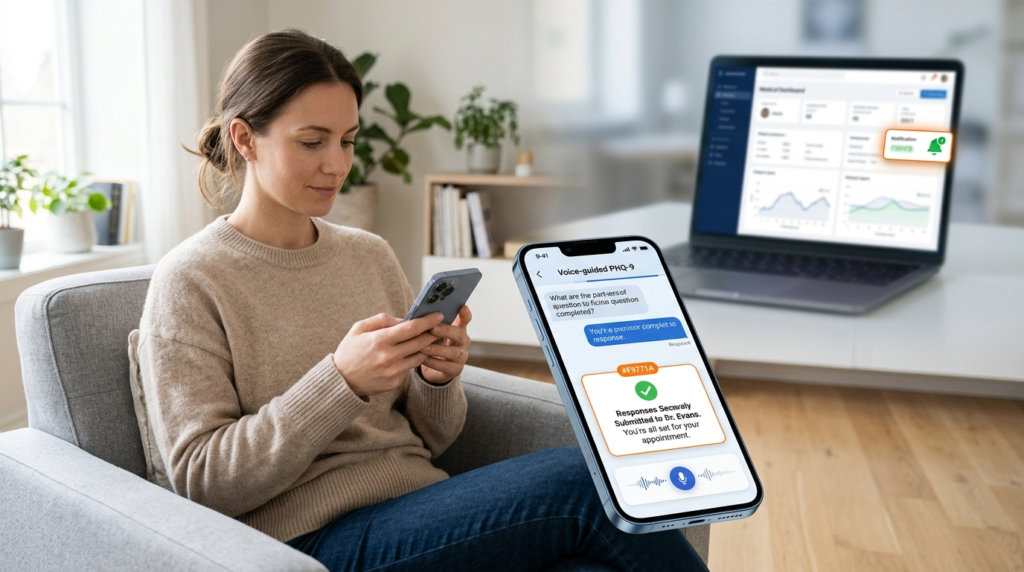
Automated pre-visit delivery removes the administration dependency. The PHQ-9 is sent to the patient automatically before the visit through a secure digital link, via SMS or the patient’s preferred communication channel, as part of the pre-visit intake process. No staff member needs to remember to give a form to a specific patient at a specific visit. No device needs to be handed over and collected back. The form goes to the patient independently of what else is happening at the front desk.
Voice-guided completion removes the literacy and format barrier. A voice-guided PHQ-9 walks the patient through each question verbally, at a natural conversational pace, before they arrive at the clinic. The patient does not need to read a form, hold a device, or navigate a digital questionnaire interface. They respond to spoken questions, and their responses are captured automatically. For clinics serving diverse patient populations, voice guidance removes barriers that silent forms do not address.
Automated scoring removes the manual calculation step. PHQ-9 scoring is a fixed algorithm: nine items, each scored zero to three, total ranging from zero to twenty-seven. At a score of 10 or above, sensitivity for major depressive disorder is 88% and specificity is 88%, according to validated psychometric data from Kroenke et al. published in the Journal of General Internal Medicine. Automated scoring produces that result the moment the patient completes the final question. No arithmetic. No delay. No transcription error.
Structured report delivery removes the EHR entry step. When the patient completes the PHQ-9, a structured report containing the total score, severity classification, and flagged item responses is delivered directly into the clinician’s existing workflow. The clinician does not need to open a separate application, retrieve the score, or enter it manually into the EHR. The report is in the workflow the clinician already uses, before the appointment begins.
Q9 suicidal ideation alert removes the detection delay. When a patient responds affirmatively to Question 9 on suicidal ideation, an immediate alert is sent to the assigned clinical staff member before the patient enters the consultation room. The clinical team has time to respond before the clinician sits down. There is no flag waiting to be discovered after the visit. No response goes unnoticed.
The Difference Between Integrated and Non-Integrated PHQ-9 Workflows
The practical difference between a clinic using AI PHQ-9 with EHR integration and one using a standalone PHQ-9 tool without integration is visible at the point of the clinical encounter.
Non-integrated PHQ-9 workflow:
- Patient completes PHQ-9 in the vendor’s separate application or on a tablet
- Score and report exist in the vendor’s system only
- Staff member must log into the vendor application, retrieve the score, and manually transfer it to the EHR before or during the appointment
- Clinician must either check the vendor application separately or wait for the staff member to complete the transfer
- If the transfer step is missed, the clinician has no PHQ-9 data available
- Longitudinal tracking requires the same manual transfer at every visit
- Q9 alert exists only in the vendor application, not in the EHR clinical decision support workflow
Integrated AI PHQ-9 workflow:
- Patient completes voice-guided PHQ-9 before the visit via secure link
- Score, severity classification, and item responses delivered automatically into the existing clinical workflow
- Clinician sees the report in the workflow they already use before the appointment begins
- Q9 suicidal ideation response triggers immediate alert to assigned clinical staff
- Every completed score is stored against the patient record and compared to previous screenings automatically
- Clinicians see a clean trend view at every follow-up visit showing whether the patient is improving, stable, or worsening
- Zero staff administration steps between patient completion and clinical receipt
The compounding outcome: A clinic seeing 80 patients per day with a 10% PHQ-9 positivity rate has 8 patients with clinically significant depression scores on any given day. With a non-integrated workflow, some of those scores do not reach the clinician before the appointment. With an integrated workflow, all 8 are in the clinical workflow before the first patient enters the room.
What Happens to the Data After the PHQ-9 Is Completed
The question clinic owners most commonly ask about PHQ-9 EHR integration is not how the form gets to the patient. It is what happens to the data after the patient submits it.
The scored report lands in the existing workflow. For a clinician using any standard EHR, the PHQ-9 report appears as a structured document within their existing workflow. There is no new system to learn and no separate dashboard to check. The workflow the clinician follows before every appointment now includes the PHQ-9 report alongside the other clinical information they review. MedLaunch handles the entire EHR integration and configuration as part of setup. Most clinics are fully live within days.
The score is stored against the patient record. Every completed PHQ-9 score is stored against the patient’s record and linked to the visit date. This creates the structured longitudinal data that measurement-based care requires. A clinician reviewing a patient at the six-month follow-up can see the score at intake, the score at every subsequent visit, and the trend line showing whether the treatment is producing the expected response. Without stored structured scores, that clinical picture does not exist.
Previous scores are automatically compared. When a patient completes a PHQ-9 at a follow-up visit, the system automatically compares it to the previous score and presents the trend. The clinician does not need to locate the previous score manually or calculate the change. The comparison is automatic.
The HIPAA compliance architecture protects the data throughout. Patient voice responses captured during the PHQ-9 assessment are never retained after the report is generated. The system operates within a HIPAA-compliant framework. Encrypted transmission, role-based access controls, and secure storage apply at every step.
What Breaks When PHQ-9 Integration Is Incomplete
Not every AI PHQ-9 system produces a fully integrated workflow. The most common integration failure points in small clinic implementations are worth understanding before selecting a system.
The score exists in a separate dashboard the clinician never opens. Some PHQ-9 tools deliver scored reports to a vendor-specific dashboard rather than into the clinician’s existing EHR workflow. In a busy small clinic, a separate dashboard the clinician has to remember to open before every applicable appointment is a dashboard that will frequently not be opened. The score exists. The clinician does not see it. The clinical outcome is the same as not screening.
The Q9 alert fires in the vendor application, not in the clinical workflow. A Q9 suicidal ideation alert that appears in a vendor application the clinician is not actively monitoring during the clinical day is an alert that may not be seen in time. The clinical value of Q9 alerting is entirely dependent on the alert reaching clinical staff through a channel they are actively monitoring before the patient enters the room. This is the most clinically significant integration failure point in AI PHQ-9 systems.
Longitudinal tracking requires manual chart review. If PHQ-9 scores are stored as free-text notes rather than structured data in the patient record, generating a longitudinal view requires a staff member to review each note individually and manually reconstruct the score history. At scale, across a panel of 20 or 30 patients with active depression monitoring, this is not a viable clinical workflow. Structured score storage is not a premium feature of PHQ-9 integration. It is the operational prerequisite for measurement-based care.
Manual data transfer between systems introduces errors. Any integration that requires a staff member to copy a PHQ-9 score from one system and paste it into another creates a data entry step that is subject to human error, time pressure, and omission. A score entered in the wrong field, transposed, or simply not entered during a busy clinic day represents both a documentation gap and a potential clinical safety risk.
What to Ask Before Selecting an AI PHQ-9 System
Five questions that determine whether the integration will work for a small clinic.
Question 1: Does the scored PHQ-9 report land automatically in my existing clinical workflow, or does a staff member need to retrieve it? This is the single most important integration question. If the answer involves any manual retrieval or transfer step, the integration is incomplete for a small clinic environment. The entire operational value of AI PHQ-9 screening depends on the scored report reaching the clinician without a staff administration step in between.
Question 2: How does a Q9 suicidal ideation response reach clinical staff? The answer should be: an immediate alert to the assigned clinical staff member before the patient enters the consultation room, through a channel clinical staff are actively monitoring. If the answer is that the alert appears in the vendor dashboard only, ask specifically whether that alert is visible in the EHR workflow or requires a separate login.
Question 3: Is the PHQ-9 score stored as structured data against the patient record, or as a free-text note? Structured data enables automatic longitudinal tracking, trend comparison, and population-level visibility. Free-text notes require manual reconstruction of score history. For any clinic intending to use PHQ-9 as a measurement-based care tool across multiple visits, structured score storage is not optional.
Question 4: Who handles the EHR integration and configuration setup? For a small clinic without dedicated IT staff, the integration setup should be managed entirely by the vendor. MedLaunch handles the entire setup including EHR integration, configuration, and staff briefing, with most clinics fully live within days. A system that delivers a login and leaves the clinic to configure its own EHR integration is a system that will produce an incomplete integration in a small clinic environment.
Question 5: Can the PHQ-9 be completed by the patient before the visit without staff involvement? Pre-visit completion is the workflow change that most directly improves clinical encounter quality. A system that requires in-clinic administration has not solved the time constraint problem that causes most small clinics to skip PHQ-9 screening in the first place. The system should send the PHQ-9 to the patient automatically before the visit and receive the completed form back without any staff step in between.
Without AI PHQ-9 EHR Integration vs With AI PHQ-9 EHR Integration
Without AI PHQ-9 EHR integration:
- Staff member administers PHQ-9 in clinic when they remember to
- Patient completes form under time pressure with other patients waiting
- Staff manually scores and enters result into EHR
- Score may not reach the clinician before the appointment
- Q9 flag discovered during the appointment with no preparation time
- Longitudinal tracking requires manual chart review at every follow-up
- Screening rate inconsistent across clinic days and staff members
- Clinical encounter shaped by whatever presenting complaint the patient raises first
With AI PHQ-9 EHR integration:
- PHQ-9 sent automatically to patient before visit with no staff involvement
- Patient completes voice-guided assessment before arrival in a private, pressure-free environment
- Scored report delivered automatically into existing clinical workflow
- Clinician sees score, severity, and flagged items before the appointment begins
- Q9 suicidal ideation response triggers immediate alert to assigned clinical staff before the patient enters the room
- Every score stored against patient record and automatically compared to previous screenings
- Clinician sees trend view at every follow-up showing improving, stable, or worsening
- Clinical encounter begins from a scored clinical picture rather than from a blank page
The compounding outcome: For a small clinic seeing patients with depression across multiple visits, the difference between these two workflows is not just the efficiency of the screening process. It is whether the clinician has objective, longitudinal depression data shaping every clinical encounter or whether each appointment starts from the patient’s subjective report alone. Over a six-month treatment episode, that difference determines whether treatment adequacy is detected and adjusted at week 8 or at week 24.
What This Means for Clinic Owners in 2026
The screening rate gap is an integration problem, not a clinical one. Only 4% of primary care patients are currently screened for depression despite universal screening recommendations. That figure reflects the failure of workflows that depend on manual administration, manual scoring, and manual EHR entry. AI PHQ-9 EHR integration removes every manual step from that chain. The screening happens because the system delivers it, not because a staff member remembered to.
Voice-guided delivery addresses the patient compliance barrier that digital forms do not. Pre-visit SMS links and patient portal forms require patients to navigate a digital interface. Voice-guided PHQ-9 administration requires only that the patient respond to spoken questions. For clinics serving older patients, patients with limited digital literacy, or patients with conditions that affect reading, voice administration produces higher completion rates than silent digital forms at the same delivery point.
Longitudinal tracking is only as good as the integration behind it. The clinical evidence for measurement-based care, including the 74% versus 29% remission rates from the landmark RCT covered in the analysis of PHQ-9 longitudinal tracking and treatment outcomes, assumes that scores are tracked consistently across every visit. That consistency is operationally dependent on structured score storage and automatic trend calculation. A PHQ-9 system that stores scores as free-text notes cannot deliver the operational foundation that MBC outcomes require.
Setup days, not months, is only true when the vendor manages the integration. Most clinics are fully live with MedLaunch AI Powered PHQ-9 Screening within days. That timeline is achievable because MedLaunch handles the entire setup including EHR integration, configuration, and staff briefing. The clinic’s team does not need to manage any technical setup. No new system to learn. The reports land in the existing EHR and workflow from day one.
The full workflow is on the AI Powered PHQ-9 Screening solution page.
FAQ
How does AI PHQ-9 screening integrate with an EHR?
AI PHQ-9 EHR integration delivers the completed PHQ-9 report, including the total score, severity classification, and flagged item responses, automatically into the clinician’s existing workflow when the patient submits the assessment. In a fully integrated workflow, no staff member needs to retrieve the score from a separate system or manually enter it into the EHR. The clinician sees the report in the workflow they already use before the appointment begins. MedLaunch handles the entire EHR integration and configuration as part of clinic setup.
What is the difference between an integrated and non-integrated PHQ-9 system?
An integrated AI PHQ-9 system delivers scored reports automatically into the existing clinical workflow when the patient completes the assessment. A non-integrated system stores the score in a separate vendor application that requires a staff member to manually retrieve the result and transfer it to the EHR. A quality improvement study published in JMIR Mental Health found that automated pre-visit PHQ-9 delivery dramatically increased completion rates and decreased staff workload compared to in-clinic manual workflows. The integration method determines whether the system reduces administrative burden or simply moves it.
Does AI PHQ-9 screening work with my existing EHR?
MedLaunch AI Powered PHQ-9 Screening is designed to work with your existing EHR and workflow, with no new system for your team to learn. MedLaunch handles the entire setup including EHR integration and configuration. Reports land directly in your existing clinical workflow from day one. If you want to confirm compatibility with your specific EHR before committing, MedLaunch recommends confirming integration scope upfront as part of the evaluation process.
What happens to the PHQ-9 score after the patient completes it?
When the patient completes the voice-guided PHQ-9, the score is calculated automatically and a structured report is delivered to the clinician’s existing workflow. Every completed score is stored against the patient’s record and automatically compared to previous screenings, giving clinicians a trend view at every follow-up visit showing whether the patient is improving, stable, or worsening. Patient voice responses are never retained after the report is generated. The system operates within a HIPAA-compliant framework throughout.
How does AI PHQ-9 handle a positive Q9 suicidal ideation response?
When a patient responds affirmatively to Question 9, an immediate alert is sent to the assigned clinical staff member before the patient enters the consultation room. The clinical team has time to act before the clinician sits down. No Q9 response goes unnoticed and no flag waits to be discovered after the visit. This alert is part of the core MedLaunch PHQ-9 workflow, not an optional add-on.
How long does AI PHQ-9 EHR integration take to set up?
Most clinics are fully live with MedLaunch AI Powered PHQ-9 Screening within days. MedLaunch handles the entire setup including EHR integration, configuration, and staff briefing. The clinic’s team does not need to manage any technical setup. For a detailed breakdown of how EHR-integrated clinical tools are set up in small clinic environments, the AI clinical documentation implementation timeline covers the week-by-week process.
Can patients complete the PHQ-9 remotely before their appointment?
Yes. The voice-guided PHQ-9 assessment can be completed remotely via a secure link sent to the patient before the appointment. The scored report is ready in the clinician’s hands before the patient arrives at the clinic. Pre-visit completion removes the in-clinic time constraint that causes most small clinics to skip PHQ-9 screening, and a quality improvement study published in JMIR Mental Health found that patients completing PHQ-9 before the visit were twice as likely to complete a Columbia Suicide Severity Rating Scale when Q9 was flagged, producing better safety outcomes on the most critical items.
Conclusion
The question clinic owners most often ask about AI PHQ-9 screening is whether it will work with their EHR. The more useful question is whether the integration will eliminate every manual step between the patient completing the form and the clinician seeing the result.
A PHQ-9 system that delivers a score to a separate dashboard is a digital version of the paper workflow. A staff member still has to retrieve the score, transfer it to the EHR, and ensure the clinician sees it before the appointment. The manual steps still exist. The failure points still exist.
A PHQ-9 system that delivers a structured report automatically into the clinician’s existing workflow, stores every score as structured data against the patient record, triggers immediate Q9 alerts to clinical staff, and presents a longitudinal trend view at every follow-up appointment has replaced every manual step with an automated one. That is not a marginal improvement on the paper workflow. It is a different clinical infrastructure.
The gap between 4% of patients screened and the USPSTF recommendation for universal screening is operational. The integration is how it gets closed.
Your workflow should end when the patient hits submit.
MedLaunch delivers scored reports and Q9 alerts into your workflow automatically, removing the data entry burden. Most clinics are live within days.