
Key Takeaways: AI and PHQ-9 Question 9 Alert Handling
-
1Screening vs. Assessment: Question 9 (Q9) is a severity marker with a high negative predictive value (~96%), but it is not a full suicide risk assessment like the C-SSRS. Its value lies in triggering the clinical follow-up that actually manages patient risk.
-
2The Standard of Care: Any positive Q9 response requires immediate follow-up. AI solves the structural problem of ensuring this follow-up happens reliably, every time, before the patient leaves the building.
-
3Solving Workflow Failures: AI alert routing prevents two major clinical failure modes: alerts reaching clinicians too late and alert fatigue. It addresses these by removing latency and respecting the severity tiers defined by the practice.
-
4Support, Not Assessment: The system captures verbal responses and routes them according to clinic rules. It does not assess risk itself; that clinical responsibility remains entirely with the clinician.
-
5Clinic-Owned Protocols: MedLaunch implements the safety protocols defined by your clinical leadership. Your team decides who is alerted, through what channel, and in what order, ensuring technology serves your existing medical standards.
-
6Practical Benefits: This provides real-time alerts the moment a response is recorded, audit trails for risk management, and the total elimination of unread paper forms sitting on a front desk while a patient walks out.
PHQ-9 Question 9 alerts are the clinical workflow layer most mental health practices struggle to get right not because the screening item itself is unreliable, but because the structural workflow that connects a positive Q9 response to the clinical safety follow-up has historically depended on manual handoffs that fail under real-world clinic load. This guide explains what AI alert routing actually does, what it doesn’t, and why the framing matters.
A clinical director is sitting in her practice’s monthly safety review.
The case being discussed is a patient who completed a paper PHQ-9 in the waiting room three weeks ago, scored 18, and answered “more than half the days” on Question 9. The form was returned to the front desk. The medical assistant scored it. The PHQ-9 was placed in the chart. The clinician opened the chart at the start of the consultation, fifteen minutes later, and saw the Q9 response then. The conversation that followed was appropriate, but the clinical director’s question for the safety review is the one that does not have a comfortable answer.
“What if the clinician had been running late and had only read the chart after the consultation started? What if the appointment had been cancelled and the patient had walked out of the building? At what point in this workflow does the safety follow-up actually fire?”
This is the workflow problem at the heart of every conversation about Question 9. It is not a question about whether Q9 detects suicidal ideation; Q9 detects it competently, as the literature has established for two decades. It is a question about whether the clinical response to a positive Q9 reliably happens, every time, with the latency the clinical situation requires.
This guide is the honest answer to that question. It walks through what Q9 actually is and what it is not, what the published literature says about its predictive value, why every positive response requires immediate clinical follow-up despite Q9’s known limitations, the two workflow failure modes that AI alert routing exists to solve, and what an AI system can and cannot legitimately claim to do in the suicide-risk space.
This is the post that engages with the clinical reality directly. The credibility of every other claim MedLaunch makes about Q9 alert handling depends on it.
Table of Contents
1. What Question 9 Actually Is, and What It Is Not
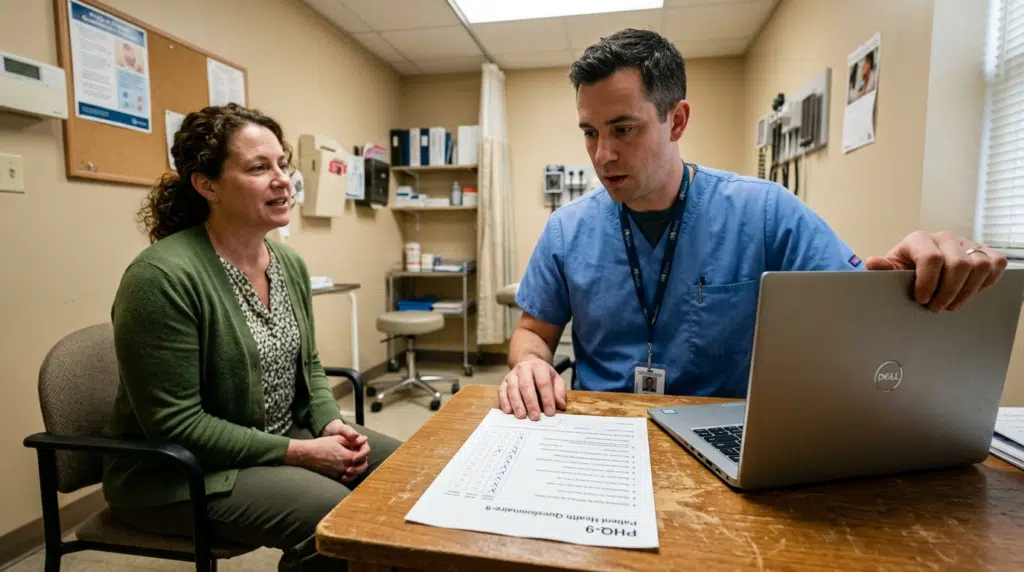
Question 9 of the Patient Health Questionnaire-9 reads: “Over the past two weeks, how often have you been bothered by thoughts that you would be better off dead or of hurting yourself in some way?”
The response options match the rest of the PHQ-9: 0 = not at all; 1 = several days; 2 = more than half the days; 3 = nearly every day.
That is the entire instrument. One item. Four response options. Embedded in a nine-item depression-severity questionnaire that was developed and validated in the late 1990s for use in primary care.
Q9 is a screening item. It is not a suicide risk assessment. It was not designed as one and has never been positioned as one in the foundational PHQ-9 validation literature. The original Kroenke 2001 validation paper described the PHQ-9 as a measure of depression severity. The suicide-related item is one of the nine DSM diagnostic criteria the instrument operationalizes, included because suicidal ideation is a diagnostic criterion for major depressive disorder.
This matters for one specific reason: a different instrument, the Columbia Suicide Severity Rating Scale (C-SSRS) was designed as a dedicated suicide risk assessment. The C-SSRS is a structured clinical interview that distinguishes passive death wishes from active suicidal ideation, ideation with a plan from ideation with intent, and assesses recent suicidal behavior. It is the instrument the Joint Commission and most U.S. health systems use as the standard for suicide risk assessment.
The relationship between Q9 and C-SSRS is not adversarial. They serve different purposes. Q9 is a brief, in-flow screening item embedded in a depression questionnaire. C-SSRS is a dedicated risk assessment that is administered when a screening signal, like a positive Q9, indicates further evaluation is warranted. The published literature is consistent: a positive Q9 is a signal that a more detailed risk assessment, often C-SSRS, should follow.
A clinic deploying any Q9-based alert system needs to be clear-eyed about this. The alert is not a risk assessment. It is a signal that triggers the practice’s existing safety protocol, which itself includes the appropriate clinical assessment. The post that follows is about the workflow that connects the screening signal to the clinical assessment without latency or loss.
2. What the Literature Shows About Question 9’s Predictive Value
A clinically credible discussion of Q9 alert handling has to engage with what the published literature actually shows about Q9’s predictive properties. The honest summary is that Q9 has well-characterized strengths and well-characterized limitations, and any responsible system built around it has to design for both.
The headline findings
A 2018 validation study published in the Journal of Affective Disorders (Na et al.) compared the PHQ-9 Question 9 against the electronic Columbia Suicide Severity Rating Scale (eC-SSRS) in 841 patients across National Network of Depression Centers sites. The findings:
- Sensitivity: 87.6% (95% CI 80.2–92.5%) Q9 correctly identifies most patients who would screen positive on the C-SSRS
- Specificity: 66.1% (95% CI 62.6–69.4%) Q9 generates a meaningful number of positive responses among patients who would not screen positive on the C-SSRS
- Positive Predictive Value (PPV): 28.6% (95% CI 24.1–33.6%) among patients screening positive on Q9, fewer than one in three would also screen positive on the C-SSRS
- Negative Predictive Value (NPV): not reported in this analysis but consistently high (~96%) across the broader literature among patients screening negative on Q9, the vast majority are also negative on more detailed risk assessment
A separate analysis in mood disorder outpatient settings replicated the pattern: sensitivity 74.7%, specificity 74.1%, PPV 27.5%, NPV 95.7%.
What these numbers mean in plain language
Q9 is good at not missing patients who have suicidal thoughts. The high sensitivity and high NPV mean that if a patient screens negative on Q9, the probability that they have clinically significant suicidal ideation is low. This is the property that makes Q9 useful as a broad-net screening item.
Q9 is less good at predicting which positive screens are acute risk. The low PPV means that most positive Q9 responses, when followed up with a more detailed assessment, do not reflect acute, intent-to-act suicidal ideation. The Q9 response captures a real signal that the patient endorsed thoughts of being better off dead or of self-harm, but the clinical meaning of that signal varies substantially across patients.
What Q9 does predict, longitudinally
Despite the modest PPV against acute risk, Q9 does predict longitudinal suicide outcomes at a population level. A 2017 analysis by Rossom and colleagues, drawing on data from four Mental Health Research Network–affiliated health systems, found that patients reporting daily suicidal ideation on Q9 were 3 to 11 times more likely to die by suicide within 30 days, depending on age. A 2016 analysis of Veterans Health Administration data by Louzon and colleagues replicated this longitudinal predictive value in a national VA sample.
The synthesis: Q9 is a real signal of elevated longitudinal risk that is too noisy to be relied on as a standalone acute-risk predictor. It is a screening trigger for the clinical assessment that follows, not a substitute for that assessment.
The honest synthesis from the published literature
A representative summary, from a 2024 quality improvement study of integrated primary care depression screening: “While question 9 is an important marker of disease severity, it has little predictive utility for acute risk of suicide.”
This is the conclusion any clinically credible discussion of Q9 has to start from. Q9 is genuinely useful for what it is. The next section is about why, given these limitations, the standard of care is still that every positive Q9 requires immediate clinical follow-up.
3. Why the Standard of Care Is Immediate Follow-Up for Every Positive Q9
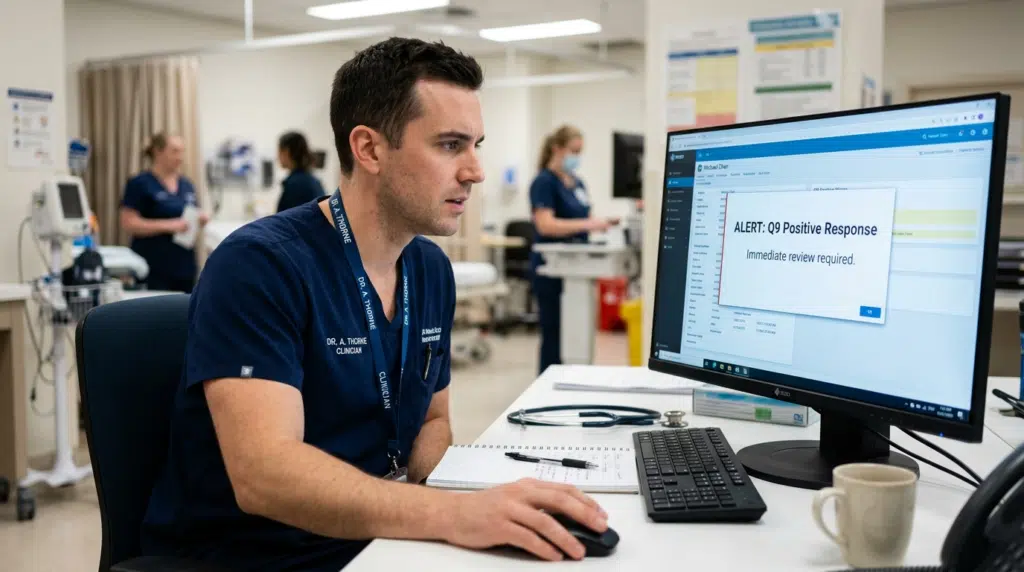
If Q9’s PPV against acute risk is only ~28%, why does the clinical standard mandate immediate follow-up for every positive response, including a single endorsement of “several days”?
The answer is straightforward and sits comfortably in the published clinical guidance: high sensitivity and high NPV mean that the negative signal is reliable, but the positive signal is not, and in suicide-risk workflow, the asymmetry of harms favors the broad-net response.
The asymmetry of error
The cost of missing a true positive, a patient with acute suicidal ideation who is not assessed and acted on, is potentially catastrophic and irreversible. The cost of following up on a false positive, a patient who endorsed Q9 but turns out, on detailed assessment, to have a passive death wish without intent or plan, is a clinical conversation. The conversation is itself often valuable. The cost ratio between the two errors is very large in one direction.
This asymmetry is what justifies the broad-net standard. With high sensitivity (~88%), Q9 catches the patients who matter. With low PPV (~28%), it generates additional alerts that turn out not to require escalation, but each of those alerts triggers a clinical conversation that itself has value, and the additional time cost is acceptable in exchange for not missing the patients in the smaller, true-positive subset.
What “immediate clinical follow-up” actually involves
The published clinical standard, reflected across Joint Commission guidance, the Suicide Prevention Resource Center, and operational protocols at integrated health systems, is that any positive Q9 triggers a defined sequence:
- Notification of the appropriate clinician before the patient leaves the clinical setting
- Brief safety assessment, often using C-SSRS or an equivalent dedicated risk assessment instrument
- Safety planning if indicated by the assessment
- Escalation pathways to crisis services, ED transfer, or psychiatric consultation if the assessment indicates acute risk
- Documentation of the assessment, the clinical judgment, and the disposition
The standard is unambiguous: every positive Q9 enters this sequence. The clinical response is what manages risk. Q9 is the entry point.
The implication for any Q9 alert system
Any system that handles Q9 alerts has one job: make sure step 1 of the sequence reliably happens, every time, with the latency the clinical situation requires. The remaining steps, assessment, safety planning, escalation, and documentation, are clinical work that the alert system does not perform and should not claim to perform.
The value of an alert system is therefore measured by how reliably it triggers the practice’s existing safety sequence, not by any clinical inference the system makes about the patient’s risk level.
4. The Two Workflow Failure Modes
The clinical sequence in Section 3 only works if the alert reaches the right person at the right time. The published literature and the operational reality of busy clinics both surface two specific failure modes that AI alert routing exists to address.
Failure Mode 1 — Alert latency
The most common workflow failure is that the alert reaches the clinician too late.
The typical paper PHQ-9 workflow: patient completes the form in the waiting room. Form returns to the front desk. Medical assistant scores it during a quiet moment, which may be several minutes later. The form is placed in the chart. The clinician opens the chart at the start of the consultation, which may be another five to fifteen minutes later. The Q9 response is discovered, then often after the patient has already begun talking about something else, sometimes after the appointment has ended and the patient has left the building.
A 2024 quality improvement study from a Northern California primary care system, evaluating 1,683 patients with positive Q9 responses across 33 clinic sites, was specifically motivated by this latency gap. The system implemented automated electronic pre-visit PHQ-9 distribution to ensure the screening was completed and scored before the patient arrived for the consultation, so the clinician could be informed before the visit began rather than mid-visit.
The implication is operational: any system that delivers the alert after the moment when clinical action could most easily be taken is a system that has failed at its core function.
Failure Mode 2 — Over-triggering and alert fatigue
The opposite failure mode is over-triggering. If every positive Q9 response, including a single endorsement of “several days,” triggers the same high-priority alert as a “nearly every day” response, the clinical team experiences a constant stream of alerts that quickly outpaces the team’s capacity to respond at the urgency level the alerts demand.
The well-documented pattern that follows: alerts get acknowledged but not acted on with full urgency. Some alerts get triaged silently in the workflow. Some get missed. The system becomes operationally less effective the more it fires, because the clinical team learns that not every alert requires the same response.
This is alert fatigue, and it is a substantial, well-studied phenomenon in clinical informatics across many domains. In a Q9 context, the consequence is that the system meant to ensure every positive response triggers the safety sequence ends up degrading the very workflow it was deployed to support.
The shared underlying problem
Both failure modes point at the same underlying issue: a Q9 alert system that does not respect the workflow context, the clinical severity tier of the response, the timing of the patient’s visit, the staffing and availability of the clinical team will fail in one direction or the other. Latency in one direction. Fatigue in the other. Both lead to the same outcome: the safety follow-up does not reliably happen at the urgency the patient’s clinical situation requires.
The next section is about what AI alert routing can legitimately do to address both.
5. How AI-Driven Alert Routing Addresses Both Failure Modes
This is the section where the workflow value of a well-implemented Q9 alert system becomes concrete. None of what follows is a clinical claim about suicide risk prediction. All of it is a workflow claim about removing latency and respecting clinical severity tiers.
Real-time alert firing
When the patient completes the Q9 item verbally, in a voice-administered system, the response is captured immediately. If the response is anything other than “not at all,” the alert fires the moment the response is recorded. There is no waiting for the medical assistant to score the form, no waiting for the clinician to open the chart, no waiting for the consultation to begin.
The latency between the patient’s response and the alert reaching the designated clinical staff is on the order of seconds, not minutes or visits.
Configurable recipient routing with escalation paths
The alert is routed to the clinical role the practice has designated for Q9 follow-up, the assigned clinician, the on-call psychiatric consultant, the licensed clinical social worker, or whatever role the practice has defined for this function. The routing is not a generic notification queue; it is a defined recipient with a defined acknowledgment expectation.
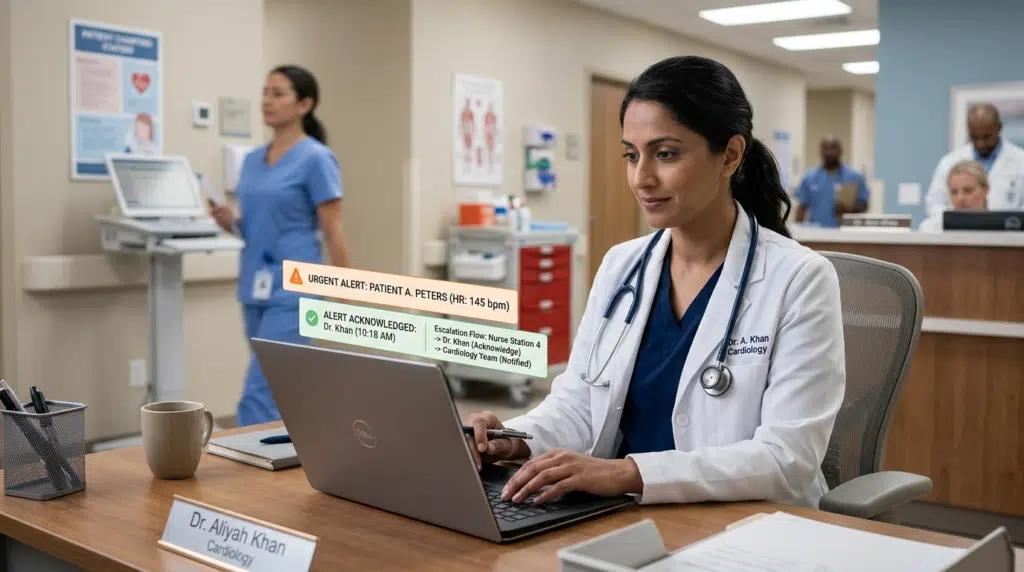
If the primary recipient does not acknowledge the alert within the practice’s defined window, the alert escalates to the next role in the configured pathway. This is not the system making a clinical decision; it is the system implementing the practice’s protocol about who covers Q9 alerts when the primary recipient is unavailable.
Severity tiering
The alert configuration can differentiate between Q9 response levels, reflecting the practice’s clinical protocol about graduated response. A response of “several days” might trigger an alert with the expectation that the clinician addresses Q9 during the consultation, a routine but defined part of the visit. A response of “more than half the days” might trigger a higher-priority alert with the expectation that the clinician is informed before the consultation begins. A response of “nearly every day” might trigger an immediate-response alert with escalation pathways pre-defined for the case where the patient cannot be assessed during this visit.
Crucially, the severity tiering is configured by the clinic, not assumed by the system. The system implements the tiers the practice has defined; it does not impose its own clinical judgment about what constitutes “severe.”
This addresses Failure Mode 2 directly. Alerts are still generated for every positive Q9, the broad-net standard is preserved, but the response expectation matches the clinical severity, which prevents the alert-fatigue spiral.
Audit trail
Every alert is logged with a timestamp, recipient, acknowledgment status, escalation history, and disposition. This creates the documentation trail that the practice’s quality improvement and risk management functions require, and supports the periodic safety reviews that are standard at most mental health practices.
What the system does not do
This is the section that distinguishes a responsibly-built workflow tool from an overreaching clinical claim. The system does not:
- Assess suicide risk. The patient’s response to Q9 is captured; the clinical interpretation of that response is the clinician’s work.
- Substitute for C-SSRS or any dedicated risk assessment. Q9 is a screening item; the assessment that follows is a separate clinical action.
- Replace the clinical safety conversation. The alert triggers the conversation; it does not constitute it.
- Make any inference about the patient’s intent, plan, or imminent risk. All of these are clinical determinations that remain entirely with the clinician.
- Provide any clinical content to the patient. The system administers the validated PHQ-9 item; it does not offer crisis resources, safety planning, or any clinical intervention.
A vendor that claims any of these things is overreaching, and the clinical readers vetting the system will notice. A vendor that is clear about what the system does and does not do and where the clinical work begins and ends is the vendor that earns clinical trust.
6. What the Alert System Requires From the Clinic
The honest disclosure that protects both the practice and MedLaunch.
Any Q9 alert system, including MedLaunch’s, runs the safety protocol the clinic has defined. The system does not create a protocol or substitute for one. This is true for two reasons. First, safety protocols are appropriately a clinical decision they reflect the practice’s clinical leadership, staffing model, regulatory context, and patient population. Second, the clinical responsibility for the response to a positive Q9 is appropriately the clinical team’s responsibility, not the technology vendor’s.
What this means in practice:
The clinic must have a defined Q9 follow-up protocol. Who is alerted at each severity tier? What is the expected response time? What is the escalation pathway when the primary recipient is unavailable? What the clinical assessment that follows the alert involves? What documentation is required? These are clinical decisions made by the practice’s clinical leadership.
The clinic configures the alert routing. MedLaunch implements the configuration; the practice defines it. The clinic identifies who receives alerts at each severity level, through what channel, with what acknowledgment expectation.
The clinical response to every alert is the clinical team’s responsibility. The system notifies; the clinician assesses, plans, and acts. The clinical judgment about what a positive Q9 means for a specific patient remains entirely with the clinician.
The alert system supports the safety protocol; it does not constitute it. A positive Q9 in MedLaunch’s workflow triggers the practice’s safety sequence on time and with documentation. The sequence itself the clinical assessment, the safety planning, the escalation, the documentation of clinical reasoning is clinical work that happens after the alert and is not performed by the system.
This division of responsibility is not a limitation of MedLaunch. It is the appropriate division of responsibility between any safety workflow technology and the clinical team that uses it. A system that claimed otherwise would be making claims that no Q9-based system, AI or otherwise, can responsibly support.
7. How MedLaunch Implements Q9 Alert Handling
The translation of the principles in Sections 5 and 6 to what MedLaunch actually does.
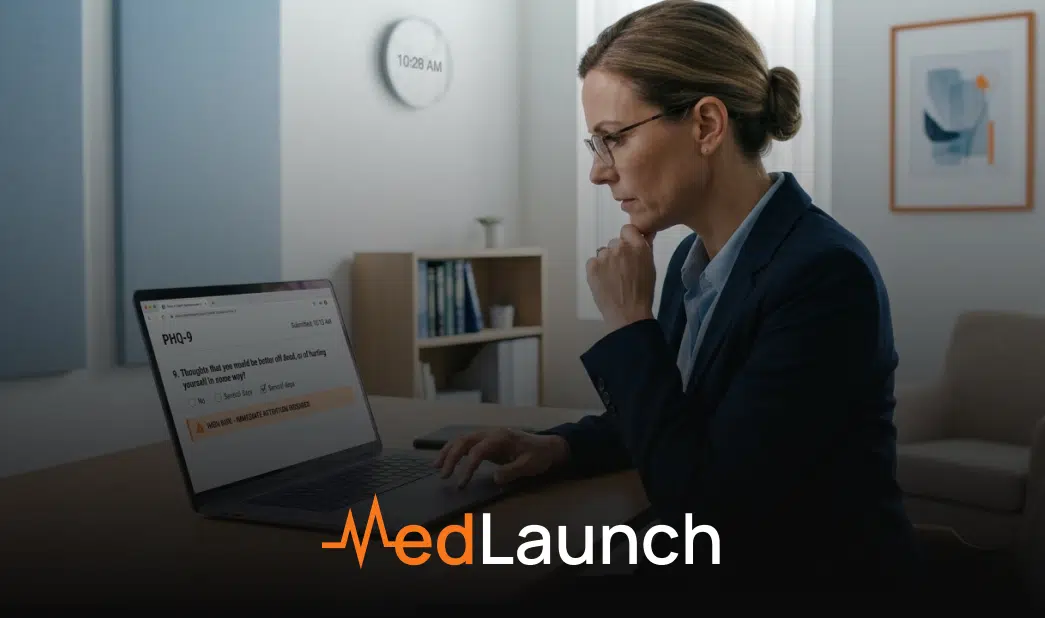
When a patient completes the AI-administered PHQ-9 and responds to Q9 with anything other than “not at all,” the alert fires in real time at the moment the response is captured, before the patient enters the consultation room, before the medical assistant has a chance to review the form (because there is no form), before the clinician opens the chart.
The alert is routed to the clinical staff role the practice has designated, through the channel the practice has designated, with the priority level the practice has assigned to that severity tier of response. If the primary recipient does not acknowledge within the configured window, the alert escalates to the next role in the practice’s pathway.
The severity tiering is configured during implementation, in collaboration with the practice’s clinical leadership. A typical pattern: “several days” → notification to the assigned clinician with the expectation that Q9 is addressed during the consultation; “more than half the days” → priority notification to the clinician before the consultation begins, with safety assessment expected as part of the visit; “nearly every day” → immediate notification with escalation pathway pre-defined for the case where the patient cannot be assessed during this visit.
Every alert is logged with a timestamp, recipient, acknowledgment status, escalation history, and final disposition. The audit trail is available to the practice’s clinical leadership, quality improvement function, and risk management function.
All alert flow data is covered under the Business Associate Agreement signed before go-live. Patient data within the alert flow is encrypted in transit and at rest, with role-based access controls. Audio of the patient’s verbal response is not retained after the response is captured and scored.
What MedLaunch does not do, in this workflow: the clinical assessment, the C-SSRS or equivalent, the safety planning, the documentation of clinical reasoning, the disposition decision, or any inference about the patient’s risk level beyond the literal Q9 response the patient provided. All of these remain the clinical team’s work.
8. Frequently Asked Questions
Is the AI assessing suicide risk?
No. The AI captures the patient’s verbal response to PHQ-9 Question 9 and routes the alert according to the clinic’s configured protocol. The clinical assessment of what the response means for that specific patient whether it constitutes acute risk, what intervention is appropriate, what disposition is warranted remains entirely with the clinician. The system handles workflow notification; it does not handle clinical determination.
Can the AI miss a positive Question 9 response?
The system is designed to capture every Q9 response that the patient provides verbally. The reliability of capture is primarily a function of accurate speech recognition of the patient’s response. Any system handling clinical workflow has technical failure modes, and a clinic deploying any Q9 alert system should ask the vendor what the verified reliability is and what the fallback is when capture fails. MedLaunch addresses this through redundant capture, response confirmation in ambiguous cases, and audit logging that surfaces any administration that did not complete cleanly.
What if no clinician is available when the alert fires?
The alert routing includes escalation pathways defined by the practice. If the primary designated recipient does not acknowledge within the configured window, the alert escalates to the next role in the pathway which may be an on-call clinician, a covering provider, a clinical supervisor, or a defined crisis-response role. The escalation logic is the practice’s clinical decision; the system implements it. The case where no clinician is reachable across the entire escalation pathway is a clinical staffing issue, not a workflow technology issue, and the practice should have a defined protocol for that scenario regardless of whether MedLaunch is involved.
Does this replace the C-SSRS or other suicide risk assessments?
No. The C-SSRS and other dedicated suicide risk assessments are clinical instruments administered by the clinician as part of the clinical follow-up that a positive Q9 should trigger. The alert system delivers the Q9 result and notifies the clinical team; the clinical assessment that follows whether that includes C-SSRS or a different validated instrument is a separate clinical action that the system does not perform.
What happens if Q9 is positive but the patient denies suicidal thoughts in the consultation?
This is a clinical scenario, not a system scenario. The clinician’s assessment determines the disposition. The Q9 response is a screening signal that warrants assessment; the clinician’s assessment is what determines what happens next. The audit log records the alert was generated, the clinician acknowledged it, and the clinical disposition that was documented.
How are alerts configured?
During implementation, MedLaunch’s clinical implementation team works with the practice’s clinical leadership to define the alert protocol: who receives alerts at each Q9 severity tier, through what channel (in-app, SMS, EHR notification), with what acknowledgment window, with what escalation pathway. The configuration is reviewed, tested, and approved by the practice’s clinical leadership before go-live.
What’s the clinical liability when the AI is part of the safety workflow?
The clinical responsibility for the response to a positive Q9 remains with the clinical team. The system supports the practice’s safety protocol by notifying the clinical team in real time, with audit logging. It does not assume clinical responsibility for the response. The Business Associate Agreement signed before go-live documents the system’s role, the data flows, and the security controls. Practice-level liability for the clinical workflow remains with the practice; the system’s role is appropriately bounded as a workflow tool.
How fast does the alert reach the clinician?
The alert fires the moment the Q9 response is captured. Delivery latency to the designated recipient depends on the channel configured (in-app, SMS, EHR notification) and is typically measured in seconds. The practice’s expected acknowledgment window is configured per severity tier a “nearly every day” alert may have a 5-minute acknowledgment expectation; a “several days” alert may have a longer window aligned with the consultation cadence.
Can we configure different responses to “several days” vs. “nearly every day”?
Yes. The severity tiering is a core part of the configuration and reflects the practice’s clinical protocol about graduated response. The clinic defines what response level each Q9 severity tier should trigger, and the system implements it. This is the mechanism by which the system avoids the alert-fatigue failure mode while preserving the broad-net standard that every positive Q9 triggers a clinical response.
What happens to the patient’s experience when an alert fires?
The patient is not notified that an alert has fired. The Q9 administration completes normally; the patient proceeds with the visit as scheduled. The clinical team’s response informed by the alert is integrated into the clinical conversation that follows. The patient’s experience is the experience of being asked the standard PHQ-9 questions and then having a clinician who is informed about their responses and prepared to address them appropriately.
9. Conclusion
The clinical director in the safety review is asking the right question.
“At what point in this workflow does the safety follow-up actually fire?” is the question that protects the practice, the patient, and the clinical team from the structural failure where a positive Q9 sits unread in a paper form on the front desk while the patient walks out of the building.
The honest answer to that question, for AI-driven Q9 alert handling in 2026, has three layers.
Question 9 is a screening item with well-characterized strengths and well-characterized limitations. It is good at not missing patients with suicidal thoughts. It is less good at predicting which positive screens are acute risk. The clinical response to a positive Q9 assessment, safety planning, and escalation if warranted, is what manages risk. Q9 is the entry point.
The standard of care is unambiguous: every positive Q9 requires immediate clinical follow-up. The asymmetry of harms is catastrophic if a true positive is missed, acceptable if a false positive triggers a clinical conversation that justifies the broad-net response. Any Q9 alert system has one job: ensure the broad-net response reliably fires, every time, with the latency the clinical situation requires.
AI-driven alert routing addresses the two real workflow failure modes, latency and alert fatigue, by firing in real time, routing to clinically-designated recipients with escalation pathways, and respecting the severity tiers the practice has defined. None of this constitutes a clinical claim about suicide risk prediction. All of it is workflow infrastructure that supports the clinical safety protocol the practice has already defined.
The clinic owns the safety protocol. The system runs it. The clinical responsibility for the response to a positive Q9 remains, appropriately, with the clinical team. The system removes the structural failure where the alert arrives too late or gets lost in alert fatigue.
For mental health and psychiatry practices in 2026, this is the layer of the safety workflow that has finally caught up with the clinical standard the profession has held for decades.
Configure Q9 alert handling for your practice.
Book a 20-minute call to see how MedLaunch implements your specific Q9 follow-up protocol; including alert routing, severity tiering, and escalation pathways.