


Key Takeaways: Patient Consent for Text Messages
-
1Patient consent for text messages is a legal requirement, not a formality:
HIPAA, TCPA, and state-specific privacy laws all govern how and when you can text patients. Non-compliance can result in financial penalties, regulatory action, and serious reputational damage. -
2Written consent is required for automated or PHI-related messages:
If your practice sends automated appointment reminders, billing alerts, or any message referencing patient health information, written consent is typically required under TCPA, implied consent is not sufficient. -
3Consent must be specific, transparent, and voluntary:
Vague consent language creates compliance gaps. Patients must clearly understand what types of messages they’ll receive, how often, and that they can opt out at any time. Care cannot be conditioned on agreeing to receive texts. -
4Documentation is as important as collection:
Collecting consent without proper records is nearly as risky as not collecting it at all. Maintain signed forms, timestamps, method of collection, and opt-out logs, these become your protection in any regulatory dispute. -
5Your messaging vendor must have a signed BAA:
Consumer-grade SMS tools are not HIPAA-compliant. Any vendor handling patient communications must provide encryption, access controls, audit logs, and a signed Business Associate Agreement before you send a single message. -
6A well-managed consent system is a strategic asset:
Beyond compliance, structured SMS consent reduces no-shows, improves care coordination, increases patient satisfaction, and builds the kind of trust that drives long-term retention.
Text messaging has transformed how healthcare providers communicate with patients. From appointment reminders and follow-ups to billing alerts and limited promotional updates, SMS offers speed, convenience, and higher engagement compared to email or phone calls. However, before sending any message that involves patient information, healthcare organizations must obtain proper patient consent.
Patient consent for SMS communication is not just a formality. It is a legal, ethical, and operational requirement. Federal regulations, privacy standards, and consumer protection laws govern the consent requirements for healthcare text messaging. Failure to comply can result in financial penalties, reputational damage, and loss of patient trust.
This comprehensive guide explains how to obtain patient consent for text messages, how to remain compliant with the Health Insurance Portability and Accountability Act (HIPAA), and how to implement a sustainable and compliant text messaging system within your practice.
Table of Contents
The Importance of Patient Consent in Healthcare Communication

Healthcare communication involves sensitive information. Even a simple reminder that references a clinic name may imply that an individual is receiving medical care. Because of this, patient authorization for text messages must be handled carefully and documented properly.
When patients provide explicit consent, they acknowledge that:
- They understand the type of communication they will receive.
- They accept potential privacy risks associated with SMS.
- They agree to the frequency and purpose of messaging.
- They can revoke permission at any time.
Obtaining patient consent for SMS communication protects patient rights while safeguarding your organization from legal risk.
Beyond compliance, consent strengthens transparency. Patients are more likely to engage with communication channels when they clearly understand how and why those channels are used.
Regulatory Framework Governing Healthcare Text Messaging
Healthcare providers must align SMS communication practices with federal and state regulations. Understanding the legal framework ensures your consent process is properly structured.
HIPAA and Electronic Communication
Under HIPAA, healthcare organizations must implement safeguards to protect Protected Health Information (PHI). The law does not prohibit texting, but it requires that:
- PHI is reasonably protected.
- Risks are assessed and mitigated.
- Communication policies are documented.
- Staff are trained on privacy practices.
HIPAA-compliant text messaging consent involves both permission and security. Even if a patient consents, the provider must still use reasonable technical and administrative safeguards to protect information.
The U.S. Department of Health and Human Services oversees HIPAA enforcement and expects healthcare providers to evaluate communication risks carefully.
TCPA and Written Consent Requirements
The Telephone Consumer Protection Act (TCPA) regulates automated messaging systems. If your practice sends automated, recurring, or promotional messages, written consent for medical text messages is typically required.
Written authorization must be clear, voluntary, and documented. Consent cannot be implied or bundled in unclear language.
State-Specific Privacy Laws
Some states enforce stricter privacy standards than federal regulations. Practices operating in multiple jurisdictions should ensure their medical practice text messaging policy aligns with the strictest applicable standard to reduce compliance risk.
Defining the Scope of SMS Communication

Before collecting consent, healthcare providers must clearly define what types of messages will be sent. Consent language must reflect actual communication practices.
Common categories include
- Appointment reminders and confirmations
- Pre-visit instructions
- Post-treatment care updates
- Prescription notifications
- Billing alerts
- Patient satisfaction surveys
- Service announcements
Each category may carry different compliance considerations. For example, promotional campaigns often require more explicit authorization than purely operational messages.
Clarity in scope prevents confusion and reduces the risk of exceeding authorized communication boundaries.
Developing a Medical Practice Text Messaging Policy
A structured medical practice text messaging policy is the foundation of compliant communication. This policy should be documented, approved by leadership, and regularly reviewed.
A strong policy typically includes:
- Purpose of SMS communication
- Categories of messages sent
- Frequency limits
- Consent collection procedures
- Documentation standards
- Opt-out handling procedures
- Security safeguards
- Staff training requirements
- Vendor compliance standards
The policy ensures consistency across departments and locations. It also serves as a reference during audits or regulatory reviews.
Without a formal policy, even well-intentioned messaging practices can create compliance vulnerabilities.
Designing an Effective Consent Collection Process
Obtaining patient consent for SMS communication should be integrated naturally into the patient experience. Consent should be collected at predictable touchpoints where patients are already reviewing documentation.
New Patient Registration
The intake process is one of the most effective opportunities to obtain written consent for medical text messages. Consent forms can be incorporated into:
- Paper registration packets
- Electronic health record (EHR) systems
- Tablet-based check-in systems
- Online pre-registration portals
This approach ensures consent is documented before any communication is initiated.
Online Appointment Scheduling
If your practice allows digital scheduling, consent language can be included during the booking process. Patients should actively select agreement rather than being automatically enrolled.
Patient Portals
Secure patient portals offer another opportunity to request patient authorization for text messages. Digital signatures and timestamped confirmations provide reliable documentation.
Elements of HIPAA-Compliant Text Messaging Consent

To meet healthcare text message consent requirements, consent language must be specific and transparent.
A compliant consent statement should clearly explain:
- The types of messages that will be sent
- That messages may include health-related information
- That SMS is not always encrypted
- That standard messaging rates may apply
- How frequently messages may be sent
- How patients can opt out
Consent should never rely on vague wording. Precision ensures that patients fully understand what they are agreeing to.
Additionally, consent must be voluntary. Care should never be conditioned upon agreeing to receive text messages.
Documentation and Recordkeeping
Collecting consent is only the first step. Proper documentation is equally important.
Healthcare organizations should maintain:
- Signed consent forms
- Date and time of consent
- Method of consent collection
- Confirmation logs
- Records of opt-out requests
- Any changes to consent status
Digital systems should include audit trails. These logs demonstrate compliance if a dispute arises.
Consent records should be retained according to your standard medical record retention schedule and applicable legal requirements.
Implementing Opt-Out and Revocation Procedures
Patient autonomy extends beyond initial consent. Patients must be able to withdraw permission easily.
An effective opt-out process should:
- Be clearly communicated in each message
- Be processed automatically when possible
- Immediately halt further communication
- Be documented within the patient record
Healthcare providers must treat opt-out requests seriously and ensure no further unauthorized messages are sent.
Failure to respect revocation requests can create legal exposure under consumer protection laws.
Technology and Vendor Considerations
Choosing the right messaging platform is critical for compliance. Consumer-grade texting tools often lack the safeguards required for HIPAA-compliant text messaging consent.
When evaluating vendors, confirm that the platform provides:
- Encryption capabilities
- Access controls
- Audit logs
- Data backup procedures
- Role-based permissions
- A signed Business Associate Agreement (BAA)
Vendor due diligence reduces risk and strengthens data protection.
Regular security reviews should also be conducted to ensure that systems remain compliant as technology evolves.
Staff Training and Internal Controls
Even with strong policies, human error can compromise compliance. Staff must be trained on:
- When consent is required
- How to verify consent status
- What information can be shared via text
- How to respond to opt-out requests
- Documentation procedures
Ongoing training sessions reinforce compliance culture and reduce risk.
Internal audits can further ensure that consent procedures are followed consistently across the organization.
Managing Risk Through Periodic Review
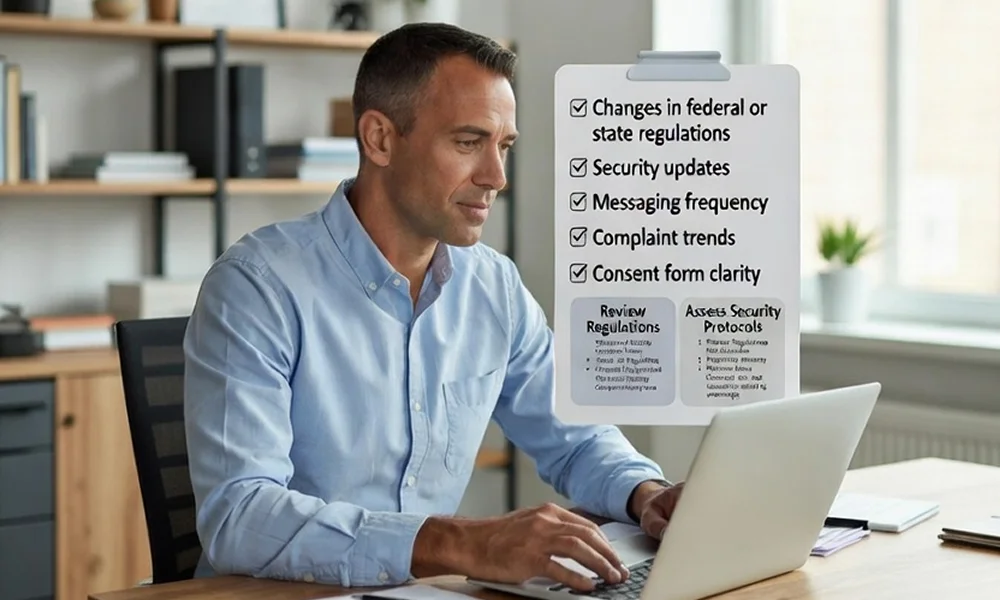
Healthcare regulations evolve, and technology changes rapidly. Your medical practice text messaging policy should not remain static.
Periodic reviews should assess:
- Changes in federal or state regulations
- Security updates
- Messaging frequency
- Complaint trends
- Consent form clarity
Updating consent language when services change is also critical. If you introduce new types of communication, updated patient consent may be required.
Ethical Considerations in Patient Communication
While legal compliance is essential, ethical communication goes further. Respecting patient privacy and autonomy builds long-term trust.
Practices should avoid excessive messaging or irrelevant content. Text communication should provide value, improve care coordination, and enhance convenience.
Ethical use of SMS includes:
- Limiting message frequency
- Avoiding sensitive detail in unsecured messages
- Providing alternative communication options
- Ensuring accessibility for patients with disabilities
Consent is not merely about protection from penalties—it reflects respect for patient choice.
Integrating Consent into Workflow Efficiency
Efficient integration of patient consent for SMS communication into existing workflows improves adoption and reduces administrative burden.
Automated EHR prompts can alert staff if consent is missing. Intake systems can require completion before finalizing registration. Centralized dashboards can track consent status across locations.
Operational efficiency reduces the risk of sending messages without proper authorization.
Addressing Common Operational Challenges
Many practices struggle with fragmented systems, inconsistent documentation, or outdated consent language.
To address these challenges:
- Standardize forms across departments
- Centralize consent storage
- Assign compliance oversight to a designated role
- Conduct quarterly reviews
- Maintain updated vendor agreements
Proactive management reduces reactive compliance crises.
Building Patient Trust Through Transparency
Patients are increasingly aware of privacy rights. Transparent communication strengthens relationships.
Practices should clearly explain:
- Why texting improves service
- How data is protected
- How consent can be withdrawn
- What types of messages will be sent
Transparency increases opt-in rates while maintaining compliance.
When patients feel informed and respected, engagement improves naturally.
Long-Term Benefits of Proper Consent Management
Implementing structured healthcare text message consent requirements offers more than legal protection.
Benefits include:
- Reduced appointment no-shows
- Faster care coordination
- Improved patient satisfaction
- Stronger documentation
- Lower regulatory risk
- Enhanced operational efficiency
A well-managed consent system becomes a strategic asset rather than a regulatory burden.
Conclusion
Obtaining proper patient consent for text messaging is a critical component of modern healthcare communication. As digital engagement becomes standard, practices must balance convenience with privacy and regulatory responsibility.
By developing a clear medical practice text messaging policy, implementing transparent consent language, documenting written consent for medical text messages, and maintaining strong security safeguards, healthcare organizations can confidently use SMS as a compliant communication channel.
Patient consent for SMS communication is not simply about meeting healthcare text message consent requirements. It is about protecting patient rights, maintaining trust, and ensuring responsible use of digital communication in a highly regulated environment.
When approached strategically and ethically, text messaging enhances patient engagement while preserving privacy and compliance standards in today’s healthcare landscape.
Frequently Asked Questions
What is patient consent for text messages in healthcare?
Patient consent for text messages is the documented permission a healthcare provider must obtain before sending any SMS communication that references patient health information or uses automated messaging systems. It is required under HIPAA for messages involving PHI and under TCPA for automated or recurring messages and must be explicit, voluntary, and properly recorded.
Is written consent required before texting patients?
Yes, written consent is required for automated messages, recurring texts, or any message that includes or references protected health information. Implied consent is not sufficient. The consent form must clearly explain what types of messages will be sent, how often, and how patients can opt out.
What must a healthcare text message consent form include?
A compliant consent form must cover: the types of messages to be sent, that messages may contain health-related information, that SMS is not always encrypted, that standard messaging rates may apply, the frequency of messages, and clear instructions for opting out. Vague or bundled consent language creates compliance gaps.
Can patients withdraw consent to receive text messages?
Yes, patients can opt out at any time using any reasonable method. Under updated TCPA rules, providers must honor opt-out requests within 10 business days. Every message you send must include clear opt-out instructions, and withdrawal must be documented and immediately applied.
Who enforces healthcare text messaging compliance?
The U.S. Department of Health and Human Services enforces HIPAA compliance for patient data in text messages. The Federal Communications Commission enforces TCPA compliance for automated and recurring messaging. State attorneys general may also enforce additional state-level privacy laws. Non-compliance can result in substantial financial penalties from multiple agencies simultaneously.
What is the safest way to text patients in a HIPAA-compliant manner?
Use a messaging platform that is specifically built for healthcare with encryption, access controls, audit logs, role-based permissions, and a signed Business Associate Agreement (BAA). Never use standard SMS apps, email-to-SMS gateways, or consumer messaging platforms for communications containing patient health information.
Need a HIPAA-Compliant Texting System for Your Practice?
Book a call to see how MedLaunch helps healthcare practices implement compliant patient messaging.