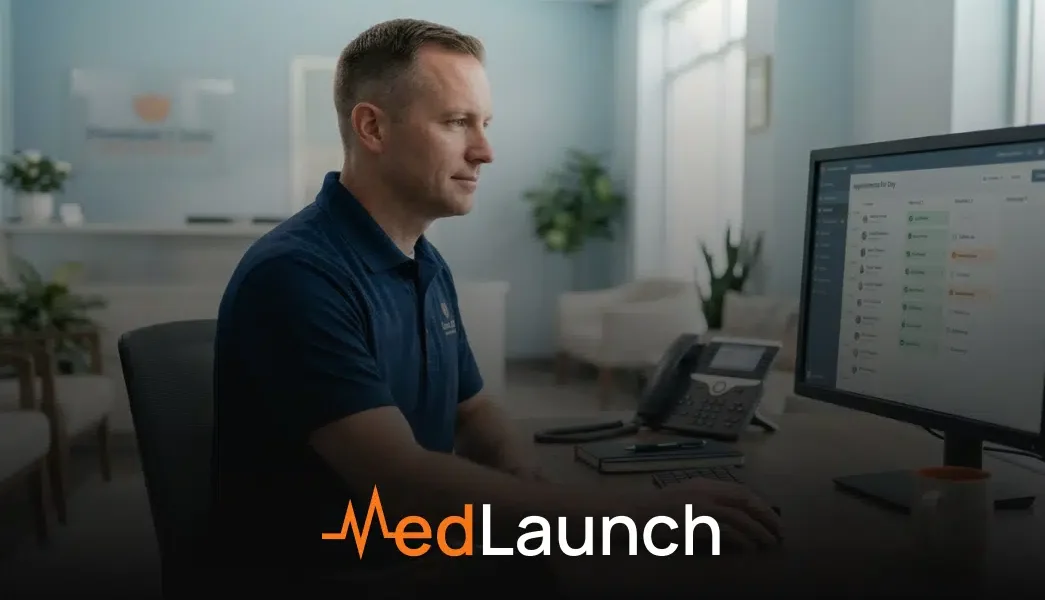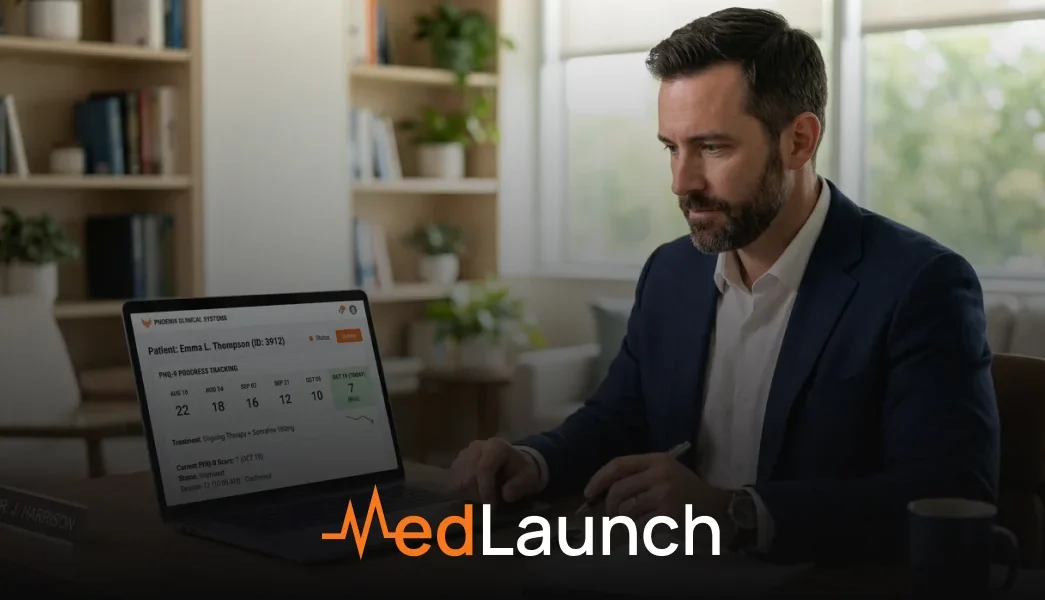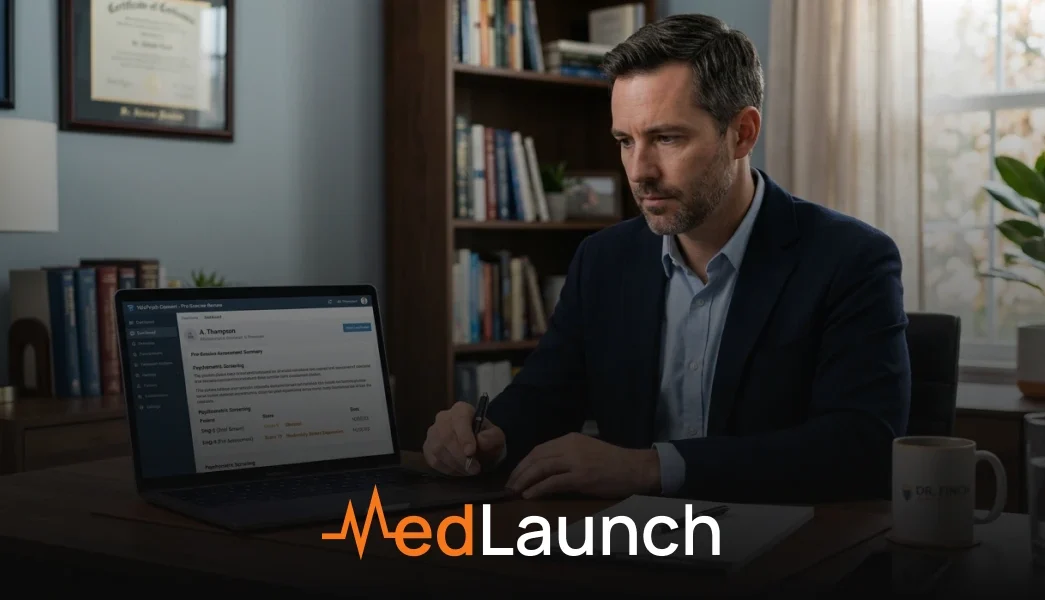
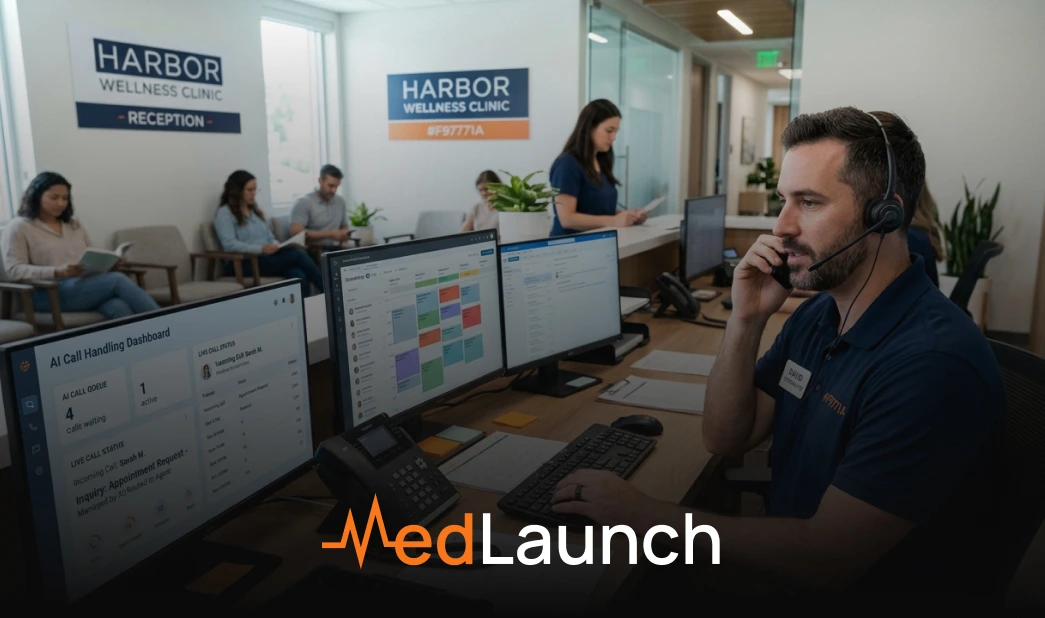

AI medical receptionist mental health clinics is the use of a voice-guided or conversational AI system to handle the front desk functions of an outpatient mental health practice, including inbound call handling, appointment scheduling, appointment reminders, after-hours communication, and patient routing, without requiring a staff member to manage each interaction. For mental health clinics specifically, the AI receptionist operates within a context that differs from general practice in three important ways: the patient population is clinically vulnerable, calls frequently arrive outside office hours when patients are in distress, and the front desk staff who would otherwise handle these calls are among the most burned out workers in healthcare.
Table of Contents
Key Takeaways
- Mental Health Front Desk Staff Face Disproportionate Burnout: A report by the National Institutes of Health found that the mental well-being of frontline health workers is poor and many are considering leaving the industry, with stress and burnout cited as the main reasons. Mental health clinic front desk staff deal with a uniquely demanding call mix that general practice receptionists rarely face.
- The National Average Wait Time for Behavioural Health Services Is 48 Days: According to HRSA’s State of the Behavioral Health Workforce 2025 report, the national average wait time for behavioural health services is 48 days. A clinic that misses calls, delays scheduling, or fails to respond after hours is adding to that wait and losing patients to the next available provider.
- The Practice That Responds First Gets the Booking: Research cited in Psychreg’s 2026 analysis confirms that when a patient contacts a clinic, they are often also contacting others. The practice that responds first is frequently the one that secures the booking. An AI receptionist replies instantly at any hour.
- AI Receptionists Do Not Replace Mental Health Clinic Staff — They Protect Them: The American Academy of Arts and Sciences report on AI and Mental Health Care found that automated scheduling systems have improved clinicians’ sense of efficiency and reduced exhaustion from menial tasks. When AI handles repetitive enquiries, administrative staff focus on interactions that require human judgment.
- Crisis Call Routing Is the Non-Negotiable Requirement: An AI receptionist for a mental health clinic must be configured with an explicit crisis call routing protocol. Any caller expressing distress, suicidal ideation, or an immediate mental health emergency must be routed to a human staff member or crisis line immediately. This is not optional and must be verified before any AI receptionist system is deployed in a mental health setting.
Why Mental Health Clinics Have a Different Front Desk Problem Than GP Clinics
The front desk challenge in a mental health clinic is not the same as in a GP or specialist practice. In a GP clinic, the majority of incoming calls are appointment bookings, prescription enquiries, and test result follow-ups. In a mental health clinic, the call mix is different. Patients calling to reschedule may be doing so because of a symptom episode. Patients calling after hours may be in distress. Patients who do not reach anyone on their first call are less likely to try again. The stakes of a missed call are higher and the emotional intensity of each interaction is greater.
According to HRSA’s State of the Behavioral Health Workforce 2025, approximately 62 million US adults had a mental illness in 2024 and nearly half did not receive treatment. Six in ten psychologists do not accept new patients and the national average wait time for behavioural health services is 48 days. Every missed call at a mental health clinic is a patient who may wait another 48 days or not seek care again.
The front desk staff managing this call volume are themselves among the most burned out workers in healthcare. The NIH has identified poor mental well-being and high burnout rates among frontline health workers across the sector. For mental health clinic administrative staff specifically, managing a call queue that includes patients in active distress while simultaneously handling check-ins, insurance queries, and scheduling for a fully booked clinician is a workload that manual systems cannot sustain.
For clinics already managing PHQ-9 screening workflows, understanding how the AI receptionist integrates with clinical processes like AI Powered PHQ-9 Screening is part of the broader operational picture.
What an AI Medical Receptionist Actually Does in a Mental Health Clinic
An AI medical receptionist for a mental health clinic performs five core functions that currently require staff time.
Inbound call handling: The AI answers every incoming call instantly, 24 hours a day, 7 days a week. It identifies the caller’s need, confirms their details, and routes the call appropriately, to scheduling, to a clinical staff member, or to a crisis line if the situation requires it.
Appointment scheduling: The AI books, reschedules, and cancels appointments directly against the clinic’s scheduling system. No staff member needs to be available for a patient to secure a booking. For a mental health clinic with high cancellation rates driven by symptom episodes, real-time rescheduling availability is particularly important.
Appointment reminders: Automated SMS and email reminders sent at defined intervals before each appointment reduce no-show rates. Research cited by Psychreg estimates that automated reminder systems reduce no-shows by 30% to 40%. For mental health clinics where no-show rates can exceed 30%, this represents significant recovered clinical time and revenue.
After-hours communication: Patients who call outside office hours receive an immediate response rather than a voicemail. The AI can book appointments, answer common questions, and triage the nature of the call, including routing to emergency services or a crisis line when the patient’s language indicates a mental health emergency.
Patient routing: Complex queries, clinical questions, and anything outside the AI’s defined scope are transferred to the appropriate staff member or flagged for a callback. The AI handles the volume. Staff handle the complexity.
MedLaunch’s AI Medical Receptionist is configured specifically for outpatient clinic contexts, with custom call scripts and routing protocols built for the clinical environment before go-live.
The After-Hours Problem in Mental Health Clinics
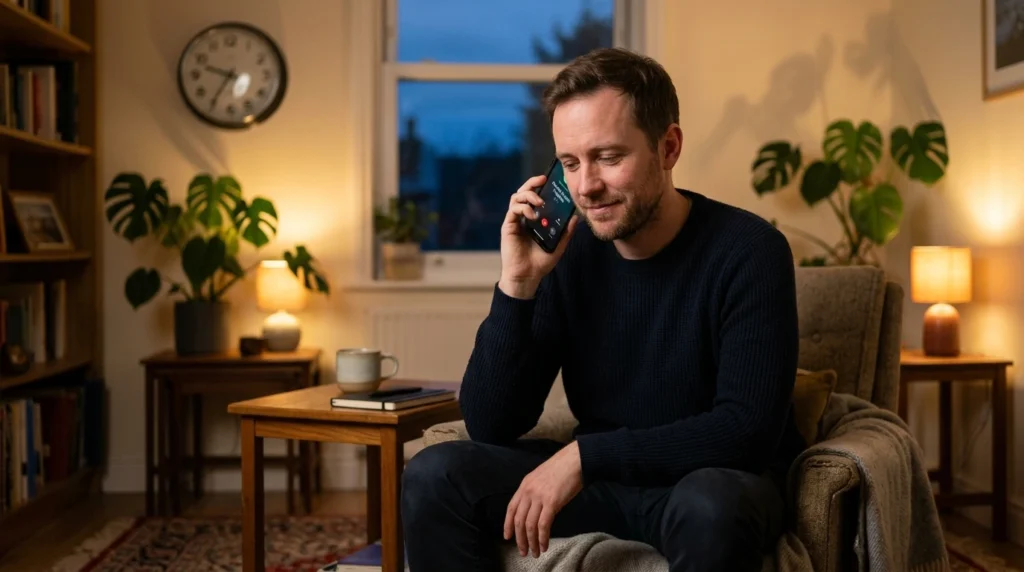
Mental health patients do not experience their worst moments during office hours. Anxiety spikes, depressive episodes, and suicidal ideation are not constrained to the 9 to 5 window when clinic phones are staffed. For most mental health clinics, after-hours calls go to voicemail. The patient leaves a message and waits for a callback the next business day.
That gap between a patient reaching out and receiving a response is one of the most significant access barriers in outpatient mental health care. A patient in distress who reaches voicemail at 8pm on a Thursday and does not hear back until Monday morning has had the worst weekend of their week with no clinical contact point.
An AI receptionist does not resolve the clinical response gap, as it cannot provide clinical care. What it does is ensure that every after-hours contact is responded to immediately, the patient’s need is triaged, appropriate resources are offered, and a callback or appointment is booked rather than the patient being asked to try again during business hours.
This after-hours capability is particularly relevant for mental health clinics serving patients who are also managing depression identified through consistent PHQ-9 screening, where between-session access points matter clinically.
Crisis Call Routing: The Non-Negotiable Requirement
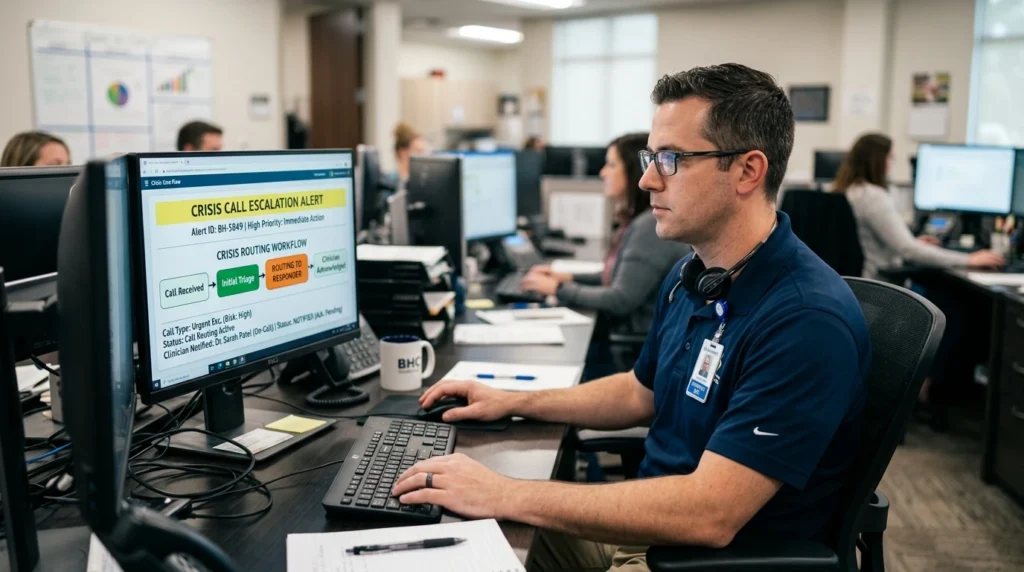
Any AI receptionist deployed in a mental health clinic must have an explicit, tested, and verified crisis call routing protocol. This is the single most important configuration requirement and the one that most generic AI receptionist systems handle inadequately for mental health settings.
A crisis call routing protocol for a mental health clinic must specify: which phrases and language patterns trigger a crisis routing response, what the routing action is when a crisis is detected, whether the patient is transferred to a human staff member, a crisis line such as the 988 Suicide and Crisis Lifeline, or emergency services, and whether a human staff member is alerted when a crisis routing event occurs.
The protocol must be tested before go-live with scenarios that include patients expressing passive suicidal ideation, patients describing a mental health emergency in indirect language, and patients who refuse transfer when offered. A system that handles booking and scheduling competently but routes crisis calls to a voicemail box is not a safe deployment for a mental health clinic.
Before deploying any AI receptionist in a mental health setting, the clinic should verify the specific crisis routing protocol with the vendor and conduct live testing of crisis scenarios with clinical staff present. This requirement applies equally to clinics that have already deployed PHQ-9 automation, as covered in PHQ-9 Question 9 and Suicidal Ideation: Clinical and Legal Responsibilities for Outpatient Clinics.
What the Research Says
Three findings from research directly relevant to AI medical receptionist deployment in mental health clinic settings.
Finding 1 – Automated scheduling reduces no-show rates by 30% to 40%. Research cited in Psychreg’s analysis found that automated reminder systems reduce no-show rates by an estimated 30% to 40%. For mental health clinics where no-show rates consistently exceed 20%, this recovery in clinical time directly reduces the access gap for patients waiting for appointments.
Finding 2 – AI automated scheduling improves clinician efficiency and reduces burnout from menial tasks. The American Academy of Arts and Sciences report on AI and Mental Health Care cites early reports that automated scheduling systems have improved clinicians’ sense of efficiency and reduced exhaustion from menial tasks in mental health care settings. The effect is felt by clinical staff, not just administrative staff, because a front desk that functions smoothly reduces the interruptions that fragment clinical time.
Finding 3 – The average wait time for behavioural health services is 48 days nationally. HRSA’s 2025 behavioural health workforce report puts the national average wait time for behavioural health services at 48 days. Clinics that miss calls, fail to respond after hours, or lose bookings to slower competitors are contributing to this access gap. An AI receptionist that captures every inbound contact and converts it to a scheduled appointment directly shortens the wait time for the patients a clinic serves.
How AI Receptionist Reduces Staff Burnout Without Reducing Headcount
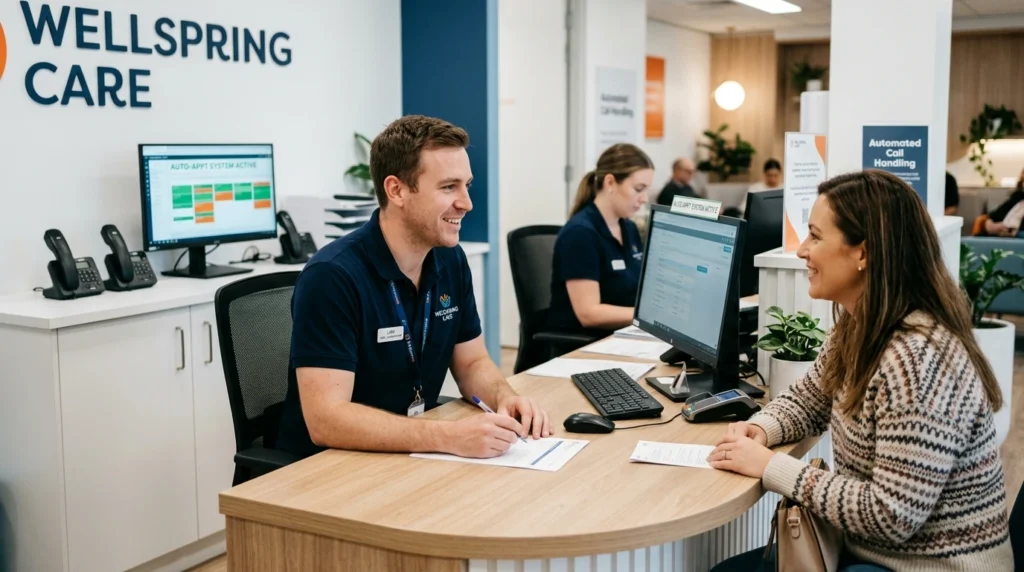
The concern that AI receptionists will eliminate front desk jobs in mental health clinics is consistently not borne out in implementation. The more common outcome is a redistribution of what staff spend their time on.
When an AI system handles the high-volume, repetitive portion of the front desk workload, inbound call answering, routine scheduling, reminder calls, and after-hours coverage, administrative staff are freed from the interactions that produce the most burnout and given more time for the interactions that require human judgment.
In a mental health clinic specifically, the interactions that require human judgment include supporting patients with complex scheduling needs, managing situations where a patient is distressed and needs a human voice, coordinating care between clinicians, and handling insurance and billing queries that require relationship and context. These are the interactions that make front desk work in mental health meaningful rather than exhausting.
The NIH finding that frontline health workers are experiencing poor mental well-being and considering leaving the industry reflects a workforce that is not being protected from the most grinding portion of their workload. Removing that portion through automation is not a threat to these roles. It is a protection of the people in them.
What to Verify Before Deploying an AI Receptionist in a Mental Health Setting
Five things to verify with any AI receptionist vendor before deploying in a mental health clinic.
Verify 1 – Crisis call routing protocol. Ask the vendor to describe exactly what happens when a patient expresses suicidal ideation or a mental health emergency during an AI-handled call. Request documentation of the routing logic and conduct live testing before go-live.
Verify 2 – HIPAA compliance. All patient communication handled by the AI must be encrypted, access-controlled, and covered by a Business Associate Agreement with the vendor. Do not assume compliance. Request documentation.
Verify 3 – EHR integration. The AI receptionist should book appointments directly into your existing scheduling system. If the system requires staff to manually transfer bookings, the administrative burden has not been reduced. It has been moved.
Verify 4 – Customisation of call scripts for the mental health context. A generic AI receptionist configured for a dental practice is not appropriate for a mental health clinic. The call scripts, triage logic, and routing rules must be customised for the specific patient population and clinical context of a mental health setting.
Verify 5 – Implementation support and ongoing management. Who configures the crisis routing protocol? Who updates the call scripts when the clinic’s services change? Who monitors performance and fixes issues after go-live? For a mental health clinic where a misconfigured call routing event has patient safety implications, the vendor’s post-implementation support model is a clinical requirement, not a commercial preference.
What This Means for Your Clinic in 2026
Mental health clinics in 2026 operate in an access environment where 62 million adults have a mental illness, nearly half receive no treatment, and the average wait time for a behavioural health appointment is 48 days. Every call a clinic misses, every after-hours patient that reaches voicemail, and every booking that does not get converted because no one answered is a patient who waits longer or stops seeking care.
An AI medical receptionist configured correctly for a mental health setting does not make those patients’ conditions better. What it does is ensure that every inbound contact is captured, every scheduling opportunity is converted, every after-hours call gets a response, and every clinical staff member has more time for the work that only they can do.
For a clinic where front desk staff are burning out and the waiting list is growing, that is not a marginal operational improvement. It is a structural change in how the practice functions.
For a complete overview of how MedLaunch AI Medical Receptionist works for mental health and psychiatry clinics, visit the solution page.
FAQ
What does an AI medical receptionist do in a mental health clinic?
An AI medical receptionist for a mental health clinic handles inbound call answering, appointment scheduling and rescheduling, automated appointment reminders, after-hours patient communication, and call routing. For mental health clinics specifically, it must also include a configured crisis call routing protocol that identifies patients in distress and routes them appropriately, either to a human staff member, a crisis line, or emergency services.
Is an AI receptionist safe to use in a mental health clinic?
An AI receptionist is safe for administrative functions in a mental health clinic when deployed with an explicit, tested crisis call routing protocol. The AI handles scheduling and routine communication. Clinical judgment, crisis response, and complex patient interactions remain with human staff. The safety question is not whether to use AI but whether the specific system’s crisis routing has been verified and tested for the mental health context before go-live.
Will an AI receptionist replace front desk staff at a mental health clinic?
No. The consistent finding across implementations is that AI receptionists redistribute what staff spend their time on rather than eliminating roles. The American Academy of Arts and Sciences report on AI and Mental Health Care found that automated scheduling systems improve efficiency and reduce exhaustion from menial tasks, freeing staff for interactions that require human judgment.
How does an AI receptionist handle after-hours calls from mental health patients?
An AI receptionist responds to after-hours calls immediately rather than routing to voicemail. It identifies the caller’s need, books appointments if appropriate, answers common questions, and routes to a crisis line or emergency services if the caller’s language indicates a mental health emergency. The after-hours routing protocol must be configured specifically for a mental health context and tested before deployment.
What HIPAA requirements apply to AI receptionists in mental health clinics?
All patient communication handled by an AI receptionist must be conducted over encrypted channels, stored securely, and access-controlled. The vendor must provide a signed Business Associate Agreement confirming HIPAA compliance before any patient data passes through the system. Verify that the vendor’s compliance documentation addresses the specific regulatory requirements of your clinic’s patient population.
How long does it take to implement an AI receptionist in a mental health clinic?
With MedLaunch, most clinics are fully live within days. MedLaunch handles the full configuration including call scripts customised for a mental health context, crisis routing protocol setup, EHR integration, and staff briefing. No technical setup is required from the clinic’s team.
Conclusion
Mental health clinics have a front desk problem that is more complex than most healthcare settings acknowledge. The patient population is clinically vulnerable, calls arrive at all hours, and the administrative staff managing this workload are burning out. An AI medical receptionist configured correctly for a mental health clinic addresses all three dimensions: it handles the routine call volume that exhausts staff, responds to after-hours contacts that currently go unanswered, and converts every inbound scheduling opportunity into a booked appointment.
The configuration question is more important than the deployment question. A generic AI receptionist is not appropriate for a mental health clinic. A correctly configured one, with a verified crisis call routing protocol, HIPAA-compliant infrastructure, and customised call scripts for a mental health patient population, changes how the clinic functions at the front desk without changing who is responsible for clinical care.
For a complete overview of how MedLaunch AI Medical Receptionist works for mental health and psychiatry clinics, visit the solution page. For mental health clinics also managing PHQ-9 screening automation, see AI PHQ-9 Screening for Mental Health Clinics.