

Key Takeaways
-
1Human Error in Lead Management: Human error is a common issue in healthcare lead management, especially in manual processes. Missed leads, slow follow-ups, and inconsistent responses can negatively affect patient conversion rates.
-
2AI Automation Solves System Failures: AI automation doesn’t replace staff but acts as a safety net, eliminating the errors caused by human limitations. It ensures faster, more accurate lead responses, qualification, and appointment booking.
-
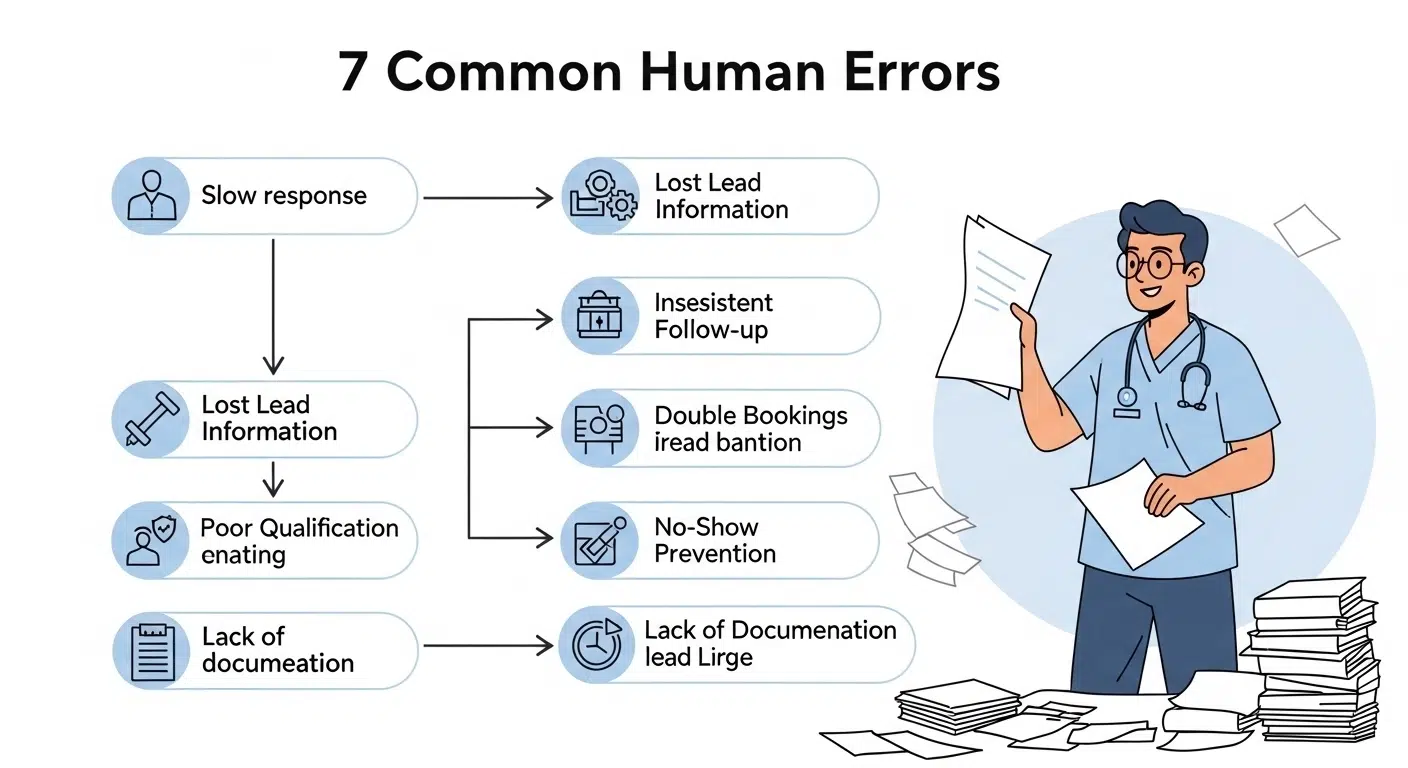
37 Common Errors in Lead Management: Slow responses, lost lead information, inconsistent follow-up, poor qualification, double-bookings, no-show prevention failures, and lack of documentation are the seven common human errors AI can solve.
-
4AI Enhances Lead Qualification: AI chatbots provide consistent, accurate lead qualification by asking structured questions and flagging issues like contraindications, ensuring only qualified leads are passed to staff.
-
5AI-Powered Scheduling and Reminders: AI automation helps prevent double-bookings and no-shows by syncing calendars in real-time and sending automated reminders, reducing human mistakes in scheduling.
Imagine this: your clinic runs a well-targeted Facebook ad campaign for a new service. The leads start coming in: Instagram DMs, form submissions, website inquiries. It looks like a success. But behind the scenes, your front desk is already stretched across three other responsibilities. A few messages get missed. A phone number gets copied down wrong. A follow-up call never happens because a more urgent task came up. By the end of the week, half of those leads have gone cold and the ad spend that generated them has been quietly wasted.
This scenario plays out in clinics everywhere, every single week. And in most cases, it gets written off as a staffing problem, not enough people, not enough hours. But that diagnosis is wrong. The real problem is a system’s failure. When manual processes are used to manage high volumes of leads, human error isn’t a possibility; it’s a mathematical certainty.
The good news is that AI automation addresses this at the root. Not by replacing your staff, but by building a structural safety net that catches what humans inevitably miss; ensuring every lead is responded to, every follow-up fires on schedule, every appointment is properly confirmed, and every interaction is logged.
This guide walks through the seven most common human errors in healthcare lead management and shows exactly how AI eliminates each one, building toward a fully automated system that runs consistently, scales with demand, and never has an off day.
Table of Contents
Why Human Error in Healthcare Lead Management Is More Common Than You Think

Before diving into the errors themselves, it’s worth normalizing the problem. Human error in clinic lead management isn’t a sign of a poorly run practice. It’s the predictable outcome of asking people to do something that humans aren’t well-suited for: managing high-volume, time-sensitive, repetitive communication tasks simultaneously with everything else they’re already responsible for.
Healthcare admin staff at small-to-mid-size practices are typically managing multiple roles at once. In a single hour, a front desk staffer might check in three patients, answer five phone calls, process insurance paperwork, and field a question from a clinician — all while being expected to monitor and respond to incoming leads from Instagram, Facebook, and a website contact form.
The American Medical Association has extensively documented the administrative burden on healthcare staff, noting that documentation and administrative tasks, not patient care, account for the majority of working hours for many clinical teams. Lead management sits on top of all of that, largely unstructured and under-resourced.
Add to this the unpredictability of paid social campaigns. A well-performing ad can spike lead volume overnight, creating a backlog that a manual system simply cannot absorb. There’s no standardized lead management process in most small practices, which means the response depends entirely on whoever happens to be at the desk at that moment.
The cost of each dropped lead is also deeper than it first appears. It’s not just one lost patient; it’s wasted ad spend, lost lifetime patient value, and a signal to the market that the practice is unresponsive.
These errors aren’t random. They follow predictable patterns, and that predictability is exactly what makes them solvable with AI.
The 7 Most Common Human Errors in Clinic Lead Management
Error #1 — Slow or Missed Initial Response
The speed-to-lead problem is the most damaging error in the entire pipeline, and it happens constantly. When a lead comes in via Instagram DM, Facebook Lead Ad, or website form, and nobody responds for hours or days, the lead goes cold. The patient either books with a competitor who responded faster, or they interpret the silence as a lack of interest and move on.
The causes are straightforward: staff are mid-task with existing patients, leads arrive outside office hours, or DM notifications get buried under other messages in an already-crowded inbox. None of these are failures of effort or intention, they’re structural limitations of a manual system.
AI fixes this by responding instantly the moment a lead is captured, 24 hours a day, 7 days a week. It doesn’t matter whether the inquiry comes in at 2 pm on a Tuesday or 10 pm on a Sunday — the patient gets an immediate, warm, personalized response. That alone eliminates the single biggest source of lead drop-off in most clinic pipelines. Learn more about how this works in our guide on how to automate patient messaging in healthcare.
Error #2 — Incomplete or Lost Lead Information
Ask any clinic owner who currently manages leads manually, and most will describe some version of the same workflow: a lead comes in, someone screenshots the message, sends it to a colleague via text or email, and the details get manually entered somewhere — maybe a spreadsheet, maybe a notes app, maybe a sticky note on the monitor.
In that chain of handoffs, things go wrong. Phone numbers get transposed. Names get paraphrased. Key details: what the patient said about their condition, what questions they asked, which service they were interested in, get lost entirely. The downstream effect is real: staff call the wrong number, can’t locate the lead in any system, or end up asking the patient to repeat information they already provided, which erodes trust immediately.
The root causes are a lack of centralized healthcare CRM infrastructure and the unavoidable inaccuracies of manual data entry under time pressure. AI eliminates this entirely by capturing lead data directly from the source, whether that’s an Instagram DM, a Facebook Lead Ad form, or a website inquiry and pushing it automatically into a centralized CRM with no human transcription involved. The data is complete, accurate, and immediately accessible to anyone who needs it.
Error #3 — Inconsistent Follow-Up
Follow-up quality in a manual system is entirely dependent on the individual staff member handling the lead on any given day, their current workload, their memory, their energy level, and their judgment about which leads deserve more attention than others.
In practice, this looks like: one lead gets called three times across two days, while another gets one attempt and is quietly abandoned. Follow-up stops entirely after the first no-answer, with no structured retry sequence. Leads that don’t respond immediately get mentally deprioritized in favor of warm inbound calls that feel more likely to convert.
The compounding effect is significant. Research consistently shows that most conversions happen after the third or fourth contact point, meaning leads that could absolutely have been converted are being written off after one attempt. For a deeper look at what consistent follow-up does for appointment rates, see our piece on why patients miss appointments and how clinics can prevent it.
AI fixes this by treating every single lead identically. Every inquiry enters the same automated follow-up sequence regardless of staff bandwidth; SMS, email, and call prompts fire on a consistent, pre-set schedule. No lead is ever deprioritized because someone had a busy afternoon.
Error #4 — Poor Lead Qualification
When qualification is handled manually, two opposite problems tend to emerge. The first is under-qualification: staff books anyone who seems interested, either because they’re not trained to ask the right clinical questions, or because they feel uncomfortable probing on medical history over the phone, or simply because they’re trying to fill the schedule. The result is wasted clinical time on patients who were never real candidates, frustrated clinicians, and a higher-than-expected no-show rate from patients who weren’t genuinely committed.
The second problem is over-qualification: staff who are too cautious end up turning away leads who would have been excellent candidates with a bit more education or a slightly different framing of the service.
Both errors are costly, and both stem from the same root cause: an inconsistent, undocumented qualification process that varies from person to person and day to day.
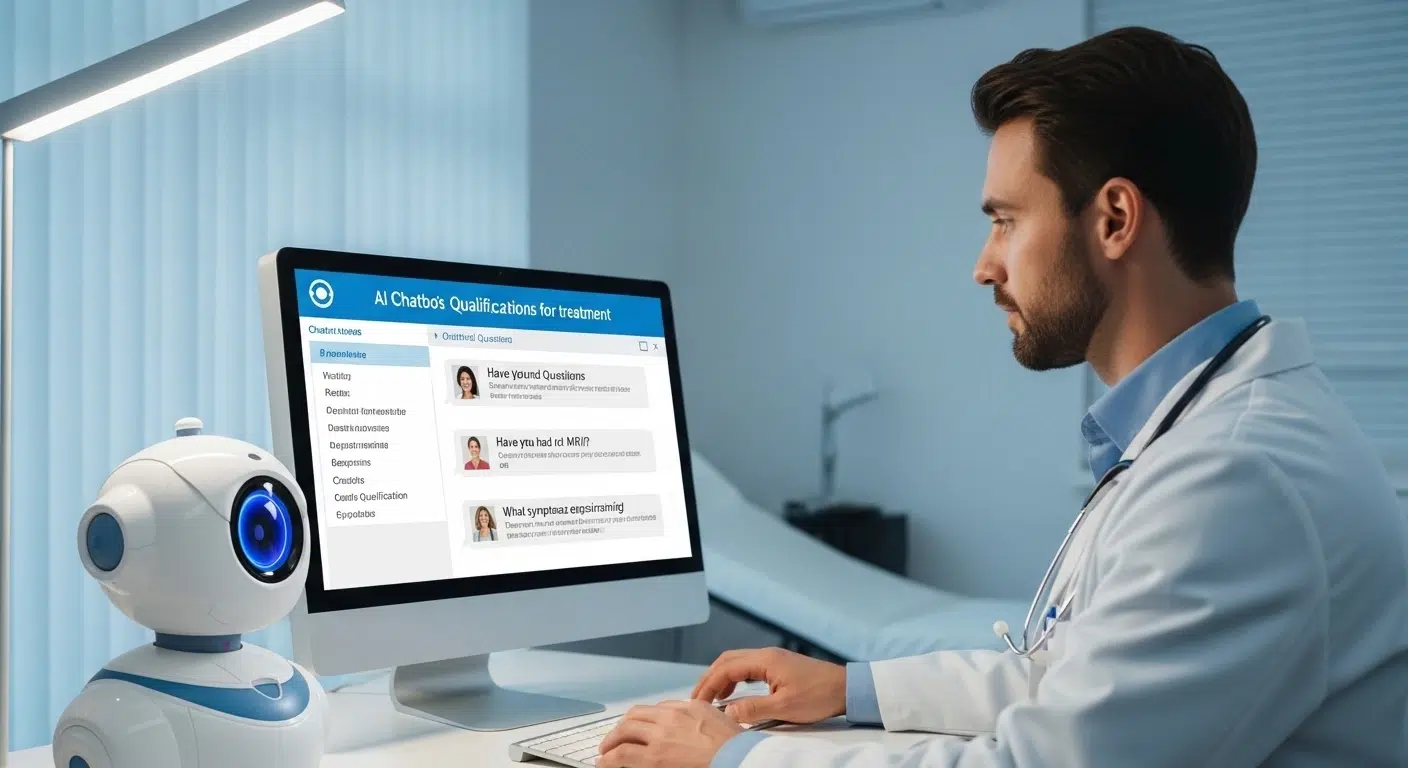
AI addresses this with a consistent, pre-programmed qualification flow that asks the right questions every single time: Has the patient had an MRI? What is their diagnosis? What symptoms are they experiencing? What treatments have they already tried? What is their age? It never skips a question, never feels uncomfortable asking, and never books a lead that doesn’t meet the defined criteria. It can also be configured with contraindication logic to recognize red flags: cancer, pregnancy, severe osteoporosis, and handle those leads appropriately rather than routing them to clinical staff incorrectly.
Error #5 — Double Bookings and Scheduling Conflicts
In clinics where appointments are managed across multiple systems that don’t communicate with each other, a Google Calendar, an EMR, and a paper appointment book all running simultaneously, scheduling conflicts are almost unavoidable. A staff member checks one system, sees availability, books the slot, and doesn’t realize that the same slot was already committed in a different system.
The patient-facing impact is significant. Double-bookings create chaos, damage trust, and require awkward, apologetic phone calls that could have been entirely avoided. They also waste clinical time that could have been spent on care.
AI-powered scheduling tools address this by booking directly into a single, live, synced calendar, checking real-time availability before confirming any slot, regardless of which channel the booking came through.
Error #6 — No-Show Prevention Failures

No-shows are largely preventable. The problem isn’t a lack of awareness; it’s that human staff can’t reliably execute a consistent reminder sequence for every patient, every time.
Reminder calls don’t get made because staff are tied up with in-clinic patients. Reminders go out same-day, too late to allow meaningful rescheduling. Voicemails get left with no way of knowing whether the patient is actually coming or not. There’s no two-way confirmation system, so the first sign that a patient isn’t showing up is an empty chair at appointment time.
AI replaces this with an automated multi-step reminder sequence: a confirmation immediately after booking, a reminder 48 hours before the appointment, and a final check-in 2–3 hours before. Each message includes a one-tap confirm or reschedule option. If a patient cancels, the slot is immediately freed and can be offered to the next qualified lead in the pipeline, turning a potential revenue loss into a recovered booking. Our AI appointment setter is built to handle exactly this workflow.
Error #7 — Lack of Documentation and Audit Trail
In most manual lead management systems, there is no system. Interactions happen verbally, via text message, or through informal notes that live on individual devices or in individual heads. When a staff member leaves, their memory of every lead conversation they ever had leaves with them. When something goes wrong with a lead, a complaint, a dispute, or a compliance question, there’s no record to refer back to.
This creates three distinct problems. The first is operational: without a documented interaction history, the next staff member who picks up a lead has no context and has to start from scratch, which patients find frustrating and unprofessional. The second is analytical: without data on lead interactions, there’s no way to identify patterns, measure conversion rates, or improve the process over time. The third is compliance-related: certain patient communication must be documented to satisfy HIPAA requirements outlined by the U.S. Department of Health and Human Services.
AI solves all three simultaneously. Every interaction, from the first DM to the confirmed appointment to every follow-up message in between, is logged automatically, timestamped, and stored in the CRM. The audit trail is complete, searchable, reportable, and transferable to any staff member who needs it.
How AI Automation Rebuilds Your Lead Management System From the Ground Up
The seven errors above aren’t isolated problems requiring seven separate fixes. They’re all symptoms of the same underlying issue: a manual system that was never designed to handle the volume, speed, and complexity of modern healthcare lead management.
AI automation doesn’t patch the individual errors. It replaces the system entirely with one that is structured, consistent, and scalable. Here’s what a fully automated lead management workflow looks like end-to-end:
A lead is captured from Instagram or Facebook and is instantly pushed into the CRM with all details intact — no manual entry, no transcription errors. The AI sends an immediate response and begins a qualification conversation, asking the right questions in a conversational, patient-friendly tone. Once the lead is qualified, they’re offered booking options that sync with the clinic’s live calendar, and they self-schedule without staff involvement. A confirmation fires automatically, followed by a multi-step reminder sequence that dramatically reduces no-shows. Leads who don’t convert immediately enter a structured follow-up sequence that runs on schedule regardless of how busy the front desk is. Every step of every interaction is logged, creating performance data that can be reviewed and used to improve the pipeline over time.
The critical staff benefit here is worth stating clearly: this doesn’t take work away from your team — it takes the wrong work away. Administrative, repetitive, error-prone tasks get handled by the system. Your staff gets to focus on the work that actually requires a human: in-clinic patient experience, clinical support, and the relationship-building that turns first-time visitors into long-term patients. Read more about how this dynamic plays out in our post on how AI reduces front-desk burnout without replacing staff.
What to Look for in an AI Lead Management Solution for Healthcare
Not all AI tools are built for the specific demands of healthcare lead management. When evaluating options, here are the criteria that matter most:
HIPAA compliance is non-negotiable. Any platform handling patient inquiries, health information, or appointment data must operate within HIPAA guidelines and be willing to sign a Business Associate Agreement (BAA). This is a baseline requirement, not a differentiator.
Native integrations with your existing tools are essential. The platform needs to connect directly to your EMR or EHR, your scheduling calendar, your social media channels, and your CRM without requiring manual bridges or custom workarounds. Every integration gap is a new source of the same errors you’re trying to eliminate.
Customizable qualification flows are what separate a generic chatbot from a genuine clinical tool. The AI needs to ask your specific questions, not a template designed for a different type of practice. Your contraindication criteria, your treatment options, your pricing structure, and your booking pathways all of this needs to be configurable.
Multi-channel follow-up capability ensures that leads who don’t respond on one channel can be reached on another. SMS, email, and voice capabilities in a single integrated system outperform any single-channel approach.
Real-time reporting gives you visibility into every stage of the pipeline: lead volume, response rate, qualification rate, booking rate, and show rate. Without this data, you’re managing blindly.
Human escalation logic is what keeps the system trustworthy. The AI should be configured to recognize when a lead requires human judgment: urgency signals, emotional distress, complex clinical questions — and hand off seamlessly in those moments. Automation handles the routine; humans handle the exceptions.
The strongest warning here: resist the temptation to patch together multiple disconnected tools to approximate this functionality. Every gap between tools is a potential error point, which is exactly what you’re trying to eliminate. An end-to-end solution purpose-built for healthcare lead management delivers far better results than a stack of generic tools that were never designed to work together. Explore how MedLaunch’s AI medical receptionist brings all of this together in one integrated system.
Additional Best Practices for Error-Free Lead Management
Audit your current lead flow before automating. Map every step from the moment an ad generates a click to the moment a patient sits down for their first appointment. Identify every handoff, every manual step, and every point where leads are currently dropping off. This gives you a clear picture of what the automation needs to fix.
Don’t automate a broken process. If your qualification questions are wrong, or your booking pathways are unclear, automation will just execute the broken process faster and at greater scale. Fix the workflow logic first, then build the automation on top of a solid foundation.
Train staff on the division of responsibility. Clarity about what the AI handles versus what requires human judgment prevents two failure modes: staff duplicating the AI’s work (which causes confusion for patients) and staff assuming the AI has handled something it hasn’t. Document the handoff criteria clearly and review them regularly.
Review AI conversation logs monthly. Chatbot flows need to evolve as patient questions evolve. New campaigns generate new questions. Seasonal trends shift inquiry patterns. A monthly log review surfaces unanswered questions, drop-off patterns, and opportunities to improve conversion at every stage.
Set escalation triggers for urgency signals. If a lead uses language indicating severe pain, a surgical deadline, or acute distress, the system should flag it immediately for human follow-up rather than routing it through the standard sequence. Speed matters even more in high-urgency situations.
Keep qualification flows concise. Four to six questions is the optimal range for a chatbot qualification sequence. Longer flows cause drop-off; patients lose patience and abandon the conversation before reaching the booking stage. Every question in the flow should directly influence whether the lead gets qualified or not. Anything that doesn’t clear that bar should be removed.
Conclusion
Human error in healthcare lead management isn’t a people problem. It’s a systems problem, and the clearest evidence of that is how predictably and consistently those errors occur across practices of every size, specialty, and staffing level. Slow responses, lost information, inconsistent follow-up, poor qualification, scheduling conflicts, no-show failures, and missing documentation don’t happen because your staff isn’t good at their jobs. They happen because manual systems weren’t designed for the demands placed on them.
AI automation is the system’s solution. It doesn’t replace the judgment, empathy, and clinical expertise that your team brings to patient care. It replaces the error-prone, repetitive, high-volume administrative layer that was never a good fit for human execution in the first place.
The result is a lead management system that responds instantly, qualifies consistently, books accurately, confirms automatically, follows up without fail, and documents everything, freeing your clinical team to focus entirely on the work that only humans can do.
If you’re ready to find out exactly where your lead management system is leaking revenue, book a free workflow audit with MedLaunch, and we’ll map out the gaps and show you precisely what automation can recover.
FAQs
Is AI automation in healthcare lead management HIPAA compliant?
It can be, when implemented correctly. HIPAA compliance requires working with platforms that offer signed Business Associate Agreements (BAAs), using encrypted communication channels, obtaining patient consent before automated messaging, and avoiding the transmission of protected health information through non-compliant systems. Always verify compliance credentials before deploying any automation tool.
Will AI automation replace my front desk staff?
No. AI automation handles the high-volume, repetitive, time-sensitive tasks: lead response, follow-up sequences, appointment reminders, and data logging, that are currently consuming staff time without requiring human judgment. Staff are freed to focus on in-clinic patient experience, clinical support, and complex situations that genuinely require a human touch.
How long does it take to see results from AI lead management automation?
Most practices see measurable improvement in lead response rates and conversion within the first few weeks of implementation. Reduction in no-show rates typically becomes visible within the first month as the automated reminder sequences take effect.
What happens when a lead asks something the AI can’t answer?
A properly configured AI lead management system is built with escalation logic. When a question falls outside its configured knowledge base, or when a lead exhibits urgency or distress signals, the system flags the interaction for immediate human follow-up rather than attempting to answer incorrectly.
How much data do I need to get started?
You don’t need existing lead data to get started. The system is configured based on your service offering, qualification criteria, booking options, and FAQ content; all of which your clinical knowledge provides. Performance data builds over time as leads flow through the system.