

Key Takeaways
-
1Cancellations Signal Issues: Every cancellation reveals gaps in communication, scheduling friction, or attendance barriers the practice can address.
-
2Prevention Beats Recovery: Multi-touch reminders, clear cancellation policies at booking, and flexible scheduling prevent more cancellations than reactive recovery systems.
-
3Waitlists Recover Revenue: Clinics with maintained waitlists and automated slot-filling recapture most same-day cancellations quickly; without them, revenue is lost permanently.
-
4Habitual No-Shows Need Strategy: Patients who repeatedly cancel require personalized outreach, flexible scheduling, and sometimes deposit requirements beyond standard reminders.
-
5Cancellation Data Informs Operations: Tracking reasons, timing, and patient patterns uncovers inefficiencies, peak no-show periods, and high-risk segments for proactive adjustments.
Every clinic faces patient cancellations, but few truly understand their impact. A cancelled appointment doesn’t just leave an empty slot on the calendar; it disrupts workflows, affects staff productivity, and quietly reduces monthly revenue.
Cancellations are one of the clearest signals that something in the patient journey needs attention. Clinics that handle patient cancellations strategically don’t just reduce no-shows; they also build patient trust and improve long-term retention.
Studies show that medical practices lose billions of dollars annually due to patient cancellations and no-shows. For example, a 2023 report found that U.S. clinics lose an average of $150 per missed appointment, which quickly adds up for medium to large practices.
This highlights why handling patient cancellations effectively is crucial, not just for revenue but for maintaining a smooth, efficient, and patient-friendly operation.
Modern clinics increasingly use digital tools to manage cancellations. Healthcare automation solutions help monitor appointment patterns and enable staff to take proactive action when a cancellation occurs.
For instance, an AI medical receptionist can handle initial patient calls, update schedules instantly, and free up staff to focus on care delivery. These tools also allow clinics to analyze cancellation trends, helping predict peak no-show times and proactively adjust scheduling.
Table of Contents
Why Patient Cancellations Matter
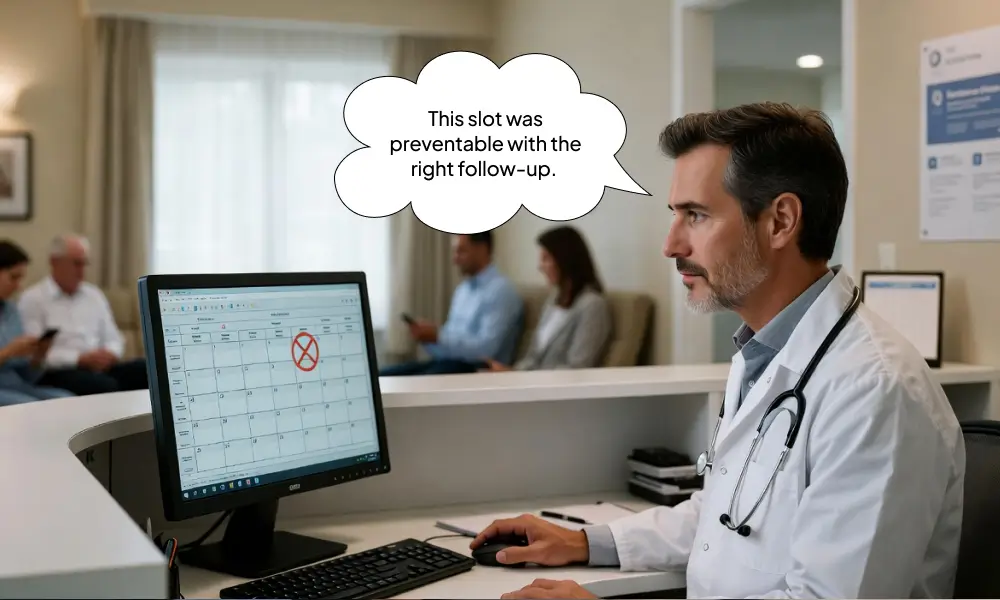
Patient cancellations affect more than just schedules, they impact finances, staff productivity, and patient care continuity.
1. Financial Impact
Missed appointments are a major revenue drain. In the U.S., no-shows cost clinics an estimated 150 billion dollars each year, with many providers losing around 200 dollars for every empty slot.
Over time, this adds up quickly. Frequent cancellations lower appointment use, disrupt provider schedules, and reduce the long-term value of patients who stop showing up regularly.
The good news is that much of this loss can be recovered. Clinics that manage cancellations well can refill open slots using waitlists and quick rescheduling.
Tools like AI-based patient scheduling help automate this process, filling canceled appointments without adding extra work for the front desk.
2. Operational Inefficiencies
A canceled appointment disrupts workflows. Providers may remain idle, staff scramble to rearrange schedules, and resources prepared for procedures go unused. These inefficiencies can frustrate staff and reduce overall clinic morale. Clinics that track no-show rates and integrate predictive scheduling often minimize disruption and improve scheduling efficiency.
3. Patient Experience and Continuity of Care
Missed appointments can break treatment plans and delay follow-ups. For example, a patient missing a routine follow-up may experience delayed diagnosis or treatment adjustments. Thoughtful patient cancellation management ensures continuity of care while reinforcing patient trust and engagement.
Bottom Line: Clinics that view cancellations as opportunities to improve workflows and communication often outperform those that simply react passively. Proactive management protects revenue, maintains efficiency, and strengthens patient relationships.
Common Reasons Why Patients Cancel Appointments
Understanding the reasons behind cancellations helps clinics develop targeted strategies. Common causes include:
- Scheduling conflicts: Work, school, or family responsibilities.
- Transportation or logistical issues: Lack of transport, sudden emergencies, or weather-related problems.
- Health concerns or anxiety: Fear of procedures or discomfort.
- Forgetting appointments: Patients may forget without timely reminders.
- Social determinants: Financial constraints, caregiving responsibilities, or limited access to care.
- Miscommunication or unclear expectations: Confusing instructions or complicated booking systems.
- Childcare and caregiving responsibilities: Childcare and caregiving responsibilities.
On the positive side, patients consistently say they are more likely to show up when:
- They receive clear, timely reminders via their preferred channel (SMS, WhatsApp, email, call).
- They can easily reschedule online without calling during office hours.
- Telehealth or same‑day / next‑day slots are available when their schedule is unpredictable.
- Policies are clearly explained and feel fair—not punitive.
Scenario: A patient misses a cardiology appointment because they weren’t aware of a new clinic location. A simple patient communication workflow could have prevented this. By understanding these reasons, clinics can implement cancellation prevention strategies that go beyond schedule management.
Patient flow solutions can also help track patient movement through the clinic, identifying bottlenecks that may contribute to cancellations.
Tip: Tracking cancellation reasons over time can reveal patterns. For example, patients with transportation issues may benefit from telehealth or flexible scheduling, while forgetful patients respond best to multiple automated reminders.
Proactive Strategies to Prevent Patient Cancellations
While some cancellations are unavoidable, clinics can implement strategies to reduce them and improve workflow.
1. Set Clear Cancellation Policies
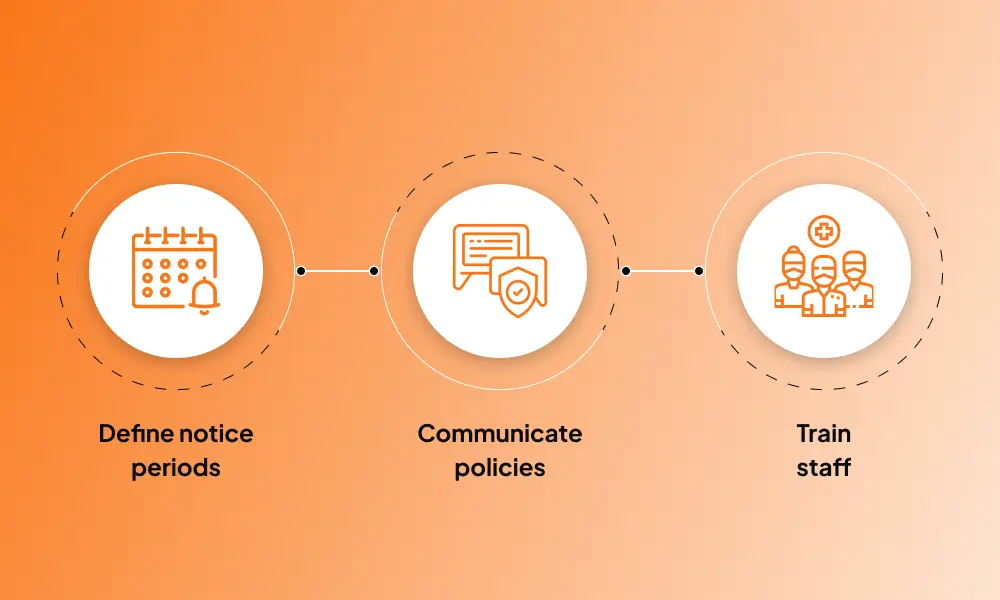
Most practices have a cancellation policy. Very few patients know it exists. A policy buried in new patient paperwork that was signed once and never referenced again does not change patient behavior. A policy that reduces cancellations is communicated at every touchpoint, written in plain language, and enforced consistently.
Build a policy that patients actually follow:
- Require 24 hours notice for standard appointments and 48 hours for procedures or longer consultations
- Communicate the policy at booking, in every reminder, on your website, and at check-in
- Use plain language — avoid legal or clinical terminology patients will not read
- Define consequences proportionally — empathy for first offences, deposits for repeat cancellations
- Train every staff member to apply the policy using identical language and criteria
- Build in a genuine emergency exception clause so patients do not feel the policy is punitive
Policy template you can use today:
Why this works: Patients who encounter the policy repeatedly before their appointment have no reasonable basis for claiming they were unaware of it — and clear expectations reduce last-minute decisions to simply not show up.
2. Use Automated Appointment Reminders
A single reminder sent the day before an appointment is the most common approach in healthcare — and one of the least effective. By the time a patient receives it they have already decided whether they plan to attend.
A multi-touch reminder sequence intercepts disengagement earlier and gives patients an easy path to reschedule rather than simply not showing up.
The reminder sequence that reduces cancellations:
| Touch | Timing | Purpose |
|---|---|---|
| Booking confirmation | Immediately | Confirm details, provide rescheduling link |
| First reminder | 72 hours before | Prompt early rescheduling if a conflict has emerged |
| Confirmation request | 24 hours before | Require active YES confirmation — flag non-responders |
| Same-day reminder | Morning of | Final logistics prompt with time and location |
| Non-responder follow-up | 4 hours after no confirmation | Personal call from front-desk staff |
What makes reminders actually work:
- Use an AI appointment setter to automate the entire sequence — manual reminder systems break down exactly when the practice is busiest.
- Send through the patient’s preferred channel — SMS, email, or phone call.
- Address patients by name and reference their specific provider.
- Include a one-sentence clinical context — “Your follow-up is an important checkpoint for your blood pressure management” is far more motivating than a generic reminder.
- Require an active confirmation reply — patients who confirm are significantly less likely to no-show.
3. Offer Online Scheduling & Rescheduling
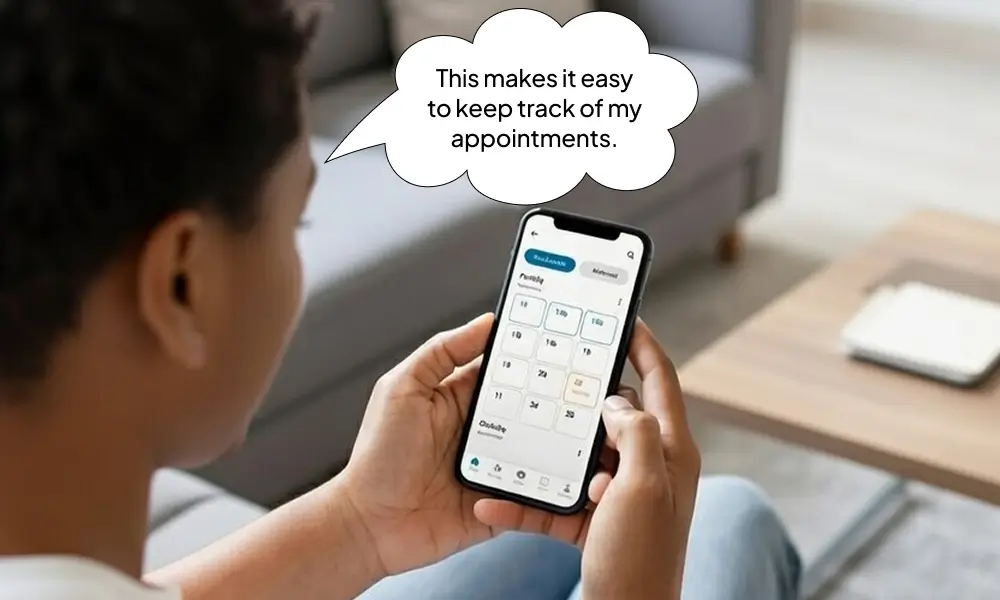
A significant proportion of patient cancellations are not cancellations of intent. The patient still wants care but cannot attend at the original time.
When rescheduling requires a phone call during business hours, a hold queue, and a staff member manually finding a slot — most patients take the path of least resistance and simply do not show up. Remove that friction and you convert cancellations into rescheduled visits.
How to make rescheduling easier than cancelling:
- Embed a direct one-tap rescheduling link in every reminder message
- Enable 24-hour self-service scheduling — patients realize scheduling conflicts at 10 PM, not 9 AM
- Display availability across all providers and locations so patients find a time that works
- Test your rescheduling flow on a mobile device quarterly — most patients reschedule from their phone
- Use an AI patient scheduling system that offers alternative slots the moment a patient initiates a cancellation — intercepting the cancellation before it completes is the highest-conversion rescheduling moment available
The key insight: When rescheduling is harder than cancelling, patients cancel. When rescheduling is easier than cancelling, most patients reschedule.
4. Provide Flexible Appointment Options
Many cancellations are not about patient disengagement — they are about structural barriers the practice has the power to remove. A patient working a standard shift cannot attend a 2 PM appointment without taking half a day off.
A patient managing childcare cannot reliably commit to a midday slot. When these barriers are not addressed, cancellations become predictable and preventable rather than random.
Flexibility options that directly reduce cancellation rates:
- Split appointments for patients with multiple concerns — patients who feel they cannot address everything in one visit sometimes cancel because the appointment feels inadequate before it starts; booking a primary concern now with a follow-up immediately confirmed solves this.
- Early morning and evening slots — even four slots before 8 AM or after 5 PM per provider per day materially reduces cancellations among working-age patients.
- Telehealth for appropriate visit types — follow-ups, medication reviews, chronic disease check-ins, and mental health sessions have lower no-show rates via telehealth because the attendance barrier is dramatically lower.
- Same-day and next-day availability — a patient booked three weeks in advance for a concern that no longer feels urgent is a cancellation waiting to happen; same-day availability converts intent into attendance.
- Express slots for simple visits — a patient who only needs a prescription renewal or blood pressure check does not need a 20-minute appointment; shorter slots reduce the time commitment barrier that drives some cancellations.
5. Educate Patients on Appointment Importance
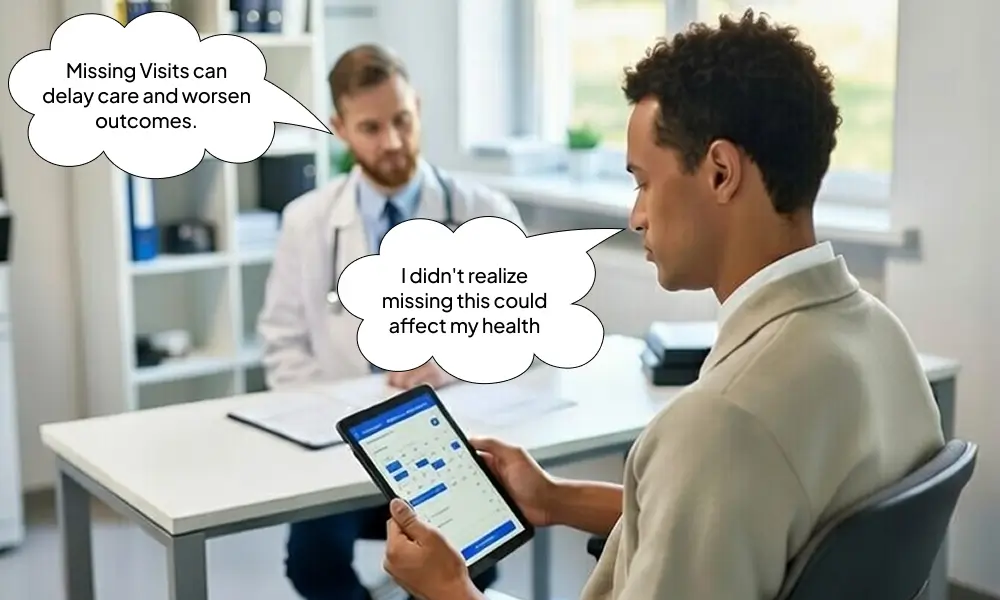
Patients who understand specifically why their appointment matters are significantly more motivated to attend than patients who view it as interchangeable with a future visit. This is not about lecturing patients about clinic policy — it is about connecting each appointment to the patient’s individual health situation and making the clinical stakes of missing it tangible.
How to make appointment value clear:
- Use in-clinic signage that normalizes regular attendance and explains the value of preventive and follow-up care.
- Add one sentence of clinical context to every reminder — “Your provider will be reviewing your recent blood sugar results at this visit” is far more motivating than a date and time.
- Communicate what missing the appointment specifically means — delayed medication adjustment, incomplete care plan, missed screening window.
- Train providers to close every appointment by framing the next one — “Your appointment in six weeks is when we decide whether to adjust your dosage” gives the follow-up a specific purpose that no reminder can replicate.
- Share relevant health education between visits — patients who receive condition-specific content between appointments arrive feeling invested in their care rather than indifferent to it.
Reactive Handling: What to Do When Cancellations Happen
Even with proactive measures, cancellations will occur. How clinics respond can turn potential losses into recovery opportunities.
1. Immediate Acknowledgment and Rescheduling
How a practice responds in the first 60 seconds of a cancellation determines whether it becomes a rescheduled visit or permanently lost revenue.
Patients who cancel are often managing a conflict — not abandoning their care. A response that makes rescheduling easier than not rescheduling converts a significant percentage of cancellations into future completed visits.
The right response to every cancellation:
- Use the AI medical receptionist to respond to digital cancellations instantly at any hour and offer real-time rescheduling without staff involvement.
- Acknowledge before offering — “No problem at all, thank you for letting us know” creates a receptive patient before the rescheduling conversation begins.
- Offer two specific slots rather than open-ended availability — “Would Thursday at 9 AM or Friday at 2 PM work?” converts significantly better than “When would you like to come in?”
- Always make the reschedule offer before ending the interaction — patients rarely call back proactively to rebook.
- Document the cancellation reason every time — scheduling conflict, transportation, cost, health concern, or no reason given; this data reveals the patterns that prevention strategies need to target.
2. Check & Fill from Waitlists
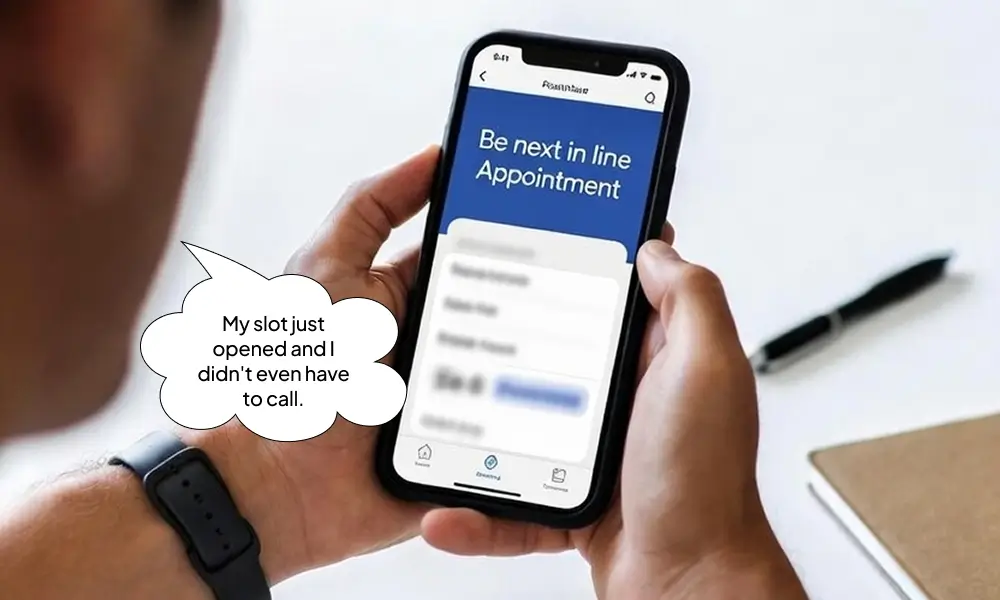
A canceled slot has meaningful revenue recovery potential for two to four hours after the cancellation is received. After that window, the probability of filling it drops sharply.
Practices that consistently fill 70 to 80 percent of canceled slots do so because they have a maintained waitlist and an automated notification system — not because they have faster staff.
How to build a waitlist that actually fills slots:
- Ask every patient booking more than two weeks out whether they want to be on the waitlist for earlier availability — most say yes.
- Segment the waitlist by appointment type and provider preference so outreach targets the right patients for each slot.
- Notify the top three to five matching waitlist patients simultaneously the moment a cancellation is confirmed — the first to respond gets the slot.
- Make acceptance a single tap — a direct confirmation link that books immediately; phone-call acceptance loses patients to the friction of making a call during a workday.
- Refresh the waitlist weekly — patients who booked elsewhere and were never removed produce failed outreach that wastes the slot recovery window.
3. Follow-Up Communication
A patient who cancels is not necessarily a patient who is leaving. Many simply need a low-friction pathway back to a rescheduled appointment and a signal that the practice noticed their absence. A structured follow-up sequence recovers a meaningful percentage of patients who would otherwise drift out of the care schedule silently.
Follow-up sequence:
| Touch | Timing | Channel | Tone |
|---|---|---|---|
| First follow-up | Within 24 hours | SMS | Warm, offer two specific slots |
| Second follow-up | 7 days later if no reschedule | Reference care context specifically | |
| Third follow-up | 21 days later for clinical need patients | Phone call | Personal outreach from care coordinator |
| No response after three touches | Flag as inactive | — | Enter into patient reactivation workflow |
Ready-to-use message templates:
Same-day SMS:
24-hour SMS:
7-day email:
4. Apply Cancellation Policies Fairly
The moment a cancellation policy is applied to one patient and waived for another without a clearly defined reason it stops functioning as a policy.
Fair application does not mean inflexible application — it means applying the same criteria to every patient in the same situation so no patient feels singled out and no staff member feels uncertain about how to respond.
How to apply policy without damaging patient relationships:
- Define exception criteria before you need them — medical emergencies, bereavement, first-time late cancellations, severe weather.
- Give every staff member an identical script for every cancellation scenario so policy language is consistent across all locations and staff members.
- Apply fees through a formal billing process not a front-desk conversation — this reduces disputes and creates a clear paper trail.
- Document every policy application and exception in the patient record — this protects the practice in disputes and builds the data needed for consistent escalation decisions.
5. Monitor and Adjust Over Time
Cancellation data is one of the most actionable operational intelligence sources available to a practice manager. When tracked and analyzed consistently, it reveals patterns that allow proactive scheduling, staffing, and communication adjustments. This turns unpredictable patient behavior into a manageable operational variable.
What to track and how to use it:
- Cancellation rate by provider, location, day, and appointment type — a practice-wide rate of 18 percent conceals the fact that Monday mornings may be running at 34 percent; segmented data targets intervention precisely
- Cancellation reasons by category — require staff to select from a defined list: scheduling conflict, transportation, cost, health concern, forgotten, no reason given; free-text entry produces data that cannot be analyzed
- Monthly revenue impact — multiply monthly cancellation volume by average revenue per visit; this single calculation turns cancellation management into a financial priority rather than an administrative task
- Slot recovery rate — track what percentage of canceled slots are filled; below 50 percent signals a waitlist and gap-filling protocol problem that is costing the practice measurable revenue every week
- Peak cancellation times — identify which days and hours have the highest cancellation rates and adjust scheduling template density, reminder timing, and staffing for those periods proactively
Review cancellation metrics monthly in leadership meetings alongside revenue and patient volume data. Cancellation performance is a financial metric — treat it as one.
Strategies for Dealing with Habitual No-Shows
Some patients cancel or miss appointments repeatedly, which can disrupt clinic operations and affect revenue. Implementing effective strategies is essential to minimize these no-shows and maintain a positive patient experience:
1. Targeted Communication
Personalized communication through phone calls, emails, or text messages can be used to remind patients of the importance of attending their appointments.
Tailoring the message to the individual, explaining the impact of missed appointments, and offering an easy rescheduling process can help reinforce commitment.
2. Booking Restrictions or Deposits for Repeat Offenders
Introducing booking restrictions, such as requiring a deposit or pre-payment for patients with a history of frequent cancellations, can discourage habitual no-shows.
This strategy not only ensures the patient takes the appointment more seriously but also protects the clinic from lost revenue.
3. Flexible Scheduling Options
Offering flexible scheduling options, including after-hours appointments or the ability to reschedule easily through an online portal, can reduce scheduling conflicts. This approach accommodates patients’ busy schedules and minimizes the chances of them canceling at the last minute.
Additionally, offering incentives for consistent attendance or flexible appointment times can further motivate patients to keep their appointments and reduce future cancellations.
4. AI-Powered Personal Follow-Ups
High-risk patients, those with frequent no-shows, may benefit from personalized follow-ups, either via AI-powered medical receptionists or automated systems.
These tools can send tailored reminders, check on the patient’s health status, and even allow easy rescheduling. Not only does this reduce no-shows, but it also enhances the overall patient experience by providing a more accessible, convenient, and proactive approach.
5. Predictive Scheduling
By double-booking high-risk slots (based on historical no-show data), clinics can ensure that even if a patient cancels, the appointment slot remains utilized, leading to reduced gaps in the schedule. This is especially effective during peak hours or for high-demand services.
Technology & Practice Tools
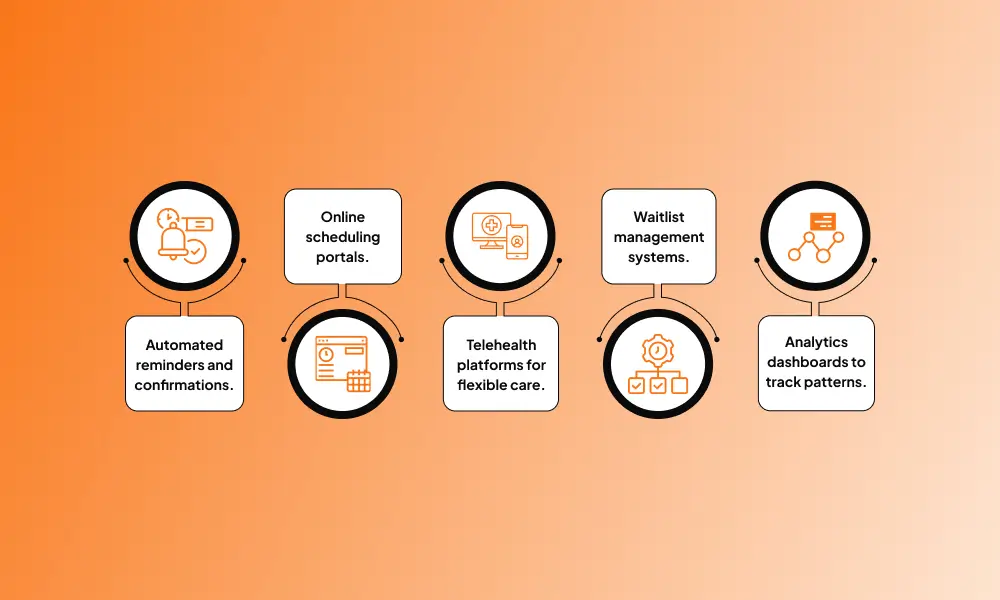
Technology supports both prevention and handling of cancellations:
- Automated reminders and confirmations.
- Online scheduling portals.
- Telehealth platforms for flexible care.
- Waitlist management systems.
- Analytics dashboards to track patterns.
Example: A clinic used analytics to identify spikes in cancellations on Monday mornings and adjusted staffing and communication accordingly, reducing last-minute cancellations by 18%. Integrating AI patient scheduling ensures smooth, automated management while freeing staff for patient care.
Staff Training & Communication Workflows
Staff play a key role in handling cancellations:
- Train on cancellation scripts and rescheduling conversations.
- Ensure familiarity with digital tools.
- Maintain consistent messaging across all touchpoints.
Scenario: A front-desk staff member using a standardized script reduced follow-up time and improved patient satisfaction by 20%. When supported by healthcare automation solutions, staff can turn cancellations into opportunities for recovery without extra stress.
Conclusion
Handling patient cancellations requires a structured approach:
- Preventive strategies: reminders, flexible scheduling, patient education.
- Reactive strategies: immediate rescheduling, waitlists, follow-ups.
- Optimized scheduling and technology adoption.
- Staff training for consistent, empathetic communication.
When implemented effectively, cancellations can be managed and even reduced, improving both patient engagement and clinic revenue. Audit your cancellation processes today and turn missed appointments into opportunities for growth, retention, and improved patient care.
FAQs
What is the difference between a cancellation and a no-show?
A cancellation occurs when a patient notifies the clinic ahead of time that they are unable to attend their scheduled appointment. In contrast, a no-show happens when a patient misses their appointment without providing any prior notice or communication to the clinic.
Why do patients cancel appointments and how can practices reduce this?
Reasons for missed appointments include conflicts with other commitments, transportation issues, anxiety, forgetfulness, and miscommunication.
To reduce missed appointments, clinics can send reminders, offer flexible scheduling options, allow online rescheduling, and educate patients about the importance of keeping appointments.
What cancellation policy should clinics use?
Require 24–48 hours notice, communicate policies clearly, enforce fairly, allow exceptions for emergencies.
How can online scheduling impact cancellation rates?
Makes rescheduling easy, provides real-time slots, reduces forgetfulness, increases patient engagement.
What tools are effective for managing patient cancellations?
Automated reminders, online scheduling, AI patient scheduling, AI appointment setters, AI medical receptionists, patient flow solutions, analytics dashboards.