
AI PHQ-9 accuracy vs clinician administered screening is one of the most common questions clinic owners ask before switching from paper-based workflows to automated systems. AI-administered PHQ-9 is a method of delivering, scoring, and routing the Patient Health Questionnaire-9 in which an automated system, voice-guided, conversational, or digital, replaces the clinician or staff member who would otherwise administer the questionnaire in person. Based on the research published to date, the scores produced are psychometrically equivalent to clinician-administered results, with specific conditions that clinic owners need to understand before selecting a system.
Table of Contents
Key Takeaways
- Validated Psychometrics Across Formats: Research published in Frontiers in Digital Health demonstrates that automated PHQ-9 administration produces internal consistency scores of 0.896, statistically equivalent to paper administration, with a 99.82% completion rate across 3,902 adults.
- Voice Administration Is Specifically Validated: An automated telephone-based PHQ-9 study published in PMC found test-retest reliability of kappa 0.76, sensitivity of 82.4%, and specificity of 90.7% for moderate-plus depression, results consistent with the validated paper instrument.
- The Accuracy Gap Is Not Scoring, It Is Completion: The accuracy difference between AI-administered and clinician-administered PHQ-9 is not in the scoring algorithm. It is in completion rates. AI pre-visit delivery consistently produces higher completion rates than in-clinic paper administration.
- Format Does Not Change the Instrument: The PHQ-9 questions are fixed. The scoring algorithm is fixed. A patient answering the same nine questions verbally produces the same clinical data as a patient answering them on paper, provided the administration is standardised.
- Clinical Utility Depends on Integration, Not Format: The accuracy of the score matters less than whether that score reaches the clinician before the appointment. A clinician-administered PHQ-9 completed in the room and never recorded is clinically worthless. An AI-administered PHQ-9 delivered automatically to the EHR before the visit is clinically actionable.
What Does “Accurate” Mean for PHQ-9 Administration?
Accuracy for a psychometric instrument like the PHQ-9 is measured in four ways: internal consistency, test-retest reliability, sensitivity, and specificity.
The original paper PHQ-9 published by Kroenke et al. in the Journal of General Internal Medicine established a sensitivity of 88% and specificity of 88% for major depressive disorder at a threshold score of 10 or above. Those numbers are the benchmark against which every alternative administration format is compared.
The clinical accuracy question for AI administration is not whether the questions change. They do not. It is whether the format of delivery, voice guidance, automated scoring, or digital interface, introduces any systematic bias into how patients respond to the nine items.
Understanding this distinction matters before evaluating any AI Powered PHQ-9 Screening system for your practice.
What the Research Says About Automated PHQ-9 Administration
A study published in Frontiers in Digital Health by Dosovitsky, Kim, and Bunge at Palo Alto University assessed the psychometric properties of a chatbot-administered PHQ-9 across 3,902 adults and older adults in the US and Canada. The chatbot version achieved a completion rate of 99.82% and an internal consistency score of 0.896, results the researchers described as equivalent to the validated paper instrument. The one-factor structure of the PHQ-9 held across both age groups.
A separate study published in PMC examined an automated telephony version of the PHQ-9 administered five times over three months to 80 subjects across four depression severity categories. Test-retest reliability showed substantial agreement with a weighted kappa of 0.76 between the first and second administrations. Sensitivity for moderate-plus depression was 82.4% and specificity was 90.7%, within the range of the original validated instrument. The researchers concluded that automated telephone administration of the PHQ-9 is a valid and reliable tool for monitoring depression symptoms.
The consistent finding across multiple administration formats, chatbot, automated telephony, touch screen, and smartphone app, is that the PHQ-9 questions produce psychometrically stable results regardless of the delivery medium, provided the nine items and their response options are presented consistently.
Where AI PHQ-9 Accuracy vs Clinician Administered
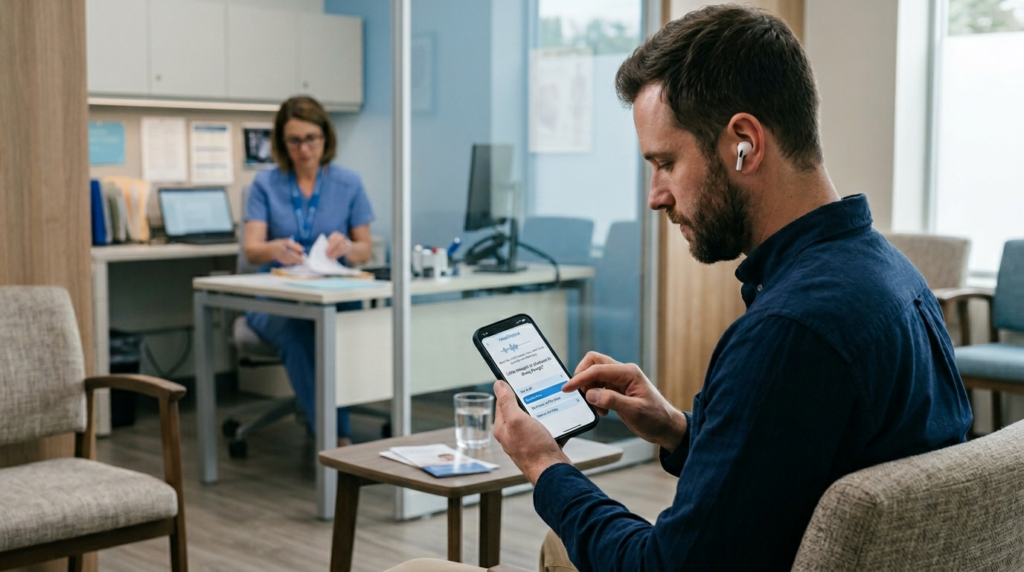
Three genuine differences exist between AI-administered and clinician-administered PHQ-9. Each one is worth understanding, but none of them is an accuracy argument against AI administration.
Tone and rapport: A clinician administering the PHQ-9 in person can observe non-verbal cues, adjust pacing, and offer reassurance in real time. An AI voice system cannot do any of those things. For most patients answering a standardised nine-item questionnaire, this does not affect scoring. For patients in acute distress or crisis, clinical judgment matters in ways that automated administration cannot replicate.
Question 9 response: When a patient endorses suicidal ideation on Question 9 during a clinician-administered PHQ-9, the clinician is present and can respond immediately. With AI pre-visit administration, the Q9 response must trigger an immediate alert to clinical staff before the patient arrives. This is exactly how MedLaunch’s PHQ-9 screening handles it, with an immediate alert to assigned clinical staff before the patient enters the room.
Complex clinical presentations: For patients with significant cognitive impairment, severe psychiatric presentations, or language barriers not addressed by the administration language, a clinician administering the PHQ-9 can adjust the process in ways an automated system cannot.
None of these differences affects the psychometric accuracy of the instrument. They are clinical workflow considerations that determine when pre-visit AI administration is appropriate.
The Completion Rate Advantage of Pre-Visit AI Administration
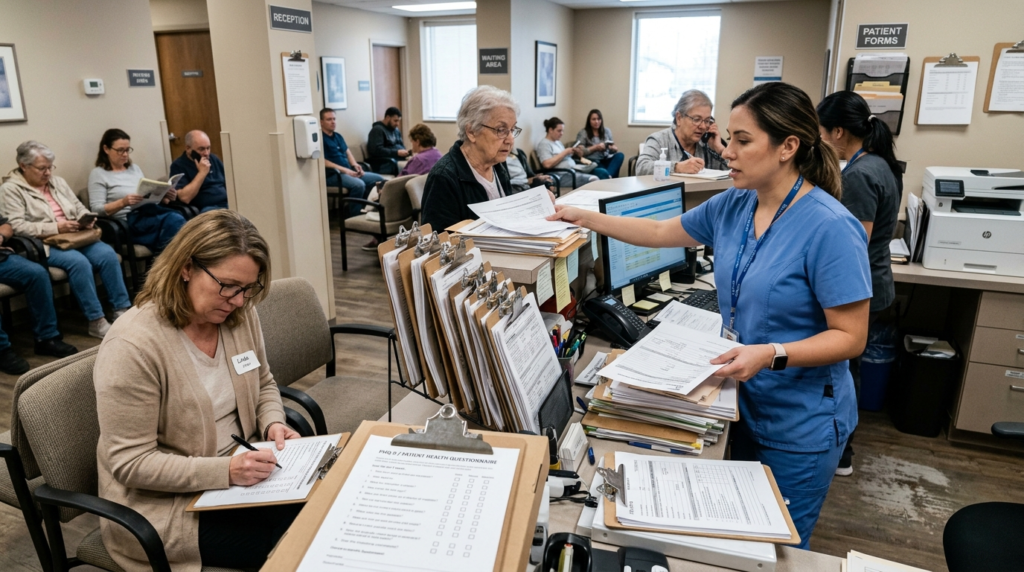
The accuracy comparison between AI-administered and clinician-administered PHQ-9 assumes both methods produce a completed form. In practice, clinician-administered PHQ-9 in small outpatient clinics frequently does not produce a completed form because the administration step is skipped entirely.
Research published in the Annals of Family Medicine found that only 4% of primary care patients are currently screened for depression despite USPSTF universal screening recommendations. That gap is not a clinical failure. It is an operational one. Paper-based in-clinic administration depends on a staff member remembering to hand over a form at a specific visit, the patient completing it under time pressure, and the staff member collecting, scoring, and entering the result before the clinician enters the room.
This is the same operational problem covered in detail in AI PHQ-9 EHR Integration: The Essential 2026 Guide Every Clinic Owner Must Read. AI pre-visit administration removes every manual step from that chain.
A completed AI-administered PHQ-9 is clinically more accurate than an uncompleted clinician-administered one. For a small clinic where the realistic alternative is no screening at all, the comparison is not AI vs clinician accuracy. It is AI accuracy vs zero data.
What the Research Says
Three findings from peer-reviewed research are directly relevant to clinic owners evaluating AI PHQ-9 administration in 2026.
Finding 1 – Automated formats produce equivalent psychometrics to paper. The Frontiers in Digital Health study by Dosovitsky et al. found that a chatbot-administered PHQ-9 across nearly 4,000 adults produced internal consistency of 0.896 and a 99.82% completion rate. Multiple prior studies cited in the same paper, including computerised, smartphone, and tablet formats, found correlations of 0.92 or higher between automated formats and the paper instrument. Format does not change the psychometric properties of the PHQ-9 when the instrument items and response options are presented consistently.
Finding 2 – Automated telephone PHQ-9 is valid and reliable for monitoring. The automated telephony PHQ-9 study in PMC demonstrated that voice administration specifically produces test-retest reliability and sensitivity-specificity profiles consistent with the validated instrument. For clinics considering voice-guided pre-visit administration, this is the most directly applicable evidence: automated voice delivery of the PHQ-9 is clinically valid for both screening and longitudinal monitoring.
Finding 3 – The accuracy question is secondary to the completion question. The Annals of Family Medicine data showing 4% depression screening rates in primary care demonstrates that the primary clinical accuracy risk in outpatient practice is not administration format. It is non-administration. A clinic choosing between AI pre-visit administration and in-clinic paper administration is choosing between a system that produces scored results for every applicable patient and one where most patients will not be screened at all.
This is also why PHQ-9 Longitudinal Tracking becomes meaningful only when screening actually happens consistently across every visit.
When Clinician Administration Is Still Preferable

AI pre-visit PHQ-9 administration is not appropriate for every patient at every visit. Three clinical situations where in-person clinician administration remains preferable:
Active crisis presentation: A patient presenting in acute psychiatric crisis should not be receiving a PHQ-9 via pre-visit link. The clinical encounter should be managed by the clinician from the moment of contact.
First psychiatric evaluation with complex presentation: For an initial evaluation where the clinician needs to observe how the patient engages with the questions and what language they use to describe their symptoms, in-person administration provides clinical context that a completed score alone does not.
Severe cognitive impairment: Patients who cannot reliably understand and respond to nine standardised questions without clinical support should not be completing automated pre-visit forms.
For the majority of outpatient mental health and primary care patients, routine follow-ups, depression monitoring visits, and intake screenings, pre-visit AI administration is appropriate and produces equivalent clinical data. This applies equally to mental health counselling clinics, psychiatry practices, and telehealth providers.
What This Means for Your Clinic in 2026
The psychometric evidence for AI-administered PHQ-9 is clear. Automated formats produce internal consistency, test-retest reliability, and sensitivity-specificity profiles equivalent to paper administration. The completion rate advantage of pre-visit delivery means AI administration is more likely to produce a scored result than in-clinic paper administration in a busy outpatient practice.
The practical question for clinic owners in 2026 is not whether AI-administered PHQ-9 is as accurate as clinician-administered. It is whether the system you select delivers that scored result automatically into your clinical workflow before the appointment begins, stores it as structured longitudinal data, and alerts clinical staff immediately when Question 9 is endorsed.
Those are integration questions, not accuracy questions. MedLaunch AI Powered PHQ-9 Screening handles all three, with most clinics fully live within days.
For a complete breakdown of how the integration works inside your EHR, see AI PHQ-9 EHR Integration: The Essential 2026 Guide Every Clinic Owner Must Read.
FAQ
Is AI-administered PHQ-9 as accurate as clinician-administered?
Research published in Frontiers in Digital Health and PMC supports the psychometric equivalence of automated PHQ-9 administration to the validated paper instrument. Internal consistency, test-retest reliability, and sensitivity-specificity profiles are consistent across chatbot, telephony, and digital formats when the nine items and response options are presented standardly. The accuracy difference between formats is not clinically significant for routine outpatient depression screening and monitoring.
Does the format of PHQ-9 administration affect the score?
The nine PHQ-9 questions and their four response options are fixed. A patient answering the same questions verbally through a voice-guided system produces the same clinical data as a patient answering them on paper, provided the questions are presented identically. Multiple studies across computerised, smartphone, tablet, and telephony formats have found correlations of 0.92 or higher between automated formats and the paper instrument.
What completion rate does AI-administered PHQ-9 achieve?
A chatbot-administered PHQ-9 study published in Frontiers in Digital Health found a completion rate of 99.82% across 3,902 adults. This compares favourably to in-clinic paper administration where completion depends on a staff member administering the form at each applicable visit. In a busy outpatient clinic, the realistic completion rate of manual paper PHQ-9 administration is significantly lower than the theoretical maximum.
Is voice-guided PHQ-9 administration specifically validated?
Yes. An automated telephony PHQ-9 study published in PMC found test-retest reliability of weighted kappa 0.76 and sensitivity of 82.4% with specificity of 90.7% for moderate-plus depression, consistent with the validated paper instrument. Voice administration of the PHQ-9 is clinically valid for both screening and longitudinal monitoring in outpatient settings.
When is clinician-administered PHQ-9 still preferable to AI administration?
In-person clinician administration is preferable for patients presenting in acute psychiatric crisis, patients undergoing initial complex psychiatric evaluation where clinical observation of question engagement matters, and patients with severe cognitive impairment that affects their ability to respond to standardised questions reliably. For the majority of outpatient depression screening and monitoring visits, pre-visit AI administration is appropriate and produces equivalent clinical data.
How does MedLaunch handle a positive Question 9 response in AI-administered PHQ-9?
When a patient endorses suicidal ideation on Question 9 during a pre-visit voice-guided PHQ-9, MedLaunch immediately alerts the assigned clinical staff member before the patient enters the consultation room. The clinical team has time to respond before the clinician begins the appointment. This alert is part of the core workflow and applies across all clinic types including outpatient behavioral health centers and psychiatry clinics.
Conclusion
The psychometric evidence is settled. Automated PHQ-9 administration, across voice, chatbot, telephony, and digital formats, produces scores that are clinically equivalent to paper administration for routine outpatient depression screening and monitoring. The accuracy question clinic owners ask about AI PHQ-9 is the wrong question. The right question is whether the system eliminates every manual step between the patient completing the form and the clinician seeing the result.
For a complete overview of how MedLaunch AI Powered PHQ-9 Screening works across all clinic types, visit the solution page.
Streamline operations with research-backed clinical insights.
Access practical guides to help clinic owners and practice managers reduce administrative burden and build efficient workflows that actually hold.