
Outpatient Behavioral Health Centers Are Still Running PHQ-9 on Paper.
MedLaunch PHQ-9 AI Agent
Intelligent Behavioral Health Screening Without the Intake Burden.
The MedLaunch PHQ-9 AI Agent conducts depression screenings through natural voice conversations before the patient arrives, guiding patients through PHQ-9 questions while automatically capturing structured responses and scores. Clinics receive completed screening results in advance, enabling clinicians to prepare for visits, streamline intake workflows, and ensure consistent behavioral health assessments without adding administrative work.
0:00 / 0:00
Voice-guided
PHQ-9 scored live
HIPAA-secure
Clinician handoff
9:41
MedLaunch AI
PHQ-9 Screening
Tap play to start
AI
Tap play to begin the demo conversation.
The PHQ-9 Problem in Outpatient Behavioral Health Is Not a Staffing Problem. It Is a Systems Problem.
Outpatient behavioral health centers operate under some of the most demanding PHQ-9 screening requirements in the industry. Best practice guidelines require screening at intake, annually for patients scoring 9 or below, and at least every four months for patients scoring 10 or above. Some managed care organizations and state behavioral health authorities require even more frequent documentation. Yet in most outpatient behavioral health centers, the process that is supposed to produce this consistent, longitudinal record is manual, paper-based, and entirely dependent on whether a staff member remembered to hand over a form. Here is what breaks down.
Intake Screening Is Inconsistent
When intake staff are managing multiple patients simultaneously, the PHQ-9 paper form gets skipped. Patients enter the treatment programme without a baseline score. The clinical picture starts incomplete and stays incomplete.
Follow-Up Screening Intervals Are Not Tracked
Knowing a patient needs rescreening every four months is one thing. Tracking that across a high-volume caseload manually is another. Follow-up screening falls through the gaps and the longitudinal record that managed care organisations require is never built.
Question 9 Is Being Skipped by Some Organisations
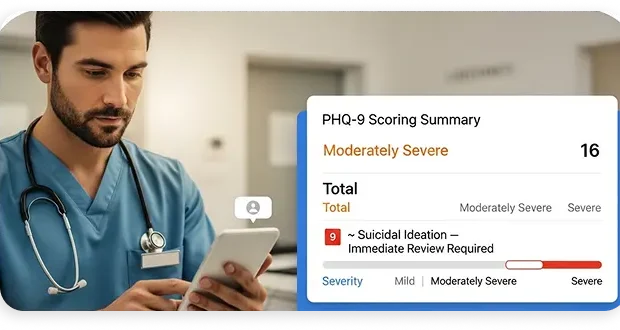
Some health care organisations are omitting Question 9 from their PHQ-9 screening due to liability concerns. This is clinically and ethically indefensible. MedLaunch includes Question 9 in every screening and alerts your clinical staff immediately if it is endorsed, before the patient reaches the clinician.
How AI PHQ-9 Screening Works in Outpatient Behavioral Health Centers
Three steps. Zero manual work. Clinical clarity before every consultation.
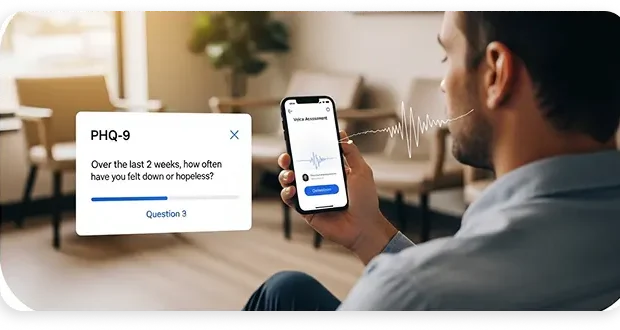
Completed Before Every Session From Intake Onwards
Completed in the Waiting Room.
Your patient receives a link before their intake appointment and before every subsequent session where screening is required. Our AI voice agent guides them through all nine PHQ-9 questions at a natural pace, in plain language. This can be completed at home, in transit, or in your waiting room. No paper form. No staff required.
Scored Instantly With Automatic Follow-Up Interval Tracking
Mild to Severe; Identified the Moment the Patient Finishes
The moment the patient completes the screening, MedLaunch scores the response automatically against validated severity thresholds. The score is stored against the patient record and the system flags when the next screening is due based on the score, annually for scores 9 or below, every four months for scores 10 or above. No manual tracking required.
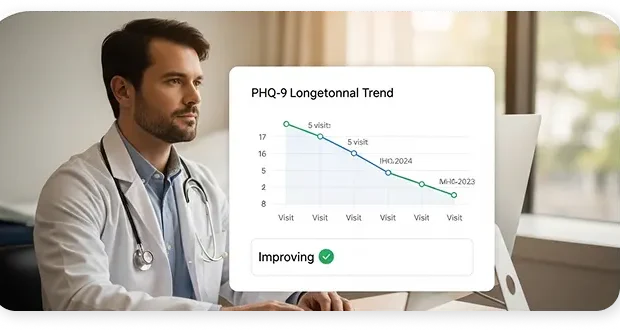
Delivered to Your Clinician Before the Session With Full Longitudinal History
Show Patients Their Improvement.
A structured, clinician-ready PHQ-9 summary is delivered directly to your EHR before the session begins. Every score is automatically compared to previous screenings. Your clinician walks in with a full longitudinal record in hand, the complete clinical picture across the patient’s entire treatment history.
Built for Every Type of Outpatient Behavioral Health Center
Three types of clinics. One shared problem
Community Behavioral Health Centers
Community behavioral health centers serve high-volume, complex caseloads with significant managed care documentation requirements. MedLaunch automates the entire PHQ-9 process — intake, follow-up intervals, longitudinal records- without adding a single step to your clinical staff’s workflow.
Intensive Outpatient and Partial Hospitalisation Programs
IOP and PHP programmes see patients multiple times per week. Consistent PHQ-9 tracking across that frequency of contact is clinically valuable but operationally demanding when done manually. MedLaunch makes consistent session-by-session tracking practical by running entirely in the background.
Dual Diagnosis and Co-Occurring Disorder Programs
Outpatient programs treating co-occurring mental health and substance use disorders have the most complex PHQ-9 requirements. Depression screening must be consistent, longitudinal, and clearly documented for managed care authorisation. MedLaunch builds that record automatically.
Why Outpatient Behavioral Health Centers Choose MedLaunch for PHQ-9 Screening
Every clinic sees it. Most miss it. Here’s where depression slips through the gaps.
Automates Required Screening Intervals Without Manual Tracking
Best practice guidelines require PHQ-9 at intake, annually for patients scoring 9 or below, and every four months for patients scoring 10 or above. MedLaunch tracks these intervals automatically based on each patient’s score history and prompts the next screening at the right time without any manual tracking from your team.
Builds the Longitudinal Record Managed Care Requires
Managed care organisations and state behavioral health authorities require documented longitudinal PHQ-9 records for treatment authorisation and quality reporting. MedLaunch builds this record automatically — every score, every interval, stored against the patient record and available for reporting.
Question 9 Is Always Included. Always Flagged.
Some organisations have begun omitting Question 9 from their PHQ-9 screening due to liability concerns. MedLaunch includes Question 9 in every screening. When a patient endorses suicidal ideation, your clinical staff receives an immediate alert before they reach the clinician. There is no clinical or ethical case for skipping it. MedLaunch does not allow it to be skipped.
Reduces Staff Burden at Intake and Follow-Up
Outpatient behavioral health centers typically run lean on administrative staff. MedLaunch removes PHQ-9 administration from the staff workload entirely — at intake and at every follow-up interval. Your team does not hand out forms, collect them, score them, or file them.
HIPAA-Aligned by Design
Every patient interaction, score, and report is handled within a fully HIPAA-aligned framework. Encrypted in transit and at rest. Role-based access controls. Business Associate Agreement in place. No patient data is used to train external models.
Live Within Days, Not Weeks
Most outpatient behavioral health centers are fully live within days. MedLaunch handles the entire configuration, EHR integration, and staff briefing from our side. Your team does not change how they work.
Frequently Asked Questions
Still Have Questions? Good. Here Are the Honest Answers.
Best practice guidelines recommend PHQ-9 at intake as a baseline, annually for patients who score 9 or below, and at least every four months for patients who score 10 or above. Some managed care organisations and state behavioral health authorities require more frequent documentation. MedLaunch tracks these intervals automatically based on each patient's score and prompts the next screening at the right time.
Yes. MedLaunch includes all nine PHQ-9 questions in every screening including Question 9. When a patient endorses suicidal ideation, your clinical staff receives an immediate alert before the patient reaches the clinician. Omitting Question 9 is not an option in MedLaunch — it is included and flagged in every deployment.
Yes. Every PHQ-9 score is stored against the patient record in your EHR and automatically compared to previous screenings. The complete longitudinal record is available for managed care reporting, quality audits, and treatment authorisation. Your documentation is consistent, complete, and structured exactly as managed care organisations require.
Yes. MedLaunch integrates with Epic and Athena Health. If your center uses a different EHR, contact us and we will confirm compatibility before you commit to anything.
The screening can also be completed in the waiting room on any device. If a patient arrives without completing it, your staff hands them a device and the AI voice agent walks them through it on site. The score is still delivered to the clinician before the session begins.
MedLaunch offers flexible pricing options including monthly plans and performance-based models depending on the size and needs of your practice. There is no one-size-fits-all structure. Contact us and we will walk you through what makes sense for your specific setup.