
Key Takeaways: AI-Powered PHQ-9 Screening
-
1What it actually is: A voice-administered version of the standard PHQ-9 assessment completed before the consultation. It is scored automatically against validated thresholds with results delivered directly to the clinician eliminating paper and staff involvement.
-
2Why it exists in 2026: While the PHQ-9 takes under three minutes, it is often skipped or miscalculated due to administrative friction. AI removes these barriers, ensuring the assessment is filed and read before the appointment starts.
-
3Clinical Impact & Alerts: Question 9 suicidal ideation responses trigger immediate alerts to clinical staff before the patient enters the room. Severity scoring and longitudinal trend tracking happen automatically across every visit.
-
4What it is NOT: This is not a chatbot, a self-diagnostic tool, or a replacement for clinician assessment. It is the administrative layer that handles scoring and paper handling, now fully automated.
-
5Implementation Reality: Most clinics are live within days. The system integrates into existing EHR workflows with minimal involvement from the clinical team, as MedLaunch handles the technical work end-to-end.
AI PHQ-9 screening is changing how mental health and psychiatry clinics deliver measurement-based care in 2026, but to understand why, it helps to start with what the workflow actually looks like in most clinics today.
A patient walks into a mental health clinic for a follow-up. They have been managing depression for six months. Their medication was adjusted four weeks ago. The clinician needs to know whether the adjustment is working before this consultation begins.
Under the current standard of care, the patient should complete a PHQ-9 at this visit. The score should be compared against the score from their last visit. The trend should inform the next clinical decision.
Under the actual workflow at most clinics: the front desk is overwhelmed, the PHQ-9 form is in the back office, the patient waits five minutes, the staff member asks the patient to fill it out quickly while the clinician is calling the next name, the patient ticks boxes without reading them carefully, the form is handed to the clinician at the start of the consultation, the clinician scores it in their head while the patient is already speaking, and the score from four weeks ago is somewhere in the chart that no one has time to find right now.
This is not a failure of any individual person in that clinic. It is a structural failure of a workflow that was never designed to support measurement-based care at the volume modern mental health practices operate at.
AI-powered PHQ-9 screening is the structural fix. This guide explains exactly what it is, what it does, what it does not do, and why the category exists in 2026.
Table of Contents
1. The Short Definition: What AI-Powered PHQ-9 Screening Actually Is
AI-powered PHQ-9 screening is a voice-administered, automatically scored implementation of the Patient Health Questionnaire-9, the standard nine-item depression screening instrument used across primary care and mental health practice for over twenty years.
The patient completes the assessment by speaking with an AI voice assistant. The voice assistant walks through all nine standard PHQ-9 questions in the validated order, captures the patient’s responses, calculates the total score against the validated severity thresholds, flags any positive Question 9 response immediately to assigned clinical staff, stores the scored result against the patient’s record, and delivers a clinician-ready summary into the clinic’s EHR before the consultation begins.
The instrument itself does not change. The questions are the same. The scoring is the same. The severity bands are the same. What changes is the administration, the scoring, and the delivery.
That is the entire category in one paragraph. Everything else in this guide is the explanation of why that simple-sounding shift matters clinically, operationally, and financially for mental health and psychiatry clinics.
2. Why the PHQ-9 Workflow Broke Before AI Existed

The PHQ-9 was developed in 2001 and has been the standard depression screening instrument across primary care and mental health practice ever since. Its clinical validity is well established. Its scoring is straightforward. Its severity thresholds are validated.
None of those things are the problem.
The problem is that the workflow around the PHQ-9, getting the right form to the right patient at the right point in the visit, ensuring the patient completes it carefully, scoring it accurately, comparing it to previous scores, and delivering it to the clinician before the consultation starts, was never automated. It has been a manual administrative process for two decades. And the volume of mental health visits in 2026 has outgrown what manual administration can sustain.
The screening-skip rate is high and underreported
In primary care, where the PHQ-9 is meant to be administered routinely under USPSTF guidelines, peer-reviewed data consistently show that depression screening occurs in only a fraction of eligible visits. In mental health and psychiatry settings, where measurement-based care should make screening routine across every visit, real-world implementation rates remain well below the clinical standard despite the recognized benefit.
The reason is not clinical disagreement. The reason is friction. When the front desk is busy, the form gets skipped. When the patient is anxious, the questions get rushed. When the clinician is running behind, the scoring happens in their head between sentences. The screening that should be the foundation of measurement-based care becomes the part of the workflow that gets compressed first.
Scoring errors are not rare
Manual PHQ-9 scoring introduces a small but meaningful error rate. A miscalculated score, particularly one that crosses a severity threshold (mild to moderate, moderate to moderately severe), can shift the clinical decision that follows. Over a clinic’s annual screening volume, the cumulative effect of scoring errors on treatment decisions is not trivial.
Question 9 deserves more than a paper form
Question 9 of the PHQ-9 asks about thoughts of being better off dead or hurting oneself. It is the single most clinically critical item on the instrument. In a paper workflow, a positive Question 9 response is discovered when the clinician opens the form at the start of the consultation. The patient is already in the room. The conversation has often already started. The opportunity for the clinical team to prepare the appropriate response to escalate, to brief the clinician, to adjust the visit structure is gone.
This is the gap that has driven AI PHQ-9 screening from a theoretical efficiency tool into a clinical-safety category in 2026.
3. How AI-Powered PHQ-9 Screening Works Step by Step

The mechanics of how the system actually works are simpler than most clinic owners expect.
Step 1 — The patient receives the screening before or at the visit
The PHQ-9 is initiated either remotely (via a secure link sent to the patient before their appointment) or in the waiting room (via an AI voice interaction the patient completes on a tablet or phone). Both pathways use the same instrument and the same validated administration order.
For follow-up patients, the system can be configured to administer the PHQ-9 at every visit, every other visit, or on whatever cadence the clinic uses for measurement-based care. The clinic decides the cadence. The system runs it consistently.
Step 2 — The AI voice assistant administers the assessment
The patient hears each of the nine standard PHQ-9 questions read aloud at a natural pace. They respond verbally. The AI captures the response, confirms it where helpful, and proceeds to the next item.
The administration is calibrated to be calm, clear, and unhurried. Patients who need a question repeated can ask. Patients who want to clarify their response can do so. The interaction is conversational, not robotic.
Step 3 — Automatic scoring against validated severity thresholds
The total PHQ-9 score is calculated instantly. The score is classified against the validated severity bands:
- 0–4: Minimal depression
- 5–9: Mild depression
- 10–14: Moderate depression
- 15–19: Moderately severe depression
- 20–27: Severe depression
The score, the severity classification, and the individual item responses are stored against the patient’s record.
Step 4 — Question 9 alerting
If the patient’s response to Question 9 is anything other than “not at all,” an alert is triggered immediately to the clinical staff assigned to that patient or that clinic flow. The alert arrives before the patient enters the consultation room. The clinician is briefed before the visit begins. The clinical response, whether that means the clinician adjusts the consultation structure, the patient is escalated to a safety conversation, or another protocol the clinic has defined, happens with full context, not after the fact.
Step 5 — Delivery to the clinician
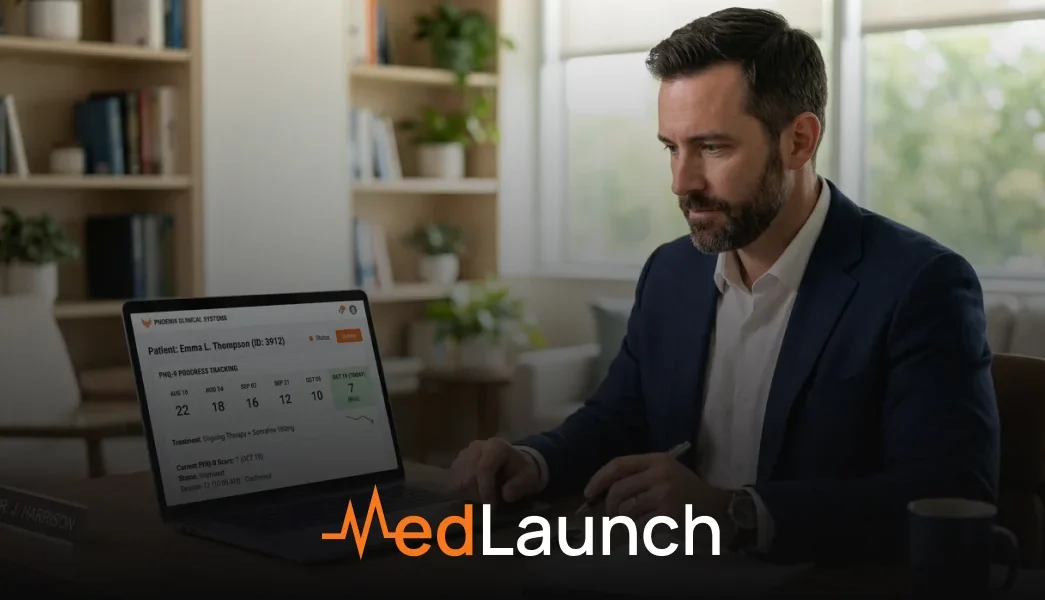
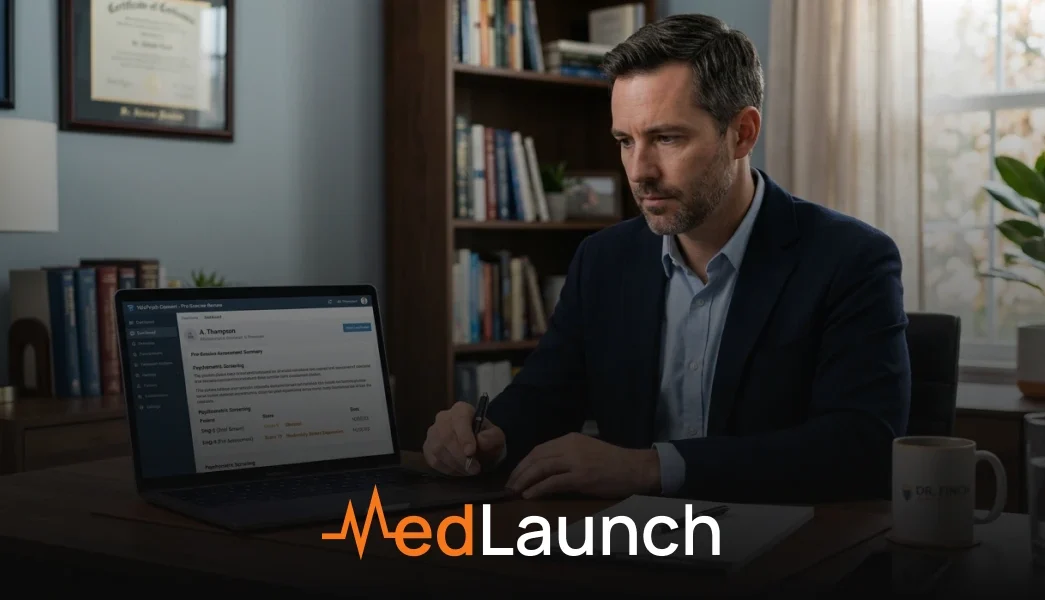
A structured summary lands in the EHR before the consultation begins. The clinician sees the current score, the severity classification, the trend against previous PHQ-9 scores for that patient, and any flagged items. No interpretation is required. No manual scoring. No paper to chase down.
Step 6 — Longitudinal tracking, automatically
Every PHQ-9 score for every patient is stored and compared automatically. At the next visit, the clinician sees not just the current score but the trend: improving, stable, or worsening. Treatment response becomes visible. Medication adjustments can be evaluated against measured outcomes. Measurement-based care stops being an aspiration and starts being the standard, because the measurement is happening automatically every time.
4. What the Patient Experiences vs. What the Clinician Receives
It is worth describing both sides separately because the experience is meaningfully different from a paper PHQ-9 for both.
The patient experience
The patient is asked the nine standard PHQ-9 questions in a calm, conversational tone. They answer at their own pace. They are not rushed by a busy front desk. They are not handed a clipboard and asked to complete the form quickly so the clinician can be on time.
For many patients, the voice administration produces a more thoughtful, less defended response than a paper form. Patients have time to consider each item. There is no social pressure to complete the form quickly to be polite to the staff member waiting for it. The administration is private and unhurried.
The clinician experience
The clinician arrives at the consultation with the scored, classified result already in hand. They see the trend. They see any flags. They see the patient’s individual item responses if they want to drill down.
The first three minutes of the consultation, which would otherwise be spent reviewing the form, calculating the score, and orienting to the patient’s current state, are recovered. The clinician begins the consultation already informed. The patient experiences a clinician who knows where they are, not one who is reading a paper form while they sit there.
This is the operational shift that drives the clinical shift. When the friction around measurement is removed, measurement-based care happens by default rather than by exception.
5. The Question 9 Problem and How AI Handles It

This is the section every mental health clinic owner asks about first, and rightly so. Question 9 is the most clinically sensitive item on the PHQ-9, and the way an AI system handles it is the single most important design decision in the category.
What “the Q9 problem” actually is
In a manual workflow, a positive Question 9 response is identified when the clinician reads the form at the start of the consultation. By that point, the patient is already in the room. The clinician has not been pre-briefed. The clinical team has not been able to prepare. The opportunity to adjust the visit to bring in additional clinical support, to extend the appointment time, to follow the clinic’s safety protocol has narrowed substantially.
In an automated workflow, the alert fires the moment the response is recorded. The clinician is informed before the patient enters the consultation room. The clinical team has time. The protocol can be followed properly rather than improvised.
The over-triggering concern
A reasonable concern that mental health clinicians raise is the opposite of the missing-an-alert problem: what about over-triggering? What if every patient who selects “several days” on Question 9 generates an alert that the clinical team has to respond to immediately?
Configured correctly, the alert thresholds are aligned with the clinic’s safety protocol, not arbitrary defaults. The clinic decides what response level constitutes an alert. The clinic decides who is alerted, in what order, and through what channel. The system runs the protocol the clinic has defined. It does not impose a protocol on the clinic.
A more detailed walkthrough of how Question 9 alerts are configured, routed, and audited is published in The Question 9 Problem: How AI Handles Suicidal Ideation Alerts Without Missing or Over-Triggering, which is the dedicated post on this part of the system.
6. What AI-Powered PHQ-9 Screening Is Not
This section matters because the category is genuinely novel and a number of adjacent technologies sound similar but are different. A clinic owner evaluating this technology should be clear about what it is not, before deciding what it is worth.
It is not a chatbot
A chatbot is a conversational AI that handles open-ended dialogue. AI-powered PHQ-9 screening administers a specific, validated, nine-item instrument in a fixed structure. The AI’s job is to deliver the standard PHQ-9 reliably, not to have a clinical conversation with the patient.
It is not a self-diagnostic tool
The system does not diagnose depression. The PHQ-9 is a screening instrument, not a diagnostic one. A score in the moderate-to-severe range is a clinical signal that warrants further assessment by a qualified clinician. The AI delivers the score. The clinician makes the diagnosis.
It is not a replacement for clinical judgment
The clinician’s assessment, conversation with the patient, history-taking, and treatment planning are unchanged. The system removes the administrative work around the screening. It does not touch the clinical work that follows.
It is not a therapy bot or a digital mental health intervention
The system does not provide therapy. It does not offer coping suggestions. It does not deliver any clinical content beyond the validated PHQ-9 questions themselves. It is a screening administration tool, not a treatment tool.
It is not a closed black box
The clinician sees every individual item response, the calculated score, the severity classification, and the trend. Nothing is hidden. The clinician can verify any score, drill into any item, and override any classification at clinical discretion.
7. Where It Fits in a Mental Health Clinic’s Workflow
The right way to think about where AI PHQ-9 screening fits is as a layer that sits between the patient’s arrival and the clinician’s consultation. It does not replace anything in the existing workflow. It removes friction from a part of the workflow that was never automated.
For a therapy practice running biweekly or weekly visits, the system can administer the PHQ-9 at the cadence the practice uses for measurement-based care. The clinician arrives at every relevant session with a current score and a trend. Treatment response becomes measurable in real time rather than retrospective.
For a psychiatry practice managing medication, the PHQ-9 trend after a medication adjustment becomes visible without requiring the clinician or staff to chase the data. The decision to maintain, adjust, or escalate medication is informed by measured outcome, not patient self-report alone.
For a clinic running intake assessments, the PHQ-9 is captured before the first consultation begins. The intake clinician arrives at the visit already informed about depression severity. The conversation starts at a different point.
The system does not require the clinic to change its EHR, its scheduling, its consultation structure, or its clinical protocols. It plugs into the workflow that already exists and removes the manual administration step that has historically lived between intake and consultation.
8. The Clinical Validity Question Every Mental Health Clinician Asks
This deserves a direct answer because it is the single most common objection from clinicians evaluating the category.
The PHQ-9’s clinical validity has been established across multiple modes of administration. Peer-reviewed studies comparing paper, telephone, computerized, and voice-based administration consistently show that the mode of administration does not materially affect the instrument’s diagnostic validity when the questions are delivered in the validated order with the validated wording.
What this means in practice: a PHQ-9 administered by AI voice produces clinically equivalent results to a PHQ-9 administered on paper, provided the administration is faithful to the instrument. AI administration improves consistency; every patient receives the questions in exactly the same wording, in the same order, at the same pace, which reduces a small source of variability that exists in human-administered or self-administered paper forms.
A more thorough walkthrough of the validation literature, including the specific peer-reviewed studies that have compared modes of administration, is published in Is AI-Administered PHQ-9 Clinically Valid? 6 Things Every Clinician Needs to Know, the dedicated post on this question.
9. What Setup Looks Like in a Real Mental Health Clinic
Most mental health clinics deploying AI PHQ-9 screening through MedLaunch are fully live within days. The implementation is handled end to end by MedLaunch.
What MedLaunch handles
EHR integration with the clinic’s existing system. Configuration of the screening cadence (every visit, every other visit, intake-only, custom). Configuration of the Question 9 alert routing, who is notified, through what channel, with what priority. Staff briefing on how the alert flow will look in their day. Testing before go-live.
What the clinic team does during setup
The clinic identifies who should receive Question 9 alerts and at what priority. The clinic confirms the screening cadence it wants to run. The clinic reviews the configured workflow before go-live. That is essentially the team’s involvement.
What changes from day one
The PHQ-9 is administered consistently at every visit the clinic has configured for it. Scores arrive in the EHR before the consultation begins. Question 9 alerts the route to the right staff member in the right channel. Longitudinal trend data starts accumulating from the first visit and becomes more useful with every subsequent one.
After-the-fact scoring stops. Skipped the screenings. Missed Question 9 responses stop being a structural risk. The clinical day starts to look the way measurement-based care was always supposed to look.
10. Frequently Asked Questions
What is AI-powered PHQ-9 screening?
AI PHQ-9 screening is a voice-administered version of the standard nine-item Patient Health Questionnaire-9 depression screening instrument. The patient completes the assessment by speaking with an AI voice assistant. The score is calculated automatically against validated severity thresholds. Question 9 responses are flagged immediately to clinical staff. The result is delivered into the EHR before the consultation begins. It removes the manual administrative work around the PHQ-9 without changing the instrument itself.
Is AI-administered PHQ-9 clinically valid?
Yes. Peer-reviewed studies comparing paper, telephone, computerized, and voice-based PHQ-9 administration consistently show that the mode of administration does not materially affect the instrument’s diagnostic validity when the questions are delivered in the validated order with the validated wording. AI administration produces clinically equivalent results to paper administration with greater consistency.
How does the system handle Question 9?
A positive Question 9 response triggers an immediate alert to the clinical staff assigned to that patient or clinic flow. The alert arrives before the patient enters the consultation room. The clinic configures the alert routing, who is notified, through what channel, at what priority, based on the clinic’s existing safety protocol. The system runs the protocol the clinic defines.
Can the patient complete the screening remotely before the appointment?
Yes. The AI voice assessment can be sent as a secure link to the patient before their visit. The patient completes the screening at home, on their phone, in their own time. The scored result is in the clinician’s hands before the patient arrives at the clinic.
Does the AI replace the clinician?
No. The AI handles the administration and scoring of the PHQ-9. The clinician’s assessment, history taking, diagnostic reasoning, and treatment planning are unchanged. The screening informs the clinician. It does not replace the clinician.
How is patient data protected?
All patient data processed by AI-powered PHQ-9 screening is encrypted in transit and at rest. The system operates within a HIPAA-aligned framework that includes role-based access controls, audit logging, and a Business Associate Agreement signed with MedLaunch before go-live. Audio is not retained after the screening result is generated. No patient data is used to train external AI models.
How long does setup take?
Most mental health clinics are fully live within days. MedLaunch handles the EHR integration, configuration, alert routing setup, and staff briefing end-to-end. The clinic team’s involvement during implementation is minimal.
Does it integrate with our existing EHR?
Yes. The system is designed to integrate into the clinic’s existing EHR rather than replacing it. The scored PHQ-9 result lands in the patient record in the EHR that the clinic already uses. There is no parallel system to manage.
What happens if the patient asks the AI a clinical question during the screening?
The AI is configured to administer the PHQ-9, the nine standard questions in their validated form. It is not configured to provide clinical advice or open-ended dialogue. If the patient raises a clinical concern during the screening, the system flags this for the clinical team to address during the consultation. The AI does not attempt to provide a clinical response.
Is this only for new patients or also for existing patients?
Both. The system can administer the PHQ-9 at intake, at follow-up visits, at medication review visits, or at any cadence the clinic uses for measurement-based care. Longitudinal score tracking across visits is one of the core features. The system is most clinically valuable for existing patients on an ongoing basis, not just for one-time intake.
11. Conclusion
The PHQ-9 has been the standard depression screening instrument across primary care and mental health practice for over twenty years. Its clinical validity is well established. Its scoring is straightforward. Its severity thresholds are validated.
What has been missing is a workflow that supports the PHQ-9 being administered at the cadence and consistency that measurement-based care actually requires. The instrument was clinically ready. The administrative infrastructure was not.
AI PHQ-9 screening is the infrastructure that closes that gap.. It administers the validated instrument consistently, scores it instantly, flags Question 9 responses immediately, delivers the result to the clinician before the consultation begins, and tracks the trend across every visit automatically.
The clinician’s clinical work is unchanged. The instrument is unchanged. What changes is whether the screening that should be happening at every relevant visit actually happens at every relevant visit, without skipped sessions, without scoring errors, without Question 9 alerts that arrive too late to matter.
For mental health and psychiatry clinics in 2026, this is the layer of the workflow that has finally caught up with the clinical standard the profession has held for two decades.
Want to see how AI PHQ-9 fits into your workflow?
Book a call to walk through how the system would be configured for your practice’s specific screening cadence, alert routing, and EHR integration.