

Key Takeaways: Healthcare Capacity Management
-
1A full calendar is not the same as optimised capacity:
If high-acuity visits are delayed because short appointments fill prime slots, access is still broken, even with zero open time. Capacity management is about visit mix and structure, not just fill rate. -
2Capacity misalignment has direct financial consequences:
Idle provider hours are unrecovered revenue. Unplanned overtime increases costs and accelerates burnout. In group practices, template variation across providers compounds these losses silently over time. -
3Demand forecasting transforms capacity from reactive to strategic:
Analyzing historical data, seasonal illness patterns, and chronic care cycles lets practices adjust staffing and templates before schedules become congested, not after the waiting room is already overflowing. -
4Real-time monitoring is what makes capacity planning sustainable:
Even a perfectly designed template degrades without oversight. Dashboards that track daily utilization, cancellation rates, and room occupancy allow proactive adjustments before small inefficiencies compound into major backlogs. -
5Outpatient capacity has system-wide consequences:
Delays in ambulatory access drive avoidable emergency department visits and worsen chronic disease outcomes. Optimising outpatient capacity isn’t just a scheduling decision. -
6Automation and AI reduce the manual burden without replacing judgement:
Intelligent scheduling systems, no-show prediction, and automated backfill don’t replace operational leaders, they give them the precision and bandwidth to focus on structural improvement rather than daily firefighting.
Healthcare Capacity Management is one of the most important operational disciplines in modern ambulatory care. At its simplest level, Healthcare Capacity Management is the structured process of matching patient demand with available clinical supply.
Demand represents the patients who need appointments, follow-ups, chronic care management, diagnostics, or urgent evaluations. Supply represents the finite resources available to deliver that care, provider time, exam rooms, clinical staff, equipment, and appointment slots.
When supply and demand are aligned, patient flow feels smooth. Appointments are available within reasonable timeframes, providers are neither overwhelmed nor idle, and patients move through visits without unnecessary delays.
When alignment breaks down, the symptoms appear quickly: long wait times, overbooked clinicians, idle rooms during peak hours, staff frustration, and revenue leakage from unused capacity.
Capacity management in health systems has traditionally focused on hospital beds and inpatient throughput. However, in today’s value-driven environment, outpatient capacity management carries even greater importance.
Most patient interactions occur in ambulatory settings, and the majority of contract performance metrics are influenced by outpatient access and continuity. For group practices and multi-site networks, structured healthcare capacity management is not optional, it is foundational to sustainable growth.
This article provides a practical, operational guide for leaders seeking to strengthen patient flow through better capacity planning, smarter scheduling, and predictive coordination across outpatient settings.
Table of Contents
What Is Healthcare Capacity Management?

Healthcare Capacity Management refers to the structured planning, allocation, monitoring, and adjustment of clinical resources to ensure patient demand can be met efficiently and safely. It is both a strategic framework and a daily operational discipline.
Capacity includes far more than open appointment slots. It encompasses the total number of provider hours available, the number of functional exam rooms, access to medical assistants and nurses, diagnostic equipment availability, and the structure of scheduling templates. It also includes visit duration logic and the way appointment types are distributed throughout the week.
In outpatient settings, capacity is dynamic rather than static. Demand fluctuates based on seasonal illness patterns, chronic disease follow-up cycles, payer requirements, referral flows, and population growth. Effective outpatient capacity management anticipates these fluctuations and adjusts resources accordingly, rather than waiting until schedules become congested.
Capacity vs Volume vs Utilization
Operational confusion often arises when capacity, volume, and utilization are treated as interchangeable terms. In reality, they measure different dimensions of performance.
Capacity refers to the total supply available. For example, if a physician works forty clinical hours per week, that is their theoretical capacity. Volume refers to the number of patient visits requested or delivered within that capacity. Utilization measures how much of that capacity is actually used.
A clinic may report high visit volume but still have inefficient utilization if certain appointment blocks go unused or if room turnover is inconsistent. Similarly, a fully booked calendar does not necessarily mean capacity is optimized. If high-acuity visits are delayed because short appointments occupy prime time slots, access remains constrained despite apparent fullness.
Understanding these distinctions is essential for accurate healthcare network capacity planning. Without clarity, organizations risk focusing on superficial metrics instead of structural improvement.
Why Healthcare Capacity Management Is Critical for Patient Flow
Patient flow is the visible outcome of capacity decisions. When scheduling templates are poorly designed or provider availability is mismatched with demand, the effects cascade across the patient journey.
Overbooking providers may temporarily increase volume, but it often results in extended in-clinic wait times, rushed visits, and lower patient satisfaction. Underbooking, on the other hand, creates idle rooms and missed revenue opportunities. Even subtle imbalances, such as clustering complex visits back-to-back without buffer time, can slow throughput and create downstream congestion.
Clinic capacity optimization ensures that the right mix of appointment types is available at the right times. It protects same-day access for urgent needs while preserving dedicated space for chronic disease management and preventive care. When capacity is structured intentionally, patient flow becomes predictable rather than chaotic.
Financial Impact of Capacity Mismanagement
Capacity mismanagement has direct financial consequences. Idle provider hours represent unrecovered revenue. Excess overtime increases labor costs and accelerates burnout. Uneven provider utilization may create compensation disparities and morale challenges.
In capacity management in group practices, financial leakage frequently occurs when scheduling templates are not standardized. One provider may consistently overrun appointment times while another finishes early, leaving unused blocks. Without oversight and load balancing, these inefficiencies compound over time.
Optimized capacity improves not only access but also revenue stability, cost control, and long-term contract performance. In value-based payment models, reliable outpatient access becomes a competitive advantage.
Common Capacity Challenges in Group Practices

Group practices face unique complexity because capacity must be coordinated across multiple clinicians, specialties, and often multiple locations. Without a centralized framework, variation becomes the norm.
Uneven provider schedules are common. Some clinicians are booked weeks in advance, while others have open slots within days. This imbalance may be driven by referral patterns, reputation, or scheduling rules, but the operational impact is the same: extended wait times for some patients and underutilization for others.
Appointment type allocation also presents challenges. When short, low-acuity visits dominate peak hours, complex chronic care appointments may be pushed into less optimal time blocks or delayed entirely. Over time, this distorts visit mix and compromises continuity.
Another recurring issue is limited real-time visibility. Without integrated dashboards, leaders lack the ability to see daily provider utilization, room turnover rates, or cancellation patterns. Manual tracking systems make proactive adjustments difficult.
Finally, many organizations operate reactively. Staffing adjustments occur only after schedules become overloaded. Predictive capacity planning replaces this reactive posture with forward-looking coordination.
Key Components of Effective Healthcare Capacity Management
Demand Forecasting
Demand forecasting forms the analytical foundation of capacity planning. By examining historical scheduling data, seasonal illness trends, and chronic follow-up cycles, organizations can anticipate future demand more accurately.
Predictive capacity planning models identify patterns such as increased respiratory visits in winter months or higher preventive visit volumes during specific quarters. With these insights, clinics can adjust provider hours, expand telehealth windows, or reallocate appointment types in advance.
Forecasting does not eliminate uncertainty, but it significantly reduces reactive scrambling. It transforms capacity planning from guesswork into structured decision-making.
Smart Scheduling Templates
Scheduling templates are the architectural blueprint of outpatient capacity management. When designed thoughtfully, they balance acute visits, chronic care, preventive exams, and procedural appointments within each provider’s day.
Protected blocks for chronic care ensure continuity for high-risk patients. Same-day slots preserve urgent access. Telehealth windows create flexibility without consuming exam room resources. Complexity-based scheduling aligns visit duration with patient acuity, reducing overruns.
Clinic capacity optimization depends heavily on template standardization across providers and locations. While individual preferences matter, excessive variation undermines system-level efficiency.
Resource Allocation and Load Balancing

In multi-site environments, healthcare network capacity planning requires cross-site coordination. Shared provider pools, centralized scheduling logic, and transparent utilization metrics help distribute demand more evenly.
Load balancing allows appointment requests to be routed to the first available qualified provider rather than defaulting to historical habits. This reduces wait times and improves overall utilization.
Real-Time Capacity Monitoring
Even the best-designed templates require ongoing oversight. Real-time dashboards enable daily monitoring of utilization, cancellation rates, and room occupancy.
Proactive cancellation backfill processes minimize revenue loss. No-show prediction models identify high-risk appointments and trigger reminders or waitlist activation. Continuous monitoring ensures capacity remains aligned as demand fluctuates.
Outpatient Capacity Management vs Hospital Bed Management
While hospital capacity management often focuses on inpatient bed turnover and discharge timing, outpatient capacity management centers on provider throughput, exam room turnover, and appointment mix.
Ambulatory settings handle the majority of patient interactions. Delays in outpatient access can increase emergency department utilization and worsen chronic disease control. Therefore, optimizing outpatient capacity has system-wide implications that extend beyond individual clinic performance.
Predictive and Automated Capacity Management
Predictive capacity planning leverages data analytics to anticipate fluctuations before they occur. By analyzing trends in appointment requests, referral patterns, and no-show behavior, organizations can adjust staffing and scheduling proactively.
Automated capacity management extends this capability further. Intelligent systems can dynamically adjust scheduling rules, recommend slot redistribution, and activate waitlists when cancellations occur. AI-based no-show prediction enables targeted interventions that improve fill rates without excessive manual effort.
These technologies do not replace human judgement. Instead, they enhance operational precision and reduce administrative burden, allowing leaders to focus on strategic improvement.
Measuring Capacity Performance
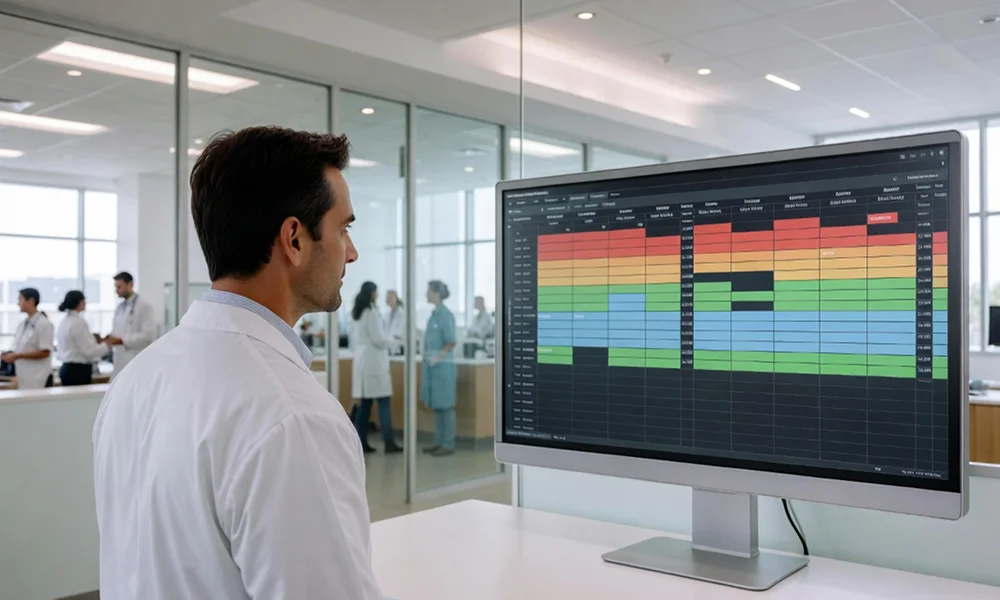
Measurement is essential for continuous improvement. Provider utilization rates reveal how effectively clinician time is being used. Room utilization rates highlight infrastructure efficiency. The time to third next available appointment serves as a widely accepted access benchmark.
Additional indicators such as average patient wait time, same-day fill rate, no-show rate, and overtime hours provide insight into operational stability. Without transparent data visibility, capacity management becomes anecdotal rather than evidence-based.
Capacity Management and Value-Based Care
Effective healthcare capacity management directly supports value-based care objectives. Timely outpatient access reduces avoidable emergency department visits. Protected chronic care capacity improves continuity and reduces complications. Predictable scheduling strengthens patient retention and engagement.
When capacity is optimized, organizations are better positioned to meet quality metrics, improve contract performance, and lower total cost of care. Access becomes not only an operational goal but a strategic lever for value creation.
Building a Healthcare Capacity Management Strategy
A structured approach begins with auditing current capacity. Leaders must map provider hours, exam room availability, and scheduling templates to identify bottlenecks and inefficiencies.
Next, mismatch areas should be identified. High wait times alongside idle provider hours signal structural imbalance. Overtime paired with unused appointment blocks indicates template misalignment.
Template redesign follows. Visit types should be redistributed according to demand patterns, and protected blocks introduced where necessary. Standardization across providers enhances consistency.
Finally, forecasting and automation tools should be implemented to sustain improvement. Predictive capacity planning ensures proactive adjustment, while automated capacity management reduces manual intervention.
How Technology Supports Better Patient Flow
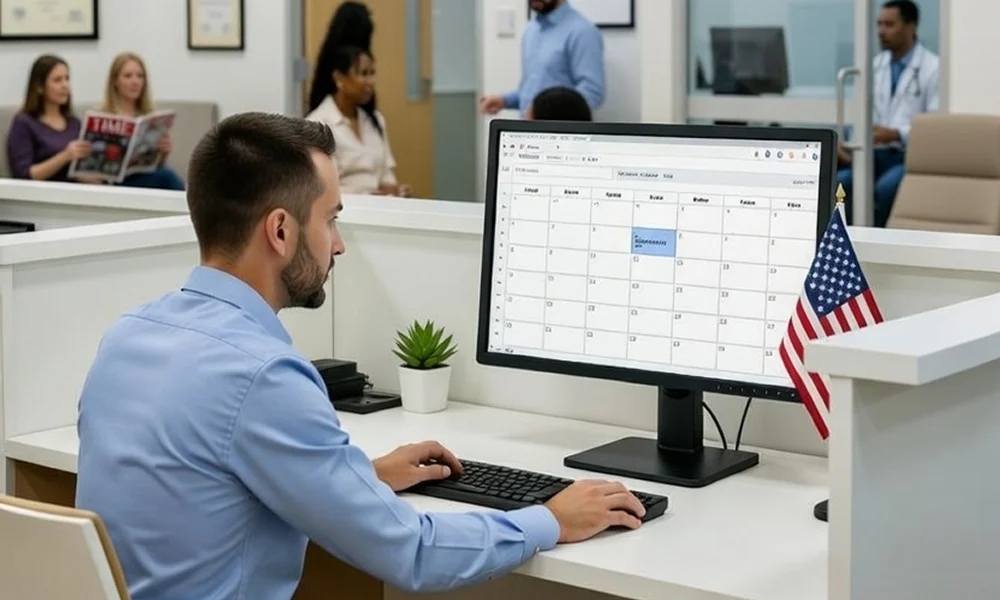
Intelligent scheduling systems enable dynamic slot management, automated backfill of cancellations, and smart patient routing across providers and locations. Integrated capacity dashboards provide multi-site visibility and real-time alerts, allowing leaders to intervene before small issues escalate.
Modern automation tools and structured patient flow systems allow group practices to shift from reactive scheduling to proactive capacity planning. This transformation improves efficiency and patient experience without requiring headcount expansion.
Common Mistakes in Healthcare Capacity Management
Organizations often equate full schedules with optimized capacity, ignoring deeper inefficiencies. Some focus exclusively on fill rate while overlooking visit mix imbalance. Others fail to standardize templates across locations, creating unnecessary variation. Over-reliance on manual scheduling further limits scalability.
Recognizing and addressing these common mistakes strengthens long-term operational resilience.
Conclusion
Healthcare Capacity Management is foundational to patient flow. It influences access, revenue stability, staff morale, and contract performance. In outpatient environments especially, structured capacity planning determines whether patient demand is met efficiently or delayed unnecessarily.
Predictive planning, standardized workflows, real-time monitoring, and thoughtful use of automation form the core pillars of sustainable capacity management. Group practices that approach capacity strategically outperform those that rely on reactive scheduling habits.
By aligning demand with supply through structured healthcare capacity management, outpatient networks can improve patient access, enhance financial performance, and build a more stable operational foundation for long-term growth.
Frequently Asked Questions
What is healthcare capacity management?
Healthcare capacity management is the structured process of matching patient demand with available clinical resources, provider hours, exam rooms, staff, and appointment slots. When demand and supply are aligned, patient flow is smooth, and revenue is stable. When they’re misaligned, wait times grow, staff burn out, and revenue leaks from idle or overloaded capacity.
How does healthcare capacity management improve patient flow?
By ensuring the right mix of appointment types is available at the right times, protecting same-day slots for urgent needs, reserving blocks for chronic care, and preventing complex visits from being displaced by short low-acuity appointments. Structured capacity directly determines whether patients move through the clinic smoothly or encounter delays at every step.
What is the difference between capacity, volume, and utilization in healthcare?
Capacity is total available supply, for example, 40 provider hours per week. Volume is the number of visits actually delivered. Utilization is the percentage of capacity used. A fully booked calendar doesn’t mean capacity is optimized if the visit mix is wrong or rooms sit idle, access remains poor despite high apparent volume.
What is predictive capacity planning?
Predictive capacity planning uses historical scheduling data, seasonal illness patterns, and patient behavior trends to forecast future demand and adjust staffing or templates in advance. Instead of reacting after schedules become overloaded, practices can proactively redistribute resources before shortages affect patient access.
What metrics should clinics track for capacity management?
The most important metrics are: provider utilization rate, room utilization rate, time to third next available appointment (the standard access benchmark), same-day fill rate, no-show rate, and average patient wait time. Together these reveal whether capacity is genuinely optimized or just appears full on paper.
How can group practices improve outpatient capacity management?
Start by auditing current templates and identifying where provider time, rooms, and appointment types are misaligned with actual demand patterns. Standardize templates across providers and sites, introduce protected blocks for chronic and urgent care, implement real-time utilization dashboards, and use automated backfill systems for cancellations. Predictive tools reduce manual adjustment and keep capacity aligned as demand evolves.
Is Poor Capacity Management Costing Your Clinic Patients and Revenue?
Book a call to see how MedLaunch helps group practices and clinics align demand with supply.