


Key Takeaways
-
1AI enhances, not eliminates jobs: AI reduces administrative tasks, allowing staff to focus on patient care, insurance, and higher-value support, not replacing empathy or judgment.
-
2Modern AI vs. old IVR: Today’s AI uses natural language and context tracking, allowing callers to speak naturally, unlike the rigid, frustrating IVR systems of the past.
-
3HIPAA compliance is achievable: Vendors must provide verified security, PHI-safe workflows, and controlled access, ensuring compliance through documented practices.
-
4Small practices benefit most: AI helps small practices manage peak call times and staffing shortages, offering cost-effective coverage compared to full-time employees.
-
5ROI is measurable: AI can convert missed calls into appointments, tracking KPIs like answer rate and conversion rate to provide clear performance insights.
AI virtual receptionists are quickly becoming a strategic solution for healthcare practices and small businesses that want to improve responsiveness without overloading their teams.
Yet despite their rapid evolution, persistent myths about AI virtual receptionists continue to slow adoption. Some fears stem from early automated phone systems that frustrated callers. Others arise from uncertainty about security, compliance, cost, and job displacement.
The reality is more balanced and more practical. Modern AI virtual reception systems are conversational, integrated, and designed to work alongside human staff rather than replace them.
They can answer calls instantly, reduce missed revenue opportunities, stabilize front-desk workloads, and enhance patient access. At the same time, they still rely on thoughtful implementation and clear escalation rules.
In this comprehensive guide, we’ll break down the most common misconceptions about AI virtual receptionists, explore how the technology actually works, and examine its real-world impact on patient experience, operational efficiency, and return on investment.
By the end, you’ll have clarity, not hype, about whether an AI virtual receptionist is right for your practice.
Table of Contents
What is an AI Virtual Receptionist (and How It Actually Works)?
Before we debunk the myths, it’s important to define what we’re talking about. Many AI receptionist misconceptions and facts debates happen because people imagine outdated automation rather than modern conversational AI.
An AI virtual receptionist is a voice-based system powered by natural language processing (NLP), speech recognition, and machine learning.
Instead of forcing callers into rigid keypad menus, it allows them to speak naturally. The system interprets intent, gathers relevant information, completes structured workflows, and routes calls appropriately.
In healthcare, that might mean verifying a patient’s date of birth, checking appointment availability, sending reminders, or escalating urgent clinical concerns according to pre-set protocols.
Core Capabilities in Plain Language
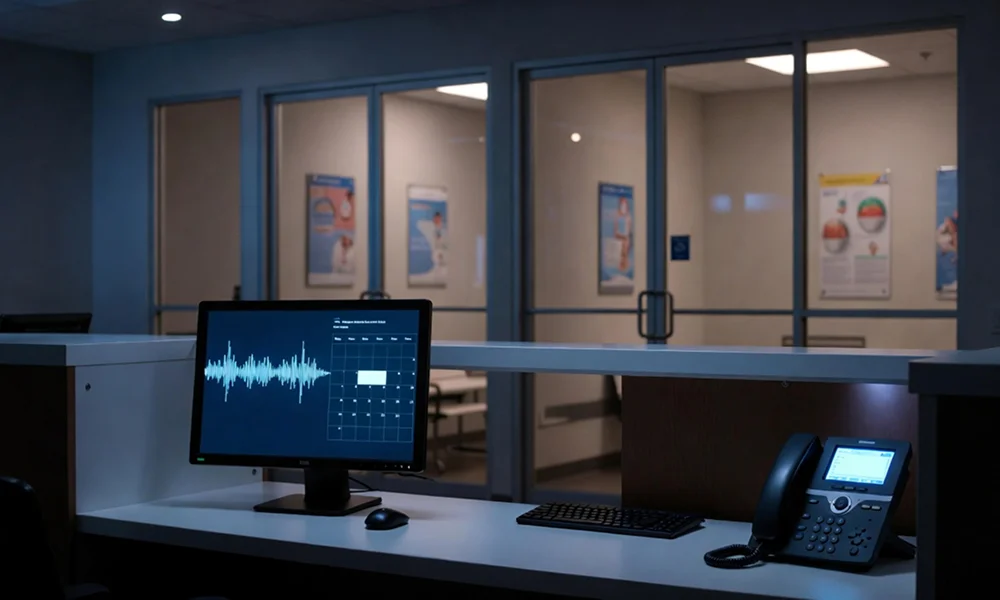
Modern AI reception systems can:
- Answer inbound calls instantly, 24/7
- Interpret natural speech
- Schedule, reschedule, and cancel appointments
- Provide answers to common questions
- Capture caller information
- Send SMS or email confirmations
- Route calls based on context
This already challenges several AI phone receptionist myths that assume AI simply transfers calls or reads scripted lines.
How AI Receptionists Integrate with Your Systems
Integration is one of the biggest differences between modern AI and older phone automation.
AI virtual receptionists can connect to:
- VoIP or cloud phone systems
- Scheduling platforms
- Practice Management Systems (PMS)
- Electronic Health Records (EHR)
- CRM software
- Messaging and ticketing tools
Through secure APIs, the AI can check availability, create appointments, update records, and log call summaries automatically. This ensures continuity and data accuracy.
Where AI Fits Alongside Human Staff
The most important concept to understand is that AI works best in a hybrid staffing model.
- AI handles repetitive, high-volume, and after-hours interactions.
- Humans handle nuanced, emotionally sensitive, or clinically complex conversations.
This balanced structure is key to understanding the truth about AI virtual receptionists.
Common AI Virtual Receptionist Myths

Myth 1 – AI Virtual Receptionists Will Replace Human Staff Completely
This fear is one of the strongest drivers behind resistance, especially in discussions about myths about AI receptionists in healthcare.
The Reality: AI Is a Force Multiplier
AI does not replace empathy, judgment, or clinical decision-making. Healthcare practices still require humans to:
- Interpret symptoms beyond scripts
- Provide emotional reassurance
- Resolve complex financial disputes
- Handle escalations
Instead of eliminating roles, AI typically reduces repetitive administrative tasks. Staff members can focus on in-person patients, insurance coordination, or higher-value support activities.
Best-Fit Use Cases for AI vs. Humans
AI is well-suited for:
- First-line call answering
- Appointment scheduling
- FAQs
- After-hours coverage
- Overflow management
Humans are essential for:
- Sensitive complaints
- Clinical triage
- Escalated billing disputes
- VIP patient communication
When responsibilities are clearly divided, efficiency increases without sacrificing care quality.
Hybrid Staffing Models That Work
Successful practices often deploy AI for:
- Nights and weekends
- Lunch-hour coverage
- Peak-hour overflow
- Multilingual support
Rather than reducing staff, this approach often protects them from burnout.
Myth 2 – AI Receptionists Feel Robotic and Frustrate Callers
Many concerns about AI receptionists come from past experiences with rigid automated systems.
Why Older IVR Systems Created This Perception
Traditional IVR systems relied on layered menus and numeric input. They lacked conversational flexibility and contextual memory.
Patients remember these frustrating experiences and assume modern AI works the same way.
How Modern AI Sounds and Behaves
Modern AI uses:
- Natural language understanding
- Intent detection
- Context tracking
- Branded voice customization
- Barge-in interruption handling
Callers can speak naturally. The system adapts instead of forcing them into narrow menu paths.
What Actually Causes Frustration
Frustration typically stems from:
- Poor workflow design
- No clear path to a human
- Excessive repetition
- Limited training data
These are implementation issues, not inherent AI limitations.
Designing a Patient-Friendly Experience
Best practices include:
- Clear greeting and purpose
- Short, simple prompts
- Immediate human fallback option
- Minimal verification repetition
When done properly, AI can reduce hold times and increase caller satisfaction.
Myth 3 – AI Virtual Receptionists Can’t Handle Real-World Call Complexity
Another major misconception about AI virtual receptionists is that they can’t handle layered conversations.
What AI Can Handle Today
Modern systems can manage:
- Multi-intent conversations
- Identity verification steps
- Insurance updates
- Appointment changes
- Payment-related inquiries
For example, a caller might say, “I need to reschedule and also update my insurance.” The AI can complete both tasks sequentially.
When AI Should Escalate
Clear escalation policies are critical. AI should transfer calls when:
- Symptoms exceed defined protocols
- Emergency language is detected
- Financial disputes escalate
- Caller intent remains unclear
Escalation safeguards maintain quality and safety.
Continuous Learning and Optimization
Unlike static scripts, AI improves over time. Through transcript analysis and feedback loops, workflows are refined and accuracy increases. This continuous improvement directly counters outdated AI phone receptionist myths.
Myth 4 – AI Virtual Receptionists Are Too Hard to Set Up and Manage

Operational complexity is another barrier.
What Implementation Actually Looks Like
Typical onboarding involves:
- Mapping call flows
- Creating FAQ libraries
- Connecting integrations
- Testing scenarios
- Phased go-live
This process is structured and manageable, not chaotic.
No-Code Configuration
Most platforms now provide:
- Drag-and-drop builders
- Healthcare templates
- Routing customization
- Performance dashboards
Changes can be made internally without engineering teams.
Ongoing Management Requirements
Maintenance typically includes:
- Reviewing call transcripts
- Updating scripts
- Monitoring KPIs
- Expanding workflows
In many cases, management time is minimal compared to hiring and training new staff.
Myth 5 – AI Virtual Receptionists Are Only for Large Enterprises
This myth fuels cost myths about AI virtual receptionists.
Why Smaller Practices Benefit Most
Small and mid-sized practices often face:
- Missed calls during peak hours
- Staffing shortages
- Budget limitations
AI enables them to extend coverage without hiring full-time employees.
Understanding Pricing Models
Common pricing structures include:
- Monthly subscriptions
- Usage-based billing
- Tiered feature plans
When comparing AI costs to salary, benefits, training, and turnover, many practices find AI significantly more economical.
Examples by Practice Size
- Solo provider: Captures after-hours bookings
- Small group: Manages overflow during peak times
- Multi-location group: Centralizes call management
Scalability makes AI accessible across practice sizes.
Myth 6 – AI Virtual Receptionists Aren’t Secure or HIPAA-Compliant
Security is one of the most legitimate concerns about AI receptionists in healthcare.
Security Foundations to Expect
- Encryption in transit and at rest
- Role-based access controls
- Audit logging
- Secure cloud hosting
- Defined data retention policies
These standards are essential.
HIPAA and PHI Handling
Healthcare vendors should provide:
- Business Associate Agreements (BAAs)
- PHI-safe workflows
- Minimal necessary data collection
- Controlled access permissions
These measures address myths about AI receptionists in healthcare related to compliance.
Vendor Evaluation Checklist
Ask vendors about:
- Compliance certifications
- Incident response protocols
- Penetration testing
- Backup and recovery plans
Security should be documented and verifiable.
Myth 7 – AI Virtual Receptionists Don’t Deliver Real ROI

This is one of the most persistent AI receptionist misconceptions and facts discussions.
Where ROI Actually Comes From
ROI typically results from:
- Reduced missed calls
- Increased appointment capture
- Lower overtime expenses
- Fewer temporary staffing costs
- Improved scheduling efficiency
Simple ROI Scenario
If a practice misses 20 calls daily and converts just 5 additional appointments at $150 each, that’s $750 per day. Over a month, that can significantly exceed AI costs.
Even conservative improvements often produce measurable financial returns.
KPIs to Measure Value
- Answer rate
- Abandonment rate
- Appointment conversion rate
- Average handle time
- Staff overtime
- Front-desk turnover
Data provides objective insight into performance.
How AI Virtual Receptionists Improve Patient and Staff Experience
Beyond cost and efficiency, AI affects day-to-day experience.
Patient Access and Satisfaction
Patients experience:
- Immediate call answering
- Shorter hold times
- 24/7 scheduling access
- Language flexibility
Convenience improves retention and satisfaction.
Front-Desk and Clinician Experience
Staff benefit from:
- Fewer constant interruptions
- Reduced multitasking pressure
- More focused patient interactions
- Lower burnout risk
A stabilized front desk often leads to improved morale and retention.
A Day-in-the-Life Comparison

Before AI: Phones ring nonstop. Staff juggle check-ins, insurance questions, and inbound calls simultaneously. Some calls go unanswered.
After AI: Routine calls handled automatically. Staff focus on in-person care. Workflows become calmer and more predictable.
Choosing and Implementing the Right AI Virtual Receptionist
If you’re asking, is an AI virtual receptionist right for my practice? the answer depends on your call volume, staffing constraints, and growth goals.
Key Features to Look For
- Healthcare-specific workflows
- Secure EHR/PMS integration
- Flexible routing options
- Escalation controls
- Real-time analytics
Questions to Ask Vendors
- Do you provide a BAA?
- What integrations are supported?
- What uptime guarantees exist?
- What onboarding support is included?
- How is data secured?
Rollout Best Practices
- Start with after-hours coverage
- Expand to overflow management
- Gather staff feedback
- Monitor performance metrics
- Gradually scale workflows
Piloting reduces risk while validating performance.
Conclusion
The most common myths about AI virtual receptionists are rooted in outdated experiences or incomplete understanding. Modern AI systems are not rigid robots replacing humans, they are operational tools that augment teams, improve access, and reduce front-desk strain.
When implemented thoughtfully, AI virtual receptionists can stabilize workloads, increase appointment capture, and enhance patient satisfaction. They are not magic solutions, nor are they job eliminators. They are scalable support systems designed to strengthen operational foundations.
Rather than relying on assumptions or secondhand concerns about AI receptionists, practices should evaluate their own call data. Measure missed calls, abandonment rates, overtime costs, and patient complaints. Then test a limited AI deployment to gather real-world performance data.
The shift from myth to measurable value doesn’t require blind trust, it requires informed evaluation.
FAQs
Are AI virtual receptionists suitable for medical practices?
Yes. They support scheduling, FAQs, and call routing while staying HIPAA-compliant and working alongside staff.
How do AI receptionists handle emergencies?
They detect urgent keywords and immediately transfer the call or direct the caller to emergency services.
Can patients tell they’re speaking to an AI?
Sometimes. Modern AI sounds natural, and most systems disclose they’re automated.
How do they integrate with my phone system and EHR?
Through secure APIs, allowing real-time scheduling and data updates without replacing your systems.
What if the AI doesn’t understand the caller?
It transfers the call to a human.
How quickly can it be implemented?
Basic setups can go live in days; complex integrations may take a few weeks.