


Key Takeaways
-
1Workflow affects care: Inefficient workflows lead to documentation errors, delayed results, and missed handoffs that directly impact patient outcomes.
-
2Map before fixing: Process mapping helps identify real bottlenecks and delays so improvements address the actual workflow problems.
-
3Standardization reduces errors: Clear SOPs and checklists minimize documentation mistakes and maintain consistent care across providers and shifts.
-
4Technology amplifies processes: Automating broken workflows only speeds up problems; processes must be redesigned before applying technology.
-
5Culture drives improvement: Sustainable workflow efficiency comes from involving frontline staff and fostering a culture of continuous improvement.
Healthcare organizations today face immense pressure to deliver high-quality patient care while maintaining cost efficiency.
With increasing patient volumes, staff shortages, and complex administrative demands, inefficient workflows can slow care delivery, frustrate staff, and reduce patient satisfaction. One of the most effective ways to address these challenges is to improve workflow efficiency.
By focusing on streamlining processes, reducing waste, and leveraging technology, healthcare organizations can enhance patient outcomes, optimize staff productivity, and increase operational capacity.
This guide explores 10 practical approaches to improve healthcare workflow efficiency and offers actionable strategies for clinics and hospitals of all sizes.
Table of Contents
What is Healthcare Workflow Efficiency?
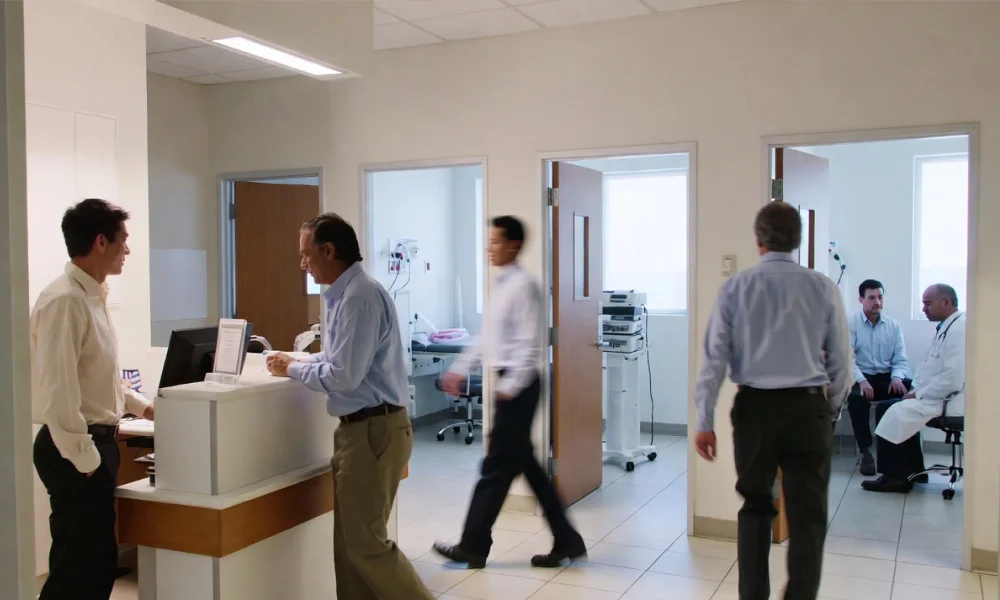
Healthcare workflow efficiency refers to the systematic organization of tasks, processes, and communication in a healthcare setting to ensure smooth operations, minimize delays, and reduce errors.
It is the art of designing workflows so that every step adds value to patient care while avoiding unnecessary steps or repetition.
Examples of workflow efficiency in practice:
- A patient checks in using a digital kiosk that updates their EHR automatically, eliminating manual data entry and saving front-desk time.
- Lab results are automatically routed to the provider’s dashboard, reducing delays and improving decision-making.
Core metrics used to measure workflow efficiency include:
- Wait times: The time patients spend waiting for appointments, tests, or results.
- Throughput: Number of patients seen per day or per clinic hour.
- Error rates: Frequency of documentation errors, missed lab orders, or medication mistakes.
- Staff time utilization: Proportion of productive versus idle or redundant work hours.
By continuously monitoring these metrics, healthcare organizations can identify inefficiencies and design workflows that balance speed, accuracy, and patient satisfaction.
Why Healthcare Workflow Efficiency Matters
Optimizing workflows is more than a productivity goal—it directly impacts patients, staff, and the organization’s financial health.
Impact on Patient Experience
Long wait times, repeated forms, and delayed test results frustrate patients and can harm satisfaction scores. By improving patient flow and workflow efficiency, clinics ensure patients are seen promptly, receive timely results, and experience smoother care.
Impact on Staff Wellbeing
Healthcare staff often face heavy workloads and repetitive administrative tasks. Inefficient workflows increase burnout, reduce morale, and can result in higher staff turnover.
Streamlining clinical workflows allows staff to focus on meaningful patient interactions rather than redundant paperwork.
Impact on Safety and Quality of Care

Errors in documentation, medication, or lab follow-ups are often linked to workflow inefficiencies. By standardizing processes and reducing variation, clinics can lower error rates and enhance patient safety.
Impact on Financial Performance
Inefficient workflows contribute to lost revenue through underutilized staff, extended patient visits, and overtime. By streamlining healthcare workflows, organizations can increase throughput, reduce costs, and improve profitability while maintaining care quality.
Understanding Clinic Workflow Efficiency
Clinic workflows differ significantly from hospital or emergency department workflows. Clinics typically focus on outpatient care, routine visits, and follow-ups, whereas hospitals handle inpatient, urgent, or emergency cases.
Typical clinic workflow stages include:
- Intake: Patient registration, insurance verification, and vitals collection.
- Rooming: Escorting patients to exam rooms and preparing them for the visit.
- Visit: Provider evaluation, examination, and treatment planning.
- Checkout: Scheduling follow-ups, collecting co-pays, and giving patient instructions.
- Follow-up: Reminders, lab review, and patient education.
How Inefficiencies Show Up

- Backed-up schedules and waiting rooms full of patients.
- Staff working overtime to complete documentation.
- Rework due to missing patient information or duplicated tasks.
- Frustration for both patients and staff, reducing satisfaction and morale.
By focusing on these stages, clinics can improve clinic workflow efficiency and create a smoother experience for everyone involved.
Common Workflow Problems in Healthcare
Despite the best intentions, most healthcare organizations encounter recurring workflow challenges.
- Fragmented systems and duplicate data entry – Multiple platforms for EHR, billing, and labs often do not integrate, leading to repeated manual work.
- Poor scheduling and capacity planning – Overbooking or underutilizing resources results in idle staff or frustrated patients.
- Bottlenecks at check-in, lab, or provider handoffs – Delays at one step affect the entire patient journey.
- Communication gaps and unclear roles – Staff confusion about responsibilities creates inefficiencies, errors, and delays.
- Redundant documentation – Multiple forms or notes for the same information slow down workflows.
Addressing these problems is the first step to clinical workflow optimization.
Practical Steps to Improve Healthcare Workflow Efficiency
Here are 10 actionable strategies to enhance efficiency and patient care:
1. Map and Analyze Current Workflows
You cannot fix a workflow you have not documented. Most practices operate on inherited processes, steps that were established years ago, modified informally over time, and never reviewed as a whole. Staff know their individual piece but rarely see how it connects to what comes before or after.
Mapping makes the full picture visible. Bring together the people who perform each stage of the patient journey: front desk, medical assistants, nurses, providers, and billing staff. Work through the workflow chronologically from first patient contact to post-visit follow-up.
For each step, record what happens, who does it, how long it takes, what tool or system is used, and what can go wrong. Two mapping tools are particularly useful in clinical settings.
A swimlane diagram organizes each step by role, front desk in one lane, clinical staff in another, provider in a third, so handoff points become visible. A value stream map adds time data to each step and distinguishes between time that adds value to the patient and time that is purely administrative or waiting. Both can be built in a shared document or on a physical whiteboard in a two-hour team session.
Pay attention to steps where the same information is handled more than once, steps where one role waits on another before they can proceed, and steps with no clear owner. These are your starting points for improvement.
Repeat the mapping exercise any time a new system is introduced, a role changes, or patient volume increases significantly. A map that is accurate today may not reflect reality in six months.
2. Identify and Remove Bottlenecks and Waste

A bottleneck is any step in the workflow where work accumulates faster than it can be processed. In clinical settings, bottlenecks are often visible, a waiting room that fills up every morning, a checkout desk where patients queue at midday, a provider who is never ready when the room is, but their root cause is rarely where they appear.
The queue at checkout is visible but the cause may be in rooming. If medical assistants are double-tasked during the late morning, rooms turn over slowly, providers fall behind, and the backlog arrives at checkout an hour later. Always trace backward from where the bottleneck is visible to where it actually originates.
Lean methodology provides a practical framework for identifying and eliminating waste in healthcare workflows. The categories of waste most relevant to clinical operations are worth knowing by name.
Defects are errors in documentation, incorrect orders, or incomplete forms that require rework. Overproduction means collecting data or completing steps that no one uses downstream. Waiting covers patients or staff idle while waiting on information, a room, or a decision.
Non-utilized talent means staff performing tasks below their skill level, such as a nurse re-entering data a patient already submitted digitally. Extra processing covers steps that add no value to patient care, such as printing forms that are immediately scanned back in.
For each bottleneck identified during mapping, identify the root cause and design one specific change that addresses it. Test the change with a defined group of patients or on a single shift before applying it practice-wide.
3. Standardize Processes With SOPs and Checklists
Variation is the enemy of efficiency. When staff members perform the same step in different ways, outcomes are unpredictable, errors are difficult to trace, and training new staff takes far longer than it should.
Standardization means the best-known way of performing each step is written down, agreed upon, and followed consistently until a better way is found. A standard operating procedure for a workflow step should be specific enough that a new staff member could follow it correctly on their first day without additional guidance.
It should include the trigger that starts the step, the exact actions to take in sequence, the tools or systems used, the expected output, and the failure modes to watch for. A two-paragraph description of a process is not an SOP. A numbered checklist with decision points is.
Prioritize SOPs for the steps that are performed most frequently, the steps that most often go wrong, and the steps where variation has the highest consequences. In most practices those are patient check-in, room preparation, medication reconciliation, and end-of-visit checkout instructions.
Checklists serve a different function from SOPs. An SOP describes how to perform a process. A checklist confirms that the process was completed.
Apply checklists to high-stakes clinical steps, pre-procedure preparation, discharge instructions, lab order review, where the consequences of an omission are significant. In aviation and surgery, checklists have demonstrated dramatic reductions in error rates precisely because they interrupt the assumption that a familiar task was done correctly.
Assign a named owner to each SOP and schedule a review at least annually. Create a lightweight process for staff to flag when a written procedure no longer matches how the work is actually done. A document no one follows is worse than no document at all.
4. Automate Repetitive Administrative Tasks
Administrative tasks that are identical every time are automation candidates. The test is simple: if a step produces the same output regardless of who performs it, a person should not be performing it at all.
In most practices, four categories of administrative work meet this threshold. Appointment reminders sent at fixed intervals before the visit. Intake form delivery triggered at booking. Insurance eligibility checks run on a schedule before the appointment date. Post-visit follow-up messages sent at a defined point after the encounter.
Each of these happens the same way for every patient of the same type. Each consumes staff time that could be redirected to work that genuinely requires judgment.
Start by selecting the one administrative task your front desk performs most frequently. Document exactly what happens today, what triggers it, what information is needed, and what the output looks like. Then ask what system in your current stack could perform that trigger and output automatically.
Most EHR platforms include native automation for reminders, eligibility checks, and form delivery. The gap in most practices is not capability. It is that these features have never been configured.
Configure one automation completely before moving to the next. Verify that the output is accurate and that the patient experience is clear. Stacking automations before any individual one is stable creates compounding errors that are difficult to diagnose.
Automation handles the predictable majority so staff can focus on unpredictable cases that genuinely need them. It does not replace clinical judgment, exception handling, or any interaction where a patient’s specific situation changes what should happen next.
5. Optimize EHR/EMR Workflows and Templates
The EHR is the operational center of a clinical practice, and poorly configured EHR workflows are one of the most common and least-addressed sources of inefficiency. Providers spend an average of two hours on documentation for every hour of direct patient care. A significant portion of that time is not clinically necessary.
It is the product of generic templates, redundant fields, and alert fatigue from notifications that are not relevant to the patient in front of them.
Review the documentation templates used most frequently, typically the templates for your three to five highest-volume visit types. For each template, remove every field that is never or rarely completed. Add structured fields for information that is currently being typed in free text repeatedly.
Where the same phrase appears in dozens of notes, build it as a dot phrase or SmartText so it inserts with two keystrokes rather than thirty.
Review your most frequent diagnoses and build or update order sets for each. Include the medications, labs, imaging, and referrals that providers order for that condition in the majority of cases. Providers should be able to place a complete order set in under a minute for routine presentations.
EHR alert fatigue is a documented patient safety issue. When providers receive dozens of low-relevance alerts per shift, they begin dismissing all of them reflexively, including the ones that matter.
Conduct a quarterly alert audit. For each alert category, check the override rate. Any alert with an override rate above 90% is producing noise, not safety. Work with your EHR administrator to suppress or downgrade low-value alerts and ensure the alerts that remain are actionable and specific.
6. Improve Scheduling and Capacity Management
Scheduling inefficiency is often the upstream cause of bottlenecks that appear elsewhere. An overbooked morning creates a backed-up waiting room. An underbooked afternoon creates idle staff. Neither is a staffing problem. Both are a scheduling design problem.
Most practices use a single default appointment length, typically 15 or 20 minutes, for all visit types. In reality, a new patient comprehensive visit, a chronic disease management follow-up, a medication check, and a procedure consult have very different time requirements.
When all visit types are scheduled in the same slot length, providers either rush through complex visits or finish early in simple ones, creating unpredictable flow throughout the day.
Audit your last 90 days of appointments. Calculate the actual average duration for each visit type. Rebuild your appointment templates using those actual durations rather than a uniform default. This single change typically improves on-time starts significantly within the first two weeks.
Call volume, walk-in rates, and no-show patterns follow predictable patterns by day of week, time of day, and season. Pull three months of scheduling data and identify your consistent peak periods. Staff and schedule to those peaks rather than to average demand.
Leave a small number of same-day appointment slots unfilled at the start of each day to absorb urgent requests without disrupting the schedule. Practices that schedule to 100% of theoretical capacity have no buffer for the inevitable variation in daily demand and routinely run late as a result. A 10 to 15 percent buffer built into the template costs less in revenue than the provider overtime and patient dissatisfaction produced by chronic schedule overruns.
7. Centralize Communication and Information
In most practices, information moves through multiple parallel channels simultaneously, the EHR, a phone system, a messaging app, paper notes left at workstations, and verbal handoffs at the nursing station. Each channel operates independently. Critical information sent through one channel is invisible to staff working in another.
When the front desk leaves a note about an insurance issue in the EHR and clinical staff are communicating through a separate messaging platform, the note may not be seen before the patient reaches the exam room. Fragmented communication does not just create inefficiency. It creates the conditions for clinical errors.
Choose one primary communication channel for intra-practice clinical communication and establish it as the standard for all patient-related updates that need to travel between roles. This does not require new technology in most cases. It requires a decision about which existing channel is authoritative and a protocol that all staff follow.
The front desk posts the insurance flag in the EHR, not on a sticky note. The nurse posts the pre-visit clinical summary in the chart, not in a text message. The provider sends post-visit instructions through the system that connects to the patient record, not through a personal device.
A ten-minute start-of-day huddle between front desk, nursing, and the provider is one of the highest-return communication investments a practice can make. The agenda covers which patients today have flags the full team needs to know about, what scheduling adjustments have been made since yesterday, and whether any resource issues need to be addressed before the first patient arrives.
This replaces ad hoc information sharing throughout the day with a single structured moment where everyone starts with the same information.
8. Use Data and Analytics to Monitor Performance
Workflow improvement without measurement is guesswork. A change that feels like an improvement based on staff perception may produce no measurable effect on patient outcomes or operational performance. Data distinguishes genuine improvement from change for its own sake.
Patient wait time should be measured in two segments: from check-in to room, and from room to provider. These two segments have different causes and different fixes. Treating them as a single number obscures where the problem actually is.
Visit duration by appointment type shows how long actual visits take compared to the slot length allocated. Persistent overruns by visit type identify where template redesign is needed. Room turnover time, the gap between one patient leaving and the next entering the same room, indicates rooming workflow problems rather than provider slowness.
No-show and late cancellation rates broken down by appointment type, time of day, and day of week reveal patterns that point to where reminder timing or format needs adjustment.
Call answer rate and abandonment rate measure what percentage of inbound calls are answered and what percentage disconnect before reaching a staff member. Every abandoned call is a missed patient interaction. First-call resolution rate measures how often a patient’s request is resolved in a single call. Low rates indicate information gaps or decision authority problems at the front desk.
Set a baseline for each metric before making any workflow change. After implementing a change, track the same metric for four to six weeks and compare. Present the data in a monthly team meeting so staff can see that changes they helped design produced measurable results.
9. Redesign Roles and Task Delegation
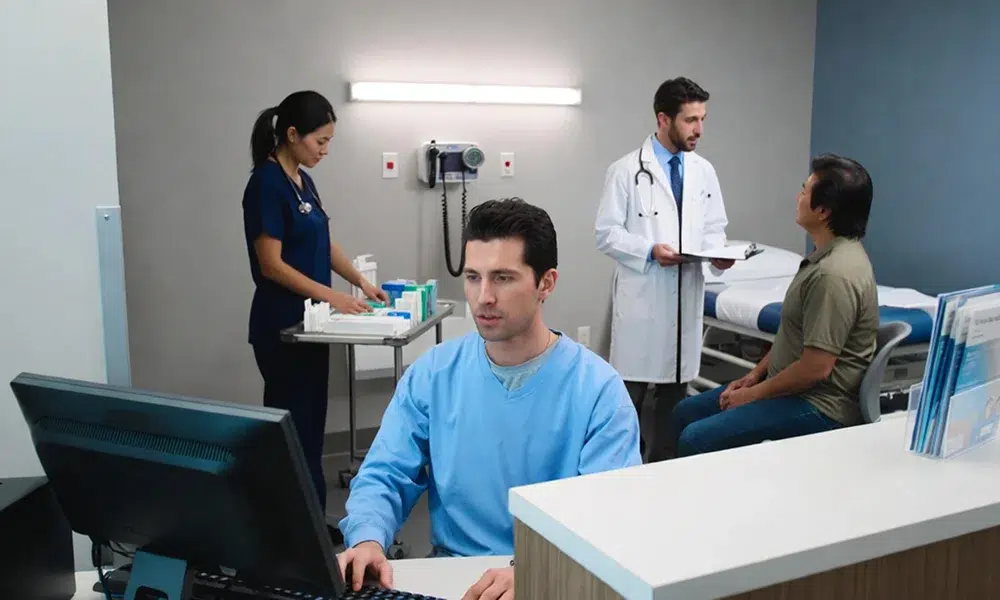
Healthcare roles are often defined by historical convention rather than by a deliberate analysis of what each role should do to maximize efficiency and staff contribution.
Medical assistants perform tasks that could be delegated to administrative staff. Nurses spend time on documentation that structured tools could handle. Providers answer questions a well-trained medical assistant could resolve.
The result is a practice where everyone is busy but the work is not distributed in a way that uses anyone’s skills well.
Every staff member should be performing work at or near the ceiling of their training and certification, not below it. A registered nurse reconciling medication lists and educating patients on discharge instructions is working at their license. A registered nurse re-entering intake data from a paper form is not.
Map your current role responsibilities against each staff member’s training. Identify tasks being performed below the level staff are qualified for. Those tasks are either automation candidates or reassignment candidates.
Single points of failure, roles where only one person knows how to perform a critical function, create fragility. When that person is absent, the workflow stops or degrades.
Cross-training two staff members for each critical function eliminates this risk and allows flexible staffing during peak periods.
As a practical example: in a practice where medical assistants spend significant time on administrative tasks that do not require clinical training, moving those tasks to front desk staff and redirecting MA time toward pre-visit patient education and post-visit instruction reinforcement produces a clear benefit.
The MA does more meaningful work, the provider spends less time on tasks the MA can handle, and the patient receives better preparation.
When redesigning roles, involve the staff whose roles are changing. Role redesign imposed without input produces resistance. Role redesign co-developed with staff produces clearer understanding and more consistent execution.
10. Build a Continuous Improvement Culture
Every improvement described in the preceding nine strategies will degrade over time without a structure that sustains and renews it. Staff change. Patient volume changes. Systems are updated. A workflow well-designed for 60 patients a day may break down at 90. Continuous improvement is the organizational habit that determines whether gains last.
Schedule a monthly workflow review meeting, 45 minutes, with at least one representative from each functional area. The agenda covers three questions: what is not working as intended right now, what does last month’s data show that is worth investigating, and what one change should be tested in the coming month. This meeting should produce one defined action per cycle, not a list of aspirations.
Create a visible, low-friction way for staff to raise workflow problems. A standing agenda item in the team huddle works. What does not work is an implicit expectation that staff will raise issues when the culture does not actively solicit them.
Front-line staff observe workflow failures that managers never see. A practice that collects and acts on that input improves faster than one that waits for managers to identify problems from the outside.
When a staff member identifies a problem and a change is made as a result, that staff member should be informed. When a change is tested and the data shows it did not work, the team should hear what was learned. Improvement culture is built on the experience that raising problems leads to action, and that action is assessed honestly.
The core principle of continuous improvement is incremental change tested frequently. A practice does not need a major restructuring project every two years. It needs a systematic habit of identifying one friction point per month, making one targeted change, measuring the result, and standardizing what works. Over two years, that habit produces 24 tested, evidence-based workflow improvements that compound into a materially different operational reality.
Analyze and Optimize Clinical Processes
Process mapping is essential for identifying inefficiencies. Tools such as swimlane diagrams and value stream mapping provide a clear visual of patient and staff workflows.
Identify bottlenecks and delays: Look for repeated tasks, redundant documentation, or unnecessary handoffs.
Standardize with SOPs and best-practice pathways:
- Use checklists for consistent care delivery.
- Reduce variation across providers and staff.
Apply Lean principles: Focus on value-added tasks, eliminate waste, and simplify care pathways. This is critical for both clinical workflow optimization and improved patient outcomes.
Leverage Technology and Automation

Technology can dramatically enhance workflow efficiency:
- Optimized EHR/EMR workflows: Customize templates, order sets, and documentation paths.
- Digital intake and self-scheduling: Online forms reduce front desk workload.
- Automated reminders and follow-ups: Text or email reminders reduce no-shows.
- System integration: Avoid duplicate data entry by connecting EHR, billing, lab, and imaging systems.
- Real-Time Location Systems (RTLS): Track staff, patients, and equipment to improve throughput.
By automating repetitive tasks and integrating systems, organizations can streamline healthcare workflows and reduce errors.
Enhance Team Collaboration and Communication
Strong team communication is critical for workflow efficiency:
- Daily huddles or stand-ups: Align staff on patient load and priorities.
- Clear roles and responsibilities: Prevent duplication and confusion.
- Standardized handoffs: Use protocols to ensure smooth transitions between staff.
- Centralized communication platforms: Reduce fragmented messaging and missed updates.
Enhanced collaboration reduces delays, errors, and redundancy, improving overall clinic workflow efficiency.
Use Data and KPIs to Drive Decisions
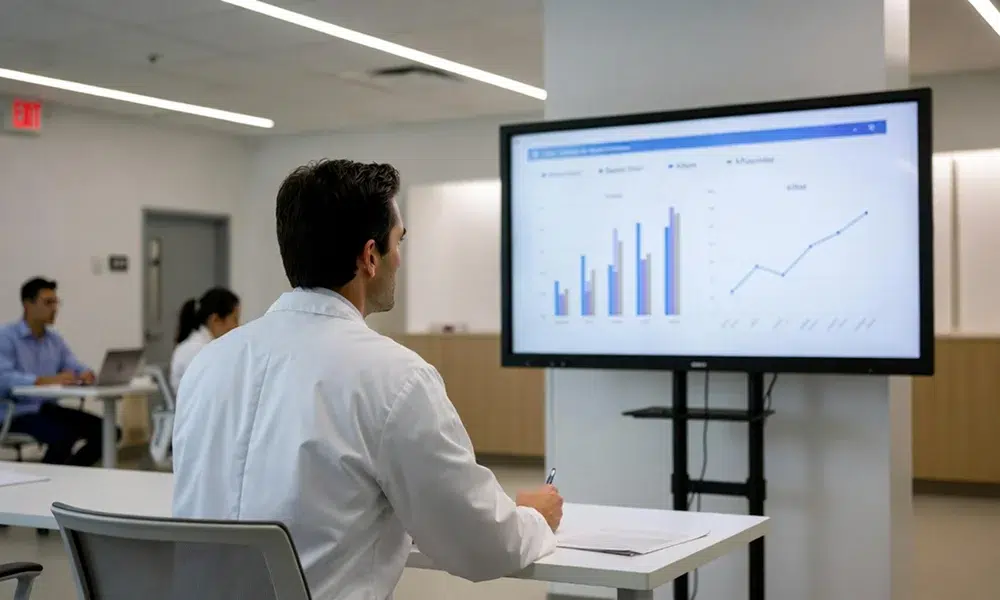
Data-driven decision-making ensures continuous improvement:
Key KPIs:
- Patient wait times
- Average visit duration
- Room utilization
- No-show and cancellation rates
- Staff overtime
- Error rates
- Patient satisfaction scores
Dashboards and reports: Provide visual insight into bottlenecks and trends.
Small tests of change: Pilot workflow adjustments, measure impact, and scale successful improvements. Using data ensures sustainable patient flow and workflow optimization.
Continuous Improvement and Change Management
Efficiency is not a one-time achievement. Organizations must foster a culture of continuous improvement:
- Staff engagement: Involve clinicians and administrative staff in identifying problems and solutions.
- Training and support: Ensure everyone adapts to new workflows efficiently.
- Feedback loops: Collect input, adjust processes, and standardize improvements.
- Kaizen mindset: Promote incremental improvements that accumulate over time.
This ensures lasting gains in clinical workflow optimization and overall operational performance.
Conclusion
Improving workflow efficiency in healthcare is essential for better patient care, staff satisfaction, and financial performance.
By mapping workflows, standardizing processes, leveraging technology, enhancing communication, using data, and fostering a culture of continuous improvement, clinics and hospitals can achieve measurable results.
Whether your goal is to improve clinical workflow efficiency, streamline clinical workflows, or optimize patient flow, these 10 approaches provide a practical roadmap for lasting improvement.
Start implementing these strategies today to create a healthcare environment where patients, staff, and the organization all thrive.
FAQs
What is healthcare workflow efficiency?
Healthcare workflow efficiency is how smoothly tasks, processes, and communication move through a healthcare setting to reduce delays, errors, and wasted effort.
How can clinics improve workflow efficiency quickly?
Clinics can improve workflow efficiency by mapping processes, removing bottlenecks, standardizing tasks, and automating scheduling, intake, and follow-ups.
What causes poor workflow efficiency in healthcare?
Common causes include fragmented systems, duplicate data entry, unclear roles, poor scheduling, and communication gaps between staff.
How does workflow efficiency affect patient experience?
Better workflow efficiency reduces wait times, shortens visits, and improves communication, leading to higher patient satisfaction.
What KPIs measure healthcare workflow efficiency?
Key KPIs include patient wait times, visit duration, room utilization, no-show rates, staff overtime, error rates, and patient satisfaction.