


Key Takeaways: Chiropractic Reviews in 2026
-
The “3-Pack” is Everything
Google Maps’ top three results capture 93% of local search traffic. If you aren’t in that block, your practice is effectively invisible to patients in pain. -
Recency Beats Total Volume:
73% of patients only trust reviews from the last 30 days. One new review every week is more powerful for your ranking than 100 old ones from last year. -
The Emotional Peak Ask:
The best time to get a review is in person, immediately after an adjustment when the patient feels relief. Use a QR code and SMS follow-up to remove all friction. -
Reviews are AI Training Data:
In 2026, Google’s AI reads your reviews to recommend you for specific conditions like “sciatica” or “lower back pain.” Detailed patient stories now directly fuel your SEO. -
The 48-Hour Response Rule:
97% of patients read your responses. Replying within 48 hours (while maintaining HIPAA compliance) signals to both Google and patients that your clinic is active and caring.
It’s 10pm on a Tuesday. Someone in your city just threw their back out reaching for something on a high shelf and starts searching for Chiropractor Google Reviews to find immediate relief. The pain is bad enough that they grab their phone and type “chiropractor near me.”
Two results appear side by side. One clinic has 6 reviews, the last one posted in 2021. The other has 47 recent reviews with personal responses signed by the doctor. The patient books the second clinic, without visiting their website, without calling, without a second thought.
That booking didn’t happen because of a great website or a clever ad. It happened because of a Chiropractor Google Reviews system. And if your practice doesn’t have one, you’re losing patients to that second clinic every single week.
By the end of this post, you’ll have a clear, repeatable system for turning your Google Business Profile into your single most powerful patient acquisition channel, without spending a dollar on ads.
Table of Contents
Google Reviews Are Not Just About Reputation; They Are a Ranking Engine
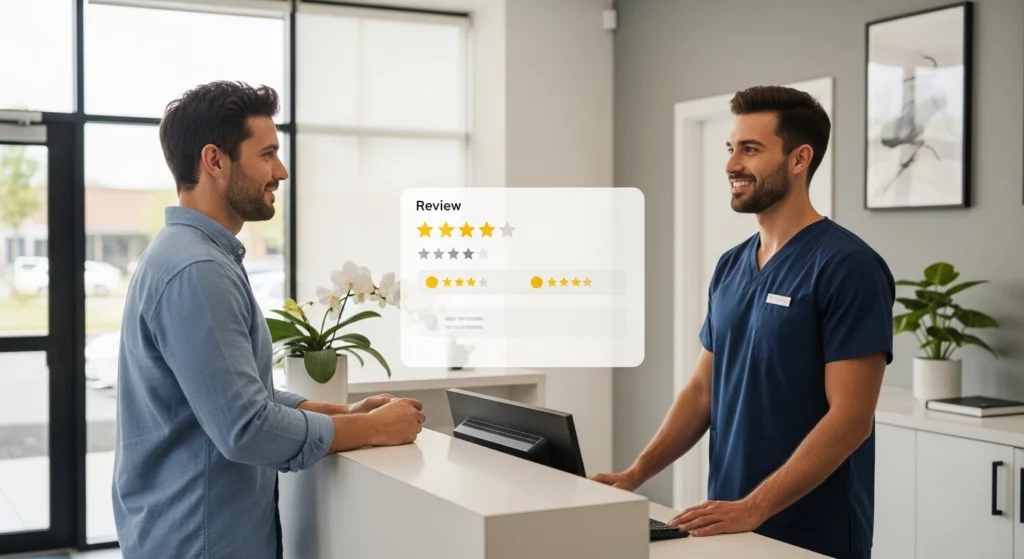
Here’s what most chiropractors get wrong: they think more reviews mean more trust, and more trust means more patients. That’s partially true. But it skips the most important step in the middle, visibility.
Before a potential patient can trust you, they have to find you. And whether you show up in that critical moment of search comes down to Google’s local ranking algorithm. A system that weighs your review profile heavily in deciding whether to show your practice in the Google Maps 3-pack.
The 3-pack is the block of three local businesses that appears at the very top of a local search result, above all organic listings. Businesses in that 3-pack receive 93% of all clicks from local searches. Positions four and below share the remaining 7%. If you’re not in those top three results, you are essentially invisible to most people searching for a chiropractor near them.
Reviews account for roughly 10% of local SEO ranking factors, one of the highest-weighted signals Google uses for map placement. That means your star rating, review count, response rate, and review recency are directly influencing whether you appear in the 3-pack at all.
Recency matters as much as volume. Clinics posting at least one new review per week rank approximately 25% higher than those with a static review profile. A practice with 200 old reviews and nothing recent will consistently lose ground to a competitor with 50 reviews and a steady weekly stream of new ones.
And volume benchmarks are real. In most US markets, a practice needs at least 40 reviews just to be competitive. In major metros like Los Angeles, Chicago, and Houston, that threshold climbs to 50 or more.
Most solo chiropractors know they need more reviews. What they don’t know is that it’s not about asking more, it’s about having a system.
The Numbers Every Chiropractor Needs to See
Before we get into the system, look at these numbers. They explain exactly why this matters so much right now.
The Data: Why Reviews Matter in 2026
And here’s one more figure that pulls it all together: the average US medical practice loses approximately $32,000 per year from no-shows alone, patients who never showed up because a competitor with a stronger review profile captured them first.
So the question is not whether Google reviews matter for your chiropractic practice. The question is whether you have a system to generate them consistently or whether you are leaving it to chance.
Why Solo Chiropractors Specifically Are Losing This Game
This section might sting a little. But understanding why you’re behind is the fastest way to close the gap.
Most solo practices have no review generation system at all. They rely entirely on patients volunteering reviews organically. That approach yields one or two reviews per month at best, not nearly enough to build the velocity Google’s algorithm rewards.
Meanwhile, franchise chains like The Joint Corp, which operates 950+ US locations, have review generation baked directly into their patient checkout workflow as standard operating procedure. Every location in every city runs the same process at the end of every appointment. That’s why franchise clinics dominate the local pack in most cities, not because they provide better care, but because they have a process and solo practitioners don’t.
Here’s the thing, though: you can’t out-spend a franchise on Google Ads. But you absolutely can out-review them. A solo clinic with 80 well-managed, recent reviews will outrank a franchise location with 40 stale ones. The playing field is more level than it looks if you treat reviews like the strategic tool they are.
Timing is also widely misunderstood. Research consistently shows the optimal moment to ask for a review is in person, immediately after the patient feels relief from an adjustment. Not via email three days later. Not in an automated text a week after the appointment. The emotional peak is right there on the table or at checkout when the pain that drove them to your door has just eased. That’s the moment when asking for a review feels natural, and the patient is most motivated to help you.
There’s also a 2026-specific dimension to this that most practitioners haven’t caught up with yet. Google’s AI doesn’t just count stars anymore; it reads and interprets the language inside reviews. It looks for consistency of positive sentiment, diversity of conditions mentioned, recency, response rate, and the quality and personalisation of your replies. Every review your patients leave, and every response you write, is now feeding the algorithm’s understanding of what your practice does and who it serves best.
If you’re not in those reviews, and the only thing Google can find about you is a thin website and a sparse profile, you’re training the algorithm to ignore you.
None of this is your fault. No one taught you this when you were in chiropractic school. But now you know, and knowing is enough to change it.
The 5-Step Google Review System for Solo Chiropractors
This is the part to bookmark. Not a list of tips, a connected workflow you run consistently.
Step 1 — Ask at exactly the right moment
The request has to happen in person, right after the adjustment while the patient is still feeling the difference. The emotional window is short. The moment the patient walks out your door and gets back into daily life, the urgency fades and so does the motivation to leave a review.
Use this script word for word: “We really appreciate your support. Would you mind leaving us a quick Google review? It takes about 60 seconds, and it helps other people in pain find us.” Then hand them a small card with a QR code linking directly to your Google review form, not your homepage, not a search result. The form itself.
Step 2 — Remove all friction with a direct link
Most patients who intend to leave a review never do because they can’t find where to go. Fix this with a direct Google review link sent via SMS within five minutes of checkout, while they’re still in the parking lot or driving home. Tools like Birdeye and Podium automate this entire process with a single SMS trigger at checkout. One tap and the patient is on the review form. No searching, no friction, no forgotten intentions.
Step 3 — Hit the volume benchmark, then maintain velocity
Your first goal is 40–50 reviews to be competitive in most markets. But once you hit that number, the work isn’t done; it’s just shifting. Volume without ongoing velocity stalls your ranking. After reaching your baseline, the system needs to generate at least one new review per week to preserve and grow your position in local search. That means steps 1 and 2 run continuously, not as a one-off push.
Step 4 — Respond to every single review within 48 hours
Remember: 97% of patients read responses. A reply to a glowing review is free advertising. A reply to a critical one is reputation management in public view. Every future patient who lands on your profile will read both.
For positive reviews, use this template:
“Thank you so much [first name], this genuinely made our day. We look forward to continuing to support your health journey. See you at your next visit!”
For negative reviews, use this template:
“We are sorry to hear about your experience. Patient care is our top priority, and we would love the opportunity to make this right. Please contact us directly at [phone] so we can speak with you personally.”
Critical HIPAA note: never confirm or deny that the reviewer is a patient in your public response. Never reference any clinical detail. Keep your response empathetic, brief, and focused on resolving the issue offline. The goal is to demonstrate to future patients how you handle difficult situations, not to win an argument.
Step 5 — Audit and clean your profile quarterly
A review profile is not set-and-forget. Every three months: flag and report any fake or competitor-planted reviews to Google, verify that your NAP data is still accurate across every directory, refresh your photos with new images, and check your Q&A section to ensure no outdated information is sitting there unanswered. Fresh, accurate profiles signal active management, and Google rewards that with better placement.
What Your Google Business Profile Needs to Support Your Reviews
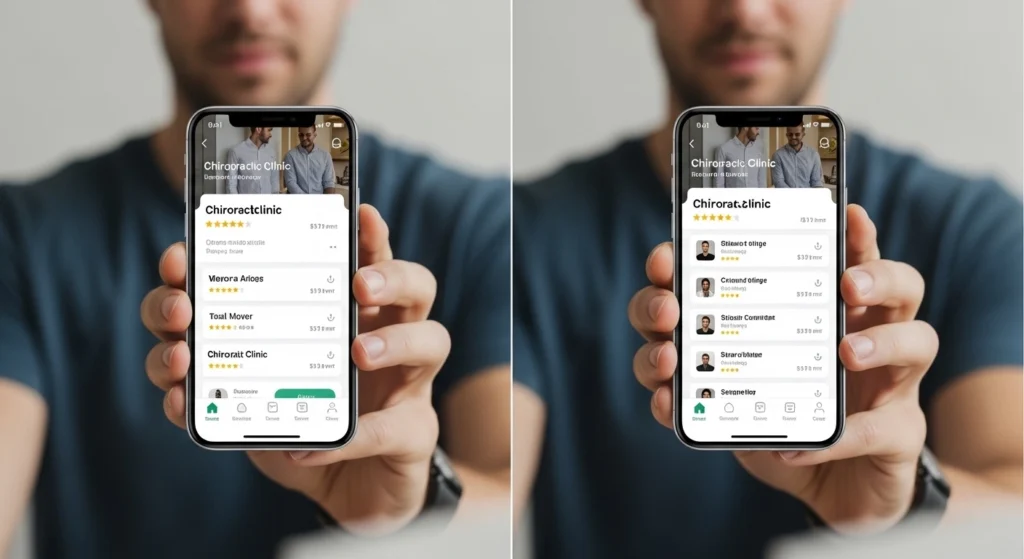
Your reviews perform best when the profile around them is fully built out. Strong reviews sitting inside a thin, incomplete profile is like a great product in terrible packaging; it underperforms relative to what it should deliver.
Here’s the optimisation checklist every solo chiropractor should complete before running their review system:
Your primary category must be set to “Chiropractor”, not “Health,” not “Medical clinic.” Secondary categories like “Sports Chiropractor” or “Pediatric Chiropractor” should be added where relevant to catch more search intent.
Your NAP: Name, Address, and Phone must be identical across every online mention of your practice. Any inconsistency across directories creates trust signals that work against your local ranking. This is called NAP consistency, and it matters more than most practitioners realise.
Upload at least 10 photos: exterior, interior, treatment rooms, and staff headshots. Update them every six months. Profiles with photos receive 42% more requests for directions and 35% more click-throughs than profiles without them. Verified, complete profiles are 80% more likely to appear in local search results.
Write your business description in full, with your primary keywords woven in naturally, not stuffed awkwardly. Publish a Google Post at least once a week. Pre-populate your Q&A section with common patient questions and clear answers. Enable messaging so patients can contact you directly from the profile without having to find your number first.
Think of your Google Business Profile as the front door of your practice. Reviews drive people to that door, but the profile determines whether they walk in or keep scrolling.
The 2026 Twist: Your Reviews Are Now Feeding AI Search

Here’s something most chiropractors haven’t heard yet, and it changes the entire strategic importance of what we’ve been discussing.
Google’s AI Overviews, which have become a dominant feature of search results in 2025 and 2026, now surface direct answers to local queries like “best chiropractor for lower back pain in Austin” without the user needing to click any website at all. The AI generates a recommendation, cites local practices, and the patient acts on it, without ever scrolling past that summary.
The AI that generates those answers pulls heavily from review content, not just website copy. Practices with rich, detailed, recent reviews that mention specific conditions, such as sciatica, disc herniation, sports injuries, and prenatal care, are far more likely to be cited in those AI-generated responses. If your reviews are sparse and generic (“Great doctor, highly recommend!”), The AI has very little to work with when matching your practice to a patient’s specific condition.
When someone asks an AI assistant, “who’s the best chiropractor near me for lower back pain?” the answer that comes back is shaped by what the AI has learned about local practices from their review profiles. If your practice doesn’t have the signal depth to appear in that answer, you are invisible to an entire segment of high-intent searchers who never scroll at all.
And here’s the part that should change how you write your review responses from today forward: every response you write is AI training data about your practice. A thoughtful, specific response to a patient who mentioned their sciatica treatment in their review is more valuable than a blog post on the same subject, because Google trusts the review format more than self-published content. Write your responses as if they’ll be read by both a patient and an algorithm. Because in 2026, they will be.
Frequently Asked Questions
How many Google reviews does a chiropractor need to rank in the local 3-pack?
In most mid-size US markets, you need at least 40 reviews to be competitive in the Google Maps 3-pack. In larger metros like Los Angeles, Chicago, or Houston, that threshold rises to 50 or more. But raw volume alone isn’t enough; review velocity matters just as much.
Can I ask my patients to leave Google reviews, or is that against the rules?
Yes, you can ask patients to leave honest reviews; Google explicitly permits this. What you cannot do is incentivise reviews (offering discounts, gifts, or any reward in exchange for a review), write fake reviews, or ask staff to post reviews as if they were patients. Asking sincerely, in person, after a successful appointment is completely above board and is exactly how the highest-ranked practices build their profiles.
Is it safe to respond to Google reviews as a chiropractor without violating HIPAA?
Yes, as long as you follow one non-negotiable rule: never confirm or deny that the reviewer is a patient in your public response. Do not reference any clinical details, appointment dates, or treatment information. Your response should be empathetic, brief, and focused on resolving the issue offline. Invite them to contact you directly by phone. This approach is both HIPAA-safe and effective; it shows future patients exactly how your practice handles difficult situations.
What is the ideal star rating for a chiropractic practice on Google?
The trust sweet spot is between 4.2 and 4.5 stars. Counterintuitively, a perfect 5.0 rating can actually raise red flags for patients; it suggests reviews may have been filtered or curated. A rating in the 4.2–4.5 range, combined with a healthy volume of recent reviews and visible responses from the practice, consistently outperforms a suspiciously perfect score in terms of patient conversion.
How quickly should I respond to a Google review?
Within 48 hours, ideally sooner. Speed signals to both patients and Google that your practice is actively managed. A response that arrives a week later feels like an afterthought. A response that arrives the same day or next morning feels like a practice that genuinely cares. For negative reviews especially, responding quickly prevents the review from sitting unanswered where every new visitor to your profile sees only one side of the story.
Do Google reviews affect how AI tools like ChatGPT or Google AI Overviews recommend local chiropractors?
Yes and this is one of the most important shifts happening in local search right now. Google’s AI Overviews pull heavily from review content when generating answers to local queries like “best chiropractor for sciatica near me.” Practices with detailed, recent reviews that mention specific conditions are far more likely to appear in those AI-generated answers than practices with generic or sparse reviews. Your review profile is no longer just a trust signal for human readers; it is now a data source that AI systems use to understand and recommend your practice.
What’s the biggest mistake solo chiropractors make with their Google reviews?
Treating the whole thing as a one-off project rather than an ongoing system. Most solo practitioners either do a push to collect reviews once and then stop, or they wait passively for organic reviews to trickle in. Both approaches stall review velocity, which directly hurts local ranking. The practices that consistently dominate local search aren’t doing anything more complicated than running a simple, repeatable ask-and-follow-up system after every single appointment; every day, every week, without stopping.
Conclusion
Here’s the full system in one paragraph: ask at the emotional peak, hand over the QR card, send a direct SMS link within minutes, respond to every single review within 48 hours, maintain at least one new review per week, audit your profile quarterly, and make sure the profile surrounding all of that work is completely optimised to convert the traffic your reviews generate.
In 2026, Google reviews are not a passive reputation asset. They are an active, algorithmic patient acquisition channel. The solo chiropractors who build a consistent system around them will outrank, out-convert, and outgrow the practices treating reviews as an afterthought, including the franchise chains that have more locations, bigger budgets, and more name recognition.
You don’t need a bigger marketing budget to win local search. You need a better system.
Getting found on Google is half the battle. The other half is what happens when a potential patient finds you and reaches out. If your clinic isn’t set up to respond instantly to every patient enquiry, every review you worked hard to earn is doing only half the job it could.
Ready to Recover Your Clinic’s Lost Revenue Now!
Book a call with us to learn how we can help you recover your lost revenue and improve your cash flow.