
Key Takeaways
-
1Lead Conversion Gap: Slow follow-up leads to missed opportunities. Automating the lead pipeline is essential for faster conversions.
-
2Automation is a Necessity: In 2026, automating lead pipelines is a baseline expectation. AI tools and CRM integrations help convert leads at scale.
-
3Speed to Response Matters: Responding within five minutes increases conversion rates significantly. AI chatbots engage leads instantly.
-
4The Real Costs of Inaction: Failing to automate leads results in wasted ad spend, staff burnout, no-show losses, and revenue cycle drag.
-
5Track Metrics and Optimize: Regularly tracking key metrics like lead-to-conversion rates and cost per booked appointment helps optimize your lead pipeline.
Every day, clinics across the country run Instagram and Facebook ads, collect leads, and then lose them. Not because the ads failed, but because no one followed up fast enough.
A prospective patient sees your ad for back pain relief, fills out a form, and waits. Your front desk is juggling six other tasks. By the time someone picks up the phone, it has been 24 hours. The lead has already been booked with someone else.
This is the gap that costs healthcare practices tens of thousands of dollars in wasted ad spend every year. The problem is not lead generation, it is lead conversion. Getting someone to raise their hand is only the first step. What happens in the next five minutes determines whether that person becomes a patient or a missed opportunity.
In 2026, automating this pipeline will not be a competitive advantage; it will be a baseline expectation. AI tools, chatbots, CRM integrations, and automated follow-up sequences have made it possible for even small practices to convert leads at scale, without adding headcount. This guide walks you through exactly how to build that system, step by step.
Table of Contents
Why Social Media Lead Generation Is a Growing Opportunity for Healthcare Practices
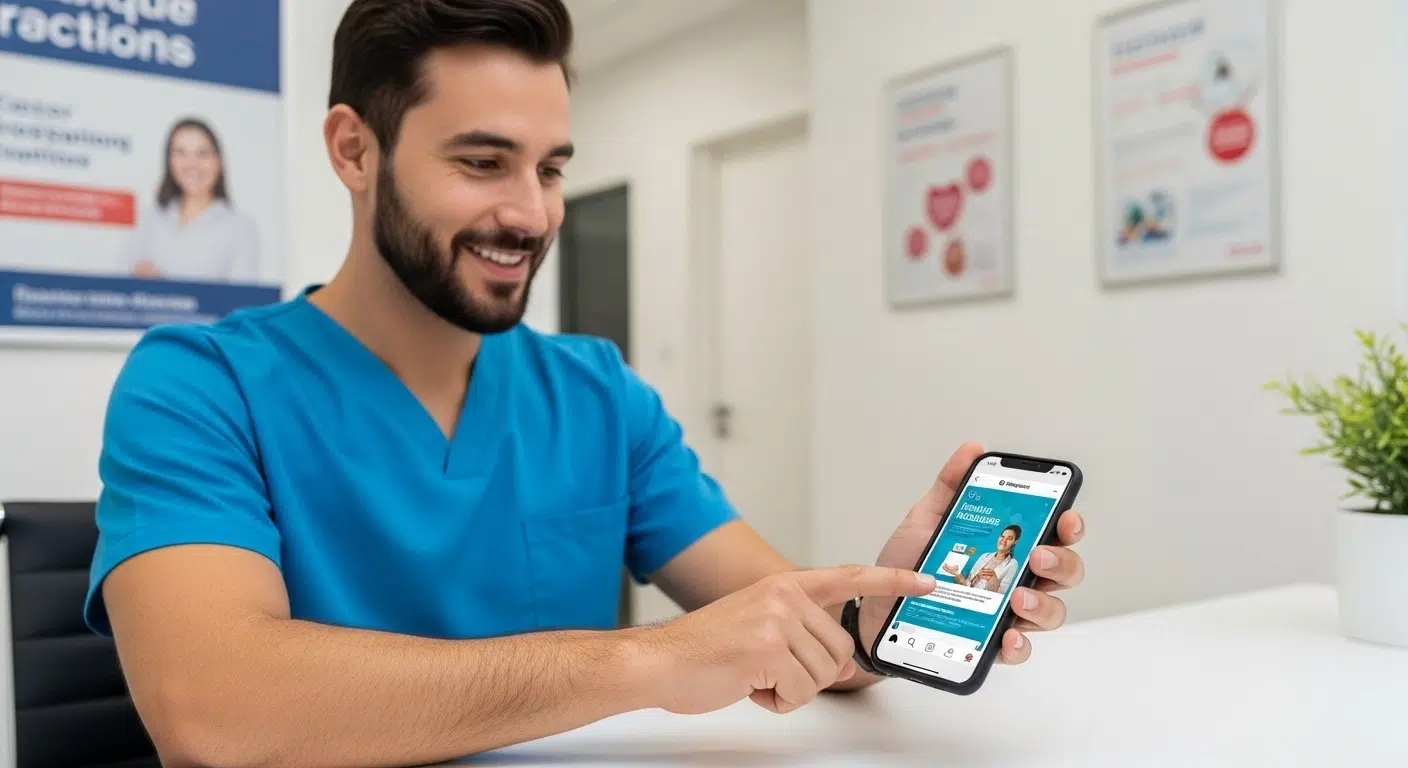
Patient behavior has fundamentally shifted. Before calling a clinic, most people now spend time on Instagram and Facebook researching symptoms, watching treatment videos, reading reviews, and forming opinions about providers. Research shows that social media platforms, when used correctly, can significantly boost patient trust, with practices seeing higher engagement when they provide informative content, including patient testimonials and condition-specific videos.
Specialty clinics, such as chiropractic, physical therapy, spine care, orthopedics, mental health, and others, are particularly well-positioned here. Condition-specific content (a short video explaining disc herniation, a patient testimonial about scoliosis treatment) attracts high-intent leads who are already experiencing the problem you solve.
The challenge is that most practices treat social media as a billboard rather than a pipeline. They generate interest but have no structured system to capture, qualify, and convert that interest into booked appointments. Here is what that gap looks like in practice:
- High-intent leads go uncontacted: People who engage with condition-specific ads are actively looking for help. Slow or absent follow-up hands them directly to your competitor.
- Patients prefer messaging over calling: According to DialogHealth’s 2024 data, 80% of individuals prefer using smartphones to interact with their healthcare provider. If your only conversion path is a phone number, you are losing a significant portion of your audience.
- Competitors are already running ads: The window to differentiate through social media advertising is narrowing. The practices that win are the ones converting leads efficiently, not just generating them.
- Manual follow-up does not scale: When you are spending $2,000–$5,000 per month on ads, a single overwhelmed front desk staffer cannot realistically convert that volume. The math does not work.
The Real Cost of Not Automating Your Lead Pipeline

Before we get into tactics, it is worth quantifying the cost of inaction. The revenue case for automation is more compelling than most practice owners realize.
Research consistently shows that the average lead response time at most businesses is 24 to 48 hours. But studies on lead behavior show that leads contacted within five minutes are up to 21 times more likely to convert than those contacted after 30 minutes. By the following day, most leads have mentally moved on.
Consider the math: if your practice generates 40 leads per month from paid social campaigns and converts only 15% due to slow follow-up, you are booking 6 patients. With a proper automation system, even improving conversion to 35% yields 14 patients, more than double, from the same ad spend.
Beyond conversion rates, there are other compounding costs:
- Wasted ad spend: Every unworked lead represents a direct loss on your cost-per-lead investment.
- Staff burnout: Repetitive outreach tasks, calling, texting, and logging are demoralizing for front desk staff and divert their attention from higher-value interactions.
- No-show losses: Even leads that do book often go on to miss their appointments without proper confirmation workflows.
- Revenue cycle drag: Poorly captured or unqualified leads create downstream administrative waste, incomplete records, incorrect insurance details, and repeat data entry.
Automating the lead pipeline eliminates most of these losses at the source.
Discover how much revenue you could be losing due to inefficient lead conversion by requesting a free Revenue Gap Assessment
8 Ways to Automate Lead Generation for Your Healthcare Practice on Instagram and Facebook
Step 1 — Set Up Your Social Media Lead Capture Correctly
Automation is only as good as what it has to work with. If your lead capture is poorly designed, no follow-up system will save you.
There are two primary lead sources from Meta platforms: organic DM leads (people who message you after seeing a post or reel) and paid Lead Ad form leads (people who fill out a native form without ever leaving Instagram or Facebook). Both are valuable, but they require different setup strategies.
For Facebook and Instagram Lead Ads, keep your form lean. Capturing name, phone number, and the primary condition or concern is enough to qualify intent and start a conversation. Every additional field reduces completion rates. Use condition-specific creative; an ad about disc injury should lead to a disc injury form, not a generic “contact us” page. Running separate campaigns per service line (disc injuries, scoliosis, shoulder pain) keeps your leads organized and pre-qualified from the start.
For DM-based leads, set up automation triggers for comment-to-DM flows, story reply responses, and bio link clicks. When someone comments on a post asking for more information, an automated DM should be sent within seconds, not hours.
Step 2 — Connect Your Leads to a CRM Automatically
Leads sitting in your Instagram notifications or Meta Business Suite inbox are invisible to your practice. They are not being tracked, tagged, or followed up on in any systematic way. This is one of the most common and costly mistakes in healthcare lead management.
Every lead, whether from a Lead Ad form or a DM trigger, should flow automatically into a central CRM the moment it is captured. This can be done through native Meta integrations, tools like Zapier, or dedicated healthcare CRM platforms that already support these connections.
Once inside the CRM, leads should be automatically tagged based on their source campaign. A lead from your “disc injury” Facebook ad should be tagged accordingly, so your follow-up sequences, chatbot responses, and booking offers are all contextually relevant. No manual copy-paste. No screenshot-to-text workflows. No leads slipping through the cracks.
For practices already using Google Calendar or an EMR system, the CRM should integrate directly with these tools so that booked appointments populate the right calendar without any additional steps.
Step 3 — Deploy an AI Chatbot to Engage Leads Instantly

Speed-to-response is the single biggest factor in lead conversion. The American Medical Association (AMA) emphasizes that efficient lead conversion, especially in specialized medical fields, is crucial for maintaining patient trust and engagement in today’s competitive healthcare market. An AI chatbot solves this completely, engaging every lead within seconds of capture, at any hour of the day.
In a healthcare context, the chatbot is not a replacement for your clinical team. It is the first touchpoint: warm, informative, and designed to move the patient toward booking while gathering the information your team will need.
A well-configured healthcare chatbot should handle all of the following:
- Common patient questions: Cost of treatment, what a typical session involves, whether you accept their insurance, and how long results take.
- Soft qualification: Whether the patient has had an MRI, what their diagnosis is, and how long they have been experiencing symptoms.
- Contraindication screening: Filtering out leads who are not suitable candidates before any clinical staff time is spent. This protects your team and improves lead quality.
One often-overlooked benefit: including transparent pricing information in the chatbot flow actually improves lead quality. Patients who proceed past the pricing question are genuinely interested. Those who drop off would likely have cancelled anyway.
Leverage our AI-powered Medical Receptionist to ensure faster responses and better lead engagement.
Step 4 — Automate Lead Qualification Before Human Involvement
The goal of AI-led qualification is simple: by the time a human from your practice speaks with a lead, that conversation should be about scheduling, not about gathering basic information.
The chatbot should collect answers to the core qualifying questions before any staff member is looped in:
- Have you had an MRI or received a formal diagnosis?
- What symptoms are you currently experiencing, and for how long?
- What treatments have you already tried?
- What is your age range?
- Do you have health insurance, and do you know your plan type?
This saves your clinical and administrative staff from fielding the same ten questions dozens of times per week. It also feeds the contraindication logic, if a lead’s answers flag them as a non-candidate for your specific treatment, the system can redirect them appropriately rather than consuming your team’s time.
The result is a cleaner, faster sales process and a better experience for the patient, who feels heard and guided rather than interrogated.
Step 5 — Offer Multiple Booking Pathways

Not every lead is ready to book a full in-person consultation on the first interaction. Offering a single booking option, especially a high-commitment one, creates friction that kills conversions.
A two-path approach works significantly better:
- Free phone consultation: Low friction, fast commitment. Ideal for leads who are interested but not yet fully ready to visit in person. This keeps them in the pipeline.
- Free in-person consultation with clinical review: Higher commitment, higher intent. Patients who choose this option are much more likely to convert to ongoing treatment.
The AI chatbot should present both options naturally and let the patient self-select. This respects their readiness level while keeping the pipeline moving. Whichever path they choose, the booking should go directly into Google Calendar or your clinic’s scheduling system; no manual entry, no back-and-forth email threads.
Step 6 — Build an Automated Follow-Up Sequence for Non-Responders
Most leads will not book on the first interaction. This is normal. It does not mean they are not interested; it means they got distracted, were not ready yet, or needed more time to think. A structured follow-up sequence recovers a significant portion of these leads without any staff involvement.
A well-designed sequence looks like this:
- Immediately: AI chatbot engages within seconds of lead capture.
- Day 1: Automated SMS follow-up if no booking has been completed. Keep it conversational and helpful, not salesy.
- Days 2–3: Email follow-up with educational content relevant to the lead’s condition. A short article, a patient story, or an explainer video builds trust and keeps your practice top of mind.
- Days 5–7: A final check-in message with a clear, low-friction CTA to book. This message should acknowledge that life gets busy and make it easy to re-engage.
All of this runs automatically. Your staff only gets involved when the lead responds and is ready to move forward. Tone, timing, and frequency matter; the sequence should feel helpful and human, not like a spam campaign. Always give the lead an easy way to opt out.
Step 7 — Reduce No-Shows with Automated Appointment Confirmations

Getting the booking is not the finish line. The patient still has to show up. No-shows represent a double loss; lost revenue from the empty slot, plus potential wasted appointment preparation time.
An automated confirmation and reminder workflow is straightforward to implement and delivers an outsized return. A systematic review published in BMC Health found that appointment reminders produce a weighted mean 34% reduction in non-attendance rates. A separate Imperial College London study found SMS reminders specifically reduce no-shows by 38%.
An effective confirmation and reminder workflow includes:
- Immediately after booking: A confirmation message with appointment details, clinic address, and any pre-visit instructions.
- 48 hours before: A reminder with a simple option to confirm, reschedule, or cancel via SMS reply.
- 2–3 hours before: A final reminder that also signals to the patient that you are ready for them and their care is prepared.
When a patient cancels, that slot should immediately trigger an automated outreach to your waitlist or any leads who expressed interest but did not book. This turns a no-show from a loss into a re-booking opportunity. Given that independent practices lose an estimated $150,000 per year to no-shows, even a 30–40% reduction in that number represents significant recovered revenue.
Step 8 — Track Performance and Optimize Your Pipeline
You cannot improve what you do not measure. Once your automation pipeline is running, the data it generates is one of your most valuable assets; both for optimizing your patient conversion process and for improving your ad campaigns.
The key metrics to track at each stage of the pipeline are:
- Lead volume by platform and campaign
- Lead-to-conversation rate (did the AI chatbot successfully engage them?)
- Conversation-to-booking rate (how many engaged leads scheduled an appointment?)
- Booking-to-show rate (what percentage actually attended?)
- Cost per booked appointment (total ad spend divided by confirmed appointments)
These metrics tell you exactly where leads are dropping off. If your lead-to-conversation rate is strong but your conversation-to-booking rate is weak, the issue is in your chatbot flow or booking offer — not your ads. If your booking-to-show rate is low, the confirmation sequence needs work.
Campaign-level data feeds directly back into your ad creative and targeting decisions. A/B testing different chatbot opening messages, follow-up timing, or booking offer language over time compounds into significantly better conversion rates without increasing ad spend.
Choosing the Right Tools for Your Clinic’s Social Media Lead Pipeline
Building this system does not require a large technical team or a massive budget. But it does require the right tools and, more importantly, tools that actually communicate with each other. Here is the essential stack:
| Function | Tool Category | Purpose |
| Ad Platform | Meta (Instagram + Facebook) | Capture leads via Lead Ads and DM triggers |
| Automation & Chatbot | AI-powered engagement tools | Instant lead response, qualification, and booking |
| CRM | Healthcare-compatible CRM | Central lead management, tagging, and tracking |
| Scheduling | Google Calendar / EMR calendar | Automated appointment booking without manual entry |
| Follow-Up | SMS and email automation | Nurture non-responders and reduce no-shows |
The key message here is that an end-to-end integrated solution will always outperform a patchwork of disconnected tools. When your Meta leads flow into your CRM, which triggers your chatbot, which drops appointments into your scheduling system, which fires your confirmation sequences — you have a real pipeline. When those systems are stitched together manually, every connection point is a place where leads get lost.
Watch out for the screenshot-and-text trap: manually copying lead information from ad platforms into spreadsheets or sticky notes. It is slow, error-prone, and unscalable. If any part of your current process involves a human physically transferring lead data from one place to another, that is your first priority to automate.
Additional Best Practices
Beyond the eight steps above, these operational principles will meaningfully improve your results:
- Separate campaigns per service line: Running a single “general services” ad campaign creates lead confusion and makes qualification harder.
- Keep chatbot language warm and human: Patients engaging with a healthcare practice are often in pain or distress. The chatbot tone should feel compassionate and helpful, not robotic or transactional.
- Always obtain explicit consent: Before sending automated SMS or email follow-ups, ensure you have clear opt-in consent. This is both a HIPAA requirement and a Meta platform policy. Build consent capture into your lead form or chatbot flow from day one.
- Review chatbot responses monthly: As you run new campaigns targeting different conditions or demographics, patient questions evolve. Schedule monthly reviews and updates.
- Loop in clinical staff only for escalations: The automation handles everything up to the booking confirmation. Reserve your clinical team’s involvement for leads that flag specific clinical concerns or complex cases.
- Start with one platform and one service: Build and prove the system on one channel and one condition before scaling to multiple service lines simultaneously.
Conclusion
Social media lead generation is one of the highest-ROI growth channels available to healthcare practices in 2026, but only when there is a system built to convert it.
The eight-step pipeline covered in this guide — capture, CRM integration, AI engagement, qualification, booking, follow-up, confirmation, and optimization — transforms social media from a branding exercise into a measurable patient acquisition engine. Each step eliminates a specific point of drop-off. Together, they close the gap between a lead clicking your ad and showing up as a new patient.
The practices winning on social media right now are not necessarily running better ads. They are converting more of the leads they already generate. Automation is what makes that possible at scale.
If you want to see exactly where your current lead pipeline is leaking revenue and what a fully automated version could look like for your specific practice, MedLaunch offers a free Revenue Gap Assessment. Our team will map out your current workflow, identify your biggest conversion bottlenecks, and show you what an end-to-end automated pipeline could recover. Book your free assessment at medlaunch.health.
FAQs
What is healthcare lead generation on social media?
Healthcare lead generation on social media refers to the process of attracting potential patients through Instagram and Facebook, capturing their contact information and intent, and nurturing them into booked appointments through automated workflows.
How fast should a clinic respond to a social media lead?
Ideally within five minutes. Research from Harvard Business Review shows lead conversion rates drop dramatically after the first 30 minutes of inactivity. AI chatbots make sub-minute response times achievable for any practice, regardless of staffing.
Is automating patient communication HIPAA-compliant?
It can be, provided you use HIPAA-aligned tools, obtain explicit patient consent before sending messages, and avoid transmitting protected health information through unencrypted channels. Always verify that your chosen automation platform has a signed Business Associate Agreement (BAA).
What types of clinics benefit most from social media lead automation?
Specialty clinics with condition-specific treatments — chiropractic, physical therapy, spine care, orthopedics, mental health, aesthetics, and weight management — tend to see the strongest results because their content attracts high-intent, self-identified patients.
Do I need a large team to run this system?
No. The automation handles the majority of lead engagement, qualification, and booking without human involvement. Your clinical and administrative staff only need to be involved for escalations and for delivering the actual patient care.
How do I measure the success of my lead automation pipeline?
Track five core metrics: lead volume by campaign, lead-to-conversation rate, conversation-to-booking rate, booking-to-show rate, and cost per booked appointment. These tell you exactly where your pipeline is performing and where it needs improvement.